
Every so often a customer rolls a Thunderbird into the shop and tells me, with total confidence, that it is the last convertible Ford ever built with that nameplate. They are usually off by a decade or two on the "ever" part, since Ford brought convertibles back later, but they are right about one thing. The 1966 model year marked the last Thunderbird convertible of this particular run, and after it the body dropped the drop top entirely for the rest of the decade and beyond.
Car Features
7 min read
The Last Thunderbird Convertible (1966)
The 1966 model year closed out convertible production on this generation of Thunderbird, and its power folding top remains the single most important thing to check before buying one.
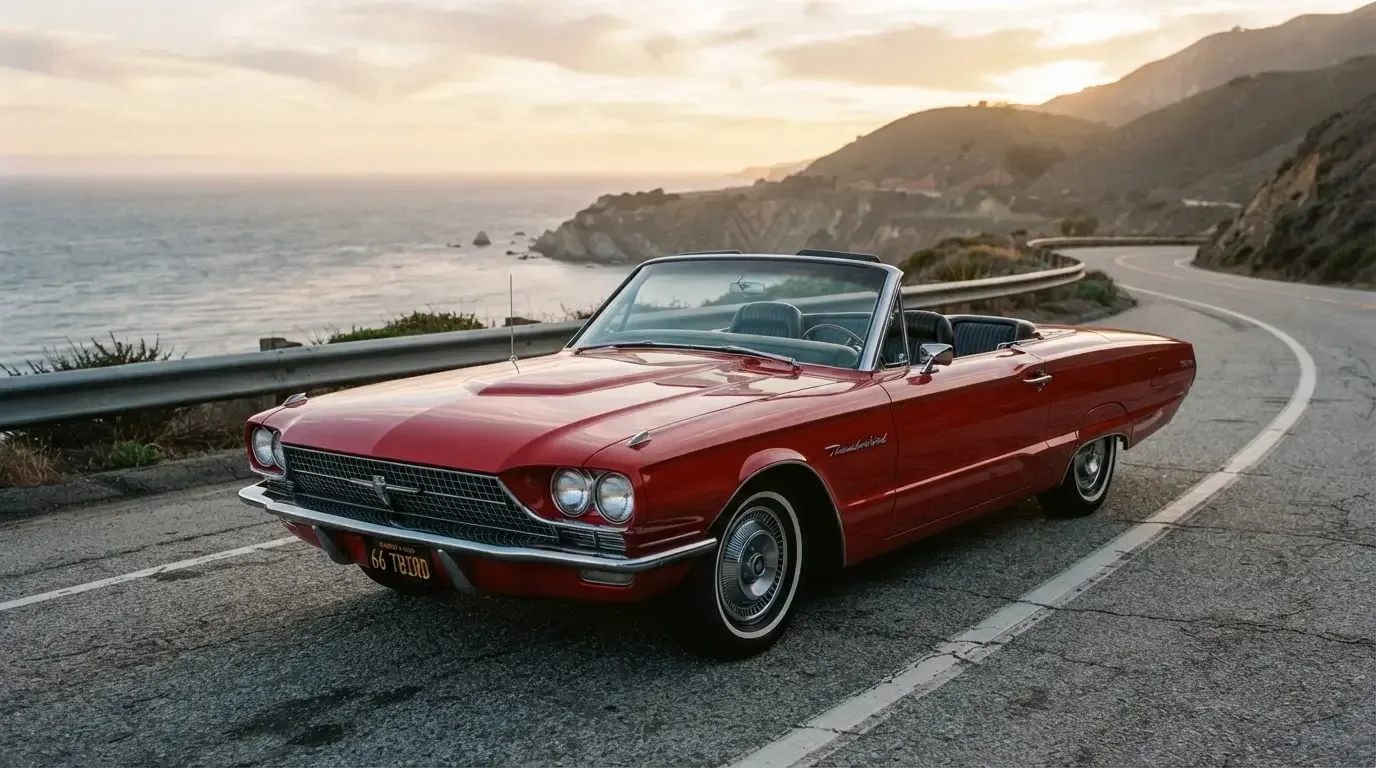
The end of an open air Thunderbird
Ford had offered a Thunderbird convertible continuously since the model's earliest two seat years, and the four seat convertibles that followed became some of the most recognizable cars of the personal luxury era, complete with a power operated top that folded down into the trunk in a way that still draws a crowd at shows today. That mechanism alone was a feat of engineering for its time, using a set of relays and limit switches to sequence the trunk lid, the top, and the tonneau cover in the correct order without the driver lifting a finger beyond holding a switch.
For 1966, that convertible carried forward largely unchanged in its basic operation, riding on the same platform that had underpinned the model since 1964. What made it significant in hindsight is that nobody buying one new in 1966 necessarily knew it would be the last of its kind. The decision to drop the convertible came from Ford's broader read on where the market was heading, not from any single announcement that turned the model into an instant collectible the day it left the factory.
Why Ford pulled the plug
Convertible sales across the American market were softening industry wide by the mid 1960s, partly due to rising interest in air conditioned hardtops that offered comfort without the complexity of a folding top, and partly because a new wave of safety regulation on the horizon made engineers nervous about a car with no fixed roof structure. Ford was not alone in scaling back convertible offerings during this stretch. The Thunderbird's convertible dropped from the lineup after 1966 and never returned to this body style, with the redesigned 1967 Thunderbird offered only as a hardtop, including a new four door model, but no open top version.
Ford built 5,049 Thunderbird convertibles for the 1966 model year, out of roughly 69,000 Thunderbirds total that year across every body style, a small slice of an already limited production run.
That production number matters to anyone shopping this specific model today, because a lower final year build count tends to translate directly into scarcity on the used market decades later. Fewer cars made means fewer cars surviving, and fewer cars surviving means the ones that do turn up get looked at more carefully by buyers who understand what they are looking at.
What a shop actually sees
Working on one of these convertibles today means respecting a mechanism that was already considered complex when it was new. The folding top relies on a series of electrical and mechanical steps happening in the correct order, and after sixty years of wear, corrosion, and in some cases well meaning but incorrect prior repairs, getting that sequence to run smoothly again takes patience. I tell owners the same thing every time. Do not judge the health of the top mechanism by whether it moves at all. Judge it by whether it completes the full sequence cleanly, tonneau cover, top, and trunk lid working together, every single time you operate it.
For more background on how this generation of Thunderbird came together before it reached its final convertible year, the full story covers the 1964 redesign that established the body these convertibles were built on.
Buying the last of the line
Anyone shopping specifically for a final year 1966 Thunderbird convertible should treat the top mechanism as the single most important system to evaluate, ahead of paint, ahead of interior condition, ahead of even the engine. A convertible with a non functioning top is not a quick fix, and parts for the specific relays and switches involved are not sitting on a shelf at every parts store the way common wear items are.
"I have seen guys buy a convertible on looks alone and find out the top motor is seized before they get it home. Test the whole sequence in person, every time, no exceptions. That is not being difficult, that is just how you buy one of these."
- Mike Sullivan
Beyond the mechanical realities, there is a straightforward appeal to owning the final example of a run. It closes out a specific chapter of the Thunderbird story cleanly, the last open top version of a body style that started strong in 1964 and went out on its own terms in 1966. If that appeals to you, you can browse classic Thunderbird listings and see what condition the survivors are actually in before deciding whether one belongs in your garage.
What replacement parts actually cost you
Owners chasing top mechanism parts for one of these convertibles quickly learn the market splits into two categories, good used cores pulled from parts cars and a smaller run of reproduction pieces built specifically for this generation. Neither option is cheap, and neither is instant. A relay bank that would cost a few dollars on a modern car can run considerably more here simply because the supply is fixed and the demand, while modest in absolute terms, never fully goes away. That reality shapes how a shop like mine approaches a repair. We diagnose before we order, every time, because guessing wrong on a part for a system this specialized wastes both money and time that a customer usually does not want to lose.
The upside is that the mechanical principles involved are not mysterious once you understand them. Relays fail, switches corrode, and wiring insulation cracks with age the same way it does on any car from this period. None of that is unique to a convertible top. What is unique is the sequence dependency, where one weak link stops the entire operation rather than just one function. A patient shop with the right wiring diagram and a multimeter can usually track down the fault without replacing the whole assembly, which is good news for anyone worried about the cost of keeping a final year convertible roadworthy.
I tell every owner who brings one of these cars in the same thing before we start. Budget time as much as money. A top mechanism repair on a car this old rarely goes exactly to plan on the first attempt, and rushing it tends to cost more in the long run than doing it carefully once.
None of that should scare anyone away from owning one. It should just set expectations correctly. A 1966 Thunderbird convertible bought with clear eyes about what the top mechanism needs, and priced accordingly if it does not work perfectly yet, tends to make its new owner happier than one bought on the promise that everything is fine when nobody actually tested the sequence before the sale closed.
Sources and notes
Related Reading
#ford thunderbird
#flair bird
#Thunderbird convertible
#1966 Thunderbird
#power top
#classic Ford convertibles

About the author
Mike Sullivan
Detroit-area muscle car enthusiast and restoration specialist with three decades of hands-on experience working on American iron.
Related Listings - Ford Thunderbird
Comments
Be the first to comment on this article.