
The case for a third gen Camaro LS swap fits in one line: the best V8 Chevrolet ever put in a 1982 to 1992 Camaro was rated at 245 hp, and a junkyard 6.0-liter truck engine was rated at 300 to 335 hp. That gap, before a single performance part, is why the swap has become the default Camaro restomod move for these cars. The engine is the easy part. The torque arm, the cooling system and the rear axle are where the real work and most of the surprises are. Here is what the numbers say, and what the swap actually takes.
Car Features
7 min read
LS-Swapping a Third-Gen Camaro
A third gen Camaro LS swap by the numbers: factory vs LS power, bolt-in mounts, the torque arm problem, cooling, the rear axle and one documented build.
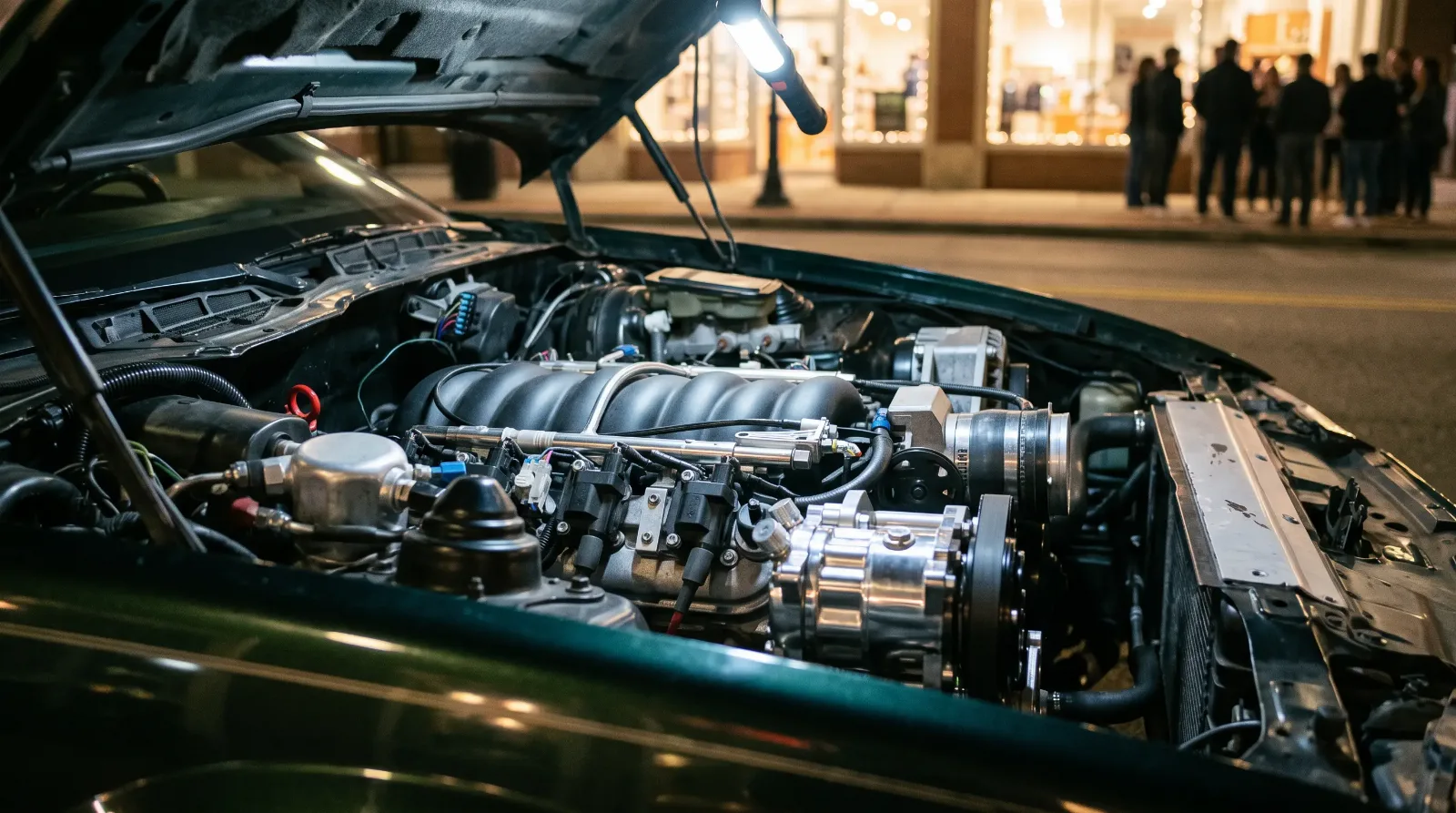
The numbers behind a third gen Camaro LS swap
Start with what the factory gave you. The top engine in the third generation Camaro was the L98 5.7-liter TPI, rated 245 hp and 345 lb-ft for 1990 to 1992, and only with an automatic. The LB9 5.0 TPI reached 230 hp with dual exhaust. In 1982 the four-barrel 305 made 145 hp. Those are SAE net ratings.
| Engine | Displacement | Rated output | Where it came from |
|---|---|---|---|
| LG4 V8 | 5.0 L | 145 hp, 240 lb-ft | 1982 Camaro |
| LB9 TPI | 5.0 L | up to 230 hp | 1989 to 1992 Camaro, dual exhaust |
| L98 TPI | 5.7 L | 245 hp, 345 lb-ft | 1990 to 1992 Camaro, automatic only |
| LM7 | 5.3 L (325 ci) | 270 to 295 hp, 315 to 335 lb-ft | 1999 to 2007 GM trucks |
| LS1 | 5.7 L (346 ci) | 305 hp, 335 lb-ft | 1998 to 2000 Camaro Z28 |
| LQ4 | 6.0 L (364 ci) | 300 to 335 hp, 355 to 375 lb-ft | 1999 to 2008 GM trucks |
Two catalog claims need to be taken apart. You will see 270 hp quoted for the 1992 350. No engine listing backs it; the documented rating is 245 hp. On the other side, you will read that the LS1 really made 350 hp at the flywheel and GM sandbagged it. There is no primary source for that number. The F-body ratings are widely thought to be conservative, but the rating you can prove is 305 hp for the 1998 to 2000 Z28 and 310 hp for 2001 and 2002, when the LS6 intake and a revised cam arrived.
Read the truck ranges carefully too. A range of 300 to 335 hp covers different years and calibrations, so the engine you pull from a wreck has its own number, not the top of the range. Even at the bottom, a stock LQ4 out-rates a stock L98 by 55 hp and 10 lb-ft.
Mounting the engine: two ways to keep it simple
The cleanest swaps put the LS where the small-block was. Two bolt-in kits do exactly that. The ICT Billet EM-LS-3FBDY kit uses two OE-style rubber mounts plus upper clamshells and keeps the factory small-block crank and bellhousing location, so you change nothing at the transmission tunnel, the driveshaft or the driveline angle. It lists at $300, on sale at $260 as of October 2026.
UMI's 223910 kit, $289.99, puts an LS mount on the factory K-member in the stock small-block location and takes 1998 to 2002 Camaro engine-side mounts. It also includes a T56 transmission mount with 3/4 inch of fore-aft adjustment. Note what that mount does not have: any provision for the factory torque arm. That leads to the biggest complication of the whole swap.
The torque arm is the real swap problem
On a stock third gen, the torque arm bolts to the differential housing with two bolts, and its front end clamps a rubber bushing on a mount on the transmission tail housing. The arm part styles differ between 1982 to 1983 and 1984 to 1992 cars. Factory transmissions were the Borg-Warner five-speed and the TH700-R4 automatic, both from 1983. Install a different transmission and the arm has nothing to attach to. If you want the background on why GM built the rear this way, our piece on the torque-arm suspension covers the design.
There are two fixes. With the UMI mount, you need an aftermarket short torque arm (UMI 2235 or 2236), because the T56 mount has nowhere for a long arm to land. Spohn's 332-PS, $629, takes the other route: it moves the torque-arm pivot from the transmission to a supplied crossmember, is made from 4130 chrome-moly, bolts in, and gives more than 6 degrees of pinion adjustment. It is designed to install a 1998 to 2002 F-body T56 in a third gen, and Spohn says it must be used with Spohn LSx mounts. Pick the torque arm and the mounts as a system, not separately.
"The engine swap costs less than people think. The parts that hold the rear axle still cost what they cost. Budget the torque arm first, then shop for the engine."
Dan Reeves
Cooling, wiring and the parts nobody mentions
Cooling is not plug-and-play. The factory radiator goosenecks do not line up with the LS thermostat and water-pump outlets. One documented 1992 build used a Flex-a-Lite radiator with dual electric fans, kit 56484, and the stock TPI-style twin-inlet airbox had to be modified for radiator clearance.
Three items are less settled than the vendor pages make them sound. The oil pan: a 1998 to 2002 LS1 Camaro already used an F-body-specific pan, but I have not seen it confirmed that it clears a third-gen crossmember and steering linkage, so check the pan you plan to use with the mount maker. The fuel system: the pump and pressure an LS needs in a car that started life with TBI or TPI were not confirmed for this article, so get that number from the engine's own service data, not a forum. The wiring: a standalone conversion harness is the usual answer, and the documented build used a PSI Conversion harness.
The rear axle, and one build from start to finish
The factory 10-bolt is the weak link once torque goes up. Its ring gear and splines changed by year: 7.5 inches and 26 splines for 1982 to 1984, 7.625 inches and 26 splines for 1985 to 1989, and 7.625 inches and 28 splines for 1990 to 1992. A Borg-Warner 7.75-inch 9-bolt was available from 1987. Those axle figures come from enthusiast sources rather than GM paperwork, but the point holds either way: the documented build below threw its stock axle out, so plan the axle as part of the swap rather than as a later fix.
One fully documented swap shows how the pieces fit. The car is a 1992 Camaro that started with a TBI 305:
- Engine: a junkyard Silverado LQ4 with an LS9 cam and LS3 heads and intake.
- Mounts: Dirty Dingo brackets on the factory clamshell mounts.
- Exhaust: Hawks long-tube headers and Y-pipe.
- Transmission: a 4L60E on a Hawks crossmember.
- Rear: a BMR adjustable torque arm and a Ford 8.8 axle.
- Electrical: a PSI Conversion harness.
That list covers every system the swap touches. The engine is one line. The axle, the torque arm, the crossmember, the exhaust and the harness are the other five.
Done right, the swap gives a 1982 to 1992 car more rated power than any factory version had, with parts that are easy to find. It also changes the car from what Chevrolet built, which matters if originality is the point; for how these cars fit the longer story, see our classic Camaro history. For a driver, the numbers make the decision for you.
Sources and notes
- Chevrolet Camaro (third generation), Wikipedia: factory engines and ratings
- GM LS engine, Wikipedia: LQ4, LM7 and LS1 specifications
- GM-EFI (2016): a quick guide to swapping an LS into a third gen, the 1992 build
- ICT Billet: 1982 to 1992 F-body LS swap engine mount kit
- UMI Performance: 223910 1982 to 1992 F-body LS and T56 swap kit
- Spohn Performance: Pro Series adjustable torque arm for LSx and T56 swaps
Related Reading
Have a
Chevrolet Camaro
for Sale?
Reach thousands of serious classic car collectors across the US.
Sell It Here →
Are You a Classic Car Dealer?
List your full inventory and connect with targeted classic car buyers.
Join as a Dealer →

About the author
Dan Reeves
Performance engine builder from North Carolina's motorsports corridor, focused on swaps, forced induction and making real, repeatable power.
Related Listings - Chevrolet Camaro

Comments
Be the first to comment on this article.