
Ask a room of Mustang people what powered the first cars and most will answer with a V8. The factory records add a quieter chapter. The $2,368 launch price that made the Mustang famous in April 1964 bought a car with a six-cylinder, and through the rest of the decade the Mustang inline 6 engine sat under hundreds of thousands of hoods that nobody photographed for a magazine cover. Ford called it the Thriftpower Six. Most owners just called it the six.
Car Features
7 min read
The Thriftpower Six: The Engine That Made the Mustang Affordable
The 170, 200 and 250 sixes that powered the cheaper classic Mustangs: codes, ratings, the seven-bearing change and how many cars carried one.
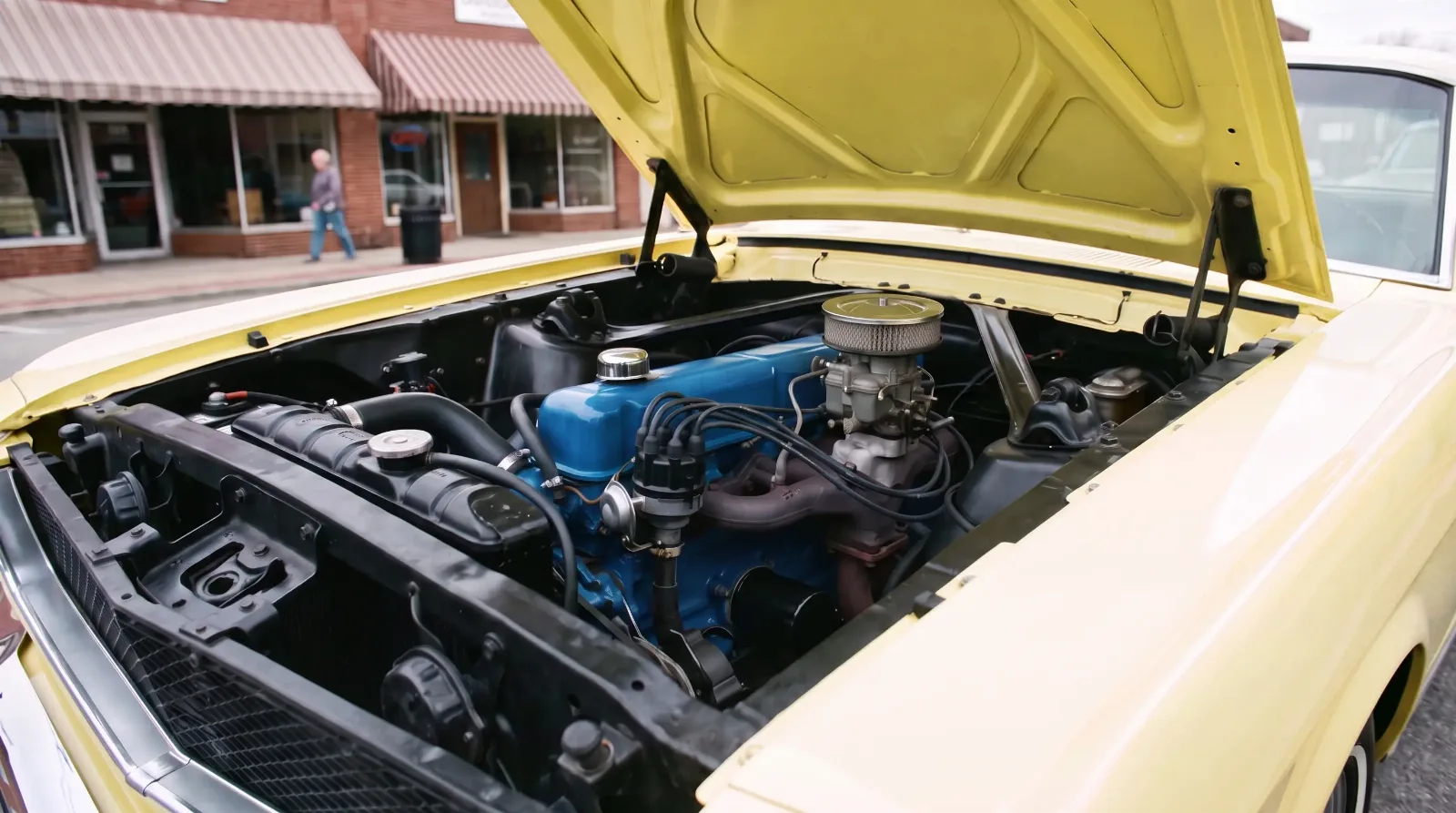
The V8 options get the attention in most histories, and the performance side of the story is covered on its own (read more here). This piece stays with the engine at the other end of the order form: what Ford changed from year to year, and how many Mustangs actually carried it.
Where the Thriftpower Six came from
The six is older than the Mustang. Ford built it at its engine plant in Lima, Ohio, for the compact Falcon, and the name in Ford's literature was Thriftpower Six, though many people still call it the Falcon six. When the Mustang borrowed the Falcon's underpinnings, it borrowed the Falcon's engine as well. The 170 six came across from the Falcon in the same way the 260 V8 came across from the Fairlane.
The design is plain on purpose. Six cylinders in a row, a single one-barrel carburetor, and an intake manifold cast as part of the cylinder head instead of a separate bolt-on piece. That kept the cost down and the parts count low. It also put a ceiling on how much air the engine could move, which is why no Mustang six ever carried a performance rating worth printing in large type.
The first Mustang inline 6 engine, the 170 U-code
The launch engine was the 170 cubic inch six, coded U in the VIN, with a one-barrel carburetor and four main bearings. Its rating is one of those small numbers that refuses to settle. The archived specification page from The Henry Ford gives 101 hp at 4,400 rpm and 156 lb-ft of torque, and the Ford straight-six references agree on 101. Other summaries say 105 hp. Both figures circulate. I use 101 because the museum record carries more weight than a secondary summary, but anyone quoting 105 is repeating a published figure, not inventing one.
The 170 had a short Mustang career. It powered the 1964½ cars only. A six-cylinder Mustang of that period had a shipping weight of about 2,570 lb, which works out to roughly 25 lb for every rated horsepower. That is a commuter's ratio, and the car was priced and sold as exactly that. Production of its replacement began in August 1964, and the U code disappeared with the start of the true 1965 model year.
The 200 T-code and the seven-bearing crank
The replacement was the 200, coded T. It kept the one-barrel carburetor and was rated at 120 hp at 4,400 rpm and 190 lb-ft at 2,400 rpm, on 9.2:1 compression. That is 19 more horsepower and 34 more lb-ft than the 170, from 30 more cubic inches.
The more important change was inside the block. The 200 had launched in 1963 with four main bearings, like the 170. From 1965 it ran seven, which supports the crankshaft between every pair of cylinders. A seven-main block is easy to spot: it has four core plugs. When a restorer says a 1965 or later six is "correct," that count is one of the first things worth looking at.
The rating moved twice after that. It dropped to 115 hp for 1968 and 1969, then returned to 120 hp for 1970. I have not seen a primary document explaining the 1968 change, so I will not guess at a cause. Two details from the 1966 order form are worth recording. That year the Cruise-O-Matic automatic cost $175.80 with the six, and six-cylinder cars that carried the Rally-Pac got a 6,000 rpm tachometer, the same unit as the base V8.
| VIN code | Engine | Mustang years | Rated output |
|---|---|---|---|
| U | 170 six, 1-bbl, 4 main bearings | 1964½ only | 101 hp @ 4,400 rpm, 156 lb-ft (gross) |
| T | 200 six, 1-bbl, 7 main bearings from 1965 | 1965 to 1970 | 120 hp @ 4,400 rpm, 190 lb-ft @ 2,400 rpm (1965 to 1966); 115 hp (1968 to 1969); 120 hp (1970) |
| L | 250 six, a stroked 200 | 1969 to 1973 | 155 hp @ 4,000 rpm, 240 lb-ft @ 2,600 rpm (1969, gross); 145 hp (1971, gross); 98 hp (1972, net); 88 hp (1973, net) |
The Sprint is a useful reminder of how Ford saw the six in 1966: as volume it could sell with trim. Estimates suggest about three in four Sprint 200 cars were ordered with the automatic. By 1967 the same order form that started with the 200 six ended with the 390 GT, and the six buyer and the big-block buyer were shopping in the same showroom for very different cars.
The 250 and the last of the classic sixes
For 1969 Ford added a larger six, the 250, coded L. It was a stroked 200 with a 3.91 inch stroke, rated at 155 hp at 4,000 rpm and 240 lb-ft at 2,600 rpm. The extra 50 lb-ft over the 200 made a real difference in a car that had grown steadily since 1964. The 200 stayed on as the cheaper six through 1970. For 1971 it was gone, and the 250 became the Mustang's base engine at 145 hp.
The 250 also powered the oddest six-cylinder Mustang of the era, the 1969 Mustang E. It was a SportsRoof-only economy model with a C4 automatic, a high-stall torque converter and a 2.33:1 axle, built for the Mobilgas Economy Run, which required 50 production cars. The run was cancelled for 1969. How many were built is not fully settled. Several references say about 50, the same number as the run's qualifying minimum, while Kevin Marti, whose reports are built on Ford's own production data, told Fox News the number was 96. I lean toward Marti's figure, but I would not trust anyone who claims certainty without a build record in hand.
The numbers for 1972 and 1973 need a warning. For 1972 Ford switched to SAE net ratings, measured with accessories and a full exhaust, so the 250's 98 hp that year (a few references print 95 or 99) cannot be compared with the 145 hp gross figure for 1971. The 1973 rating fell to 88 hp. The engine had not lost nearly 40 percent of its power overnight. Mostly, the measuring method had changed.
How many early Mustangs had the six
The six was not in most early Mustangs, but it was in a very large share of them, and the records are thinner than I would like. For 1966, Ford built about 253,200 six-cylinder Mustangs and about 354,400 with V8s, so the six was in roughly 41.7 percent of the cars. The V8 figure covers three engines, the C, A and K codes. The published totals I can find do not split that V8 figure by engine code, so whether the 200 on its own outsold any single V8 that year is not something I can confirm. For 1965 I have no reliable split at all.
Put the 1966 number next to the K-code Hi-Po and the scale is clear. Ford built 5,469 Hi-Po Mustangs that year, so the six outnumbered it by about 46 to 1. Those sixes paid for a great deal of what came later. The car's first years, from the 1964½ launch to the 1973 cars, are covered in our first-generation Mustang guide.
"The six never had a press car's glamour, and that misses the point. In 1966 about 253,200 Mustangs left the plants with one. If you want to know who actually bought the first Mustangs, start with the T in the VIN, not the K."
Tom Ramirez
The inline six left the Mustang after 1973. The 1974 Mustang II offered a 2.3 four and a 2.8 V6 instead. It came back once more: early in the 1979 model year Ford added a 3.3 liter inline six rated at 89 hp to the new Fox-body car. Three point three liters works out to almost exactly 200 cubic inches, which the original owners of a 1965 T-code would have found familiar.
Sources and notes
- Ford straight-six engine (Wikipedia): Thriftpower name, Lima plant, integral intake, bearings and ratings
- Ford Mustang, first generation (Wikipedia): engine ratings by year
- Ford Mustang, third generation (Wikipedia): the 1979 3.3 litre six
- The Henry Ford (archived): 1965 Mustang specifications
- Over-Drive Magazine: 1966 Ford Mustang fact sheet and option prices
- Fox News: the 1969 Mustang E and Kevin Marti's production figure
Related Reading

About the author
Tom Ramirez
Corvette researcher and historian based in Bowling Green, Kentucky. Two decades documenting Corvette production history from original factory records.
Related Listings - Ford Mustang




Comments
Be the first to comment on this article.