
Ford sold the 1965 Mustang on looks and price. The engine that gave it a performance reputation sat on the order form as a $430 option and went into about one car in a hundred. It was the 289 High Performance V8, the Hi-Po, and the letter K in the engine-code position of the VIN is how you know a car left the line with one. Every genuine k code mustang starts from the same place: 271 hp from 289 cubic inches, on a solid-lifter cam, in a car whose base engine was a six.
Car Features
7 min read
The 289 K-Code Hi-Po: Where Mustang Performance Began
The 271 hp 289 Hi-Po: solid lifters, a $430 price tag and 13,231 cars. What made the K-code Mustang engine different, and why it faded by 1967.
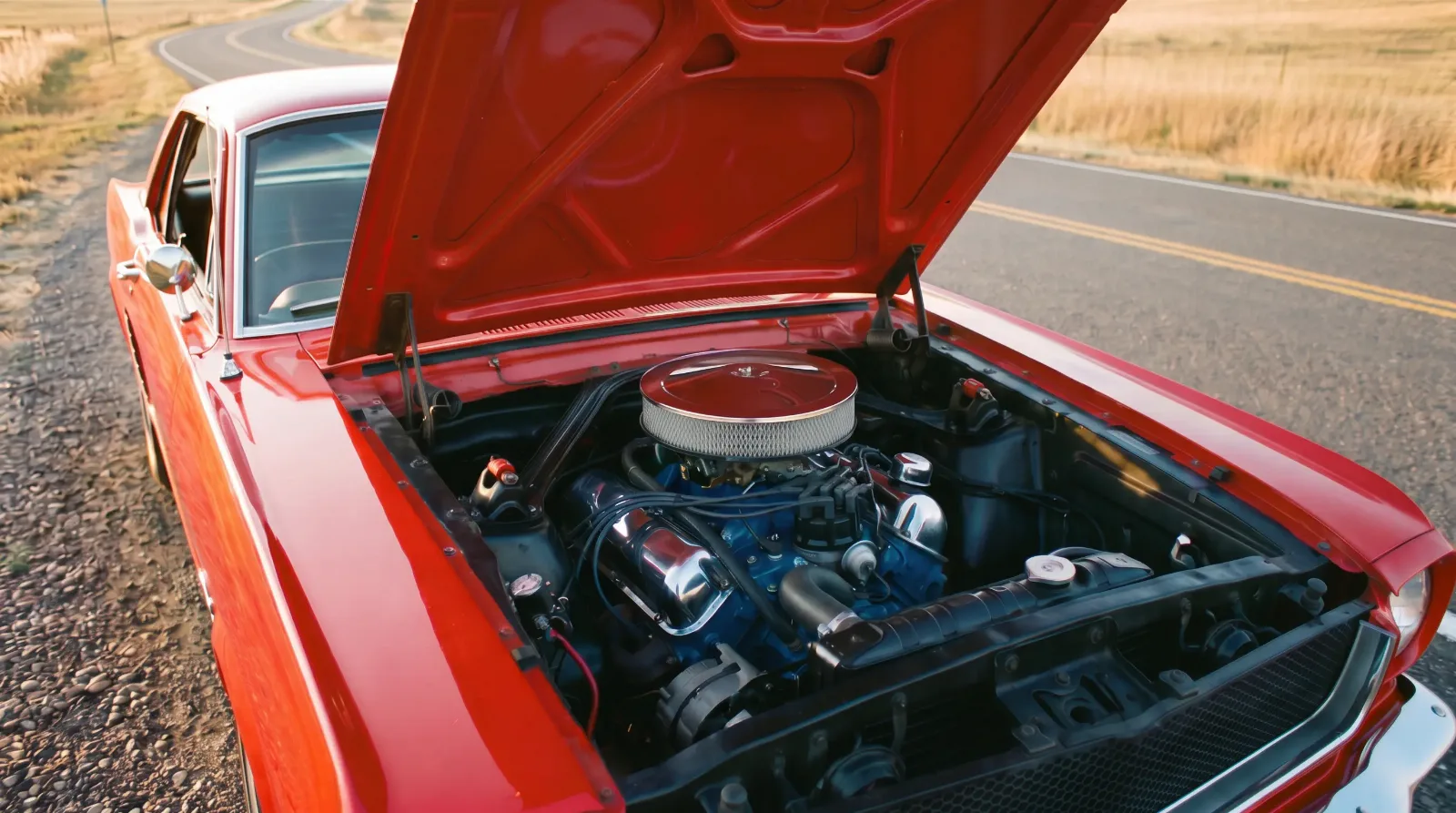
Most buyers never got near one. The launch price was $2,368, and on the cheap cars it was the six in the cheaper cars. The K-code sat at the far end of the same order sheet. It was an engine built to live at high rpm, sold to people who knew what solid lifters meant and did not mind setting the lash.
What made the k code mustang engine different
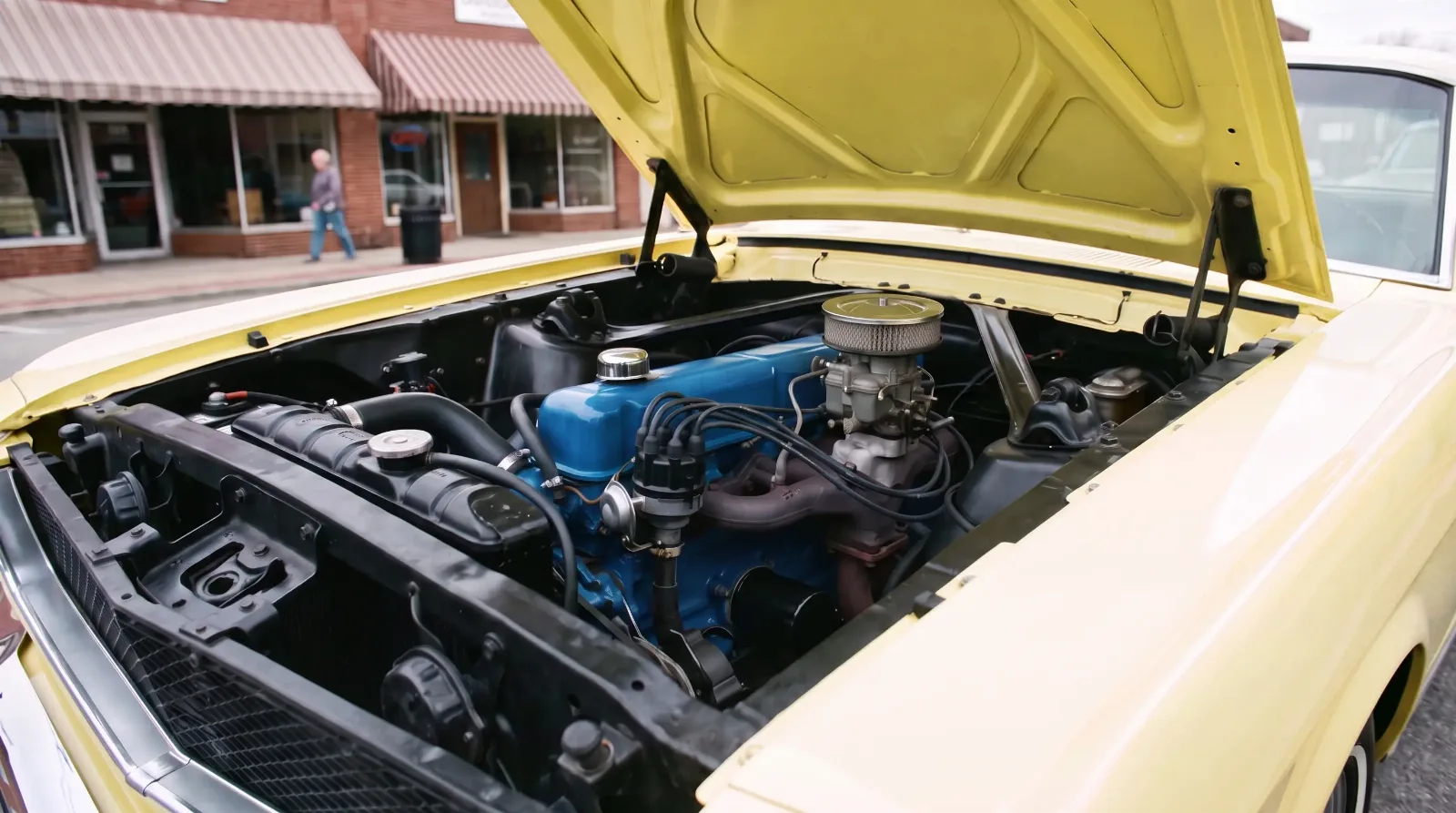
On paper the Hi-Po shared its displacement with the 200 hp two-barrel and the 225 hp four-barrel 289s. Inside, Ford changed most of the parts that give up first when a small-block is spun hard. Compression went to 10.5:1. The cam was hotter and ran solid lifters. The rocker studs screwed into the heads instead of being pressed in, and the valve spring cups were cast.
The bottom end got the same treatment. Larger rod bolts. A crankshaft cast in 80 percent nodular iron with extra counterweighting. Thicker main caps and a thicker harmonic damper. On top sat an Autolite 4100 four-barrel rated at 595 cfm with a manual choke, about 105 cfm more than the standard four-barrel carburetor, and the spark came from a dual-point distributor.
None of that is exotic today. In 1964 it was the difference between an engine that peaked at 4,800 rpm and one that kept pulling to 6,000. That extra 1,200 rpm is where the extra 46 hp over the A-code came from. Torque barely moved: 312 lb-ft against 305. This was a breathing and durability package, not a torque package.
| Engine | VIN code | Carburetor | Rated power (SAE gross) | Rated torque |
|---|---|---|---|---|
| 289 two-barrel | C | 2-bbl | 200 hp @ 4,400 rpm | 282 lb-ft |
| 289 four-barrel | A | 4-bbl | 225 hp @ 4,800 rpm | 305 lb-ft |
| 289 High Performance | K | Autolite 4100, 595 cfm | 271 hp @ 6,000 rpm | 312 lb-ft @ 3,400 rpm |
| Shelby GT350 version | K | Holley, 715 cfm | 306 hp @ 6,000 rpm | 329 lb-ft @ 4,200 rpm |
The Shelby row is there because it shows how much the Hi-Po had left. With a 715 cfm Holley, a Cobra high-rise intake and Tri-Y headers, the same basic engine was rated at 306 hp. That is 35 more horsepower, almost all of it from getting air in and exhaust out.
From Fairlane special order to Mustang option
The Hi-Po did not start in the Mustang. Ford first offered it late in the 1963 model year as a special-order engine for the Fairlane. Ford had also put a 289 HiPo rated at 271 hp in the 1963 Mustang II show car, shown at Watkins Glen in October 1963, about six months before the production car went on sale. The engine reached the Mustang order form in June 1964, about two months after the April 17 debut at the New York World's Fair. The 1964½ cars were built through the end of July, so the K-code made the early run with a few weeks to spare.
It was not cheap. For 1965 the 271 hp engine listed at $430, while the 225 hp 289 listed at $157. Against a $2,372 base hardtop, the Hi-Po alone added about 18 percent to the sticker. For 1966 it cost $433.55, or $381.97 when the car also carried the GT Equipment Group. The GT package itself could only be had with a four-barrel V8, the A or the K, so Ford was clearly pricing the two to travel together.
The package did not stop at the engine. For 1965 the K-code came with a manual transmission only, and Ford upgraded the clutch, driveshaft, differential and suspension to suit. For 1966 that changed: a special heavy-duty version of the Cruise-O-Matic automatic became available behind the Hi-Po, listed at $216.27, so a K-code with a column or console automatic can be original.
Rated output against the road tests
Ford rated the K-code at 271 hp at 6,000 rpm and 312 lb-ft at 3,400 rpm. Those are SAE gross figures, measured on a stand without the losses a real car carries, and every Mustang engine of the period was rated the same way. Treat them as a way to rank engines against each other, not as wheel horsepower.
The road tests are where it gets interesting. Car Life, in its 1965 special Mustang edition, ran a K-code to 60 mph in 8.3 seconds and through the quarter mile in 15.9 seconds at 85 mph, and saw 120 mph at 6,500 rpm in top gear. The figure repeated most often today is much quicker: 5.2 seconds to 60 and 14.0 seconds at 100 mph. That one comes from a 1965 Car and Driver comparison test of a four-speed fastback with sport suspension and 4.11 gears, and it is usually quoted without the axle ratio.
A 3.1 second gap to 60 is not a tune-up. It is a different axle ratio, a different driver, different tires, or a different stopwatch. Trap speed is the more honest number because launch technique hurts it less, and 85 mph versus 100 mph is a big spread for the same rated engine. My read: a stock street K-code on bias-ply tires lived a lot closer to the slower test than the faster one.
"Two hundred seventy-one gross horsepower is a brochure number. The parts list is not. Solid lifters, screw-in studs, a better crank, bigger rod bolts. Ford built that engine to survive 6,000 rpm on the street, and that is the part that still matters."
Dan Reeves
How many were built, and why it disappeared
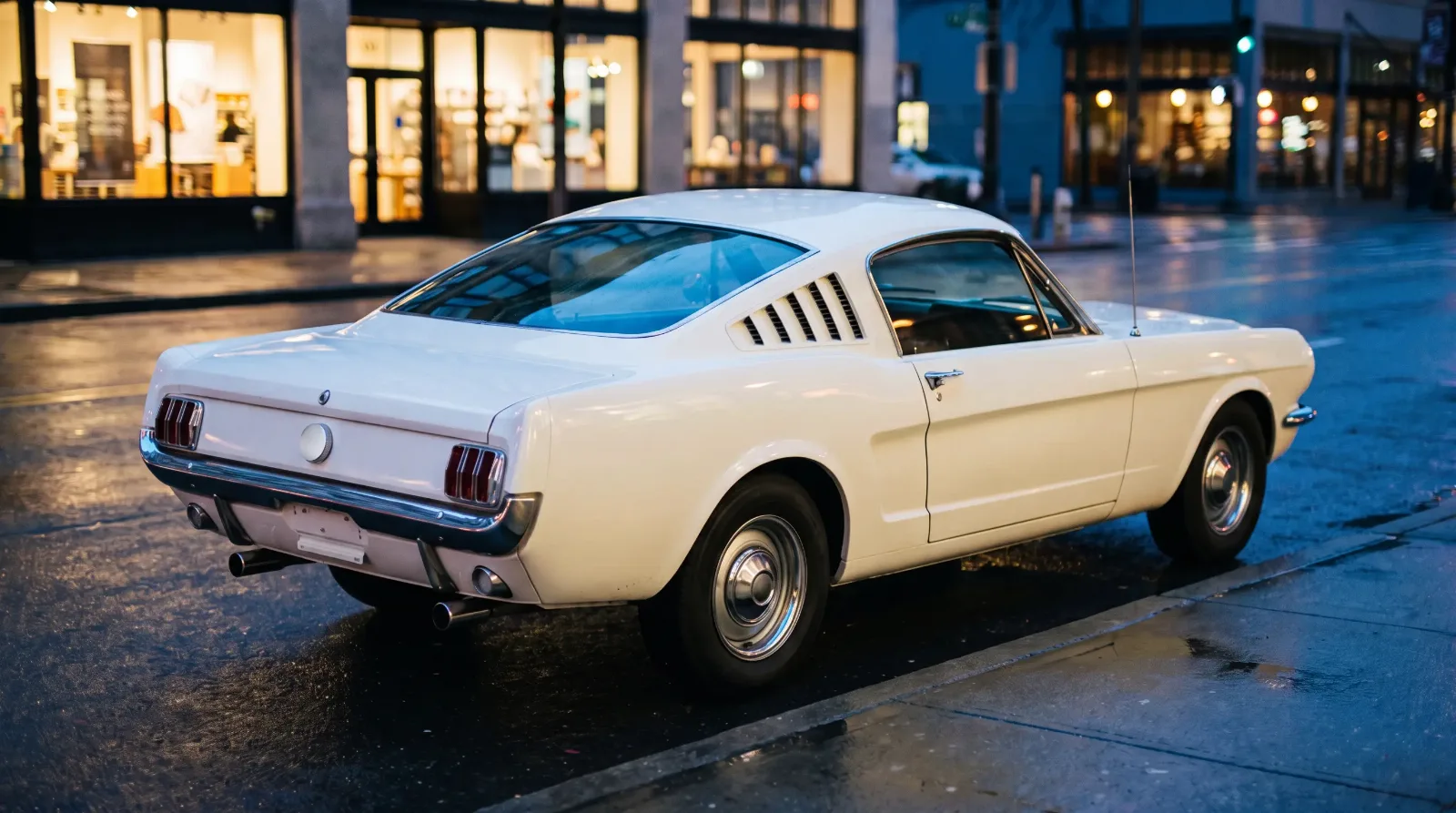
Ford built 13,231 K-code Mustangs across all body styles. The split by model year runs 7,273 for 1965 (including the 1964½ cars), 5,469 for 1966 and only 489 for 1967. Ford built roughly 354,400 V8 Mustangs for 1966, so the Hi-Po went into about one and a half percent of them, and fewer than one Mustang in a hundred overall.
The 1967 collapse has a simple cause. The restyled car had room for the 390 big-block, the S-code, rated at 320 hp and 427 lb-ft. That is 115 lb-ft more torque than the Hi-Po with no lash to adjust. A buyer who wanted speed in 1967 could get it without the high-rpm habits, and almost everyone did. By 1968 the K-code was gone from the engine list, and the top small-block was a 302 four-barrel rated at 230 hp.
Reading the evidence on a K-code car
Start with the VIN. On the early cars the engine code is the fifth character, and K means the 289 High Performance. An engine can be swapped and a badge can be added, but the code was stamped when the car was built. Anyone reading through 1965 Mustangs for sale will find "Hi-Po" in plenty of listing titles. One character settles most of those claims.
The GT rule helps too. A factory 1965 or 1966 GT had to have the A or K engine. A GT with a C, T or U code in the VIN did not leave the factory that way. Some K-code cars also carried the Rally-Pac, and the rare 8,000 rpm tachometer in that cluster belonged to the Hi-Po, with a 6,500 rpm redline. The six and the base V8 got a 6,000 rpm unit.
The K-code is one chapter of the early Mustang. For the bigger picture, from the Fairlane Committee to the last of the classic cars, the full story is told separately. What the Hi-Po left behind was an idea: a factory small-block, sold with a warranty, that wanted to rev. Ford came back to that formula with the Boss 302 for 1969, the same year the first Mach 1 Mustang arrived with a 351 as its base engine. The cubic inches changed. The thinking started here.
Sources and notes
- Ford Windsor engine (Wikipedia): 289 HiPo hardware, ratings and Fairlane origin
- Sports Car Market: K-code production by model year
- RM Sotheby's: 1966 Mustang GT K-Code lot notes and production totals
- Over-Drive Magazine: 1966 Ford Mustang fact sheet (option prices, automatic with the 271)
- SlashGear: the 1965 Car Life K-code road test
- Curbside Classic: the 1965 Car and Driver test of the 271 hp Mustang GT
Related Reading
#1965 mustang
#Ford Mustang
#K-code
#289 hi-po
#Ford small-block
#1966 Mustang
#classic Mustang engines

About the author
Dan Reeves
Performance engine builder from North Carolina's motorsports corridor, focused on swaps, forced induction and making real, repeatable power.
Related Listings - Ford Mustang




Comments
Be the first to comment on this article.