
The showroom floor in the spring of 1969 wasn't ready for what rolled onto it. Dealers had been selling Firebirds for two full seasons already, solid cars, good sellers, nothing that stopped foot traffic. Then a white coupe with blue stripes running nose to tail showed up on the floor plan, and salesmen who'd seen every option package Pontiac could dream up realized they were looking at something the brochure hadn't fully prepared them for. That car was the first Trans Am, and the 1969 Trans Am origin story is as much about a name Pontiac had to pay for as it is about the car itself.
Car Features
6 min read
The 1969 Trans Am: Where the Legend Started
A low-volume, mid-year option package with a licensed name became the foundation for one of Detroit's most enduring performance nameplates.
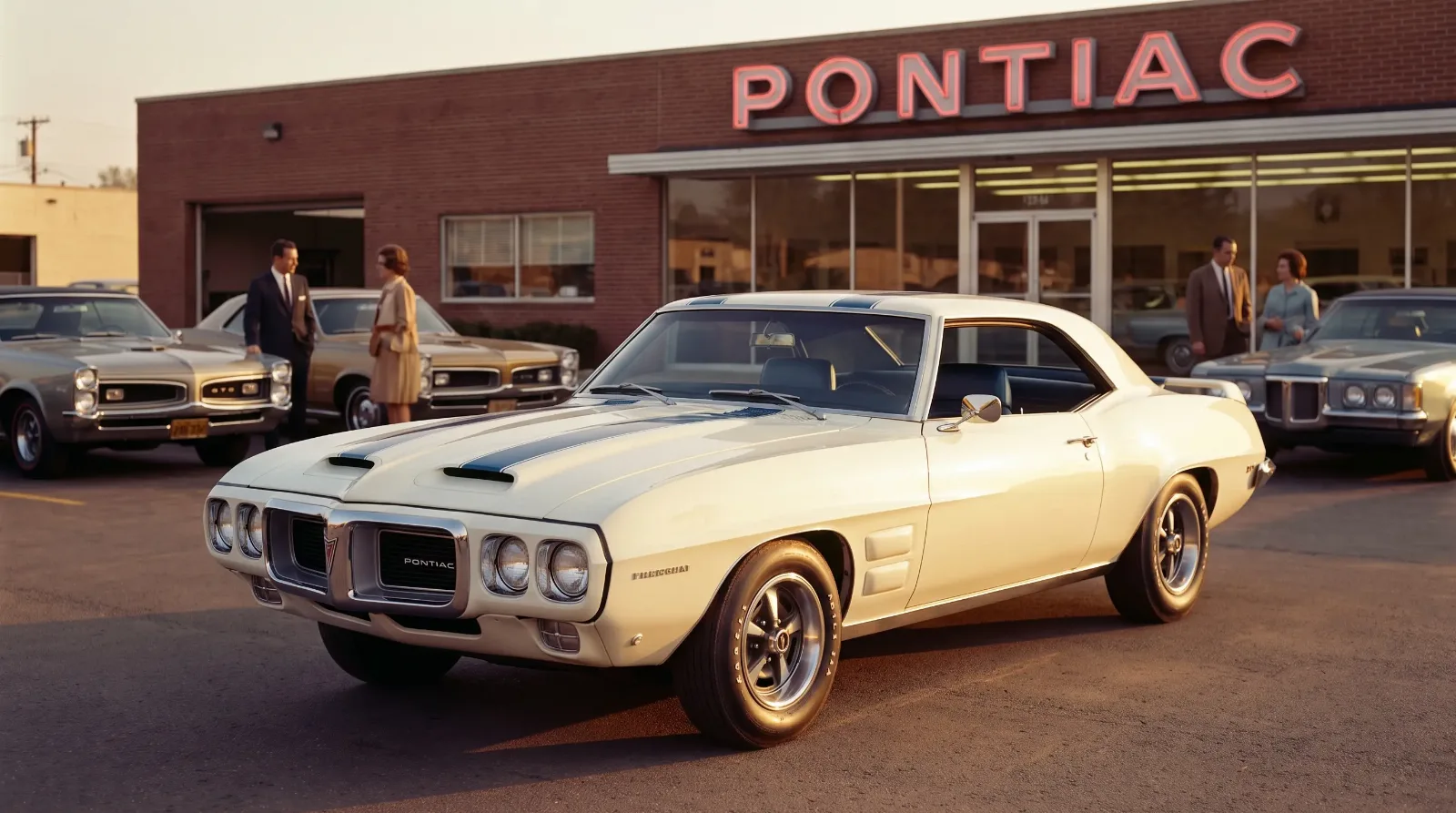
Pontiac didn't invent the words Trans Am. The SCCA owned them, tied to its Trans-American Sedan Championship road racing series, and Pontiac's engineers had to license the name to put it on a fender. The arrangement reportedly cost Pontiac a five-dollar royalty for every car sold, which is a strange footnote for a name that would go on to sell hundreds of thousands of cars over the next three decades. In 1969, though, nobody knew that yet. The Trans Am was a mid-year option package, arriving in March, tacked onto a Firebird body that was already in its final season before the full redesign.
A car built to answer a specific question
The question Pontiac was answering wasn't subtle: could the Firebird be taken seriously as a performance machine, not just a stylish alternative to the Mustang and Camaro. John Schinella's design team leaned into that by keeping the graphics aggressive and the color choice deliberately narrow. Buyers in 1969 could get the Trans Am package in essentially one look, Cameo White with blue rally stripes, because Pontiac wanted the car to be instantly recognizable rather than customizable. It worked. Even people who couldn't tell a 400 from a 350 under the hood knew what that white and blue combination meant.
Underneath, the standard engine was the Ram Air III 400, rated at 335 horsepower, with the Ram Air IV available for buyers who wanted more top-end breathing and were willing to live with a car that wanted to be revved. Both engines were shared with other Pontiac performance models, but the Trans Am's front spoiler, rear spoiler, and functional hood scoops were tuned specifically for this package, aimed at high-speed stability rather than just visual drama.
There's a detail that gets lost in most retellings: the 1969 Trans Am wasn't built as a separate model line with its own assembly slot. It was ordered as an option on top of an existing Firebird, which meant every one of these cars started life on the same line as an ordinary coupe before the package pushed it into different territory. That production reality is part of why records on exact build counts have always been a little fuzzy, and why serious buyers today lean so heavily on documentation rather than trusting a seller's word about what left the factory.
Numbers that still surprise people
Here's the part that trips up even seasoned Pontiac people: almost nobody bought one. Production for that first year landed at just 697 cars total, 689 hardtops and only 8 convertibles. Compare that to the tens of thousands of standard Firebirds Pontiac moved that same model year and the Trans Am wasn't a volume seller. It was a statement, sitting quietly in the order books while the rest of the lineup did the heavy lifting on sales.
That low production is exactly why surviving 1969 Trans Ams carry the weight they do among collectors now. A car that wasn't chasing sales volume in period becomes the rarest, most sought piece of the whole model's history decades later. It's a pattern that shows up across Detroit muscle from this era, but the Trans Am's numbers are lean even by that standard.
What made it different from a dressed-up Firebird 400
The temptation is to call the 1969 Trans Am a trim package, and mechanically that's not entirely wrong. But the spoilers, the specific suspension tuning, and the restricted color and graphics options set it apart from anything a dealer could order a la carte on a regular Firebird. Pontiac built it to look and handle like a car that had something to prove on a road course, even though most buyers were driving it to work and back.
It's also worth remembering how short the window was. Because the Trans Am arrived mid-year and the Firebird body it rode on was replaced the following season, the 1969 car had less than a full model year to make its impression before the whole platform changed shape. Most halo cars get several seasons to build a reputation. This one had a matter of months, and it still managed to set the template every later Trans Am would be measured against.
Why this origin story still matters
Every Trans Am that followed, through the SD455 muscle era and into the Firebird's final years, traces back to this odd, low-volume, mid-year experiment. Pontiac didn't know in 1969 that it had started a nameplate that would outlive the original Firebird body by decades. They just knew they needed a halo car with teeth, and they built one fast enough to get it on the floor before the model year ran out.
"Nobody walked onto a Pontiac lot in 1969 expecting to see a car built for a road racing series stamped on the fender. That's exactly why the ones who saw it never forgot it."
Patrick Walsh
If you want the full arc of how this package grew into the car people picture when they hear the words Trans Am, the Trans Am story covers the whole lineage from this first car through its highest-performance years. And if the muscle era is what you're really here for, keep reading the series to see where that engineering ambition peaked before emissions regulations changed everything.
The 1969 car didn't need volume to matter. It needed to exist, once, in exactly the right shape. It did, and the rest of the badge's history has been chasing that first statement ever since.
Sources and notes
- Pontiac Firebird Trans Am - Wikipedia
- The Rarest Pontiac Ever Produced - HotCars
- Hitman's Pontiac Trans Am Site - Production Numbers
- 1969 Pontiac Trans Am - Sports Car Market
- True Survivor: The Only 1969 Pontiac Trans Am Ram Air V Test Vehicle - Throttlestop
- Car of the Week: 1969 Pontiac Trans Am - Old Cars Weekly
Related Reading
Have a
Pontiac Firebird
for Sale?
Reach thousands of serious classic car collectors across the US.
Sell It Here →
Are You a Classic Car Dealer?
List your full inventory and connect with targeted classic car buyers.
Join as a Dealer →

About the author
Patrick Walsh
Automotive journalist covering classic car shows, events, and the enthusiast community across North America.
Related Listings - Pontiac Firebird


Comments
Be the first to comment on this article.