
A young fellow once walked up to a red IROC-Z at a club show I was judging, read the door decal out loud, and asked the owner what the letters meant. The owner, who had owned the car for twenty years, said "Iroc." Just the word, like a brand of motor oil. Nobody laughed, because half the people standing there did not know either. So, what does IROC stand for? International Race of Champions. It was a real race series, it ran real Camaros long before Chevrolet sold one with the name on the door, and the story of how those four letters ended up on a street car is better than most of the stories you will hear at a show.
Car Features
6 min read
What Does IROC Stand For? The Race Series Behind the Name
What does IROC stand for? International Race of Champions, the series that ran Camaros from 1974 to 1989 before the name went on a street Z28.
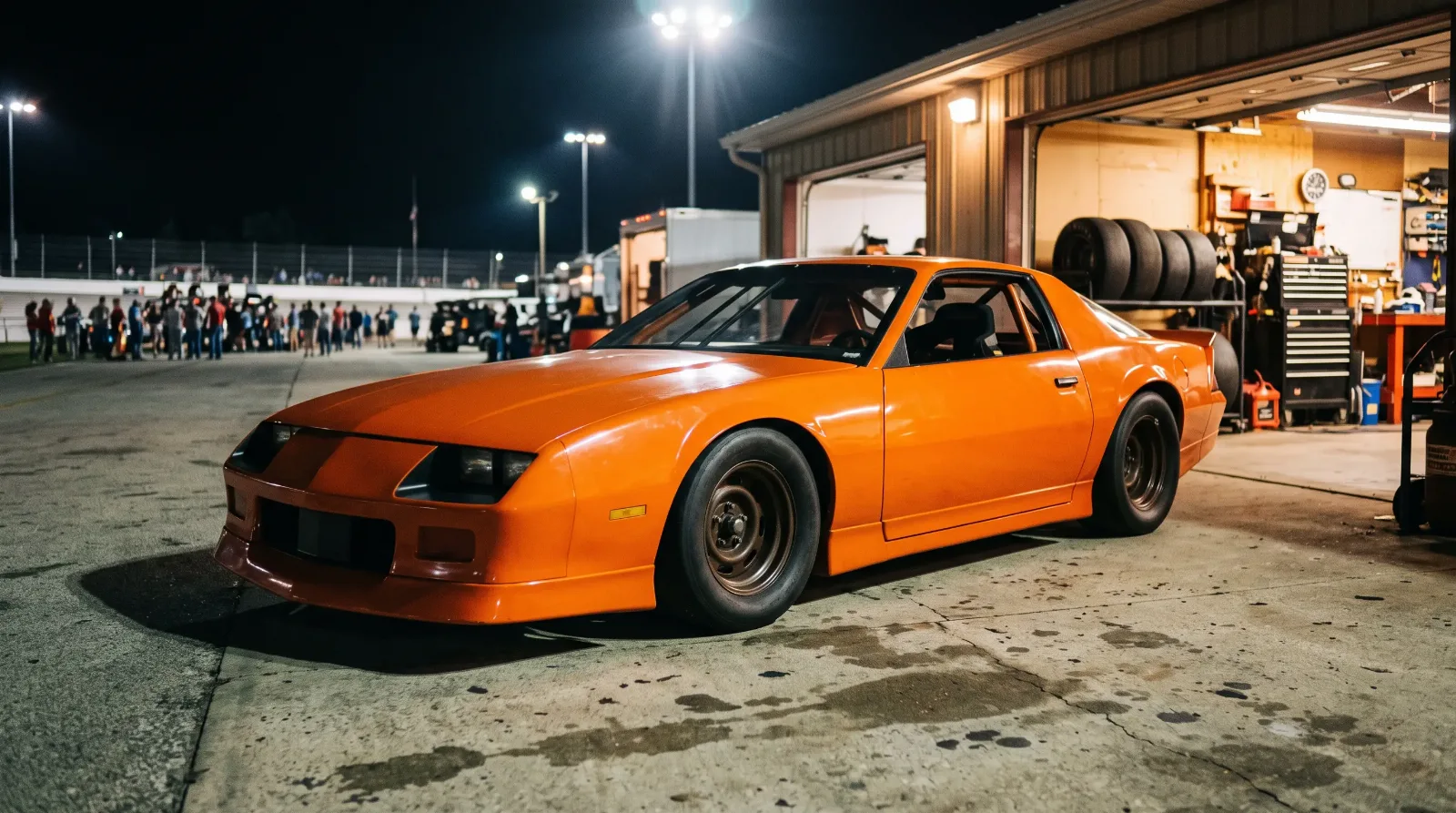
What does IROC stand for, and who started it?
The International Race of Champions was put together in 1972 and 1973 by Roger Penske, Les Richter and Mike Phelps, with the original idea credited to David Lockton, the developer behind Ontario Motor Speedway. The format was the whole point. Twelve drivers from Formula One, NASCAR, IndyCar (USAC) and sports cars were put in identically prepared cars, and the cars were assigned by a blind draw. No team advantage, no money advantage. Just the driver.
The first IROC race ran on October 27, 1973, at Riverside International Raceway in California. Mark Donohue won it. The car was not a Chevrolet at all. The first season used the Porsche 911 Carrera RSR, and the first season was three races at Riverside over one weekend, with a final at Daytona. If you want to know how the IROC-Z grew out of that, read more here, but stay with the race series for a minute, because that is where the name earned its weight.
From Porsche to Camaro in 1974
For the second season, IROC II, the series switched to the Camaro. Fifteen cars were built in the summer of 1974, three of them backups, and they started life as production steel-body 1974 Camaros. Penske shipped street cars to Reading, Pennsylvania, where they were stripped and converted. Each got a Traco-built 336 cubic inch small-block rated at 440 hp, plus or minus 5, with a 7,200 rpm cutoff and a Borg-Warner Super T-10 four-speed.
The first Camaro IROC race ran at Michigan Speedway in September 1974, and Bobby Unser won it. The Riverside races the next month went to Emerson Fittipaldi and Bobby Allison, and Unser won the Daytona finale in February 1975 to take the title and $41,000. A.J. Foyt was second and took home $27,600. Foyt won the next season, the one with a $50,000 prize.
Here is the part I enjoy most. Chevrolet had just taken over from Porsche as the supplier for a major race series, and it had no performance Camaro to sell in the showroom for 1975 and 1976. The race cars carried the Camaro name while the dealers had nothing to match them.
Tube frames, a break and the 1980s cars
The steel-body cars did not last. For the 1977 to 1980 seasons, NASCAR builder Banjo Matthews built 15 tube-frame Camaros, with mostly fiberglass panels, and the bodies were fitted at Penske Racing in Reading. A Traco 350 made about 450 hp. Then the series stopped. There was no IROC in 1981, 1982 or 1983, and the operation moved from Reading to Red Bank, New Jersey, in 1981. Jay Signore, who had managed Penske Racing for 12 years, ran IROC for 25.
When the series came back in 1984 it was still a Camaro series, now with the third-generation Z28 shape on a tube frame. That run lasted through 1989, which gave Chevrolet 12 IROC seasons in all. The table sets out the three eras.
| Seasons | Camaro body | Construction | Engine |
|---|---|---|---|
| 1974 to 1976 (IROC II and III) | Second generation | Production steel bodies, converted in Reading, Pa. | Traco 336 cu in, 440 hp |
| 1977 to 1980 (IROC IV to VII) | Second generation | Banjo Matthews tube frame, mostly fiberglass panels | Traco 350, 450 hp |
| 1981 to 1983 | None | Series not held | None |
| 1984 to 1989 (IROC VIII to XIII) | Third generation | Banjo Matthews/IROC tube frame, 3,350 lb | Katech forged-aluminum 350, 470 hp, 400 lb-ft |
The names on the trophy in the Camaro years read like a hall of fame roll call: Bobby Unser, A.J. Foyt, Al Unser, Mario Andretti and Bobby Allison in the late 1970s, then Cale Yarborough, Harry Gant, Al Unser Jr. (twice), Geoff Bodine and Terry Labonte from 1984 to 1989. It is one of the cleaner chapters in Camaro racing, because the cars were equal and the results came down to the drivers.
"Every IROC-Z owner I know has been asked what the letters mean. The good ones can name the series. The great ones can name the B4Z code on their own paperwork."
Wayne Coburn
How the race series put its name on a street Camaro
By 1985 Chevrolet finally had the street car it lacked in 1975. It took the name of the series it had been supplying and put it on an option package for the Z28. The IROC-Z was RPO B4Z, priced at $659 in 1985. What that package contained, and how it drove, belongs to the story of the 1985 launch, so I will not repeat it here. The point for this page is that the name was borrowed, under license, from a race series that existed first.
Borrowed names can be taken back. Chevrolet did not renew with the International Race of Champions after the 1989 season, Dodge took the series, and the 1990 model year was the last IROC-Z. The Z28 name returned for 1991. That is why there is no 1991 IROC-Z, no matter what the decals on a car at your local cruise night say.
After the Camaro: Dodge, Pontiac and the end of IROC
The series went on without Chevrolet. Dodge supplied the Daytona from 1990 to 1993, and Dale Earnhardt won the first Dodge season. The Dodge Avenger followed for 1994 and 1995, and from 1996 to 2006 the cars were Pontiac Firebirds and Trans Ams. The last season was 2006, IROC XXX, won by Tony Stewart. The 2007 season was postponed and never ran, and the series assets were auctioned in March 2008. A relaunch was announced by Ray Evernham and Rob Kauffman on January 8, 2024.
So the answer to the question is three words long, but the history behind it fills a good part of the wider Camaro history: a Porsche start, two generations of Camaro race cars, a three-year gap, and a street package that carried the name for six model years.
One more thing, since someone always asks. The IROC-Z name is not in the VIN. On third-generation cars, Z28 and IROC-Z are option codes, and the IROC-Z package is B4Z. So if you are ever standing next to a red IROC-Z with an owner who calls it "the Iroc," be kind. Then ask to see the paperwork that proves the B4Z package. That is where the race series really lives on the car.
Sources and notes
- Wikipedia: International Race of Champions, seasons and champions
- Wikipedia: IROC IV, the 1976 to 1977 Camaro season
- Hagerty: The first IROC Camaro was a street car with desire
- GM EFI: The history of IROC, International Race of Champions
- Motor Sport: True race champions, the IROC Camaros
- IROC: Series history
Related Reading
Have a
Chevrolet Camaro
for Sale?
Reach thousands of serious classic car collectors across the US.
Sell It Here →
Are You a Classic Car Dealer?
List your full inventory and connect with targeted classic car buyers.
Join as a Dealer →
#camaro history
#chevrolet camaro
#camaro racing
#third generation Camaro
#IROC-Z
#International Race of Champions
#IROC series

About the author
Wayne Coburn
Longtime Corvette owner, judge and club figure who knows the cars, the records and the people behind them.
Related Listings - Chevrolet Camaro
Comments
Be the first to comment on this article.