
The 1985 IROC-Z was not a new model. On Chevrolet's order form it was RPO B4Z, a $659 option package on the Z28, and every one of the 21,177 cars built that year left the plant as a Z28 with the package added. The name came from the International Race of Champions, the series Chevrolet had been supplying with Camaros. The contents were mostly chassis hardware. That distinction is worth keeping straight, because a good deal of what gets repeated about the 1985 IROC-Z, from its engines to its gearboxes, goes wrong at exactly that point.
Car Features
6 min read
The 1985 IROC-Z: A Handling Package Gets a Name
The 1985 IROC-Z was RPO B4Z, a $659 handling package on the Z28. What it added, its three V8s, the road tests and the 21,177 built.
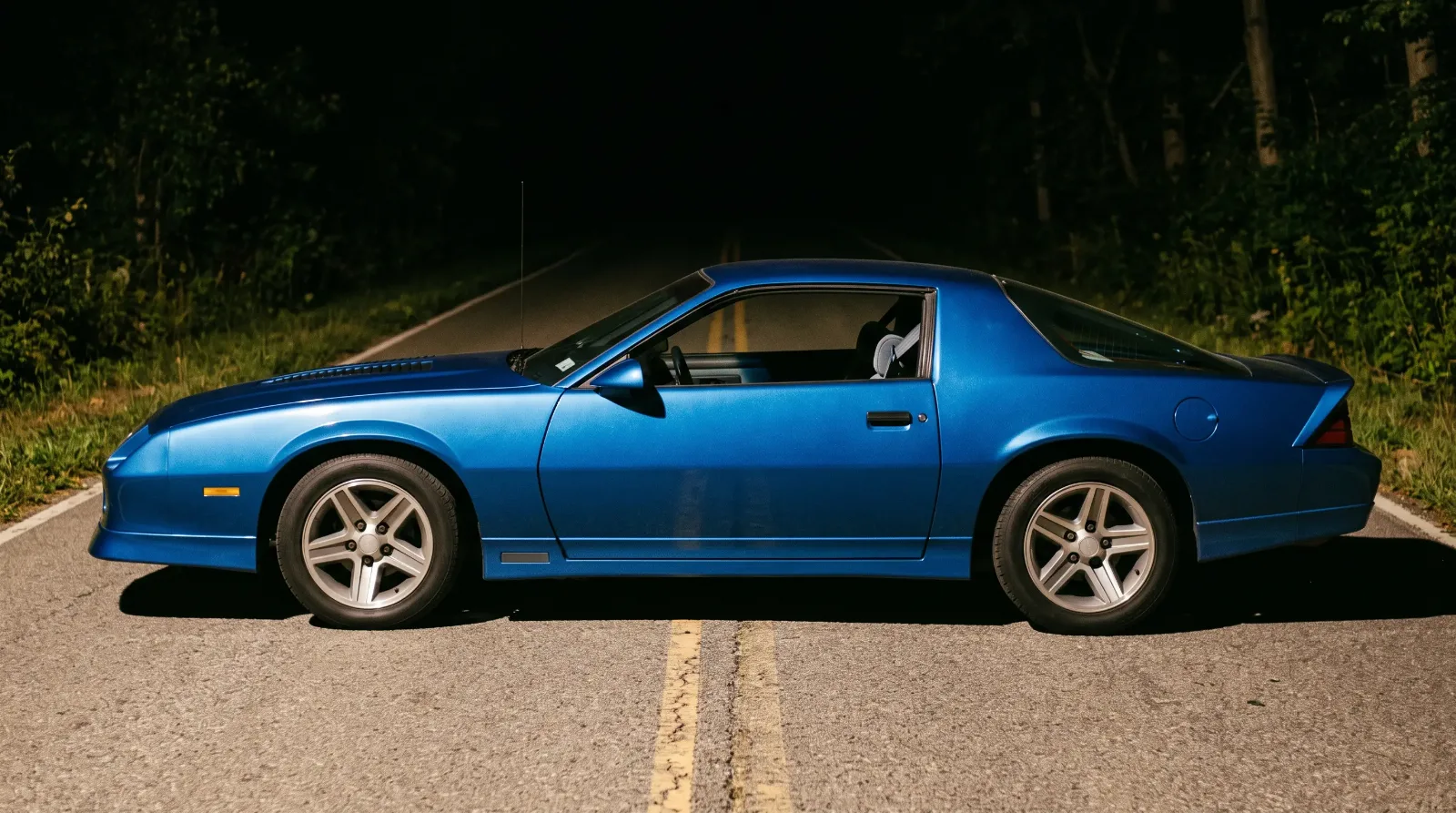
What follows covers the first year only: what the package contained, which engines and transmissions it could have, what the magazines measured, and how the production records read. The later years, from the 350 to the convertible, belong to the larger IROC-Z story.
What the B4Z package added to the Z28
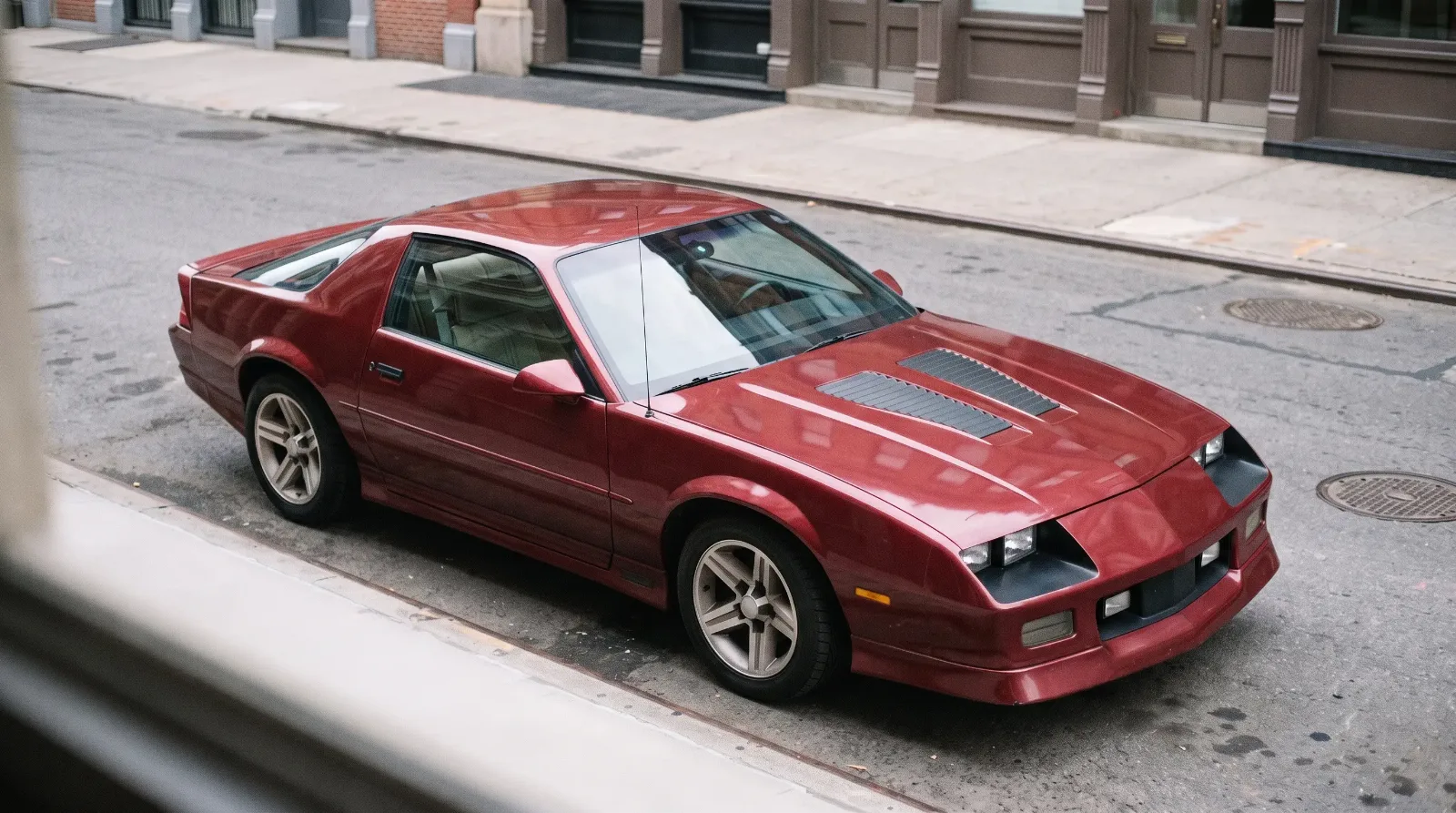
Hagerty describes B4Z as the IROC Sport Equipment Package, and the description is accurate. Most of the content was underneath the car. The IROC-Z sat about half an inch lower than a Z28. It had Delco-Bilstein rear shocks, larger anti-roll bars and a steering brace that owners call the "wonder bar." It rode on 16x8 five-spoke aluminum wheels with Goodyear Eagle GT "Gatorback" tires in size 245/50, a combination rated at 0.92 g on the skidpad.
The visible content was modest by comparison. Fog lamps went into the grille, the front air dam was deeper, rocker extensions were added, the hood carried louvered inserts, and the doors got IROC-Z decals. That is the whole list. A car with fog lamps and decals but standard Z28 suspension is not an IROC-Z, whatever it is wearing.
The 1985 IROC-Z engines and the transmission rules
Three V8s were offered, all of them 305s, and each came with its own transmission rule. The records are clear on this, and the table below is worth checking against any car before the conversation about money starts.
| Engine | Induction | Power | Torque | Transmission | Option price |
|---|---|---|---|---|---|
| LG4 305 (standard) | Four-barrel | 155 hp | 245 lb-ft at 2,000 rpm | Five-speed manual, or four-speed automatic ($425) | Standard |
| L69 305 H.O. | Four-barrel | 190 hp at 4,800 rpm | 240 lb-ft at 3,200 rpm | Five-speed manual only | $680 |
| LB9 305 | Tuned port injection | 215 hp at 4,400 rpm | 275 lb-ft at 3,200 rpm | Four-speed automatic (700-R4) only | $695, plus $425 automatic |
Two corrections are needed here. First, the base engine was the carbureted LG4, not the L69. At least one widely read retrospective has that backward. Second, there was no manual gearbox behind the injected engine in 1985. The LB9 came only with the automatic; a manual with tuned port injection did not arrive until 1987. If a seller describes a 1985 LB9 car with a factory five-speed, the description is wrong, or the car has been changed.
The L69 had one more restriction. It was available only on the IROC-Z, not on the plain Z28, while the LG4 and LB9 could be had on both. The count of L69 IROC-Zs for 1985 is 2,497, which makes it the scarce combination of the year.
The LB9 is the engine the car is remembered for. At 215 hp it made the 1985 IROC-Z the first Camaro rated above 200 hp since the 245 hp 1974 Z28. How Chevrolet got there is the subject of the separate piece on Tuned Port Injection, so I will leave the hardware there.
What the 1984 road tests recorded
The 1985 car was tested in the fall of 1984, and two October 1984 magazine tests give a consistent picture of the LB9 car. Motor Trend recorded 0 to 60 mph in 6.8 seconds and the quarter mile in 15.3 seconds at 89.1 mph. Car and Driver recorded 7.0 seconds and 15.2 seconds at 91.0 mph. (One later source gives Motor Trend's figure as 6.9 seconds; the difference may reflect a second test, and the 6.8 figure is the one with the issue cited.)
Car and Driver also tested an L69 car in the same issue: 7.5 seconds to 60 and 15.4 seconds at 90.0 mph. Half a second slower to 60, but nearly identical through the quarter mile, with a clutch pedal and a lower price.
MotorWeek ran a three-way test in 1985 against the Mustang GT and the Trans Am. The Mustang was quickest, with a 14.3-second quarter mile. On the handling course the IROC-Z was 0.9 seconds faster than the Trans Am and a full second faster than the Mustang. None of the three got past the mid-120s in mph at Pocono. The verdict was that the Mustang was fastest and the IROC-Z the most refined, which is a fair summary of what a handling package with a name was supposed to be.
"In 1985 the IROC-Z was a package, not a model. The order form says so, and the order form outranks the decal."
Tom Ramirez
Production records and reading a 1985 IROC-Z today
Chevrolet built 21,177 IROC-Zs for 1985, about 31 percent of the roughly 68,000 Z28s built that model year. Total Camaro production for 1985 was about 180,000. The share tells you something about the market's reaction: the next year, the IROC-Z took 56 percent of Z28 sales.
Because the IROC-Z was a package, the VIN will not identify one. On third-generation cars, Z28 and IROC-Z are option codes, not part of the serial number. What the VIN does record is the model year, F for 1985, and the engine. For 1985 the engine digit is F for the tuned port 305, and H or G for the four-barrel 305s. That alone separates an LB9 car from a carbureted one, but it does not separate an L69 from an LG4, and it does not prove B4Z. For that you need the original paperwork. The 1985 cars were also among the last to carry a cowl tag, which on 1982 to 1985 cars sits on the radiator support.
On price, a 1985 Z28 listed at $11,281. Adding B4Z at $659, the LB9 at $695 and the required automatic at $425 put a well-ordered IROC-Z above $13,000 before air conditioning ($750), T-tops ($846), power windows ($195) or four-wheel disc brakes ($179) were added. That arithmetic is worth remembering when you look through 1985 Camaros for sale, because an original window sticker with the right codes on it tells you more about a car than any decal on its doors.
Sources and notes
- Eighties Cars: 1985 Chevrolet Camaro IROC-Z, prices, engines and production
- Hagerty: IROC-Z, when Camaro got its mojo back
- Muscle Car Facts: 1985 Camaro Z28 and IROC-Z, period road tests
- Old Car Memories: 1985 to 1990 Chevrolet Camaro IROC-Z, base engine and gearboxes
- Wikipedia: Chevrolet Camaro (third generation)
- CamaroTech: 1985 Camaro VIN codes
Related Reading
Have a
Chevrolet Camaro
for Sale?
Reach thousands of serious classic car collectors across the US.
Sell It Here →
Are You a Classic Car Dealer?
List your full inventory and connect with targeted classic car buyers.
Join as a Dealer →
#camaro z28
#chevrolet camaro
#tuned port injection
#third generation Camaro
#IROC-Z
#1985 Camaro
#B4Z

About the author
Tom Ramirez
Corvette researcher and historian based in Bowling Green, Kentucky. Two decades documenting Corvette production history from original factory records.
Related Listings - Chevrolet Camaro
Comments
Be the first to comment on this article.