
The man I spoke with at a cars and coffee last spring had a story that stuck with me. He bought a new 440-powered Chrysler in the summer of 1973, twenty-three years old, proud as could be. By that winter he was sitting in a gas line at six in the morning, engine off to save fuel, watching the needle on his wallet drop faster than the one on the pump. He kept the car three more months and then sold it. The car had not changed. The country had.
History & Heritage
6 min read
The 1973 Oil Crisis and the End of Cheap Horsepower
The 1973 OPEC oil embargo ended the muscle car era. How gas lines and quadrupled fuel prices killed cheap American horsepower.
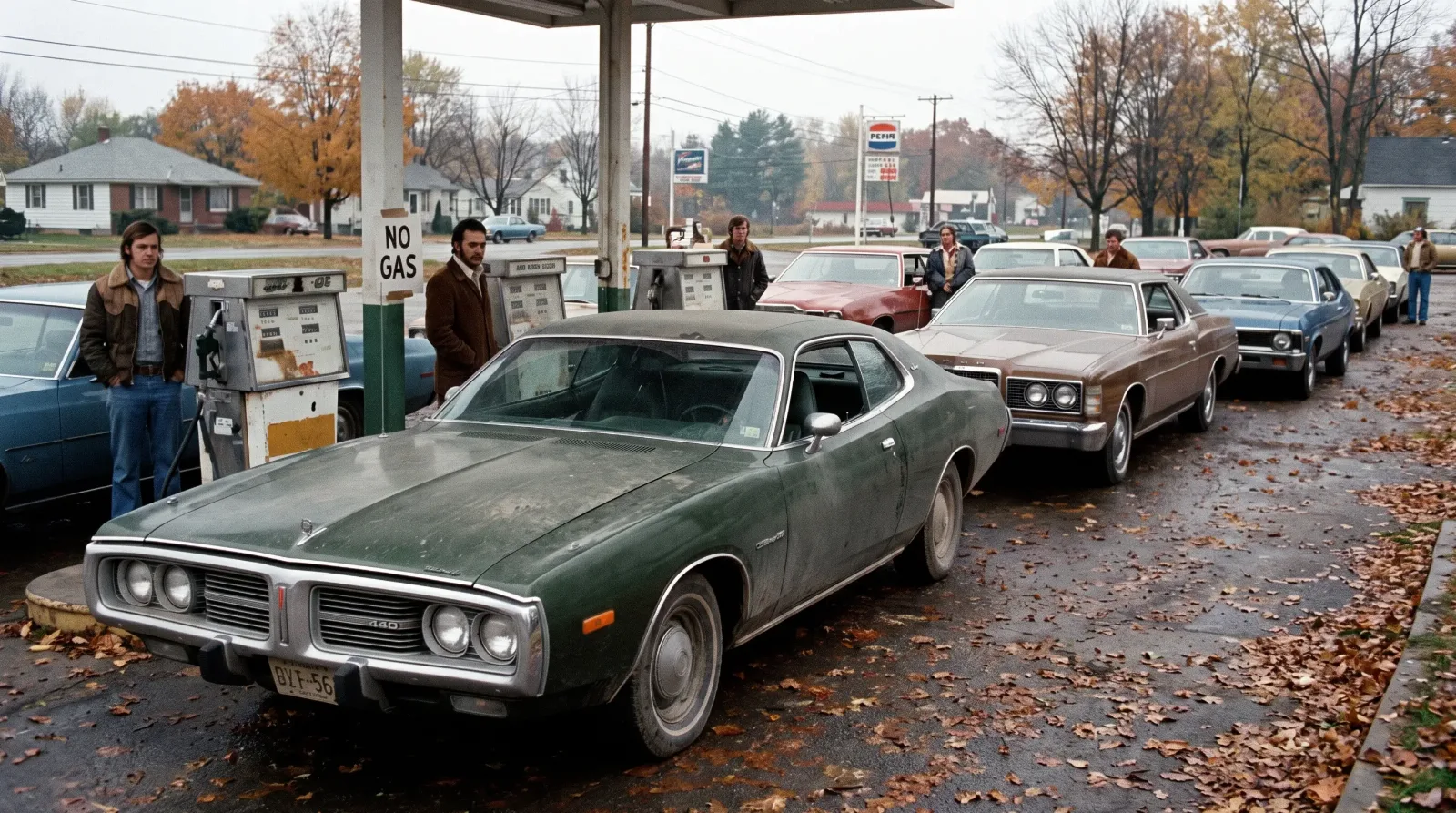
That is the 1973 oil crisis in one anecdote. The muscle car was already wounded by insurance costs and emissions rules, but the embargo did something those could not. It made a thirsty V8 feel like a mistake overnight, in front of the whole country, at the same moment. For the long arc of how the segment got here, our muscle car history guide covers the earlier chapters, but this is where the cheap horsepower ran out for good.
The autumn everything changed
In October 1973 the Arab members of OPEC announced an oil embargo against the United States and several other nations, in response to American support for Israel during the Yom Kippur War that had broken out that month. The embargo was a geopolitical weapon, and it worked. Within months the price of crude oil roughly quadrupled, and the effects rolled through the American economy fast.
For a country that had built its car culture on the assumption of cheap, endless fuel, this was a shock to the foundation. Gasoline had been an afterthought in the purchase decision. Suddenly it was the decision. The embargo ran into the spring of 1974, and by the time it lifted, American attitudes toward the big engine had already shifted in a way they never fully reversed.
Why the embargo happened
The trigger was the Yom Kippur War, which began in early October 1973. When the United States moved to support Israel, the oil-producing nations of the region used the one lever that guaranteed American attention. They cut supply and raised prices, and because the United States had grown dependent on imported oil, there was no quick domestic answer.
The important thing for our purposes is not the politics but the speed. This was not a gradual tightening that the market could adjust to over years. It was a sudden, deliberate squeeze, and it hit a car market that had no fuel-efficient product ready to sell in volume. Detroit was caught building exactly the wrong cars for the moment.
| 1973 to 1974 oil shock | What happened |
|---|---|
| October 1973 | OPEC's Arab members announce embargo on the US |
| Crude oil price | Roughly quadrupled within months |
| At the pump | Shortages, long lines, odd-even rationing by plate number |
| Embargo lifted | Spring 1974 |
What it did at the pump
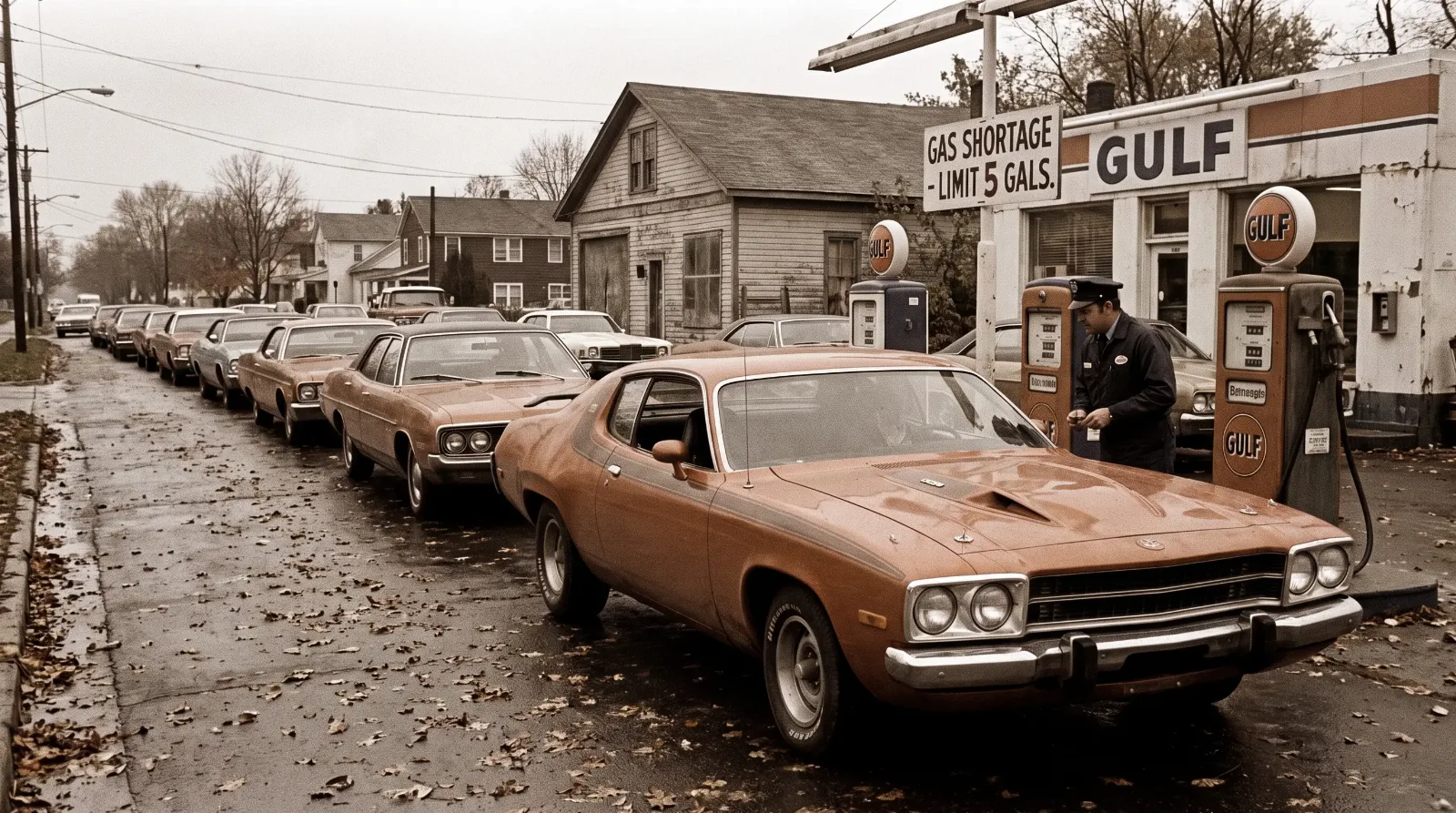
The visible part of the crisis was the gas line, and anyone who lived through it remembers it. Stations ran dry. Many places adopted odd-even rationing, where the last digit of your license plate decided which days you were allowed to buy fuel. Drivers waited hours for a tank. Some stations posted flags, green for gas available, red for none.
Beyond the inconvenience was the price. Fuel that had been a minor line in the household budget became a real expense, and it stayed elevated after the immediate shortage eased. For a family choosing a car, mileage moved from the bottom of the list to the top almost instantly. That single change in priorities was poison for the muscle car. A big engine had always cost more to feed, but for the first time that running cost was the thing buyers talked about first, ahead of the styling and ahead of the power.
Why muscle cars were the wrong car at the wrong time
A muscle car is, by design, a fuel-inefficient machine. The whole idea was a large-displacement engine making torque, and torque like that comes from burning a lot of gasoline. In an era of cheap fuel, nobody cared. In an era of gas lines and quadrupled crude, that thirst became the car's defining flaw in the eyes of the average buyer.
The timing could not have been worse for Detroit. The industry was already pulling back on high-output engines because of emissions rules and the compression cuts that had gutted the ratings for 1971 and 1972. You can read the full story of how the horsepower numbers had already fallen before the embargo hit. The oil crisis simply removed any reason to build a thirsty performance car at all. The market for it had evaporated.
"I have heard a dozen versions of the same story, guys who loved their cars and sold them in the winter of 1973 not because anything broke but because the world made them feel foolish for owning one. That is what the embargo really did. It changed how it felt to drive a big engine down the street."
Patrick Walsh
The end of cheap horsepower
The phrase cheap horsepower is the right one, because that is exactly what ended. For roughly a decade, an American buyer could get a great deal of power for a modest price and feed it with cheap gas. The embargo broke the last piece of that equation. Power was still available in theory, but the cost of living with it had climbed on every front at once.
What came after was the malaise era, a long stretch of tame engines and heavy bumpers, and the muscle car as the 1960s knew it did not return in its original form. The survivors from the good years became something else entirely, collectibles rather than cheap thrills. If you want to see where those cars stand today, you can shop muscle cars on the market and watch how the era that fuel killed became the era collectors chase.
Related Reading
Have a
Classic Car
for Sale?
Reach thousands of serious classic car collectors across the US.
Sell It Here →
Are You a Classic Car Dealer?
List your full inventory and connect with targeted classic car buyers.
Join as a Dealer →

About the author
Patrick Walsh
Automotive journalist covering classic car shows, events, and the enthusiast community across North America.
More in History & Heritage

Comments
Be the first to comment on this article.