
Walk the preview field at any major collector-car sale and you can spot the barn-find lots from fifty feet away. They are the cars nobody cleaned. Dust sits thick on the hood, the tires are flat and cracked, and a spider has usually claimed a corner of the windshield. Everything about the presentation says "found, not fixed." That look is not an accident. Auction houses have learned that a car sold exactly as it came out of long storage can bring money that a shiny restoration in the next tent cannot touch, and they stage the lot to protect that advantage.
History & Heritage
7 min read
Barn Finds at Auction
How auction houses stage barn finds as-discovered, why unrestored survivors outperform restored cars, and what to check before you raise the paddle.
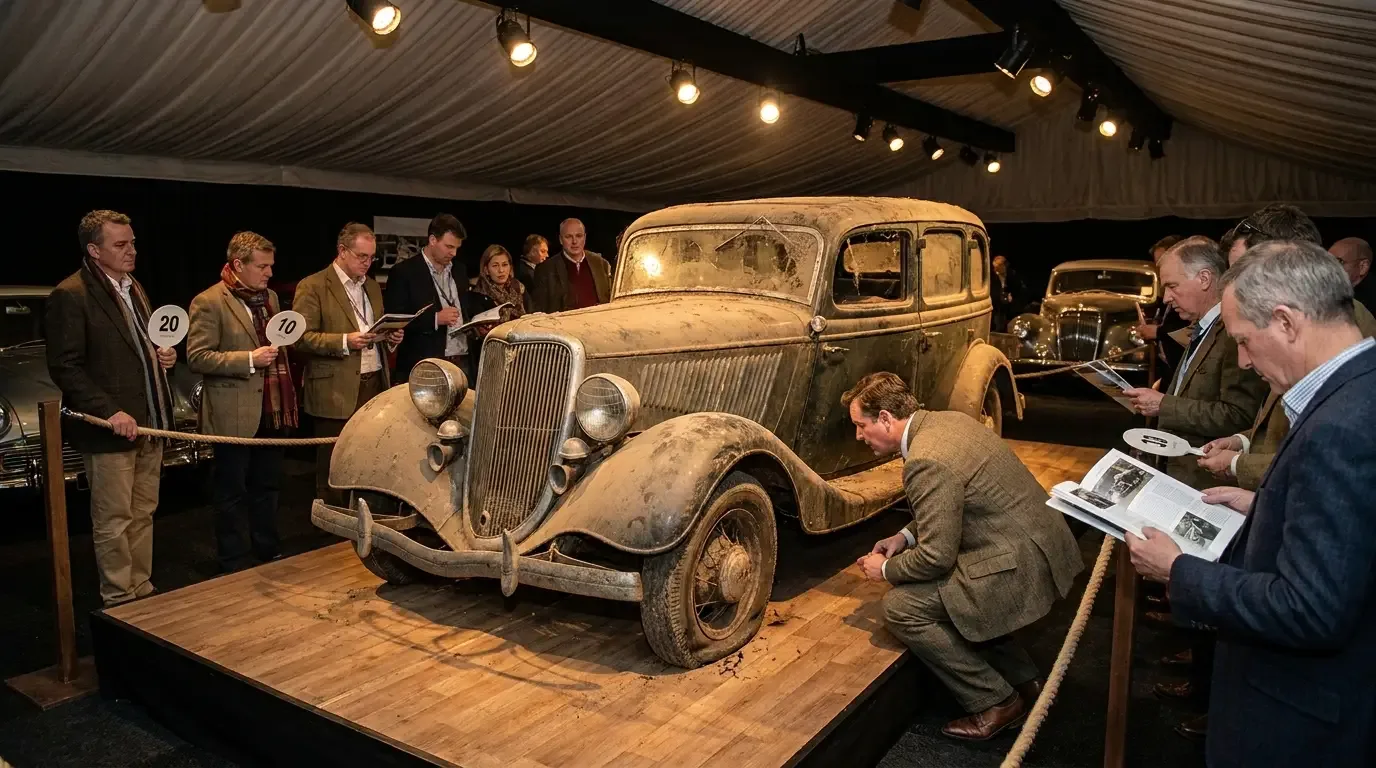
I track these results for a living, and the barn-find category has gone from a novelty to a fixed part of the calendar at the big sales. It rewards a specific kind of buyer and punishes another. Before you raise a paddle on one, it helps to understand how the house is selling you the dust. This is a corner of the market that grew out of famous barn finds becoming headline lots rather than driveway rumors.
How auction houses market a car "as discovered"
The core pitch is authenticity. A restored car has been interpreted by a shop, and that interpretation can be argued with. A genuine unrestored survivor cannot be argued with. It is a physical record of how the car left the factory and how it aged, and there is exactly one of it. Auction catalogs lean on that language hard: original paint, original interior, matching-numbers drivetrain, one or two owners, decades in the same building. Every one of those phrases is doing sales work.
The houses also sell the story. A barn find comes with a narrative that a routine used car does not: who parked it, why it sat, how it was rediscovered. That story goes in the catalog, on the placard, and into the auctioneer's patter on the block. Provenance and narrative move money in this hobby, and an undisturbed car keeps its story intact. The moment you detail it and rebuild the engine, the story becomes "car that used to be a barn find," which is a weaker product.
The dust-and-cobwebs staging is deliberate
Here is the part that surprises people. The condition you see at preview is frequently curated. A serious consignor and a smart house will resist the urge to wash the car, and in some cases they will leave the discovery grime exactly where it was because it reads as honest. The flat tires stay flat. The dead leaves stay on the cowl. The point is to sell the moment of discovery, not a clean object.
That does not mean the presentation is dishonest, but it is designed. The lighting favors patina. The placard emphasizes originality over drivability. The car is often displayed as a static tableau rather than started and moved, which conveniently sidesteps the question of whether it runs. The best-known survivor lots, the ones covered in our roundup of Legendary Barn Find Discoveries, were sold on exactly this logic.
Why unrestored lots can outperform restored ones
It sounds backward that a rough, non-running car can beat a finished one at the same sale, but the logic holds up once you look at what each buyer is actually paying for.
- Originality is finite. Any car can be restored again. A car can only be original once. When the paint comes off, that value is gone permanently, so unrestored survivors carry a scarcity that restored cars do not.
- The buyer controls the outcome. A restoration reflects someone else's choices and someone else's shop quality. An untouched car is a blank slate the new owner can preserve, recommission, or restore to their own standard.
- Restoration cost is not fully recoverable. On many models a high-quality restoration costs more than the finished car is worth, so a seller of a restored car often cannot capture what they spent, while a survivor carries no such underwater math.
- Provenance premium. The discovery story and documented history attach to the original car and add a premium that a repaint erases.
The important caveat is that this only works at the top. For a rare, desirable, historically significant car, originality commands a premium. For an ordinary car, "unrestored" often just means "needs everything," and the market prices it accordingly.
"I have watched a dusty, dead survivor clear a beautifully restored example of the same model on the same night. The buyers were not confused. They understood they were paying for the one thing money cannot rebuild, which is a car that has never been touched."
David Mercer
Reading the estimate and the reserve
Auction estimates on barn finds are wider than on known, restored cars, and for good reason. The house cannot fully inspect a mechanically dormant car without disturbing it, so it is pricing uncertainty. A wide estimate spread is the catalog telling you nobody knows exactly what is under the grime. Treat that spread as a signal, not a guarantee.
| Catalog signal | What it usually means for a buyer |
|---|---|
| "Barn find" / "as discovered" | Sold in found condition, likely non-running, sold as-is |
| "Original paint" / "survivor" | Patina is the value; do not assume drivability |
| "Matching numbers" | Drivetrain is original to the car; verify against documentation |
| Wide estimate spread | House is pricing uncertainty; condition is not fully known |
| "Offered without reserve" | It will sell at some price; opportunity and risk both rise |
| "On behalf of the estate" | Motivated seller, sometimes thin history and paperwork |
Buyer cautions before you raise the paddle
The romance of the barn find is exactly what the staging is engineered to trigger, so the discipline has to come from you. The same forces that make these cars exciting make them easy to overpay for.
None of this is a reason to avoid the category. It is a reason to enter it with your eyes open. A well-bought barn find can be one of the most rewarding cars you will own, and there is a steady supply of barn finds for sale beyond the auction tent for buyers who would rather negotiate than bid. The auction house is very good at selling the dust. Your job is to know what the dust is worth. Owners deciding whether a barn find belongs on the block at all can weigh it against the other routes in the best way to sell a classic car.
Sources and notes
- Collector-car auction catalogs and published post-sale results (major houses).
- Period and contemporary automotive press coverage of survivor and barn-find sales.
- Marque club and registry records used to interpret originality and matching-numbers claims.
- Auction-house terms of sale and buyer's-premium schedules.
Have a
Classic Car
for Sale?
Reach thousands of serious classic car collectors across the US.
Sell It Here →
Are You a Classic Car Dealer?
List your full inventory and connect with targeted classic car buyers.
Join as a Dealer →
#provenance
#barn find auction
#unrestored survivor
#collector car auction
#original paint
#buying at auction

About the author
David Mercer
Classic car market analyst with two decades of experience tracking collector car valuations, auction results, and investment trends.
More in History & Heritage
Comments
Be the first to comment on this article.