
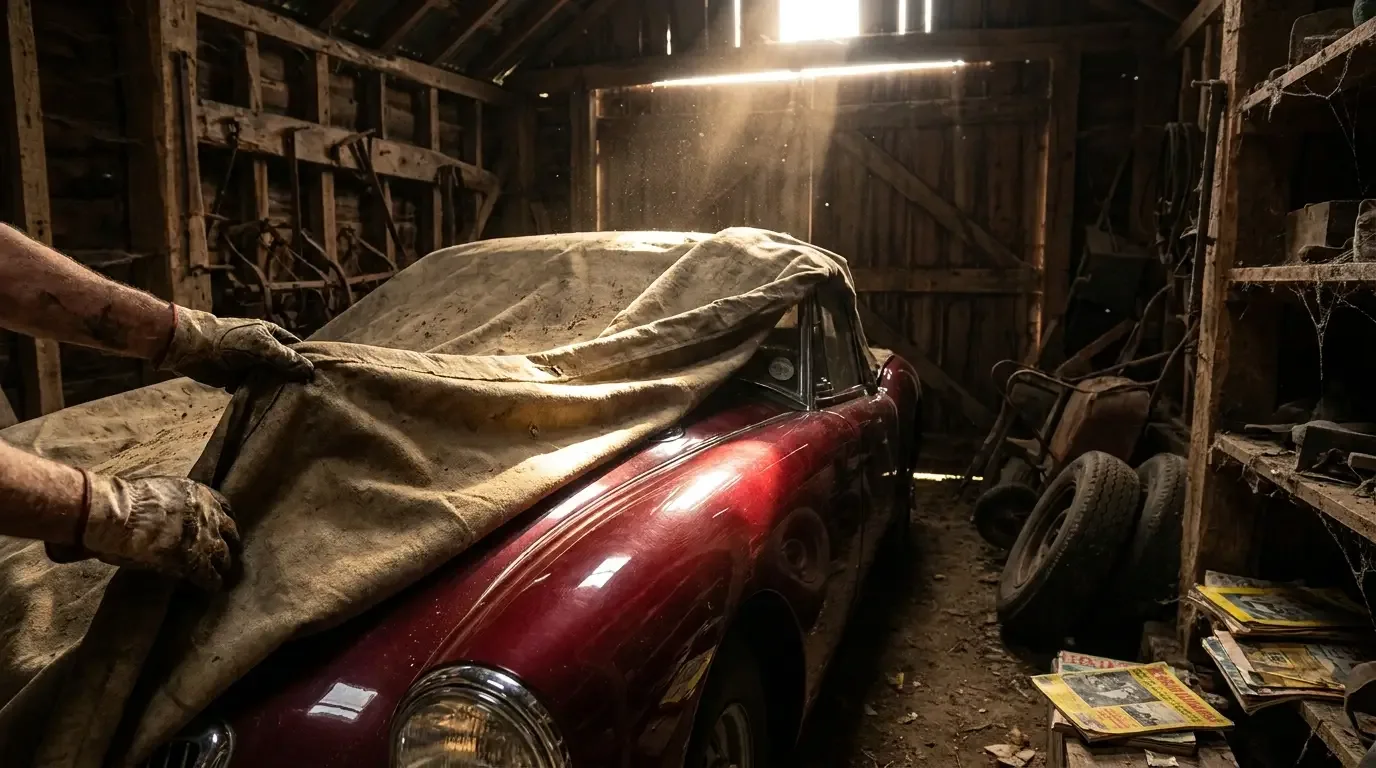
In the winter of 2014, an estate agent walked into a crumbling farm building in western France and found a Ferrari sitting under a stack of old newspapers. Not a wreck. A 1961 Ferrari 250 GT SWB California Spider, once owned by the actor Alain Delon, parked and forgotten for roughly four decades. A few months later it sold at auction in Paris for 16.23 million euros, about 18.45 million dollars. That single car, filthy and unrestored, told the whole story of why grown adults still poke around old sheds hoping to strike gold.
History & Heritage
8 min read
Famous Barn Finds in History
From the Baillon Ferrari to a Bugatti in a Gosforth garage, the legendary barn finds that built the myth, and the honest truth behind them.
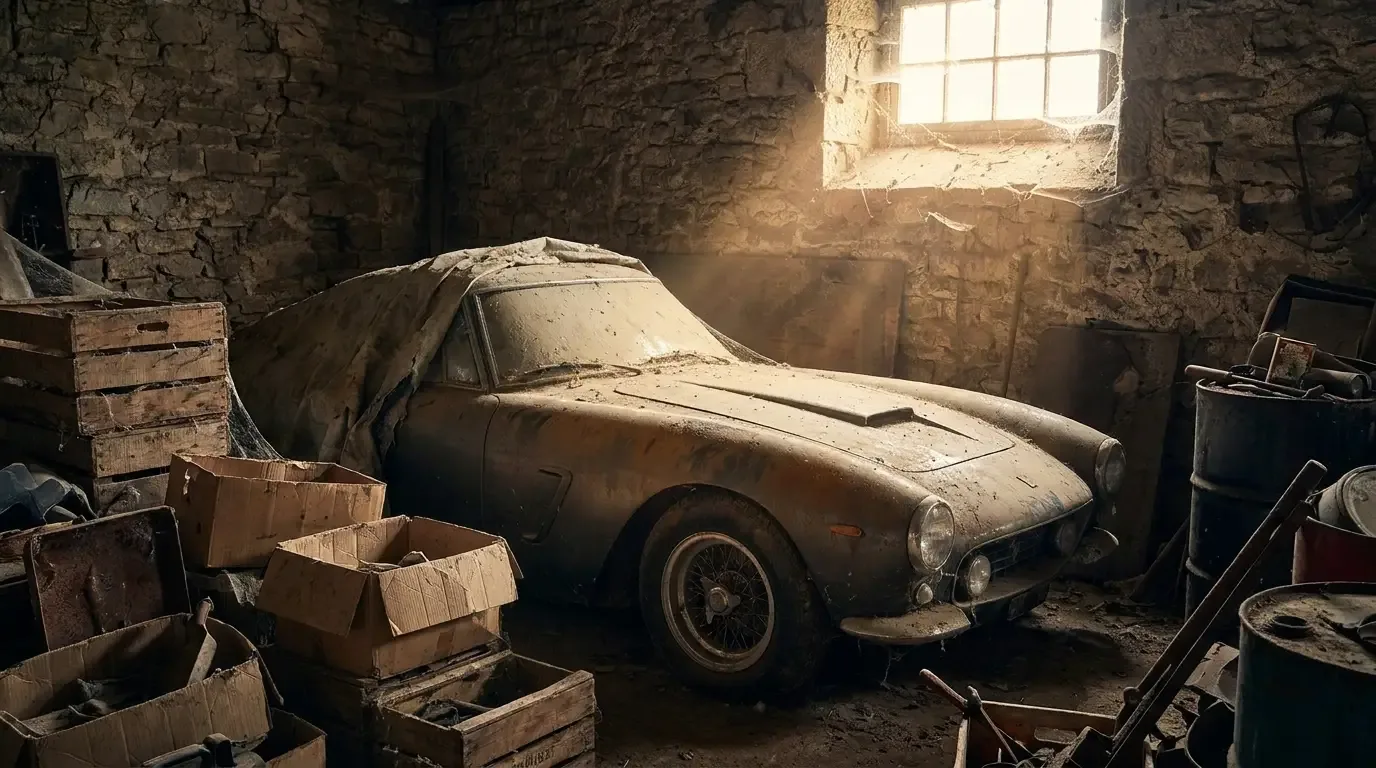
The famous barn finds are the ones that make headlines, but they matter for a bigger reason. They set the emotional temperature for the entire hobby. Every collector who buys a rough project car in a field is chasing a smaller version of what happened in that French barn. It is worth walking through the discoveries that built the legend, and being honest about what actually made each one special, because the truth is more interesting than the myth. If you want the wider argument about why these cars grip us, I have written it up separately in the story of the barn find.
The Baillon collection, the find that reset the ceiling
Roger Baillon was a French transport entrepreneur who spent the 1950s buying up beautiful pre-war and post-war cars. He dreamed of building a museum. The business faltered, the museum never happened, and the cars were left to sit. By the time his heirs called in the specialists from Artcurial, around sixty automobiles had been sitting under lean-to roofs and in outbuildings for close to half a century.
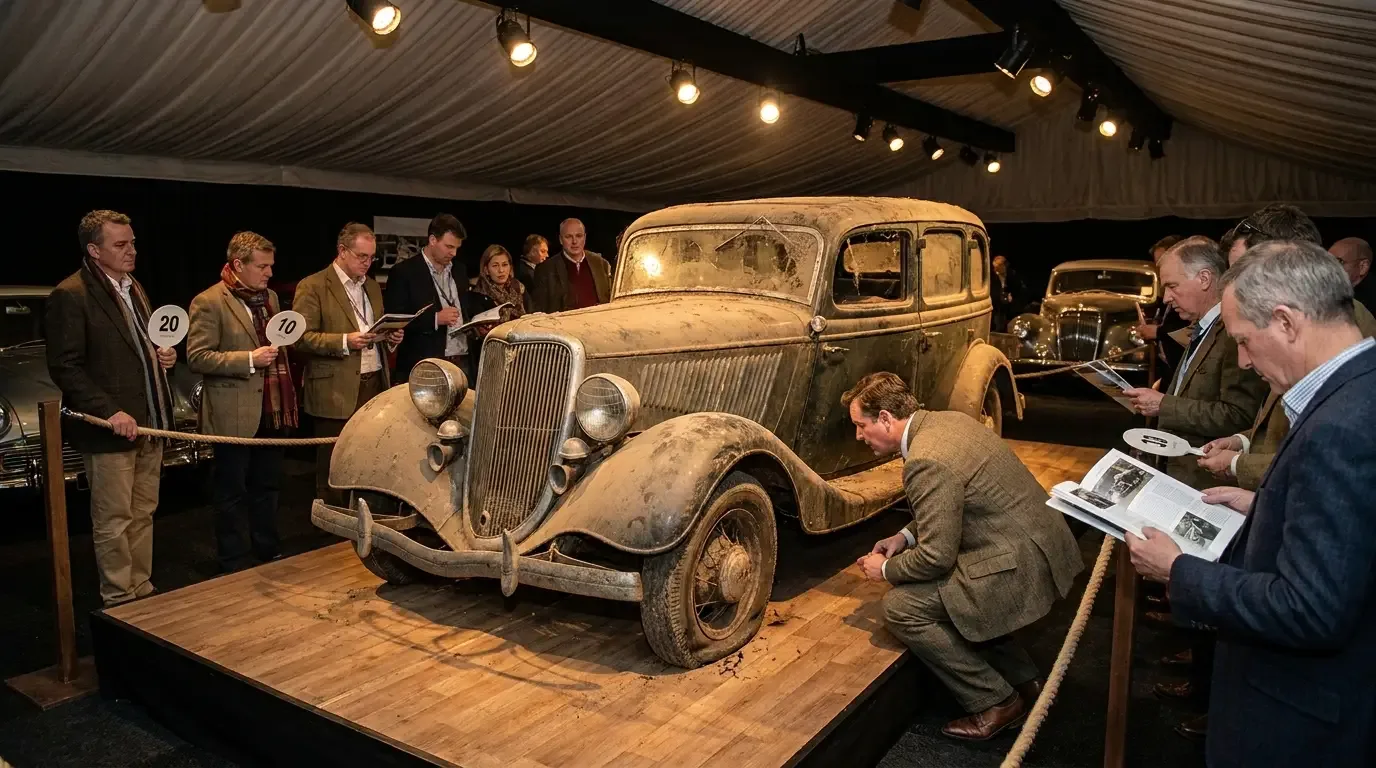
What Artcurial uncovered in 2014 read like a fantasy inventory. Bugatti, Hispano-Suiza, Talbot-Lago, Maserati, Delahaye, Delage, and the Ferrari that stole every headline. The whole collection went under the hammer at the Rétromobile show in February 2015 and brought in around 25.15 million euros across the fifty-nine cars offered. One had been withdrawn because it was in worse shape than first believed, which tells you something about the condition of the rest.
The Baillon sale mattered because it proved a thing the market had only whispered about before. Originality, even filthy and broken originality, could be worth more than a perfect restoration. Bidders were not paying for a car they could drive home. They were paying for a story nobody could ever fake again.
| Barn find | Rediscovered | Sold for | What made it special |
|---|---|---|---|
| Ferrari 250 GT SWB California Spider (Baillon) | 2014 | approx. $18.45M (2015) | Ex-Alain Delon, unrestored, one of the most original survivors |
| Bugatti Type 57S Atalante (57502) | 2008 | approx. $4.4M (2009) | Ex-Earl Howe, one of 17 Atalantes, largely original |
| Bullitt Mustang (1968 GT fastback) | Public 2018 | $3.74M (2020) | The screen hero car Steve McQueen tried and failed to buy back |
| Baillon collection (approx. 60 cars total) | 2014 | approx. €25.15M (2015) | Half a century of dust on Bugatti, Maserati, Talbot-Lago and more |
The Bugatti in the Gosforth garage
A few years before Baillon, England produced its own quiet miracle. In a garage in Gosforth, near Newcastle, sat a 1937 Bugatti Type 57S Atalante. It had belonged to Dr. Harold Carr, a reclusive orthopaedic surgeon, who parked it sometime in the 1960s and simply never drove it again. When Carr died, his family had no idea what was under the dust sheets.
The provenance was extraordinary. The car had first been ordered by Francis Curzon, the 5th Earl Howe, a serious racing man, who took delivery in June 1937. Only 43 Type 57S chassis were ever built, and only around 17 wore the closed Atalante coachwork. This one had sat untouched for roughly 48 years and kept its original engine, chassis, and body. In February 2009 it crossed the Bonhams block in Paris and sold for about 2.99 million pounds, roughly 4.4 million dollars at the time. It came in just under its reserve, but nobody in the room was complaining.
The muscle cars that America forgot in its own driveways
European exotics dominate the record books, but the American story is arguably the more relatable one. Muscle cars were built in the tens of thousands, driven hard, and then abandoned when fuel prices spiked and insurance costs climbed. Cars that felt disposable in 1974 became six-figure grails forty years later, and a lot of them spent the gap sitting in barns, garages, and back fields.
The 1971 Plymouth Hemi Cuda convertible is the cleanest example of scarcity created by neglect. Only seven Hemi Cuda convertibles were built for the 1971 model year, which is a rounding error in production terms. Plenty of the far more common 1971 Cuda convertibles, of which around 292 were made, are still rotting in yards and sheds waiting for someone to care. When a genuine numbers-matching example surfaces from long storage, the price reflects both the rarity and the near-impossibility of proving the story on a car that has been off the radar for decades.
That last point is the trap. A muscle car barn find lives or dies on documentation. VIN, fender tags, build sheet, and broadcast records separate a million-dollar survivor from a hopeful clone. If you are working out whether a rough project is worth chasing, the practical mechanics of that hunt are covered in how to find barn finds.
Bullitt, the barn find that was hiding in plain sight
Not every legend comes out of a literal barn. The original hero Mustang from the 1968 film Bullitt, the dark green GT fastback that Steve McQueen threw around the hills of San Francisco, spent decades parked in a family garage in Tennessee. Robert Kiernan bought it in 1974 and never let it go. When McQueen himself wrote in 1977 asking to buy the car back, Kiernan turned him down. The Mustang was pulled off the road around 1980 when the clutch failed at about 65,000 miles, and there it sat.
The world did not learn the car had survived until 2018. In January 2020 it sold at Mecum's Kissimmee auction for 3.74 million dollars, a record for a Mustang. The Bullitt car is a useful reminder that a barn find is really a storage find. What creates the value is time plus a story you cannot manufacture, not the specific building the car was kept in.
What actually made these cars special
Strip away the auction theatre and the famous finds share a small set of traits. They are worth naming, because they are the same things you should look for in a car that will never make a magazine cover.
- Unrepeatable provenance. An Earl, an actor, a film. A named first owner and a paper trail turn a dusty shell into a document you cannot forge.
- Genuine rarity. Seventeen Atalantes. Seven Hemi convertibles. The numbers were tiny before the cars ever went into storage.
- Untouched originality. Original engine, body, and finishes. Once a car is restored, that specific evidence is gone forever, so survivors carry a premium.
- The story of the sleep. Half a century of dust is itself part of the appeal. Nobody can add that later.
Notice what is not on that list. Condition. Not one of these cars was ready to drive. The Baillon Ferrari needed a full recommissioning to be safe, and it was still the most original survivor of its kind, which is exactly why it commanded the number it did.
"People think the magic is the money. It is not. The magic is that for forty years, in a quiet shed in France, that Ferrari was just an old car nobody wanted. The value was always there. It just needed someone to open the right door."
Nora Beckett
The honest footnote to the legend
Here is the part the headlines leave out. For every Baillon Ferrari, there are ten thousand barns holding a rusted-through sedan with a seized engine and a floor you can see the ground through. The famous finds are famous precisely because they are the rare exception. Most rediscovered cars are rough, incomplete, and worth far less than the owner's dream.
That is not a reason to stop looking. It is a reason to look clearly. The people who found these legendary cars were not lucky so much as prepared, willing to chase a rumour, read a build sheet, and recognise a shape under a tarp. If that hunt appeals to you, you can start with the project barn finds for sale and learn to read a rough car for what it really is, not what you hope it might be. The legend is real. It is just a lot rarer than the internet makes it look.
Sources and notes
- Period and contemporary auction press covering the 2015 Artcurial Rétromobile sale of the Baillon collection.
- Auction house records for the 2009 Bonhams sale of Bugatti Type 57S chassis 57502.
- Auction records and marque reporting for the 2020 Mecum sale of the original Bullitt Mustang.
- Marque registries and production references for Ferrari 250 GT California Spider, Bugatti Type 57S Atalante, and 1971 Plymouth Hemi Cuda convertible production figures.
Related Reading
Have a
Classic Car
for Sale?
Reach thousands of serious classic car collectors across the US.
Sell It Here →
Are You a Classic Car Dealer?
List your full inventory and connect with targeted classic car buyers.
Join as a Dealer →
#Barn Finds
#Bullitt Mustang
#Baillon collection
#Bugatti Type 57S
#Ferrari California Spider
#classic car auctions

About the author
Nora Beckett
Automotive features writer and photographer who tells the human stories behind the cars, from show fields to cross-country road trips.
More in History & Heritage
Comments
Be the first to comment on this article.