
Roger Baillon spent decades collecting cars, then let them rot. When his grandson called in the appraisers in 2014, they walked a farm in western France and found roughly sixty machines sitting under corrugated roofs and old magazines, tires flat, mice in the seats. One of them was a Ferrari 250 GT California Spider that had once belonged to the actor Alain Delon. Nobody had touched it in fifty years. That is the shape of a real discovery: not a polished treasure waiting to be claimed, but a moment when someone opens a door they assumed was empty and the past is just sitting there, breathing dust.
History & Heritage
6 min read
Legendary Barn Find Discoveries
The most famous barn find cars are not about the metal. They are about the moment someone opens a door and the past is just sitting there.
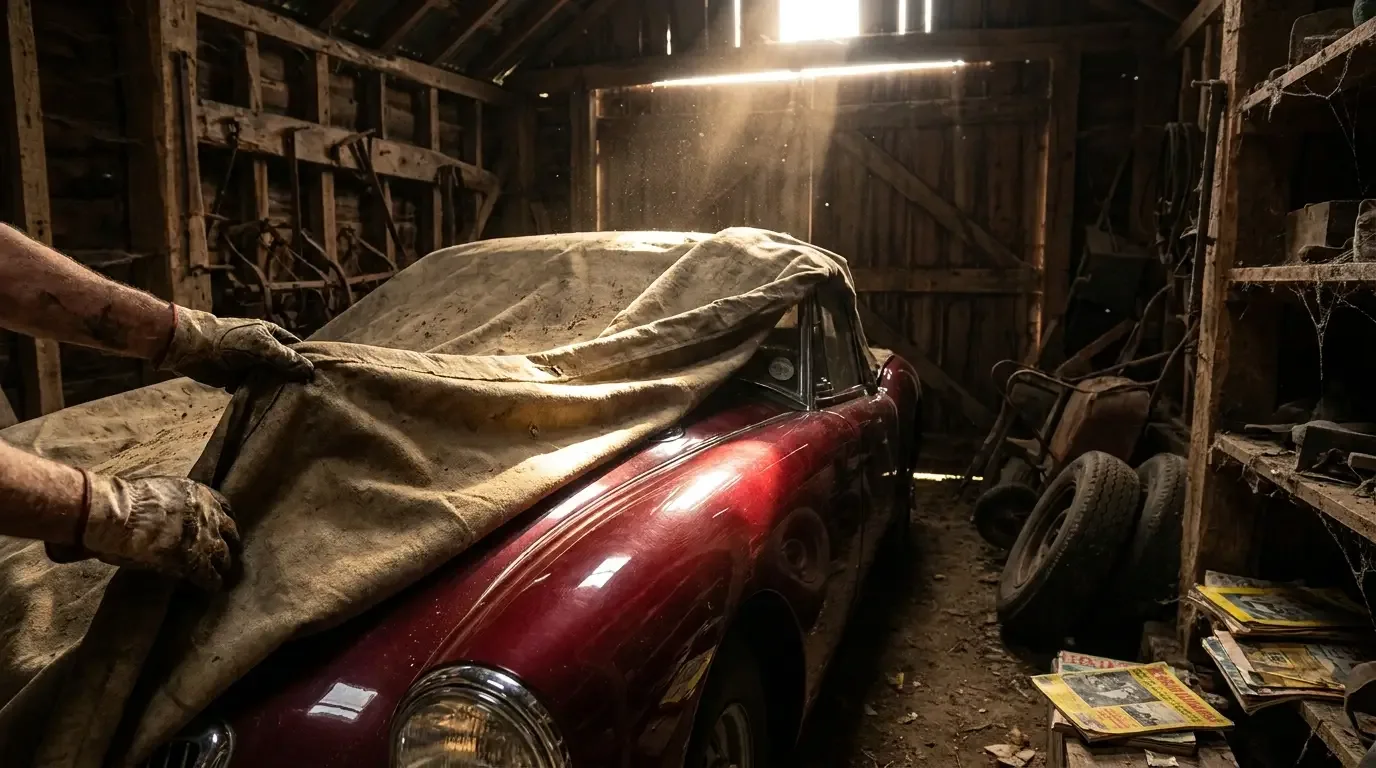
The best stories in this hobby are not about the cars. They are about the people who lost them and the people who found them. If you want the broader sweep of famous barn finds, that history piece covers the pattern. Here I want to stand inside a few individual discoveries and tell you what actually happened in the barn.
The Baillon collection and the Ferrari nobody expected
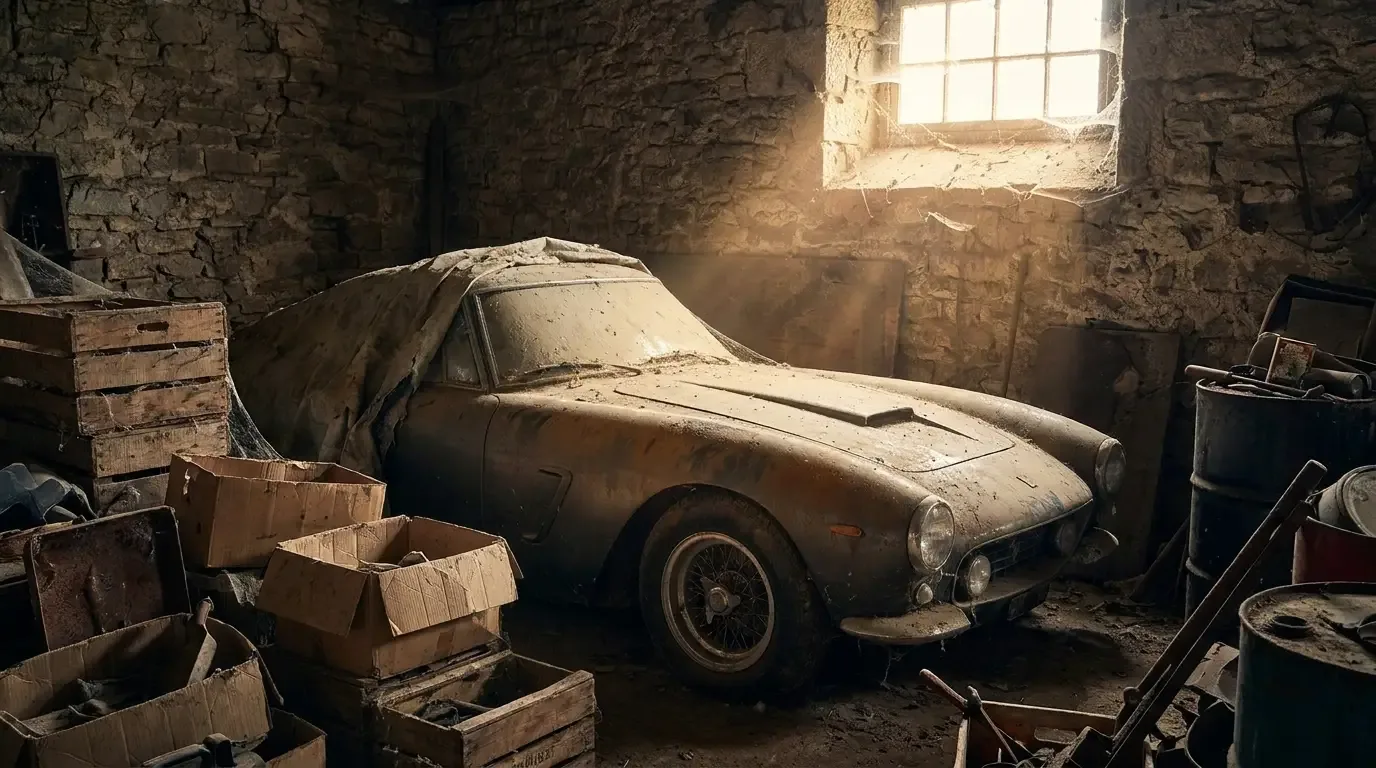
Roger Baillon was a French transport entrepreneur who dreamed of building a museum. He bought grandly in the 1950s and 1960s, then hit hard times and sold off many cars in the 1970s. What stayed behind was forgotten until his heirs asked the auction house Artcurial to take a look in 2014. The team expected a handful of tired classics. They found around sixty, including a Maserati A6G, a Talbot-Lago, and the Delon California Spider hidden under a stack of old papers in an open lean-to.
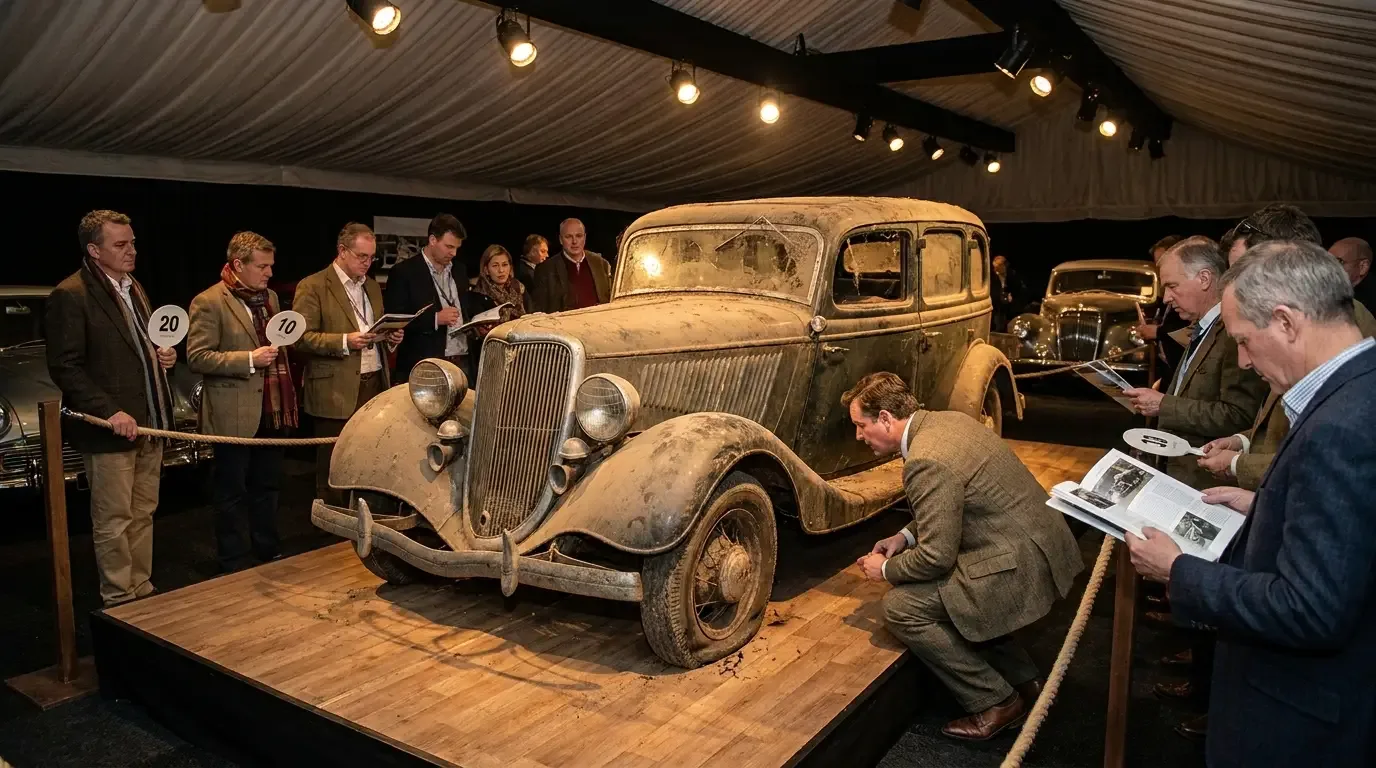
The collection went to auction in Paris in February 2015. The whole sale brought in roughly 25 million euros, and the California Spider alone sold for around 16.3 million euros. What made it electric was not the number. It was that buyers were bidding on cars with peeling paint and bird droppings still on them, refusing to let anyone clean them first. The dirt had become part of the value. That reversal, where decay is proof rather than flaw, is what separates a legendary discovery from an ordinary sale.
The Bugatti that spent seventy years underwater
In 2009 divers in Lake Maggiore, on the border of Switzerland and Italy, brought up a Bugatti Type 22 Brescia that had been on the lake bed since the 1930s. The car had reportedly been dumped to avoid an import tax dispute, and it stayed there, corroding in the cold water, for around seventy years. A local diving club had known about it for decades and visited it like a shrine. When a young member died, the club raised the car in his memory and sold it at auction.
What came up was barely a car anymore. The aluminum body had partly dissolved, the frame was a skeleton, the whole thing looked like a relic pulled from a shipwreck, which in a sense it was. It sold at a Bonhams sale for roughly 260,000 euros, bought by a museum that chose to preserve it exactly as recovered rather than rebuild it. That decision matters. A discovery this raw asks a hard question, and the honest answer here was to leave it alone.
"I have stood in a lot of dim barns, and the thing that gets me every time is not the metal. It is imagining the person who parked the car, meant to come back next spring, and never did. The car keeps the appointment they missed."
Patrick Walsh
When the find is a fortune and when it is just work
For every Baillon estate there are a hundred discoveries that make the local paper and nothing more. A retired mechanic's garage. A field of half-sunk pickups. A single coupe under a tarp behind a demolished house. Most of these are rough, incomplete, and worth far less than the owner hopes once you add up the cost of putting them right. The romance of the barn find sells the fantasy of easy money. The reality, more often, is a long invoice.
That does not mean the small finds do not matter. Some of them carry the same emotional charge as the famous ones, just without the zeros. The value can be historical, personal, or purely mechanical, and the auction results tell only part of the story. If you want to see how the market actually prices these discoveries, our piece on Barn Finds at Auction lays out the numbers behind the headlines. And if you want to understand why the myth is so durable in the first place, the story of the barn find gets at the culture underneath it.
| Discovery | Location | Rediscovered | What made it legendary |
|---|---|---|---|
| Baillon collection | Western France | 2014 | ~60 cars, incl. Delon's Ferrari 250 GT California |
| Bugatti Type 22 Brescia | Lake Maggiore | 2009 | ~70 years underwater, preserved as recovered |
| Typical local find | Anywhere | Ongoing | Rough, incomplete, more work than fortune |
How to read a discovery before you fall for it
When a find lands in front of you, the excitement is the enemy. The stories above are exceptional precisely because most are not. Before you let the fantasy take over, slow down and look at what is actually there. A discovery is a puzzle of provenance, condition, and honest cost, and the ones that end badly are almost always the ones where the buyer skipped the boring part.
Why these stories keep pulling us back
Legendary discoveries endure because they collapse time. A car parked in 1965 comes back into the light in 2014 unchanged, and for a moment the decades between are gone. That is a rare feeling in a world where almost everything gets used up and thrown away. The Baillon Ferrari and the Lake Maggiore Bugatti are famous for their money, but what actually moves people is simpler than that. Someone loved a machine, lost track of it, and years later a stranger opened a door and gave it back to history. As long as there are old barns and forgotten garages, there will be one more door, and someone standing in front of it with their heart going fast.
Sources and notes
- Auction house catalogues and post-sale records for the collections discussed.
- Period and contemporary motoring press coverage of the individual discoveries.
- Marque histories and registry material for the Ferrari and Bugatti models referenced.
- Museum and collector statements on preservation-versus-restoration decisions.
Related Reading
Have a
Classic Car
for Sale?
Reach thousands of serious classic car collectors across the US.
Sell It Here →
Are You a Classic Car Dealer?
List your full inventory and connect with targeted classic car buyers.
Join as a Dealer →
#Barn Finds
#automotive history
#Ferrari California Spider
#famous barn find cars
#classic car discoveries
#car collecting

About the author
Patrick Walsh
Automotive journalist covering classic car shows, events, and the enthusiast community across North America.
More in History & Heritage
Comments
Be the first to comment on this article.