
On a June night in 1962 at Pomona, K.S. Pittman put his '41 Willys through the traps in 10.55 seconds and, for a short while, owned the A/GS record. That number sounds slow by any modern measure. In the context of a stripped, nose-high coupe with a solid front axle bolted under it, running on pump gas by the letter of the rulebook, it was a shot across the bow. The men who built and drove these cars were not chasing a trophy so much as chasing each other, and the cars they left behind became the shape most people picture when they hear the word gasser. This is a look at a handful of those cars and the names stamped on the doors.
History & Heritage
6 min read
Famous Gassers and Their Builders
Stone, Woods and Cook, Big John Mazmanian, Ohio George Montgomery and the Willys coupes that made the gasser look famous.
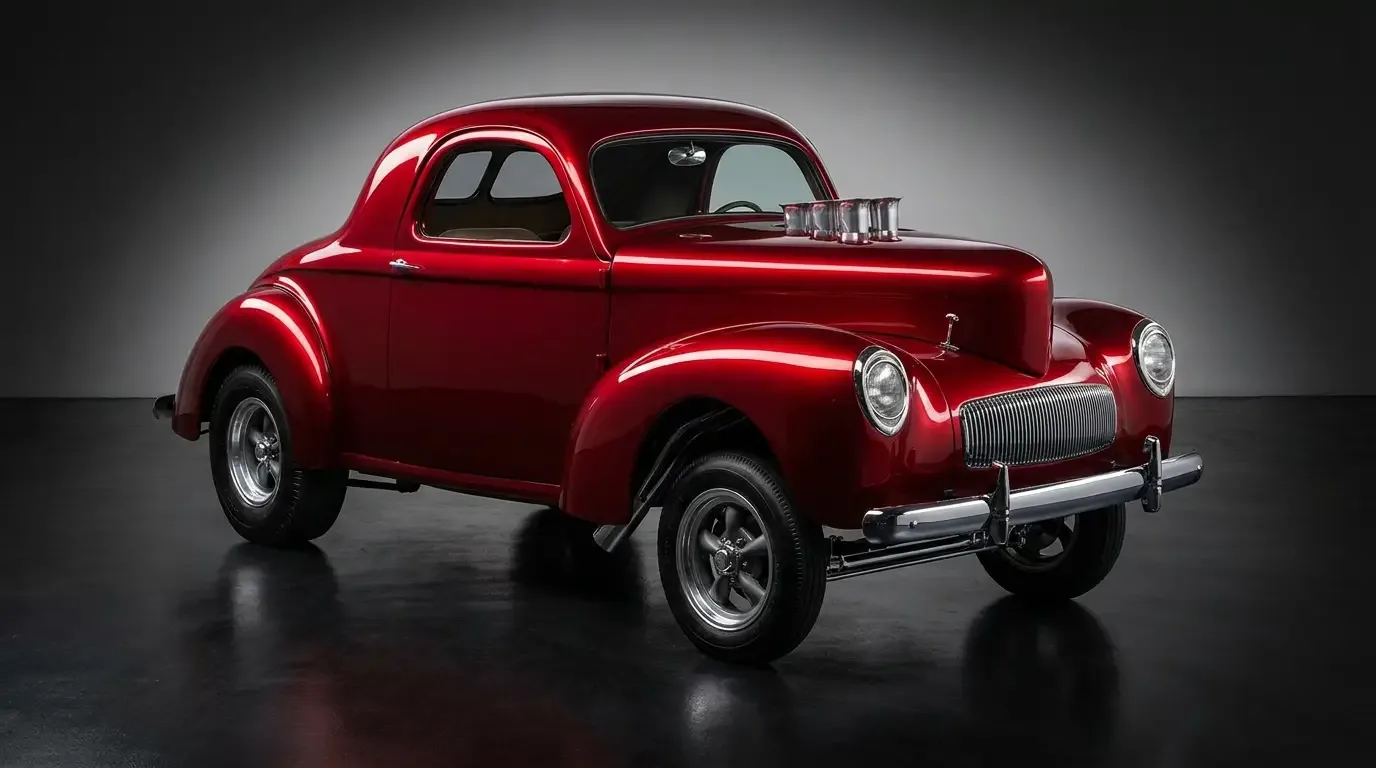
Stone, Woods and Cook: the car that won the popularity vote
If you ask a room full of drag fans to name one gasser, most of them land on the same '41 Willys. The Stone, Woods and Cook team was Fred Stone, Leonard and Tim Woods, and driver Doug "Cookie" Cook, and their car ran under the Swindler name through the 1960s. There were actually several cars. Swindler A wore gold lettering, Swindler B wore white, and the team kept feeding new iterations into the AA/Gas Supercharged wars as the class got faster.
What made the car matter was not one quarter-mile pass but a rivalry, the constant back-and-forth with Big John Mazmanian that pulled crowds to strips up and down the country. That period, the running feud between a few supercharged Willys coupes in the early-to-mid '60s, is the heart of the story I tell in more detail under gasser drag racing. The Swindlers were among the first gassers into the 10s, then the 9s, and past the 150-mph mark. In a 2008 NHRA online fan poll, the Stone, Woods and Cook Willys was voted the favorite race car of all time. Not the fastest car ever built. The favorite. That distinction says a lot about why the gasser look never really died.
Big John Mazmanian and the rival across the lane
A rivalry needs two sides. Big John Mazmanian, an Armenian-American businessman out of the Los Angeles area, ran a candy-apple-red '41 Willys with Robert "Bones" Balogh driving, and for a stretch in the early '60s that car was the one Stone, Woods and Cook had to beat. The matchups were tight. At the 1964 Winternationals, Balogh lost a close one to Cookie on a holeshot, the kind of race decided at the starting line rather than the far end.
What I always come back to with Mazmanian is that the man himself became part of the draw. Promoters billed the Willys wars around the personalities as much as the elapsed times. That is a period detail worth holding onto. These were amateur-class cars by the technical definition, gas classes rather than the fuel ranks, yet they filled grandstands because the people behind them had faces and reputations and something to prove against the guy in the other lane.
"You can read the timing slips all day and miss the point. What packed those bleachers was two men who could not stand to lose to each other, running the same car, week after week. The stopwatch just kept score."
Patrick Walsh
Ohio George: the builder who kept reinventing the car
George Montgomery earned the nickname "Ohio George" and, from the East Coast, earned a harder one too: King of the Gassers. He won eight NHRA national titles between 1959 and 1968, most of them behind a supercharged Chevy-powered '33 Willys. That alone would put him in this piece. What keeps him interesting is that he did not stand still.
By the mid-'60s Montgomery had a Ford relationship, and he put a screaming 427 single-overhead-cam engine into the Willys. Then he went further. In 1967 he built a '67 Mustang body on a Willys chassis, called it the Malco Gasser, and ran it into the 9-second range. He took Super Eliminator honors at the Spring Nationals with it and won again at the Nationals in 1969. The '67 Mustang Malco Gasser now sits in the Petersen Museum. Montgomery is the bridge between the pure straight-axle gasser and what came next, the point where the class began mutating toward the wilder machines I cover in Altered-Wheelbase Cars and the Funny Car Link.
| Car and team | Body | Signature power | Claim to fame |
|---|---|---|---|
| Stone, Woods and Cook "Swindler" | 1941 Willys | Supercharged Chrysler, gas | Voted NHRA fans' favorite race car (2008 poll) |
| Big John Mazmanian | 1941 Willys | Supercharged, gas | Chief rival in the early-'60s Willys wars |
| "Ohio George" Montgomery | 1933 Willys, later '67 Mustang | Blown Chevy, later Ford SOHC 427 | 8 NHRA national titles, 1959-1968 |
| K.S. Pittman | 1933 and 1941 Willys | A/GS spec | Held the A/GS record briefly in 1962 |
Why Willys, Anglias and tri-fives, and what the shapes tell you
The gasser silhouette was not a style decision. It fell out of the rulebook. The gas classes used weight breaks tied to engine size, so builders wanted the lightest, shortest body they could legally hang a big engine in. The 1933 and 1941 Willys coupes were small, cheap and plentiful, which is why they show up on so many door panels above. The tiny British Ford Anglia served the same purpose for the small-block crowd, a featherweight shell that let a modest engine punch above its class. And the tri-five Chevrolet, the 1955 to 1957 cars, gave a builder a slightly larger, more familiar body that still took a solid axle and a nose-high stance without argument.
That stance itself, the front end jacked up on a straight axle, was mostly about weight transfer and ground clearance for the engine and headers, and it hardened into the visual signature of the whole era. When you see a modern tribute car sitting that way, you are looking at a rules artifact from sixty-odd years ago that outlived the rules.
Sources and notes
- Period drag-racing press and event coverage from the NHRA gas-class era.
- NHRA historical records and museum documentation, including the Petersen Museum's Malco Gasser exhibit.
- Marque and builder profiles covering Stone, Woods and Cook, Mazmanian, Montgomery and Pittman.
- Drag racing hall-of-fame biographies and club/registry accounts of the 1960s gasser wars.
Related Reading
Have a
Classic Car
for Sale?
Reach thousands of serious classic car collectors across the US.
Sell It Here →
Are You a Classic Car Dealer?
List your full inventory and connect with targeted classic car buyers.
Join as a Dealer →
#drag racing history
#straight axle
#willys gasser
#gassers
#ohio george montgomery
#stone woods cook

About the author
Patrick Walsh
Automotive journalist covering classic car shows, events, and the enthusiast community across North America.
More in History & Heritage
Comments (1)
T
Tony Marchetti
2 months ago
Any suggestions on marque clubs for this car? Trying to find someone who really knows this platform in my region.