
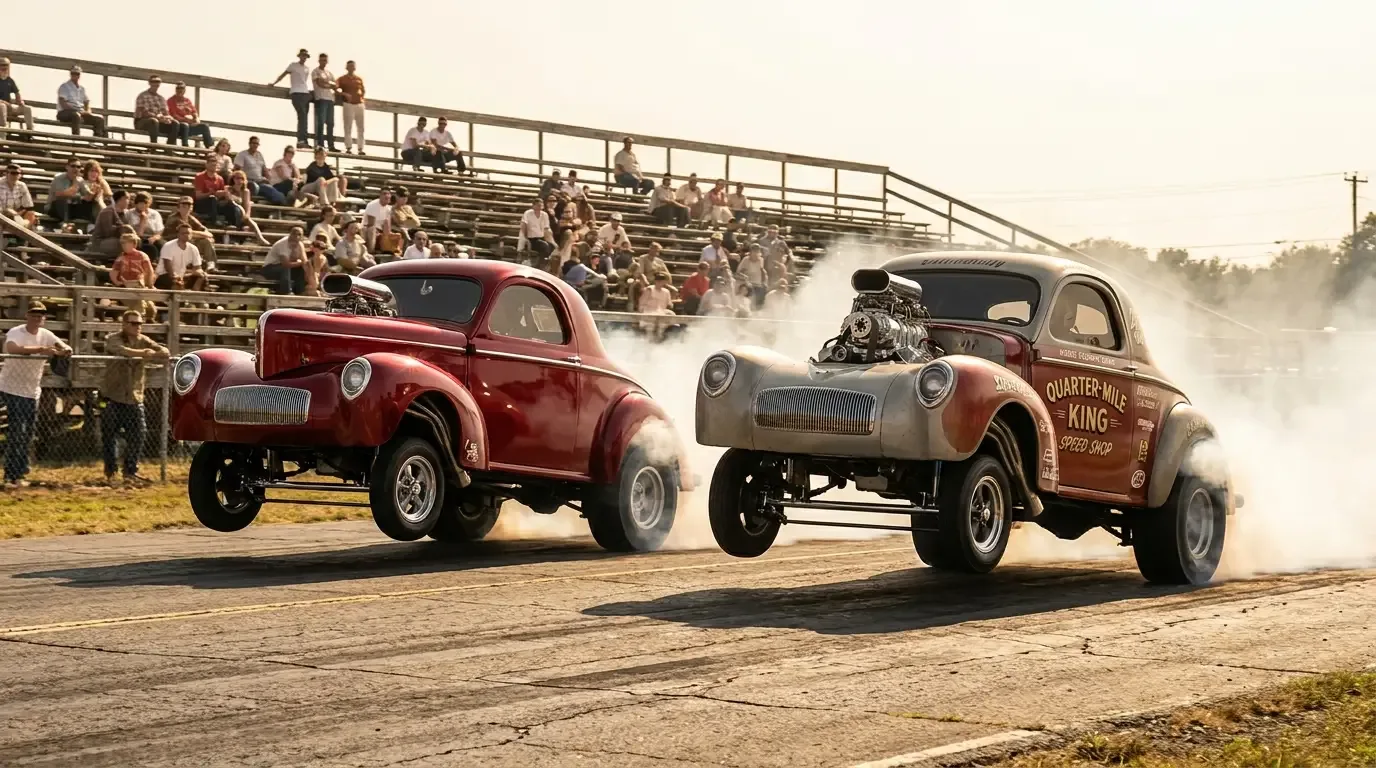
On a Sunday morning in the late 1950s, a stripped-down Willys coupe sat at the head of a quarter-mile strip somewhere in Southern California, its front end jacked toward the sky and its blower whining like a trapped hornet. The starter waved a flag, the driver dumped the clutch, and the front tires clawed for grip while the whole car lunged forward on its haunches. That image, front high, rear squatting, tires smoking, is the story of gasser drag racing in a single frame. It came out of a rulebook, and it turned into one of the loudest chapters in American motorsport.
History & Heritage
10 min read
Gasser Drag Racing History
From the NHRA gas classes to the Gasser Wars and the decline: the racing history that turned a nose-high coupe into an American icon.
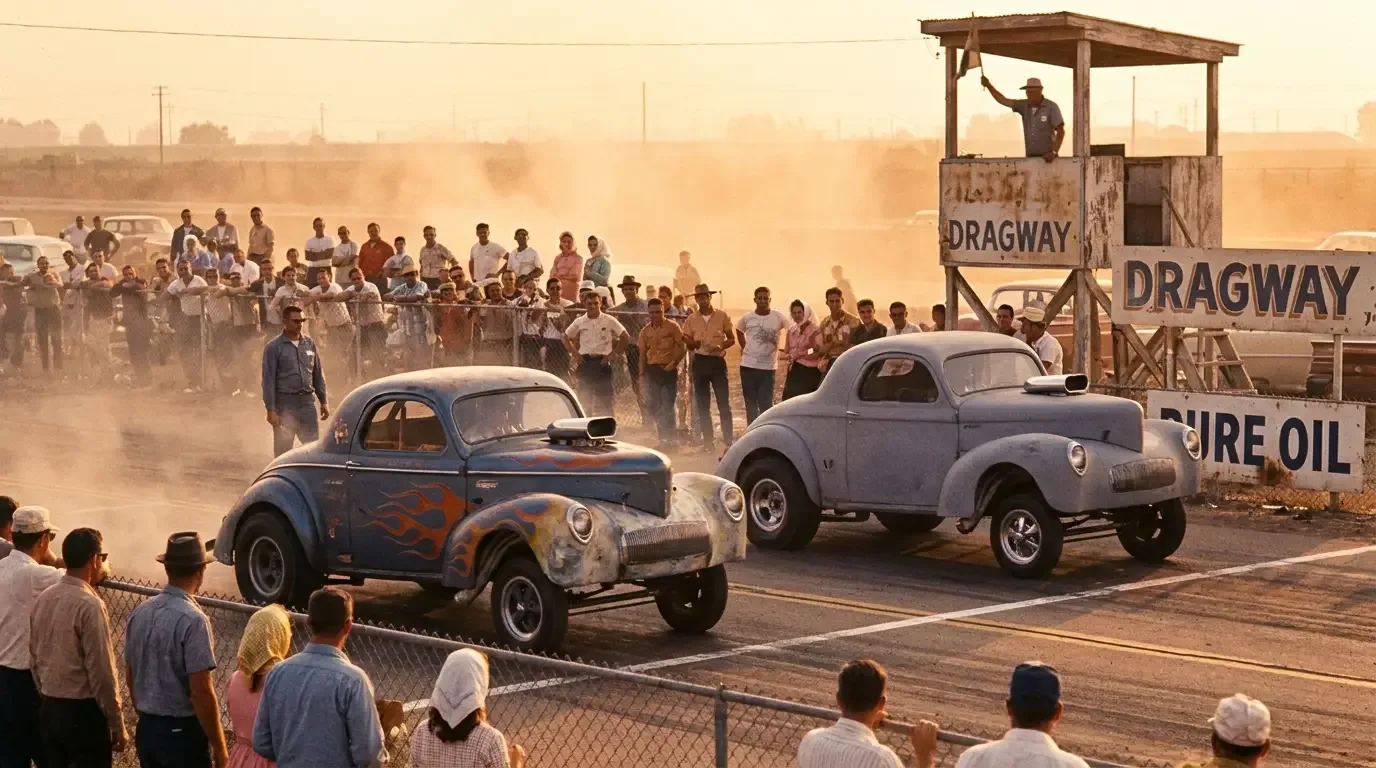
The people who lived it did not set out to invent a style. They set out to win a class. To understand how a nose-high coupe became an icon, you have to start with the sanctioning bodies, the gas classes they wrote, and the men who read those rules closer than anyone else. If you want the shorthand version of the machine itself, our companion piece explains what a gasser really is; here I want to trace how the racing made it.
The gas classes and where the name came from
The name is literal. A gasser ran on pump gasoline, not the nitromethane or alcohol brews that the wilder classes burned. The National Hot Rod Association, founded in 1951 by Wally Parks, needed a way to sort a growing flood of home-built cars into fair fights. The answer was a class structure keyed to a weight-to-cubic-inch ratio. Lighter body plus bigger engine put you in a faster class; the rules did the matchmaking so that a Chevy coupe was not lined up against a purpose-built dragster.
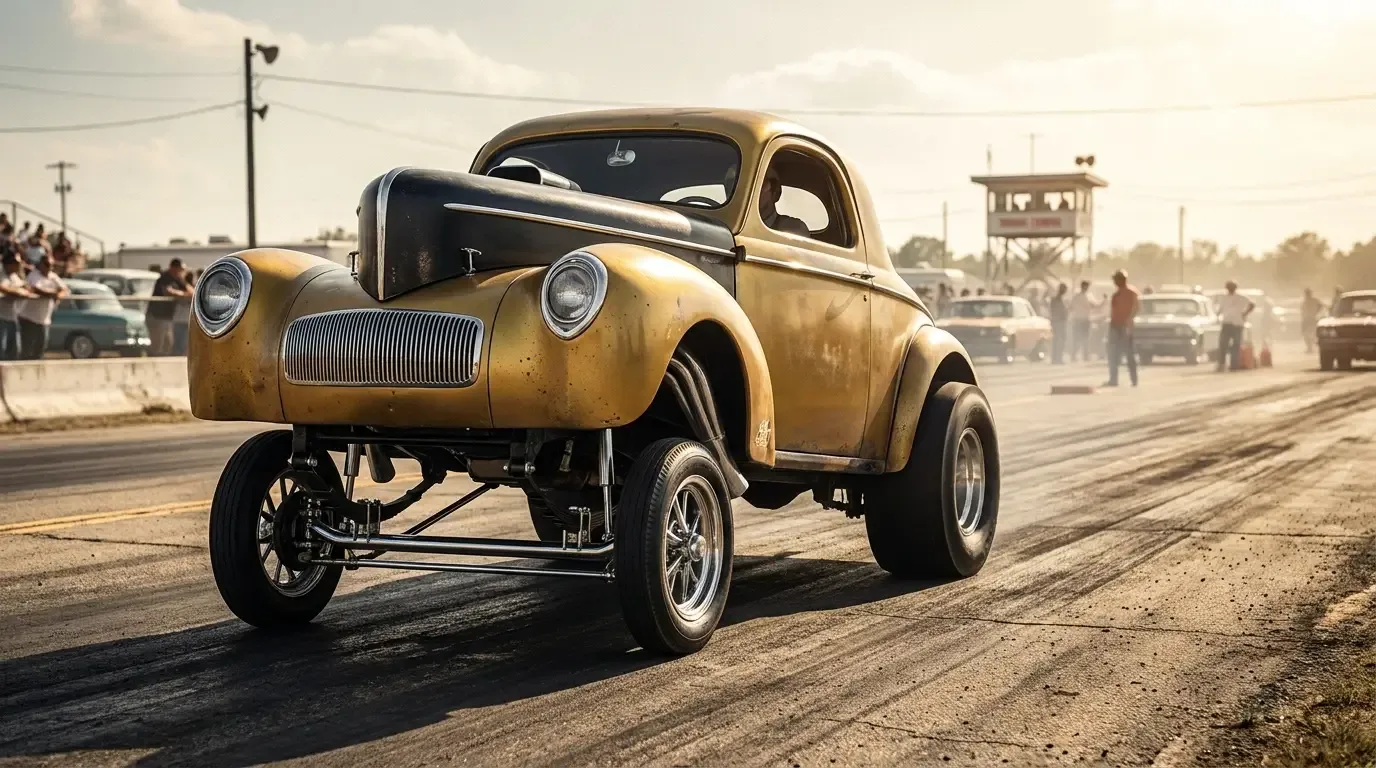
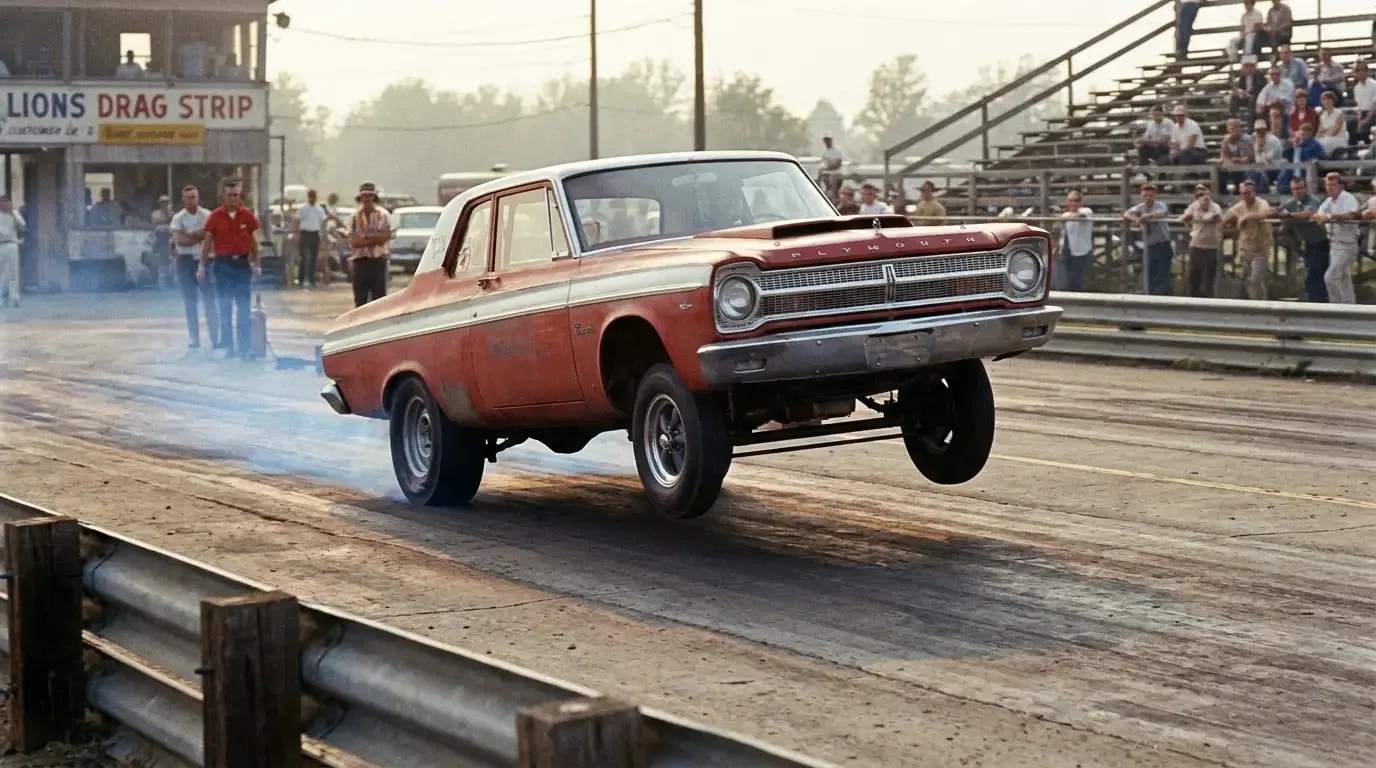
The gas coupe and sedan classes, labeled with letters such as A/Gas, B/Gas and C/Gas, rewarded exactly the kind of thinking that produced the look. You wanted the lightest legal body and the biggest legal engine for your class. You stripped interior, glass and bumpers to shed pounds. You moved weight rearward for traction. The tall front stance was not decoration at first; a straight front axle sat higher and gave room for the engine to move back, and the nose-up attitude helped plant the rear tires on launch. The rules asked for a fast, light gas car, and the gasser is the shape that answer took.
The American Hot Rod Association, formed later in the 1950s, ran parallel gas classes with its own rulebook. Racers often campaigned both circuits, and the two sanctioning bodies pushed each other. When one loosened a rule on engine setback or supercharging, cars evolved to exploit it, and the other tended to follow. The exact AHRA class letters varied by season and region.
What makes this history unusual is that the rules were the design brief. Most racing styles grow out of taste and then get regulated. The gasser worked the other way around. A racer read the weight-to-cubic-inch table, worked backward to the lightest legal shell and the biggest legal engine, then built whatever stance and setback gave the best launch inside the letter of the class. The look was an answer, and once enough builders arrived at the same answer, the answer became the style. That is why two coupes built a thousand miles apart, by men who never met, ended up looking like cousins.
| Element | What the rules produced |
|---|---|
| Sanctioning bodies | NHRA (1951) and AHRA (later 1950s), each with gas coupe/sedan classes |
| Class basis | Weight-to-cubic-inch ratio, split into A/Gas, B/Gas, C/Gas and so on |
| Fuel | Pump gasoline, which is where the name comes from |
| Front suspension | Straight (solid) front axle, giving the tall nose-high stance |
| Popular bodies | Willys coupes, Austin/Ford Anglia, 1955-57 Chevrolet |
| Peak era | Roughly late 1950s through the mid-to-late 1960s |
The Gasser Wars
By the early 1960s the gas classes had become a spectacle in their own right, and the fiercest fighting happened in the supercharged A/Gas ranks. Fans and the drag press started calling the rivalry the Gasser Wars, and the name stuck because it fit. These were not polite exhibitions. They were grudge matches run week after week at strips across the country, with match races booked specifically because the crowd wanted to see two famous coupes settle it.
The Willys became the weapon of choice for the top runners. It was light, its shape suited a blown big-block, and by the time the Wars peaked a good A/Gas Willys could run genuinely quick numbers for a full-bodied car. Promoters learned that a booked grudge match between two name cars drew a bigger gate than a bracket of unknowns, so the stars toured, racing the same rivals in different towns and building the kind of following that had belonged to the fuel dragsters.
The match-race format is worth pausing on, because it shaped the era as much as the cars did. A promoter would book two named coupes against each other for a set number of runs, advertise it in the local paper, and let the rivalry sell tickets. That structure rewarded showmanship as much as elapsed time. A driver who could smoke the tires down the strip and put on a show got booked again, win or lose. It also meant the cars had to be reliable enough to run several passes in an afternoon, so the top teams learned to build for a season of grudge matches rather than a single record run. The competition and the theater of that period are worth their own account, which we cover in The Gasser Wars.
The cars and the men who drove them
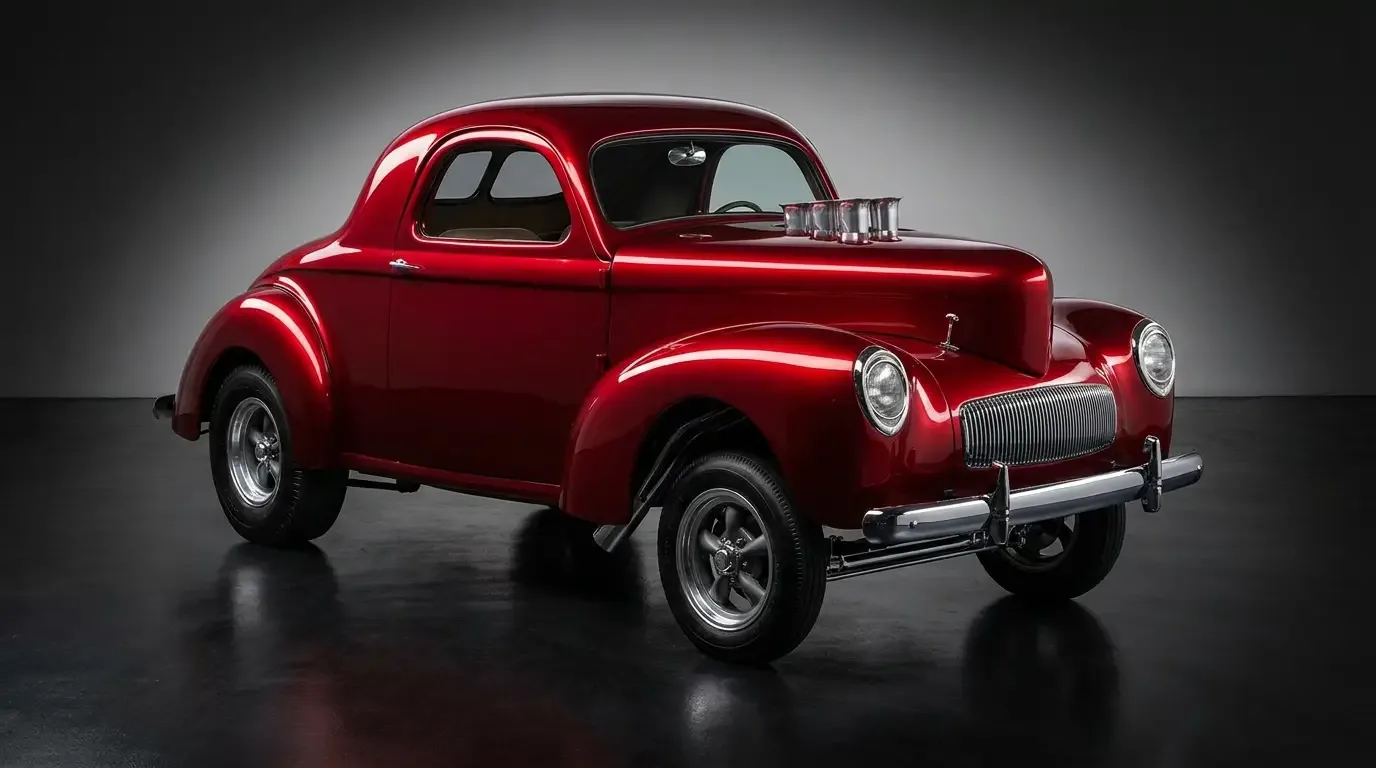
A racing era lives through its characters, and the gas classes had plenty. Two Willys coupes came to define the supercharged fight more than any others: the Stone, Woods and Cook entry out of Northern California, and "Big John" Mazmanian's immaculately finished candy-red Willys from Southern California. Their meetings were the marquee matchups of the Gasser Wars, and the contrast in personalities and cars gave the rivalry its story.
K.S. Pittman was another Willys man whose name ran near the top of the A/Gas results through the era. Junior Thompson campaigned a well-known coupe as well. Away from the Willys crowd, "Ohio George" Montgomery built a reputation with a series of cars, most famously a 1933 Willys and later a Ford-bodied machine, and he was among the racers who kept innovating on power and aerodynamics as the class matured. Specific car years, sponsors and win records for each of these racers vary across sources, so individual claims are best treated as approximate.
- Stone, Woods and Cook. A Northern California Willys team whose blown coupe was one of the defining A/Gas cars.
- "Big John" Mazmanian. His candy-red Willys was the glamour car of the Southern California gas ranks.
- K.S. Pittman. A consistent front-runner in the supercharged Willys wars.
- "Ohio George" Montgomery. A Willys and later Ford racer known for pushing power and bodywork forward.
"I have stood at enough old strips to know the sound before I understood the rules. You heard a blown gas coupe from two counties over, and by the time it cleared the lights you understood exactly why grown men skipped church to be there."
Patrick Walsh
How the racing changed the machines
Competition never sits still, and the gas classes evolved fast once the money and the crowds arrived. Builders chased weight bias, so engines crept rearward in the chassis. They chased traction, so rear tires grew and front tires shrank to skinny bias-plies. They chased power, so the top A/Gas cars ran superchargers and fuel injection where the rules allowed. Each change made the cars quicker and, not by accident, made them look wilder.
The most consequential move was setting the engine and axle back to shift weight onto the rear wheels. Some racers pushed that idea further than the gas rules intended, relocating axles to change the wheelbase for even more bite. That path led out of the gas classes entirely and toward the altered-wheelbase cars, the machines that became the direct ancestors of the Funny Car. We follow that thread in Altered-Wheelbase Cars and the Funny Car Link. The lesson of the era is simple: the same instinct that built the gasser eventually built its successor.
The decline of the class
Nothing in drag racing stays king for long, and the gasser's reign faded through the second half of the 1960s. Several forces pushed at once. Purpose-built machinery kept getting faster, and a full-bodied coupe on a straight axle could not keep pace with cars designed from the ground up for the quarter mile. The altered-wheelbase movement drew away the innovators and the crowds, and it soon produced the flip-body Funny Car, which offered more show and more speed. The factory Super Stock and early Pro Stock movements gave manufacturers a newer battleground with modern bodies.
By the end of the decade the gas classes were no longer the headline. The straight-axle look that had been a competitive necessity started to read as old-fashioned on a starting line full of newer machinery. The cars did not vanish, but the era of the booked A/Gas grudge match as a main event had run its course. What died was the racing dominance, not the appeal of the shape.
Why the style outlived the racing
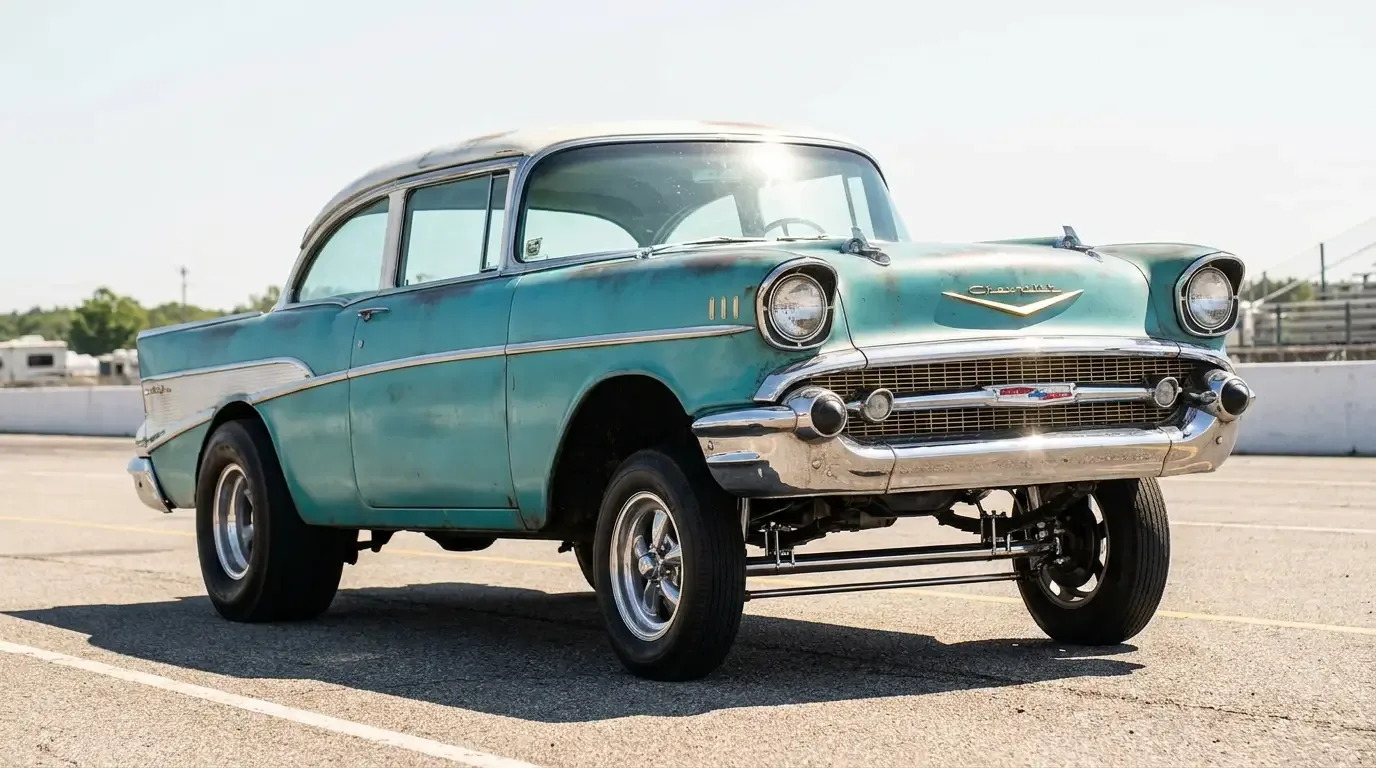
Here is the part that surprises people. The gasser lost its competitive edge, yet the look never really went away, and by the 1990s it was back with a vengeance as a build style. Enthusiasts who never saw a period A/Gas match race started raising the nose, bolting in straight axles and stuffing big engines into Willys, Anglias and tri-five Chevys, chasing the exact stance the old rulebook had forced on the racers. The style outlived the racing because it carried the memory of it, and every nose-high coupe on the street is a small tribute to those Sunday grudge matches.
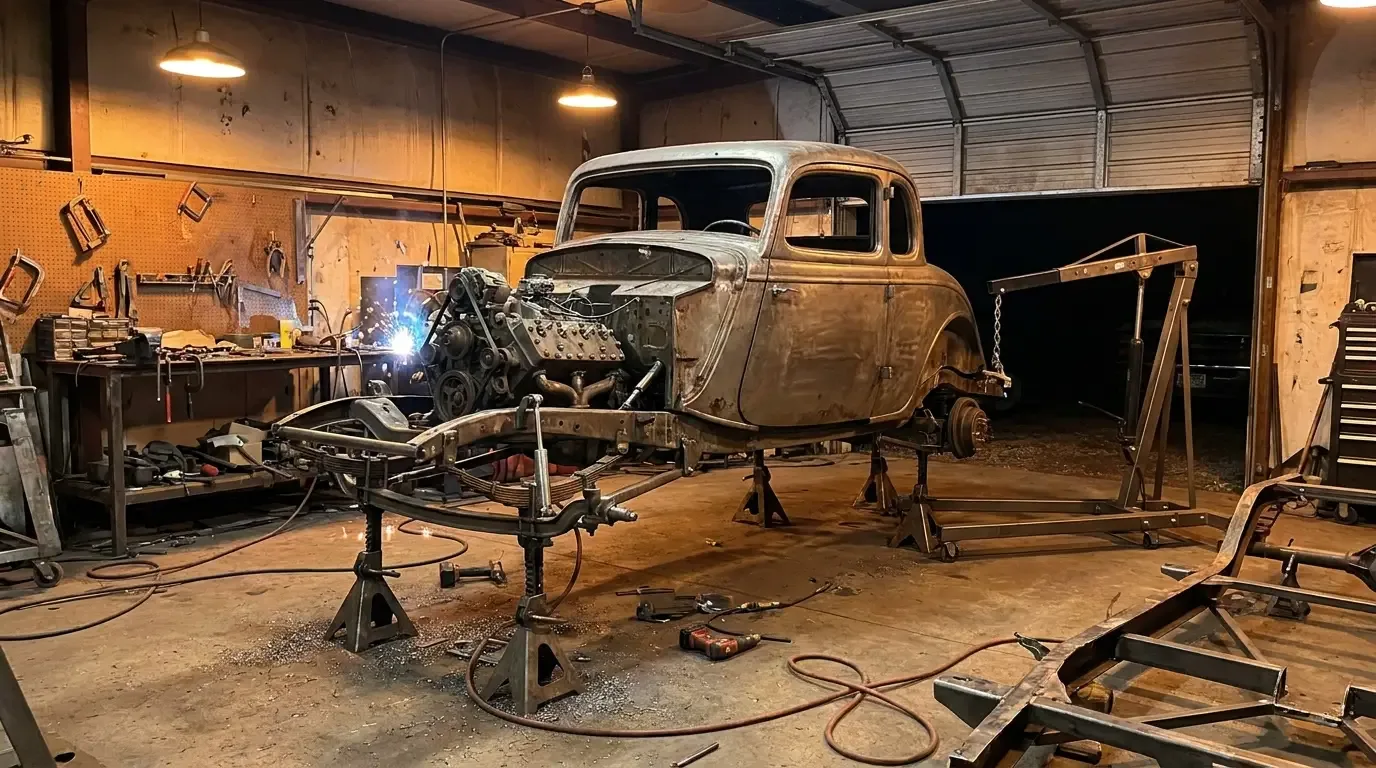
That revival is why the cars still trade hands today and why a well-sorted period-correct build draws a crowd at any show. Readers who want to try their hand at one can start with our guide to how to build a gasser, and anyone shopping for a finished car or a project can browse current gassers for sale. The racing made the legend; the builders keep it running.
Sources and notes
- Period drag-racing press and event coverage from the late 1950s and 1960s.
- NHRA and AHRA historical class and rules references.
- Builder and racer interviews and retrospective profiles.
- Drag-racing history books and club/registry records covering the gas classes.
- Where individual dates, records or sponsor details differ between sources, figures are given as approximate.
Related Reading
Have a
Classic Car
for Sale?
Reach thousands of serious classic car collectors across the US.
Sell It Here →
Are You a Classic Car Dealer?
List your full inventory and connect with targeted classic car buyers.
Join as a Dealer →

About the author
Patrick Walsh
Automotive journalist covering classic car shows, events, and the enthusiast community across North America.
More in History & Heritage
Comments
Be the first to comment on this article.