
On a warm Sunday in the mid-1960s, thousands of people paid to sit in wooden grandstands and watch two Willys coupes stand almost nose-to-tail at the starting line, front wheels barely kissing the asphalt, engines popping and snorting on a rich load of nitro. When the lights dropped, both cars pitched their noses skyward and lunged down the strip in a cloud of tire smoke and noise you could feel in your chest. That was a heat in the Gasser Wars. For a stretch of years, it was the loudest, most theatrical thing in American drag racing.
History & Heritage
7 min read
The Gasser Wars
Two Willys coupes, front wheels off the ground, the same rivals week after week. The story of the touring match-race feud that made the gasser a legend.
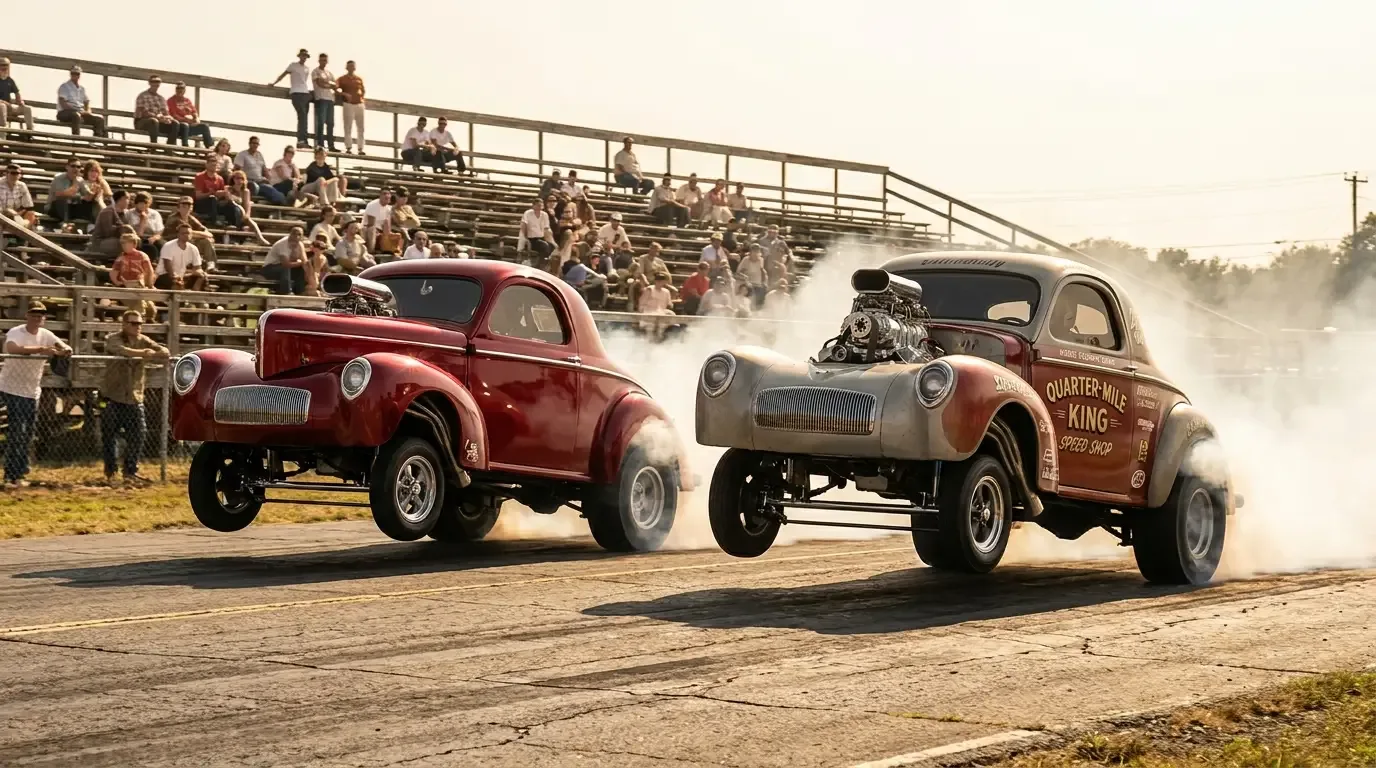
The "wars" were not one event. They were an ongoing rivalry between a handful of touring match-race teams who barnstormed the country's dragstrips, met the same opponents week after week, and turned the A/Gas Supercharged class into a traveling grudge match. If you want the wider arc of how these cars came to be, that lives in our history of gasser drag racing. This piece is about the fight itself.
What actually was a Gasser War
By the early 1960s the NHRA gas classes had produced a certain kind of car: a stripped, straight-axle coupe running on pump gas or a gas-based fuel blend, no fuel-injection-and-nitro dragster exotica, just a heavy-breathing engine stuffed into a light old body. The most competitive of these were the supercharged A/Gas cars, and the very fastest of those became household names among fans who followed the sport in Drag News and the weekly strip programs.
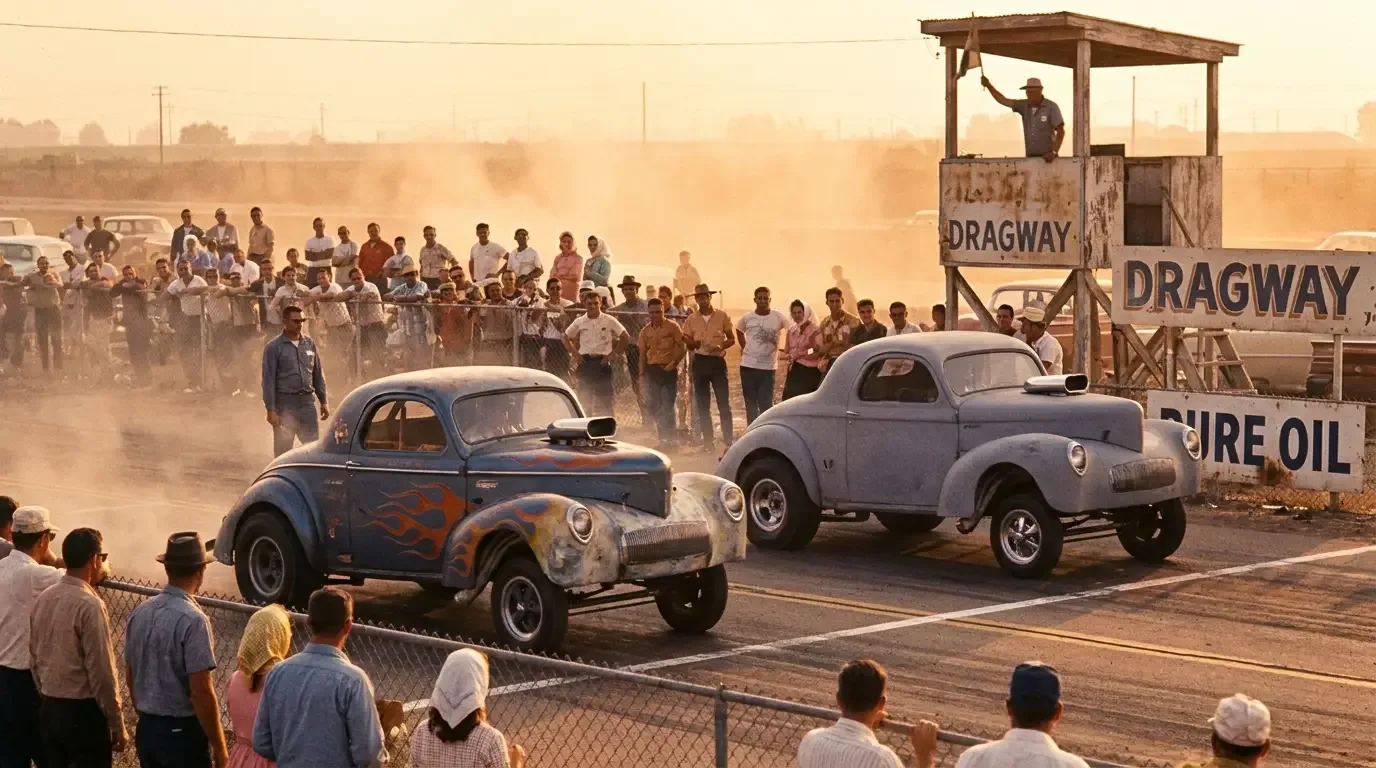
The word "wars" got attached because the top teams stopped waiting for the once-a-year national events to settle things. Promoters figured out that two famous cars, billed against each other, would sell tickets. So the teams went on the road, running best-of-three match races at strips from California to the East Coast. The same two names would appear on the marquee in Bakersfield one weekend and somewhere near Detroit a few weeks later. Fans kept score. That continuity, the same protagonists meeting over and over, is what made it feel like a war instead of a race.
Stone, Woods and Cook versus Big John
The rivalry most people mean when they say "the Gasser Wars" is Stone, Woods & Cook against "Big John" Mazmanian. The Stone-Woods-Cook team, Fred Stone, Tim Woods and driver Doug "Cookie" Cook, ran a series of supercharged Willys coupes out of California and became one of the defining A/GS cars of the era. Their most famous machine wore the nickname "Swindler," and while an earlier car ran a blown Oldsmobile, the peak-years "Swindler A" '41 Willys was known for a fierce supercharged Chrysler Hemi combination.
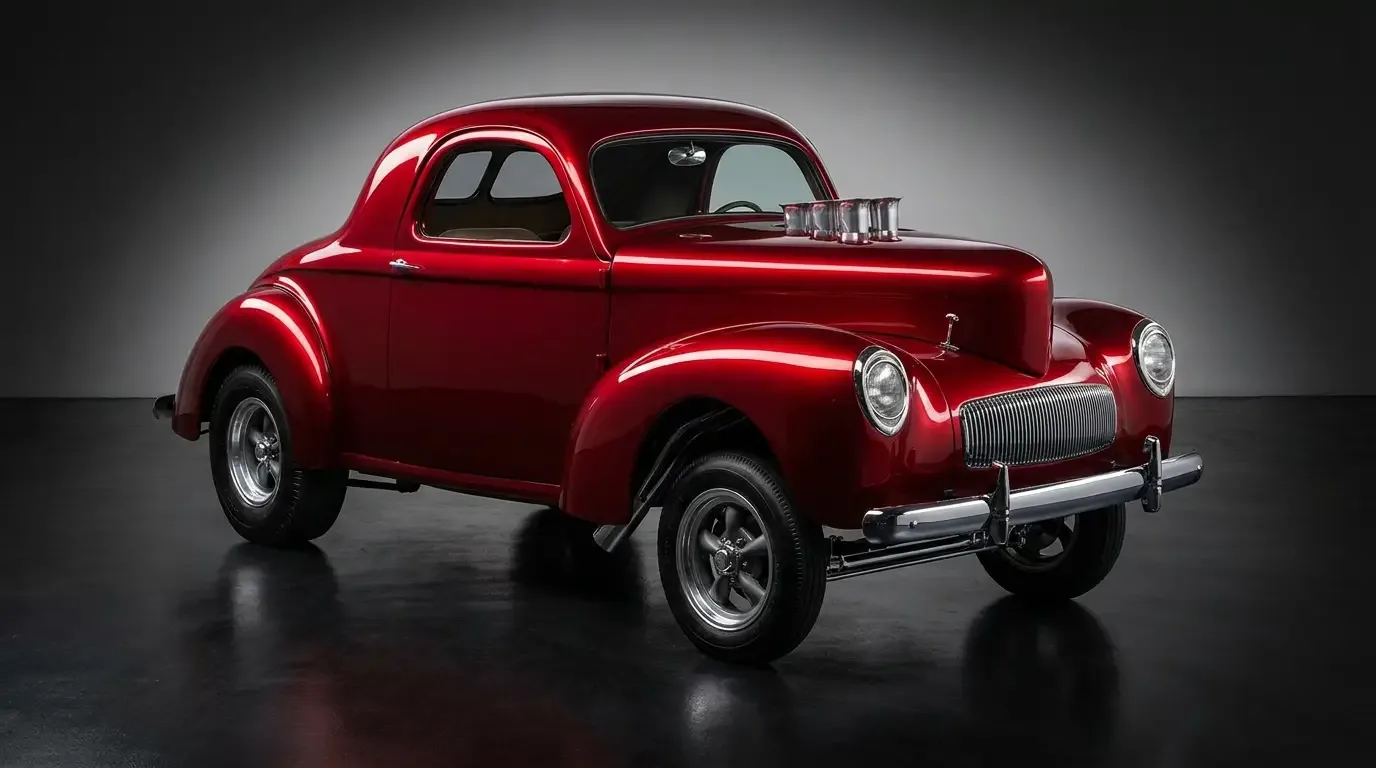
Across the line stood John Mazmanian, "Big John," an Armenian-American businessman from the Los Angeles area whose candy-red Willys was as recognizable as its owner. Mazmanian's cars were famously well-turned-out, deep gloss paint and chrome where other teams ran flat primer, and he had the money to keep the equipment current. The contrast sold the show: the hard-nosed touring pros against the immaculate, deep-pocketed challenger.
These were not the only names. "Ohio George" Montgomery ran his own legendary Willys and later a Mustang-bodied gasser, and the class was thick with cars like the Mallicoat Brothers and other regional heroes. But Stone-Woods-Cook and Mazmanian were the headline act, and their meetings are what old-timers still argue about.
It's a question I get asked a lot, why these two teams mattered so much:
"The Gasser Wars worked because you knew the cast. It wasn't anonymous machinery. It was Big John's red Willys versus the guys who lived on the road, and everybody in the stands had already picked a side before the engines fired."
Nora Beckett
The spectacle: why fans came out
Drag racing has always been about the launch, and no car launched like a straight-axle gasser. The tall front end, the light nose, the abrupt weight transfer, all of it combined to throw the front wheels off the ground and hold that pose for the first stretch of the run. It looked violent because it was. For a paying crowd in 1965, that visual was the whole point.
Beyond the wheelstands, the wars gave fans a set of things to follow week to week:
- The nicknames. "Swindler," the candy Willys, painted call-outs on the doors. The cars had personalities before the drivers said a word.
- The paint-versus-primer contrast between the touring pros and the show-quality challengers.
- The running scoreboard. Because the same teams met repeatedly, a loss one weekend set up a grudge rematch the next.
- The sound and smell. Blown engines on a rich load, tire smoke, and the pop of a car staged and impatient at the line.
Promoters leaned into all of it. A match race between two booked-in stars was advertised for weeks, and the strip announcer kept the storyline alive over the PA. This was closer to a boxing promotion than a points series, and it drew crowds to small tracks that could never have hosted a national event. If you want the personalities in more depth, our profiles of Famous Gassers and Their Builders go car by car.
How the wars ended, and what they left behind
Nothing about the gasser format was permanent. By the late 1960s the sport moved on. Flip-top Funny Cars, running altered wheelbases and full fiberglass bodies, delivered even more spectacle and more speed, and the paying crowd followed the newer, faster show. The straight-axle supercharged gasser, so dominant a few years earlier, slid from the main event to nostalgia almost inside a single decade.
What the wars left behind is a look and a feeling that never really died. The nose-high stance became shorthand for a whole style of hot rod, copied on street cars by people who never ran a quarter-mile in anger. Restored and re-created gassers are fixtures at nostalgia drag events today, and the surviving cars trade for serious money. For the longer cultural throughline, read the story of the gasser, which follows the style from the strip to the street.
| Element | What it looked like in the wars |
|---|---|
| Class | A/Gas Supercharged (A/GS), the fastest of the gas classes |
| Typical body | Willys coupe most famously; also Anglia, tri-five Chevy, later Mustang |
| Front suspension | Solid (straight) front axle, nose-high stance |
| Power | Supercharged V8 on a gas-based fuel load |
| Format that made it a "war" | Booked-in match races, best-of-three, same rivals week to week |
| Headline rivalry | Stone, Woods & Cook vs. "Big John" Mazmanian |
The numbers on horsepower, elapsed times and trap speeds from this era vary by source and by the exact car and season, so I've kept specific performance figures out of the running text rather than repeat a number I can't stand behind. The story of the Gasser Wars was never really about a single stat. It was about two cars, a full grandstand, and a rivalry everyone in the stands already had an opinion on.
Sources and notes
- Period drag-racing press and weekly strip programs from the 1960s.
- NHRA and AHRA gas-class rule references for the era.
- Team and driver histories for Stone, Woods & Cook and John Mazmanian, confirmed against NHRA records and period accounts.
- Nostalgia drag-racing club and event records documenting surviving and re-created cars.
Related Reading
Have a
Classic Car
for Sale?
Reach thousands of serious classic car collectors across the US.
Sell It Here →
Are You a Classic Car Dealer?
List your full inventory and connect with targeted classic car buyers.
Join as a Dealer →
#drag racing history
#gasser wars
#Stone Woods and Cook
#Big John Mazmanian
#straight axle gasser
#match racing

About the author
Nora Beckett
Automotive features writer and photographer who tells the human stories behind the cars, from show fields to cross-country road trips.
More in History & Heritage
Comments
Be the first to comment on this article.