
Look at a straight-axle gasser and then look at a 1965 factory experimental Mopar sitting next to it, and you can see the same idea taken two different directions. Both are chasing weight transfer. Both want the rear tires bitten into the track when the clutch drops. The gasser did it by jacking the nose up on a solid front axle. The altered-wheelbase cars did it by physically moving the axles under the car. That second move is the one that got out of hand, in the best way, and it is a straight line from a rules-bending Dodge to the Funny Car class we still watch today.
History & Heritage
6 min read
Altered-Wheelbase Cars and the Funny Car Link
The 1965 altered-wheelbase cars moved their axles forward for traction. Here is how that rule-bending trick led straight to the Funny Car.
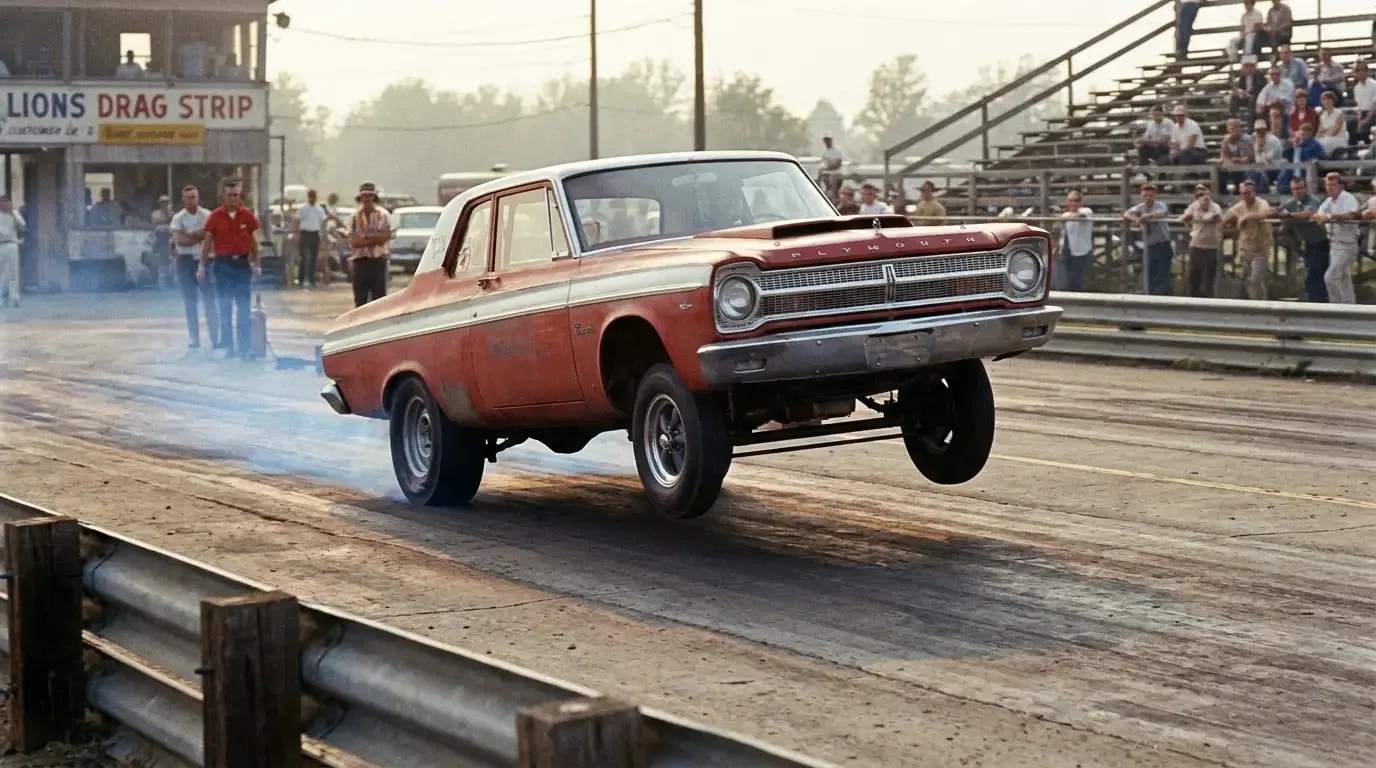
I have spent enough time under these cars to tell you the two families are cousins, not twins. If you want the stance-and-class background, read up on gasser drag racing first, because the altered-wheelbase story only makes sense once you understand how far builders would go to beat a rulebook.
Why anyone moved an axle in the first place
Drag racing is a traction problem before it is a horsepower problem. You can make all the power you want, but if the rear tires spin at the hit, you lose. Every trick a racer pulls at the starting line comes back to one goal: put more of the car's weight over the rear wheels the instant it launches, so the tires plant instead of smoke.
The gasser crowd got there with a tall front axle and a rearward engine. The factory-backed teams in 1964 and 1965 went further. They started shifting the rear axle forward in the chassis, then the front axle forward too, so the whole body sat back over the rear tires. Move the rear axle ahead maybe 10 inches, pull the front axle up a few, and suddenly a huge share of the static weight is riding on the drive wheels before the car even moves. Add the rearward pitch under acceleration and the tires got a fighting chance against the slicks-and-power mismatch of the day.
The 1965 factory experimentals
Chrysler is the name most people tie to this, and for good reason. For the 1965 season the Dodge and Plymouth teams built a run of altered-wheelbase Super Stock and A/FX cars around the 426 Hemi. Ford and others were pushing hard in the same NHRA and AHRA factory-experimental classes, so nobody was doing this in a vacuum. It was an arms race, and the wheelbase move was one more weapon.
These were not tidy machines. Builders acid-dipped panels to shed weight, hung lightweight glass and Plexiglas, moved the seats, and relocated the axles until the cars barely resembled the showroom version. The sanctioning bodies did not love it. NHRA's rules tightened and a lot of these altered-wheelbase cars ended up racing match-race circuits and the AHRA instead, where the promoters wanted spectacle and did not care how far the axles had wandered. That is a story I get into more in The Gasser Wars, because the same rulebook pressure was reshaping both camps at once.
"People call these cars ugly. I call them honest. Every weird thing about them, the short wheelbase, the axles shoved forward, the jacked-up nose on their gasser cousins, is a builder solving a traction problem with a hacksaw and a welder. Nothing on that car is there to look pretty."
Mike Sullivan
From altered wheelbase to nitro and a flip-top body
Here is where it turns into the Funny Car. Once you have moved the axles and stripped the body, the next steps are obvious to anyone chasing elapsed time. Drop in more radical fuel. The teams moved from gasoline toward nitromethane, and with nitro the power went up so fast that the acid-dipped steel bodies could not survive it and the drivetrains kept twisting themselves apart.
So builders stopped fighting the steel body. They put a lightweight fiberglass shell over a purpose-built chassis, then hinged the whole thing so it tilted up off the frame for access. That flip-top fiberglass car, running nitro, on a short chassis descended straight from the altered-wheelbase experiments, is the early Funny Car. By 1966 NHRA had made Funny Car an official eliminator, and the funny nickname the factory experimentals earned in 1965 became the official name of the category.
| Trait | Straight-axle gasser | Altered-wheelbase factory car (1965) | Early Funny Car (late 1960s) |
|---|---|---|---|
| Traction trick | Tall solid front axle, rearward engine | Axles physically moved forward in chassis | Short chassis plus massive nitro power |
| Body | Stripped stock steel | Acid-dipped steel, light glass | One-piece flip-top fiberglass |
| Fuel | Gasoline (class rule) | Gasoline, moving toward nitro | Nitromethane |
| Where it ran | NHRA/AHRA gas classes | Factory experimental, match races, AHRA | NHRA Funny Car class |
What the two families share, and where they split
The shared DNA is simple: get weight over the rear tires, cut everything you can, and read the rulebook as a challenge rather than a limit. Where they split is the body and the fuel. The gasser stayed a recognizable street-class car on a solid front axle burning gas. The Funny Car threw out the steel body and the gas and became a nitro missile with a plastic shell.
- Gassers kept the solid front axle look; altered-wheelbase cars kept a more stock silhouette but with the wheels in the wrong place.
- Both leaned on weight transfer, but the gasser did it with stance and the factory cars did it with geometry.
- The Funny Car is what you get when you stop caring about looking street-legal and only care about the clock.
If you want the wider arc of how the gas classes and these experiments grew up together, the gasser story ties the timeline together better than any single car can.
Sources and notes
- Period drag-racing press coverage of 1964 to 1965 factory experimental and Super Stock classes.
- Marque and engine references for the 426 Hemi era Dodge and Plymouth programs.
- NHRA and AHRA class-rule histories and Funny Car class origins.
- Builder and driver interviews describing altered-wheelbase construction and the move to nitro fiberglass cars.
Related Reading
Have a
Classic Car
for Sale?
Reach thousands of serious classic car collectors across the US.
Sell It Here →
Are You a Classic Car Dealer?
List your full inventory and connect with targeted classic car buyers.
Join as a Dealer →

About the author
Mike Sullivan
Detroit-area muscle car enthusiast and restoration specialist with three decades of hands-on experience working on American iron.
More in History & Heritage
Comments
Be the first to comment on this article.