
The question of which car was the first muscle car has been argued in club newsletters and forum threads for as long as people have collected these things. It is a good argument because it depends entirely on your definition, and reasonable people define the term differently. If a muscle car is simply a big engine in a lighter body, the story starts in the 1940s. If it requires the full package of body, engine, price, and marketing aimed at young buyers, it starts in 1964. The paperwork supports more than one answer.
History & Heritage
6 min read
The First Muscle Car Debate: Rocket 88 to GTO
Was the first muscle car the 1949 Rocket 88, the 1955 Chrysler C-300 or the 1964 GTO? The contenders, the records and why the GTO usually wins.
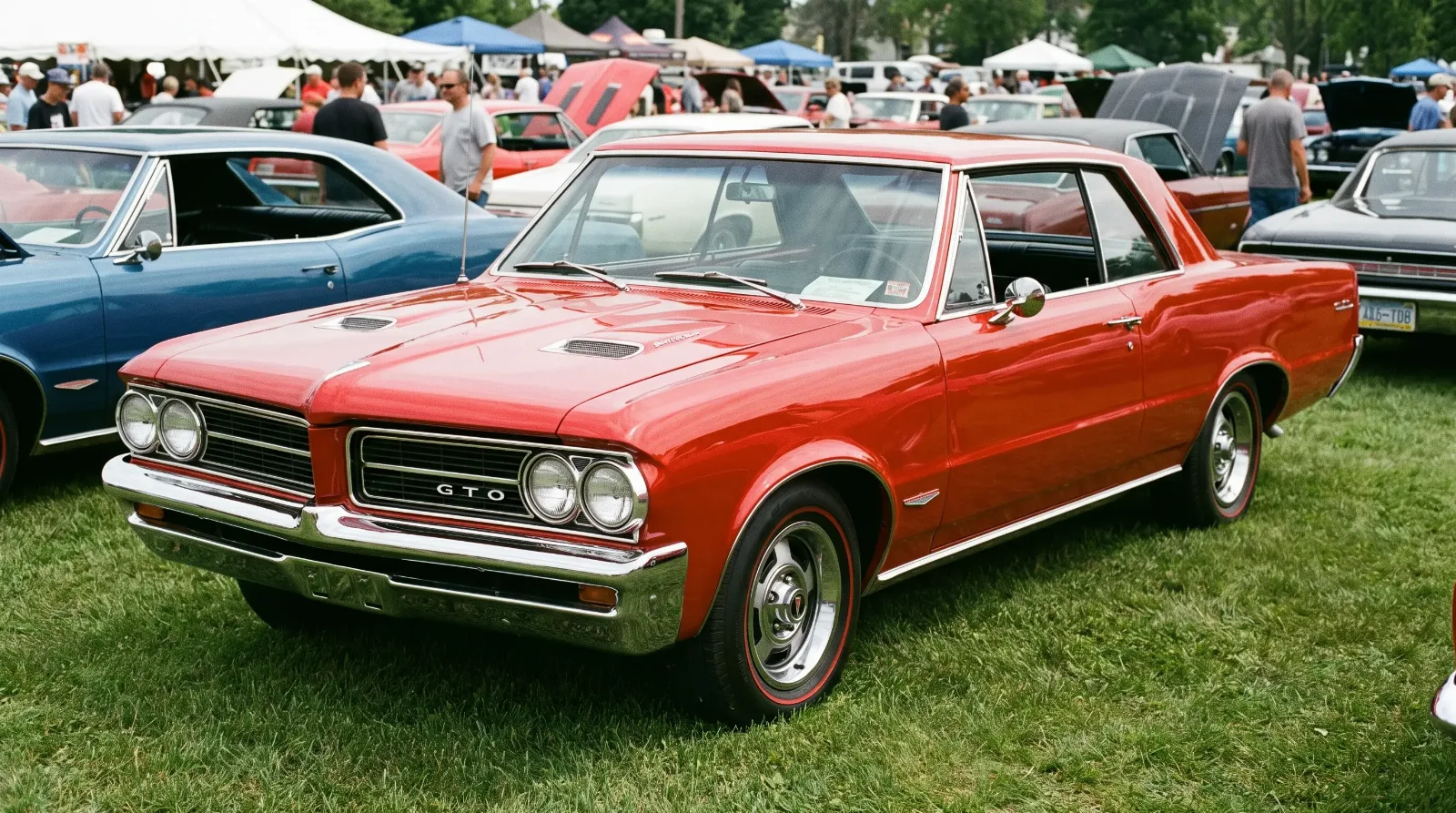
I try to settle these things with records rather than opinion, and the records point to three serious contenders. Each one has a legitimate claim, and understanding why each falls short of the others is more useful than crowning one and moving on. For the wider background on how the era developed, here is what you need to know before you pick a side.
The 1949 Oldsmobile Rocket 88 case
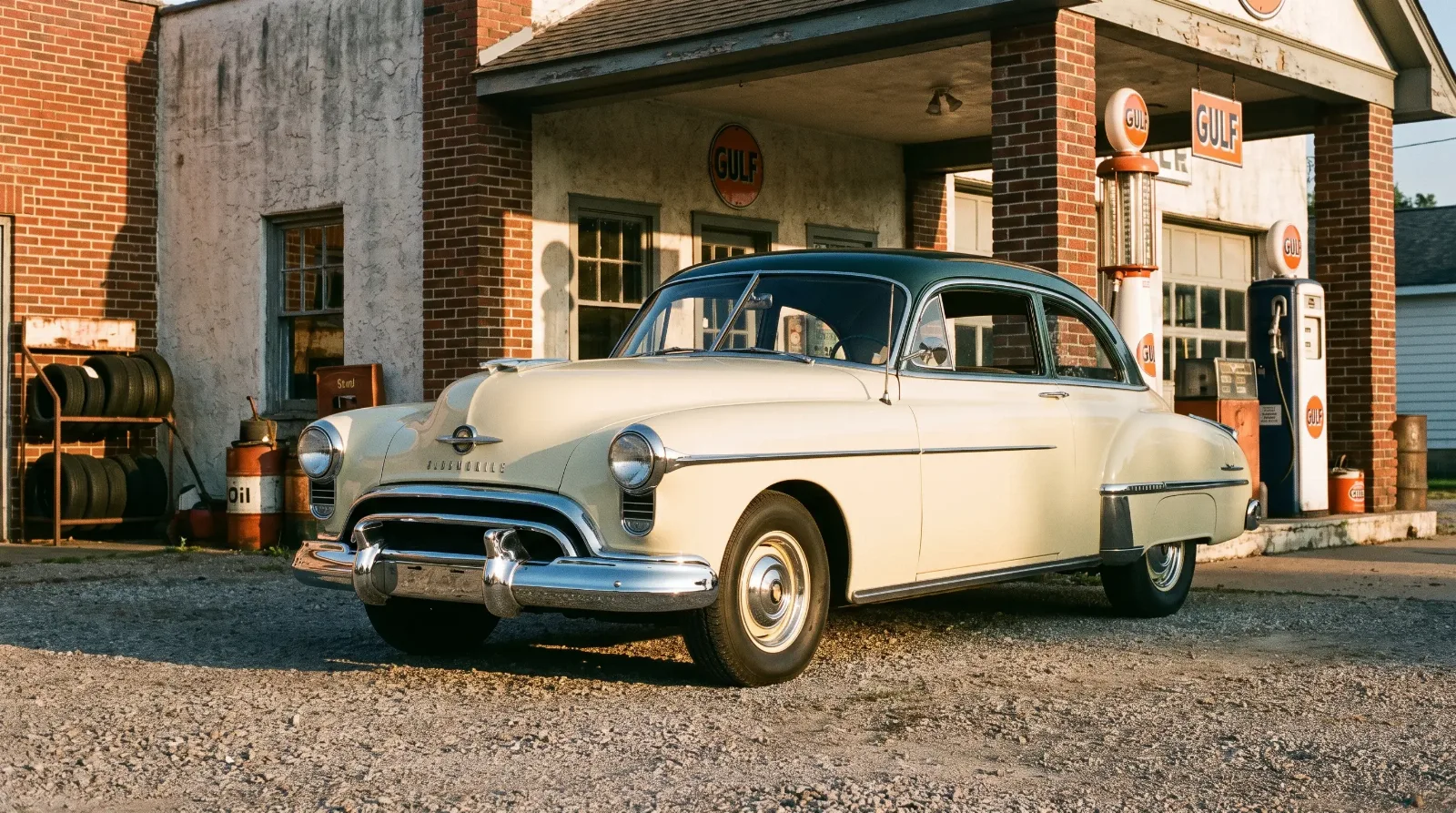
The earliest strong claim belongs to the 1949 Oldsmobile Rocket 88. Oldsmobile took its new 303 cubic-inch overhead-valve Rocket V8, an advanced engine rated around 135 horsepower, and offered it in the lighter 76-series body rather than only the heavy top-line cars. That is the muscle car recipe in its purest mechanical form: put the big engine in the smaller car.
The results backed it up. The Rocket 88 dominated early NASCAR, winning a majority of its races across the 1949 and 1950 seasons, and it inspired one of the first rock and roll records about a car. The case against it is straightforward. It was still a full-size car by the standards of the day, it was not marketed to a youth performance buyer, and the deliberate mid-size-plus-big-engine positioning that defined the later era was not the selling point. The ingredient was there. The category was not.
The 1955 Chrysler C-300 case
The next serious contender is the 1955 Chrysler C-300. It carried the 331 cubic-inch Hemi rated at 300 horsepower, making it the first American production car advertised with a full 300 horsepower. It was genuinely fast and, like the Olds, it went racing and won, taking stock car championships in the mid-1950s.
"People want a single first car, and the records will not give them one cleanly. What the records will give you is a clear line of ancestors. The Rocket 88 and the C-300 are the grandparents. The GTO is the one that had children."
Tom Ramirez
The argument against the C-300 is price and purpose. It was an expensive, low-volume luxury car, a banker's hot rod rather than a young man's first fast car. Only around 1,700 were built. It proved a powerful engine would sell, but it was aimed at wealthy buyers and priced accordingly. It is an ancestor, not the founder of the mass-market category.
There is a fourth name that comes up in these debates too, the 1957 Rambler Rebel. American Motors dropped a 327 cubic-inch V8 into a lightweight mid-size body, and on paper that is a closer match to the later formula than either the Olds or the Chrysler. The Rebel is a legitimate footnote, but it was built in tiny numbers, roughly 1,500 units, and AMC did nothing to build a category around it. It sits alongside the C-300 as proof that the idea kept surfacing before anyone knew what to do with it.
The 1964 Pontiac GTO case
The 1964 Pontiac GTO is the car most people mean when they say muscle car. Pontiac put the 389 cubic-inch V8 into the mid-size Tempest-based LeMans, rated at 325 horsepower with a four-barrel and 348 with Tri-Power. Crucially, it was sold as an affordable option package aimed squarely at young buyers, and it sold roughly 32,000 units in its first year against a cautious projection.
| Contender | Engine | Rated hp | The weakness in its claim |
|---|---|---|---|
| 1949 Olds Rocket 88 | 303 OHV V8 | ~135 | Full-size, no youth marketing |
| 1955 Chrysler C-300 | 331 Hemi | 300 | Expensive, low volume, luxury buyer |
| 1964 Pontiac GTO | 389 V8 | 325 / 348 | Had ancestors, not truly first with the engine idea |
These are period advertised figures. The GTO's case is not that it invented the big-engine-in-a-lighter-car idea, because it clearly did not. Its case is that it packaged that idea for the mass market and priced it to sell, which the earlier cars never did.
Why the GTO usually gets the crown
The GTO wins the title because it completed the formula. The earlier cars had pieces of it. The Rocket 88 had the engine transplant, the C-300 had the horsepower and the racing image, but neither combined a mid-size body, a big engine, a reachable price, and marketing aimed at young buyers into a single volume product. The GTO did all four at once, and the sales numbers proved the recipe worked.
Once the GTO sold, every competitor copied the exact package within two years, and that is the real test of a founder. A first car that no one imitates is a curiosity. A first car that spawns an entire industry within 24 months is the start of something. That is why the credit tends to land on 1964.
My own read, and I try to keep it grounded in what the records actually show, is that the argument only stays stuck because people insist on a single answer to a question that has layers. If you ask which car first put a big engine in a lighter body, the honest answer is the Rocket 88. If you ask which car first advertised 300 horsepower, it is the C-300. If you ask which car created the muscle car as a product people could buy and a category the industry would chase, it is the GTO. Those are three different questions wearing the same clothes, and the paperwork answers each one cleanly once you separate them.
The era the GTO launched hit its peak just a few years later, which you can read the full story on to see how far the idea traveled. The Rocket 88 and the C-300 keep their place as the honored ancestors. The GTO gets the title because it turned the idea into a market.
Related Reading
Have a
Classic Car
for Sale?
Reach thousands of serious classic car collectors across the US.
Sell It Here →
Are You a Classic Car Dealer?
List your full inventory and connect with targeted classic car buyers.
Join as a Dealer →

About the author
Tom Ramirez
Corvette researcher and historian based in Bowling Green, Kentucky. Two decades documenting Corvette production history from original factory records.
More in History & Heritage
Comments
Be the first to comment on this article.