
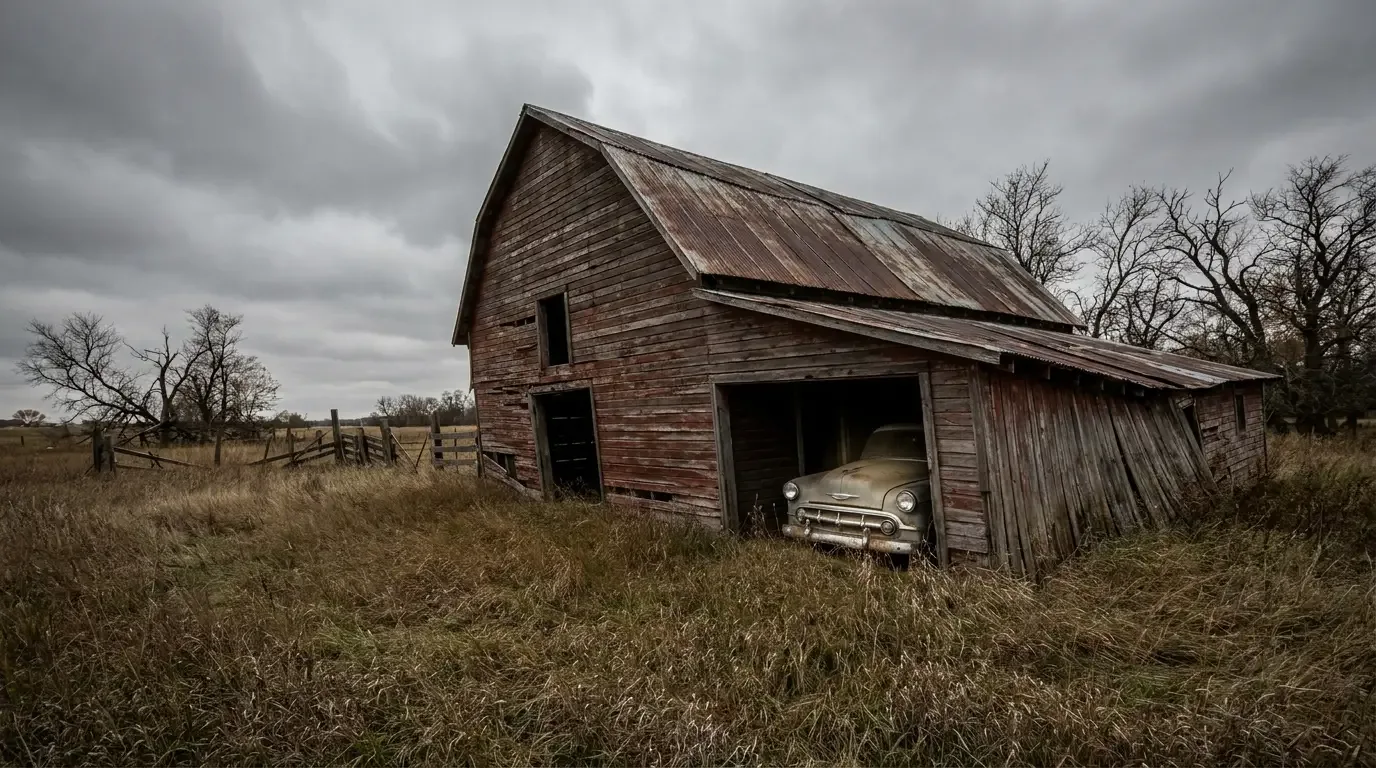
The photograph does most of the work. A car sits under a collapsed roof, tires flat and sunk into the dirt, a skin of dust turning its paint the color of the barn itself. Sunlight comes through the gaps in the boards and lands in stripes across a hood nobody has opened in forty years. Somebody says the word, and it travels: barn find. For a certain kind of person, that phrase does something a showroom photo never will. It promises that the past is still out there, parked and waiting, if you are lucky enough or stubborn enough to open the right door.
Car Features
15 min read
The Barn Find Story
The barn find is two things at once: a real category of car with rules, and a story we tell ourselves about time, luck, and rescue. Here is both, whole.
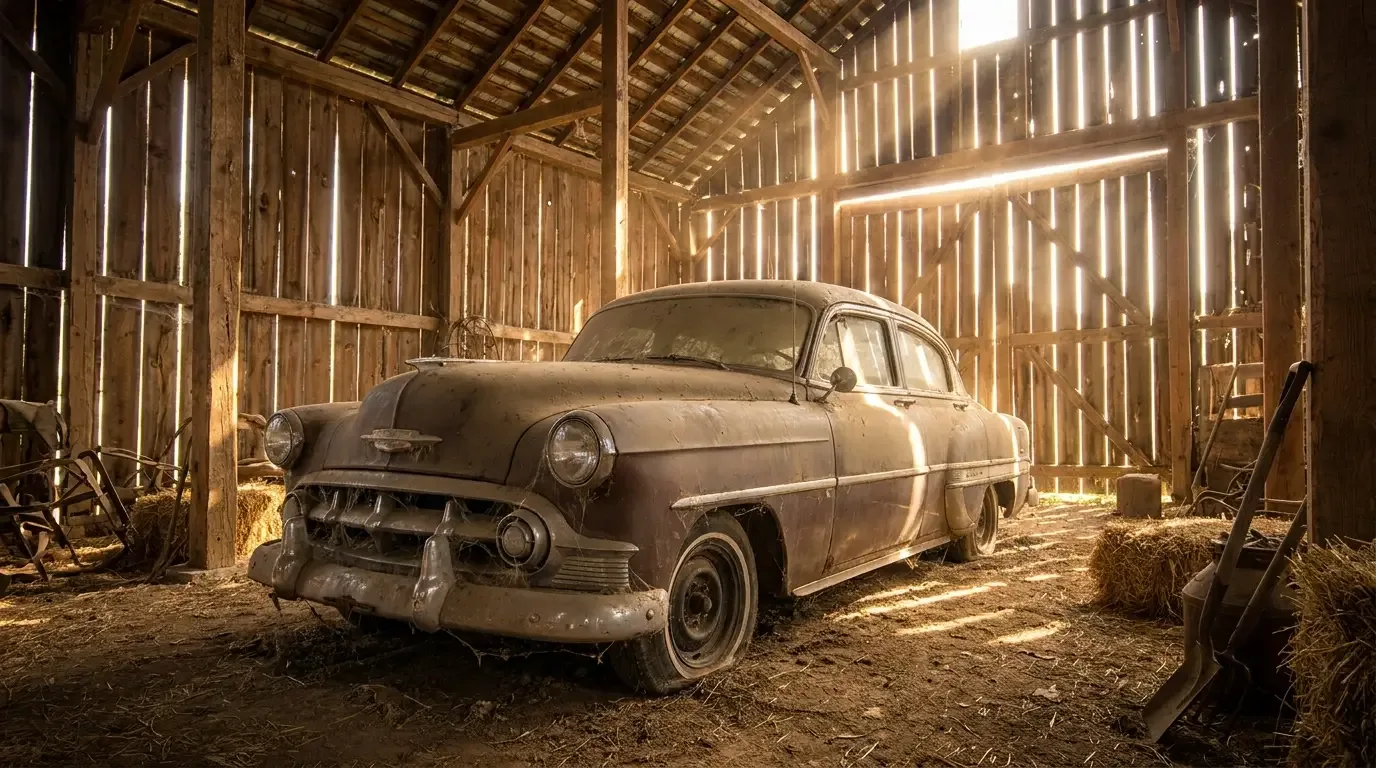
I have chased that feeling for a long time, and I have watched a lot of other people chase it too. What I have learned is that the barn find is two things at once. It is a real category of car, with real rules for how you judge it and buy it. And it is a story we tell ourselves about time, luck, and rescue. This piece is the hub for both. If you want the concept whole, before you go deeper into evaluating one, chasing one, or reading about the famous ones, start here.
What actually counts as a barn find
Strip away the romance and a barn find is a simple thing: a vehicle that has been out of use and stored, usually neglected, for a long stretch of years, then rediscovered. The barn is the icon, but the storage can be anything. A field. A closed dealership. A shipping container. A garage where the owner died and the family left the car alone. The common thread is time and stillness, not the building.
The distinction that matters is between stored and abandoned. A car put away with intent, drained or blocked up, covered, is a different animal than one left to rot where it stopped running. Both get called barn finds. Only one of them tends to reward you. The word does not certify condition. It describes a history of being lost and then found, and history is not the same as quality.
There is also a difference between a barn find and a survivor, though people blur them. A survivor is an original, unrestored car that has been used and maintained continuously. A barn find is a car that dropped out of that continuity. When a barn find happens to be complete, unmolested, and mechanically saveable, it can become the most desirable kind of survivor. That is the jackpot everyone pictures. It is also the exception.
| Trait | Barn find | Survivor | Abandoned wreck |
|---|---|---|---|
| Storage | Long, static, often decades | Continuous use | Left where it failed |
| Intent | Put away, then forgotten | Kept and maintained | Given up on |
| Typical condition | Rough but complete | Worn but sound | Rusted, stripped, or broken |
| Originality | Often high, untouched | High, documented | Irrelevant, too far gone |
| Best outcome | Preserve or gentle revival | Keep as-is | Parts donor |
Where the appeal really comes from
The pull of the barn find is not mainly about money, whatever the auction headlines suggest. It is about originality you cannot fake and a story you cannot buy. A restored car, however perfect, is a car someone decided how to present. A barn find arrives with its decisions already made, decades ago, by people who are often gone. The dealer sticker still in the window. The registration in the glovebox from a year you can barely remember. The dent nobody bothered to fix. That is the appeal: a car that is honest about where it has been.
There is a rescue instinct in it too. Enthusiasts talk about barn finds the way some people talk about adopting an old dog. The car did not ask to be forgotten. Bringing it back, or even just keeping it stable, feels like undoing a small injustice. That emotional charge is real, and it is why a rough, incomplete car can still command more attention than a tidier restored example of the same model.
There is a discovery thrill layered on top of all that, and it is worth naming because it is what turns casual fans into obsessives. Every barn find is a small mystery solved. Who owned it? Why did they stop? Why here, why now? You piece the answer together from the objects the car carried into storage, and for a while you are the only person alive who knows the whole story. Modern life offers very few chances to be the first to find something real. A barn find is one of them, and that is worth more to some people than the car itself.
The myth versus the reality
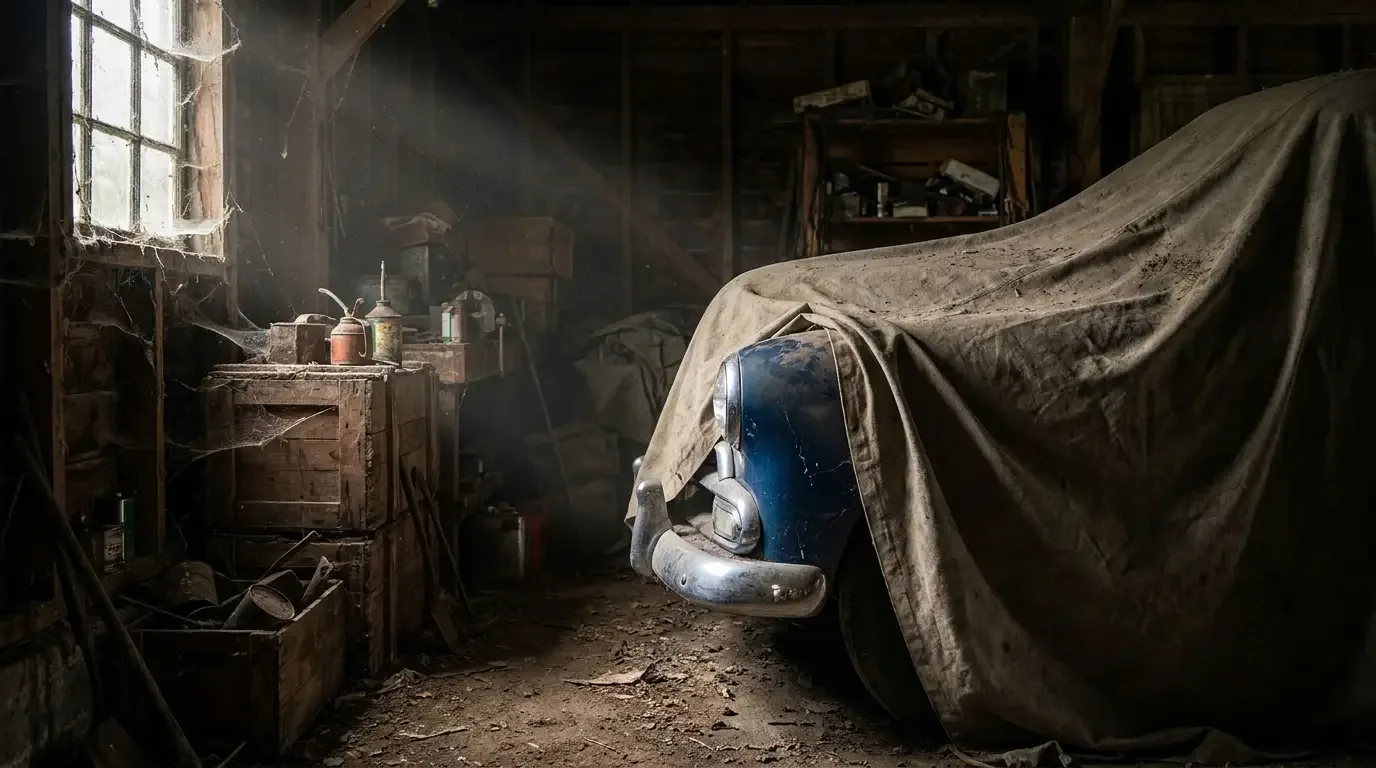
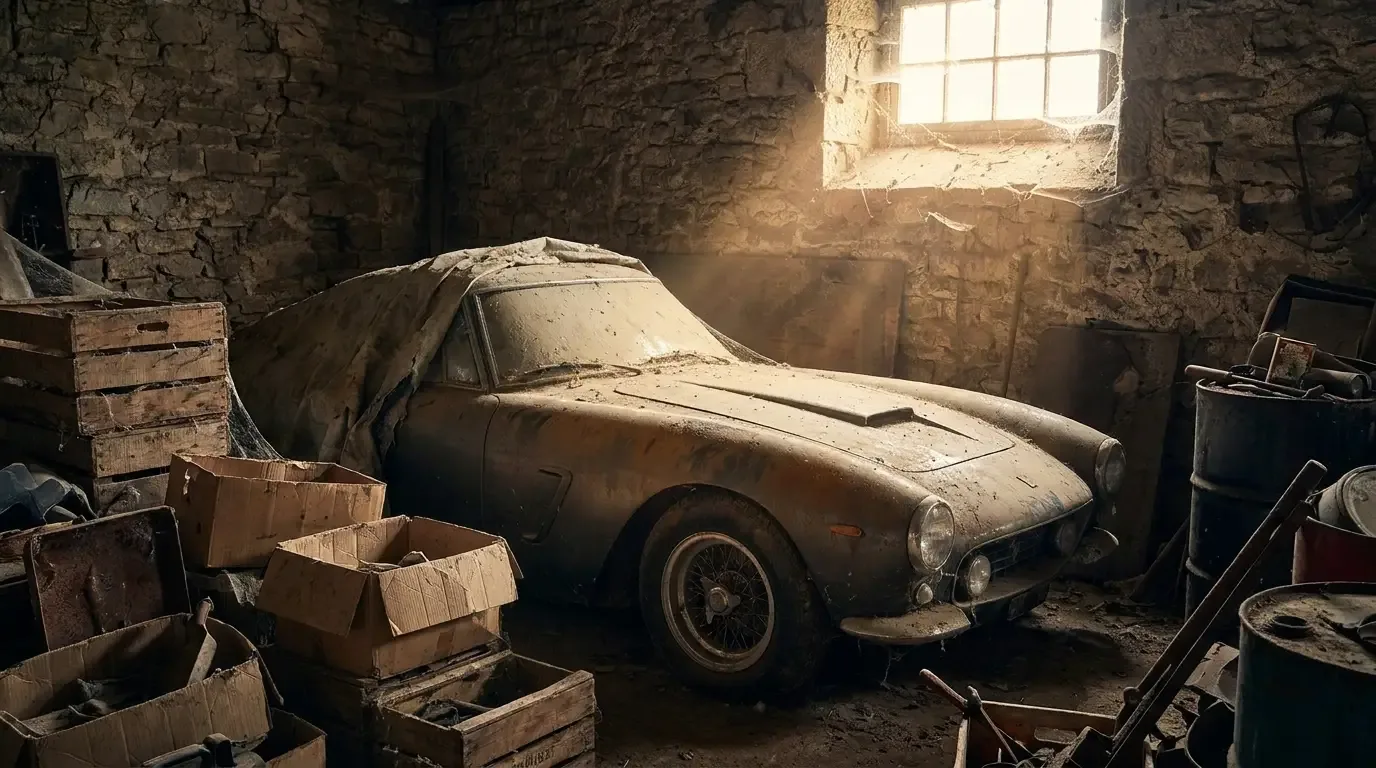
Here is where I have to be a spoilsport, because the honest version of this story does not sell posters. The vast majority of barn finds are not hidden treasure. They are rough, common cars that were put away because they had stopped being worth fixing at the time, and years of damp, mice, and neglect did not improve them. For every California Spider under a tarp, there are a thousand economy sedans with rusted floors and a family of rodents in the seats.
The myth runs on survivorship bias. We hear about the Ferrari and the split-window Corvette because those are news. We never hear about the nine out of ten discoveries that were parted out or scrapped because they were not saveable. When you go looking, calibrate your expectations to the median, not the headline. The median barn find is a project that will cost more than the finished car is worth, bought by someone who wants it anyway.
That does not make barn finds a bad idea. It makes them an emotional purchase that you should walk into with open eyes. The people who are happiest with theirs are the ones who wanted that specific car, understood it was going to be a fight, and never expected to flip it for a profit. The people who get burned are the ones who believed the poster.
"I have opened a lot of barn doors. Most of the time what is behind them is a sad car and a hopeful owner. The magic is real, but it is rare, and rare is the whole point. If they were everywhere, nobody would care."
Patrick Walsh
How to actually evaluate one
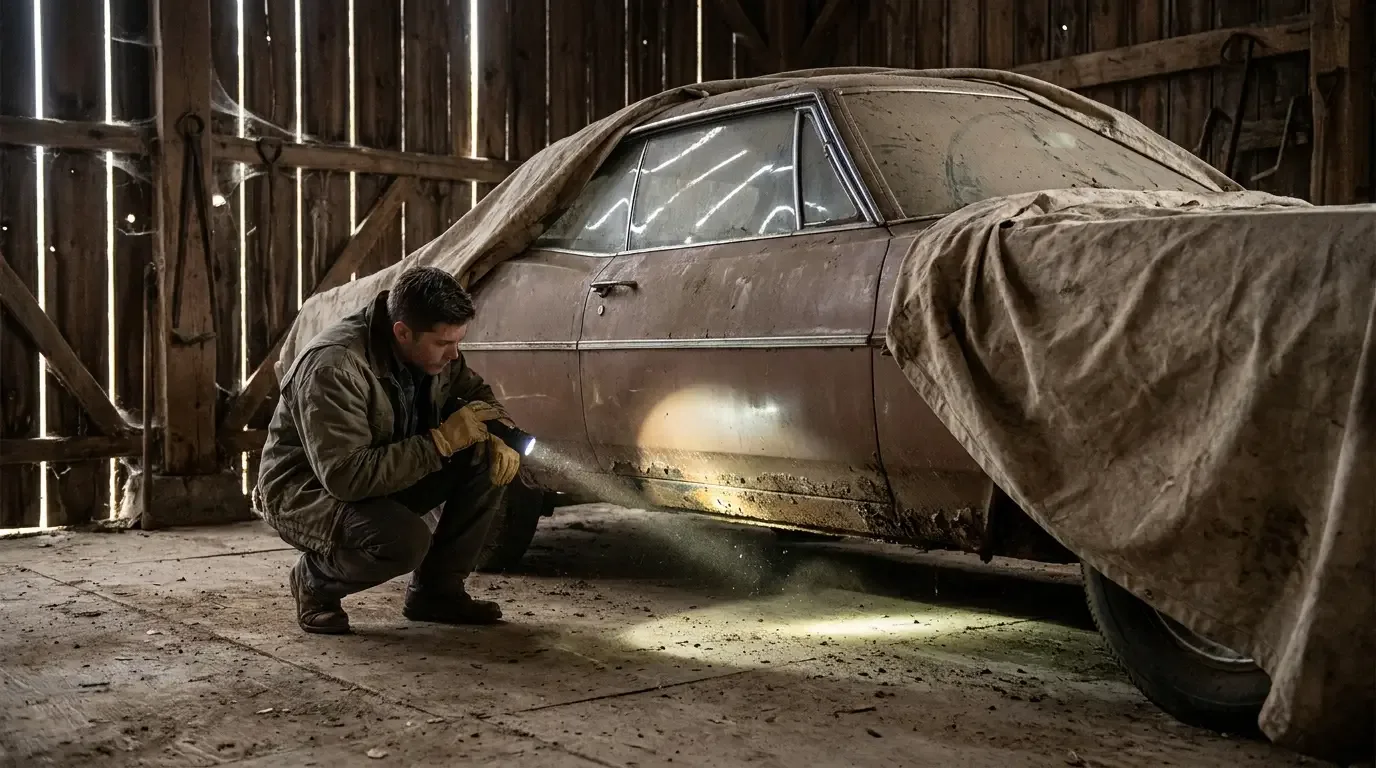
Once the goosebumps fade, a barn find is just a used car with an unusually long gap in its story, and you evaluate it the way you would any project, with a bias toward what time and moisture do to a machine that has not moved. Structure first, drivetrain second, cosmetics last. A rusted floor or frame is expensive and dangerous. A seized engine is a known quantity. Faded paint is the least of your problems and often the thing you least want to disturb.
The temptation is to fixate on whether it runs. Resist it. A car that will not start is a cheap fix compared to one whose structure has dissolved. Spend your inspection time underneath and inside the body, not listening for the engine to catch. If you want the full mechanical and structural walkthrough, that lives in its own guide, but the priorities below are the ones I would not skip on any discovery.
🔧 Inspection Priorities
- Floors, frame, and structural rust. Get underneath. Rust that has eaten load-bearing metal turns a project into a fabrication job. This is the single most common deal-killer and the most expensive to fix, easily thousands in metalwork.
- Completeness and originality. Missing trim, badges, and correct engines are hard and costly to source for older cars. A complete rough car often beats a cleaner car missing rare parts.
- Rodent and moisture damage. Check the interior, wiring looms, and heater box. Nested mice chew wiring and soak upholstery with urine, which corrodes metal and ruins the smell permanently.
- Engine internals, not just start. Pull a plug and check the bore for rust before you crank. A seized or rust-scored engine that gets forced can crack rings and scar cylinders in seconds.
- Paperwork and identity. A clear title and matching numbers can be worth more than the metal. No title on a long-stored car can mean months of paperwork or a dead end.
Preserve or restore, the fork in the road
The most consequential decision you make with a barn find is one you make before you touch a wrench: do you preserve it or restore it? Restoration returns a car to as-new condition. Preservation keeps the car as it was found, stabilizing it so it stops deteriorating without erasing its history. Twenty years ago almost everyone restored. Now, for the right car, preservation is often the more valuable and more respected path.
The logic is simple once you accept it. Originality only exists once. You can restore a car ten times, but you can only preserve its original paint, its original patina, its factory assembly, a single time before it is gone forever. For a genuinely original, unmolested discovery, the dust and the faded paint are the point. Cleaning it up to gleam can strip away the exact quality that made it special. For a rough, common, or heavily damaged car, restoration is the honest choice because there is little original character worth saving.
What decades of storage actually does to a car
To judge a barn find you have to understand what stillness does to a machine, because a car is not designed to sit. It is designed to move, and movement is what keeps most of its systems alive. When you take that away for thirty years, damage accumulates quietly in ways that do not show in a photograph. This is why a car that looks presentable under the dust can hide the most expensive problems, and why a scruffy one can turn out sound.
Rubber is the first casualty. Tires flat-spot and crack, hoses harden and split, seals shrink and let fluids weep out and moisture in. Fuel is the second. Old gasoline turns to varnish and gum that clogs carburetors, injectors, and tanks, and a tank that sat half-full for decades is usually a rusted mess inside. Brake and clutch fluid absorb water and corrode the lines and cylinders they were meant to protect. None of this is dramatic on its own, but together it means almost no long-stored car is safe to simply start and drive, however tempting it is to try.
The slower, meaner damage is corrosion. Condensation cycles through the car every day, warm to cool, and where it settles, rust starts. It starts in the places you cannot see: inside frame rails, under carpet, in door bottoms, behind trim. A car stored in a dry, dirt-floored barn in a desert climate can come out remarkably solid. The same car stored on a damp concrete floor in a humid region can be structurally gone while still looking whole. Climate and floor type tell you more about a barn find's condition than the make and model do.
| System | What storage does | Typical fix effort |
|---|---|---|
| Tires and rubber | Flat-spot, crack, perish | Low, replace outright |
| Fuel system | Varnish, gum, tank rust | Moderate, clean or rebuild |
| Brakes | Corroded lines and cylinders | Moderate, full system |
| Engine internals | Bore rust, seized rings | High if forced when seized |
| Body structure | Hidden rust in rails and floors | Very high, fabrication |
| Wiring and interior | Rodent damage, rot, mildew | Moderate to high |
The practical takeaway is that a barn find's price should reflect the recommissioning it needs, not just the car it appears to be. Two identical models can be worth wildly different money depending on where and how they slept. Learn to read the storage, not just the car, and you will avoid the most expensive mistakes people make when the romance takes over.
The finds that became legends
Some discoveries earn their fame. The stories that stick tend to combine three things: a genuinely rare car, a long and improbable slumber, and a moment of rediscovery that feels like fate. A racing car parked after one season and forgotten in a shed. A one-owner sports car put away when the owner shipped overseas and never came home. A prototype that was supposed to be scrapped and quietly was not. These are the finds that get written up, filmed, and argued over.
What the legendary finds share is not luck alone. Someone knew what they were looking at. The person who opens the barn door and recognizes a rare chassis number, or notices that the dusty coupe is one of a handful ever built, is the one who turns a curiosity into a landmark. Knowledge is the multiplier. The same car found by someone who did not know its significance might have gone to the crusher. The famous discoveries deserve their own telling, and they get it elsewhere in this collection, but the lesson they teach the rest of us is to learn your cars before you go looking for them.
"The best barn find story I know is not about the car. It is about the guy who walked past it three times before he looked closely, then spent a year working up the nerve to knock on the door. The car had waited thirty years. It could wait one more."
Patrick Walsh
How to actually find and buy one
The romance says barn finds happen to you. The reality is that people who find good ones are looking, constantly and methodically. They talk to old mechanics, estate cleaners, and rural neighbors. They read obituaries and estate-sale listings. They knock on doors when they see a shape under a tarp. Luck exists, but it favors the person already in motion, asking questions in the right places.
Buying one is its own skill. Long-stored cars often come with tangled ownership, missing titles, and sellers who either wildly overvalue the car because it is a barn find or have no idea what they have. You need patience for the paperwork and firmness on price, because the story is doing a lot of work on the seller's expectations. The full process, from where they still hide to how to handle titles and transport, has its own guides in this cluster, and if you would rather skip the hunt entirely, you can browse classic barn finds for sale that other people have already dragged into the light.
Why the barn find endures
Cars keep getting built, and old ones keep disappearing into sheds and fields, which means the supply of forgotten machines never really runs dry. As long as people park a car meaning to get back to it and then never do, there will be barn finds for the next generation to open. Today's neglected daily driver is a barn find waiting to happen in 2050.
But the deeper reason it endures is that the barn find is a story about time we can win. Everything else gets away from us. The one car under the tarp, if we find it, can be brought back, kept, understood. It is a small argument against loss. That is why a dusty car in a stripe of sunlight still stops people cold, and why it always will. The trick, if you decide to chase one, is to love the fight as much as the fantasy, because the fight is what you actually get.
Sources and notes
- Period automotive press and enthusiast magazine coverage of notable discoveries.
- Collector-car auction records and catalog descriptions for provenance and results.
- Marque registries and club documentation on originality and survivor status.
- Restoration and preservation-shop guidance on structural assessment and revival.
- Author interviews with collectors, estate liquidators, and long-time restorers.
Related Reading
Have a
Classic Car
for Sale?
Reach thousands of serious classic car collectors across the US.
Sell It Here →
Are You a Classic Car Dealer?
List your full inventory and connect with targeted classic car buyers.
Join as a Dealer →

About the author
Patrick Walsh
Automotive journalist covering classic car shows, events, and the enthusiast community across North America.
Comments
Be the first to comment on this article.