
Before there was a strip of asphalt with a Christmas tree at the end, before there was a magazine on the newsstand, there was a lakebed. Flat, cracked, hard as a shop floor, running for miles under the Mojave sun. That is where the hot rod stopped being a hopped-up jalopy and became a purpose-built machine, and I will tell you, once that clicks for you, everything else about this hobby makes sense. The dry lakes of Southern California, Muroc and El Mirage chief among them, are the ground where the whole thing was born. Anybody who wants to understand the roots of the culture has to start here, out in the dust, long before Bonneville got famous.
History & Heritage
8 min read
The Dry Lakes: Where Hot Rodding Was Born
Muroc, El Mirage and the SCTA turned a stripped-down Ford into a hot rod. The real birthplace of the sport, out on the clay.
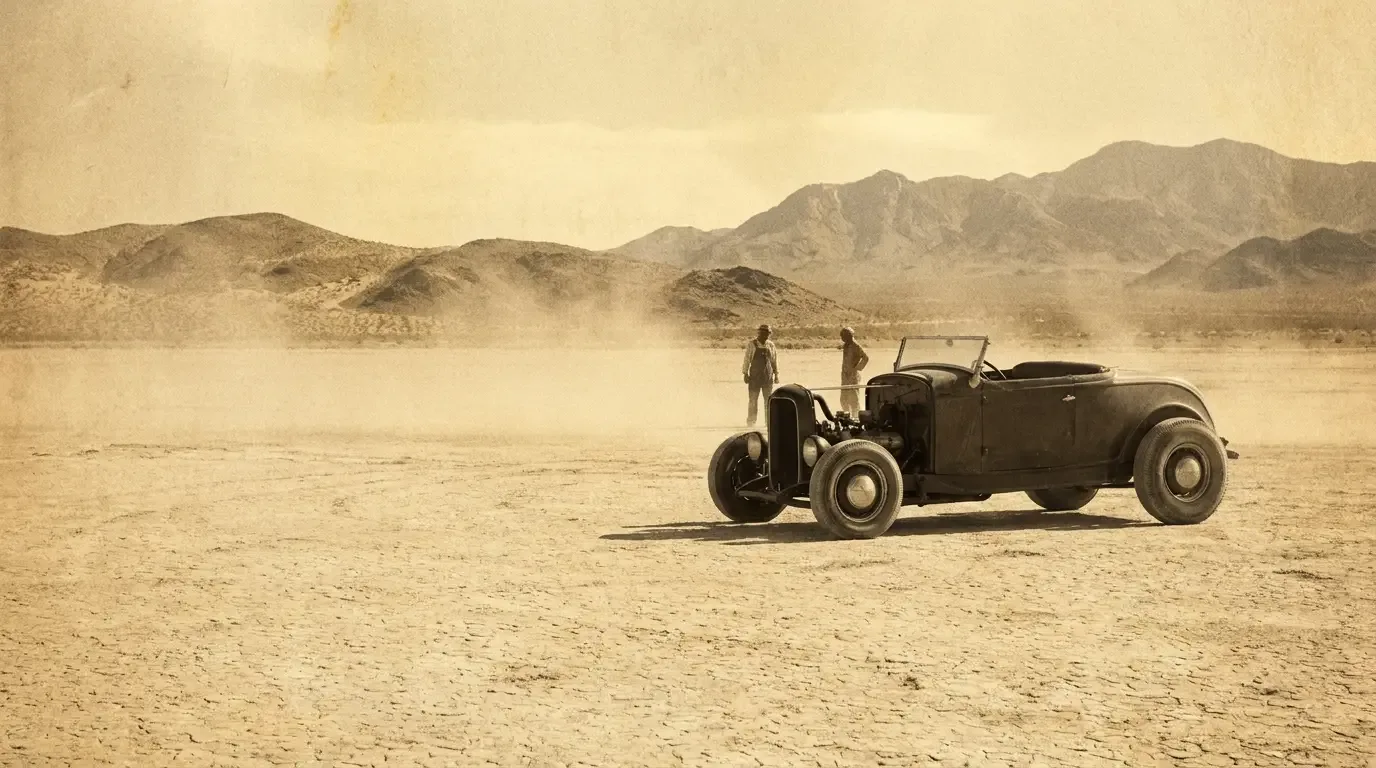
I have spent enough winters wrenching in a cold Milwaukee garage, listening to the old guys who actually ran those lakes, to know the dry lakes are not just a footnote. They are the source. The channeled roadster, the stripped-down look, the obsession with going faster on a working man's budget, all of it traces back to a few square miles of dry clay. This is the part of the story that gets skipped when people talk about chrome and shows. If you want the wider picture, read the full hot rod history, but the dry lakes are where you plant your feet first.
Why a dry lakebed became a racetrack
A dry lake is exactly what it sounds like. A shallow basin that fills with a thin sheet of water in the wet season and then bakes flat when the water evaporates. What is left behind is a surface of packed clay, smooth and firm, stretching for miles with nothing to hit. For a young man with a Model T or a Model A frame and a Ford four-banger or an early V8, that was the only place within reach where you could open the throttle all the way and hold it there.
Muroc Dry Lake, out in the high desert north of Los Angeles, was the big one in the early days. El Mirage, closer in and easier to reach, became the workhorse lake once Muroc got swallowed up by the military. These were free, they were flat, and they were within a few hours of the garages and machine shops of the LA basin. Southern California had the cars, the aircraft-industry machinists, the war-surplus parts, and the weather to run twelve months a year. No other place in the country had all four.
- Muroc. The original proving ground for lakes racing in the late 1920s and 1930s, later absorbed into what became Edwards Air Force Base.
- El Mirage. Still active today under the timing associations, the lake most people picture when they think of dry-lakes racing.
- Harper and Rosamond. Smaller lakes that saw use when the big beds were unavailable.
The SCTA and bringing order to the chaos
The early lakes scene was wild and, frankly, dangerous. Cars ran side by side across the clay, sometimes four and five abreast, chasing each other through the dust with no timing and no real rules. People got hurt. The answer, in 1937, was the Southern California Timing Association, the SCTA, formed out of a handful of car clubs that were tired of watching the sport nearly kill itself.
The SCTA did the thing that turned a stunt into a sport. It brought a governing body, a set of classes, and above all timing equipment. Instead of everybody running at once, cars went one at a time or in controlled heats against the clock. A run was measured, recorded, and published. Suddenly a builder could prove a number, and a number is what every gearhead lives and dies by. The clubs that made up the SCTA policed their own members, and the timing tags on those cars meant something.
Timing associations also standardized how speed got measured, which mattered because rival clocks gave rival numbers. Getting everyone onto agreed equipment and an agreed measured distance meant a record set at El Mirage could be compared honestly against another run weeks later. That credibility is what let the lakes produce heroes instead of just tall tales.
The prewar and postwar speed scene
Through the 1930s the lakes crowd figured out what worked. Strip the fenders, the running boards, the windshield, anything that caught air or added weight. Lower the car. Get the nose down. The classic dry-lakes roadster look, a channeled body sitting low over a Ford frame with a hopped-up flathead between the rails, was not a style decision first. It was aerodynamics and weight, worked out by trial and error at full throttle. The style came out of the function, which is how it always should be.
Then the war shut it all down. Gas rationing, the lakes turned over to the military, and every young mechanic and machinist in the sport went into uniform or into a defense plant. What is important is what those men brought home. They came back in 1945 and 1946 with real machine-shop skills, exposure to aircraft engineering, and a pile of cheap war-surplus everything. The postwar lakes scene exploded because of it. The SCTA restarted, El Mirage filled up with cars, and the level of engineering jumped hard.
"Folks always think the low, stripped, nose-down look was about style. It was not. Those guys were chasing tenths of a mile an hour on a lakebed, and the car that got lighter and lower went faster. The look we all copy today is just what fast looked like out there."
Gary Nowak
The postwar years are when the flathead really got developed. Aftermarket heads, multiple carburetors, hotter cams, the whole speed-equipment industry that fed the hot rod for decades grew up around guys trying to shave time at the lakes. The lakebed was the dyno. If a part made the car quicker across the measured distance, it sold. If it did not, it was scrap.
How the lakes seeded Bonneville
By the late 1940s the fast cars were bumping against what the dry lakes could give them. El Mirage is long, but it is not long enough for the top runners once speeds climbed. A flat-out machine needed miles to reach terminal speed and miles more to stop. The obvious next step was the Bonneville Salt Flats in Utah, a surface longer and harder than any dry lake in California.
The SCTA ran the first Bonneville Speed Week in 1949, and it was not a break from the dry lakes. It was the dry-lakes crowd carrying their timing, their classes, their clubs, and their cars to a bigger canvas. The same people, the same association, the same rulebook, just longer. The salt let the fast cars finally stretch out. If you want the rest of that story, it runs straight into Bonneville Speed Week and Land-Speed Hot Rods, which is the direct descendant of everything that started on the clay.
| Venue | Location | Role in the story |
|---|---|---|
| Muroc | Mojave Desert, CA | Original prewar lakes proving ground |
| El Mirage | Mojave Desert, CA | Longtime SCTA home lake, still active |
| Bonneville Salt Flats | Utah | The bigger stage the lakes crowd graduated to |
What the dry lakes left behind
The direct line from the lakes to the modern hot rod is not subtle once you know to look for it. The stripped roadster, the flathead worship, the class-based competition, the club culture, the whole idea that a working man could build a fast car in a home garage and go prove it, all of that is dry-lakes DNA. When magazines and shows came along later, they were documenting a sport that already had its heroes and its rules, set out on the clay.
El Mirage still runs under the timing associations, which is a rare thing. You can stand on the same lake where the sport was invented and watch cars still chasing the clock. That continuity is why the dry lakes matter. They are not a museum piece. They are the living root of hot rodding, and everything that came after, the salt, the strips, the shows, the magazines, grew out of a few gearheads with stripped-down Fords and a flat piece of desert.
Sources and notes
- Period hot-rod and lakes-racing press from the 1930s through the 1950s.
- Southern California Timing Association records and timing-association history.
- Museum and registry accounts of early dry-lakes and land-speed racing.
- Builder and old-timer interviews on prewar and postwar lakes culture.
- Dates and specific speed figures confirmed against Southern California Timing Association and land-speed-racing primary records.
Related Reading
Have a
Classic Car
for Sale?
Reach thousands of serious classic car collectors across the US.
Sell It Here →
Are You a Classic Car Dealer?
List your full inventory and connect with targeted classic car buyers.
Join as a Dealer →

About the author
Gary Nowak
Lifelong Midwest rodder who has been building and driving traditional pre-war hot rods since the 1970s.
More in History & Heritage
Comments
Be the first to comment on this article.