
Every August, a stretch of salt in northwestern Utah turns into the fastest amateur racetrack on earth. Bonneville Speed Week is the week when hot rodders point their cars at a horizon that shimmers white and just hold the throttle down. There is no wall to hit, no corner to set up for, no crowd screaming in your ear. There is you, the machine you built in a garage, and a measured mile that does not lie about how fast you actually went.
History & Heritage
8 min read
Bonneville Speed Week and Land-Speed Hot Rods
Bonneville Speed Week is where hot rodding stops looking fast and proves it, from belly tankers to streamliners on the salt.
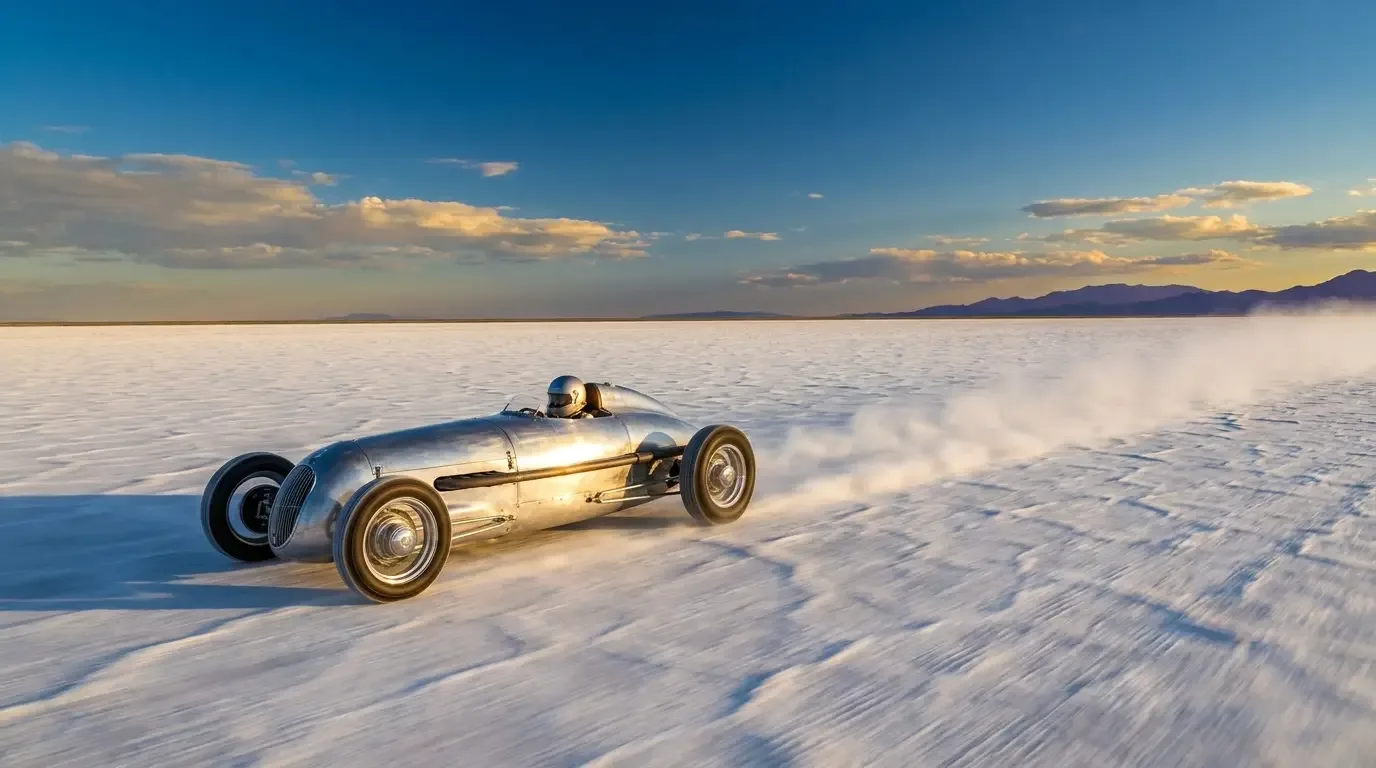
Speed Week is where hot rodding stops being about looking fast and starts being about proving it. A car can have the sweetest chop and the deepest black lacquer in the county, but the salt does not care. Out here the only number that matters is the one on the timing slip. That is what makes Bonneville the spiritual home of land-speed racing, and why it has pulled builders west since the early 1950s.
The salt, and why it is there
The Bonneville Salt Flats are the dried bed of an ancient lake, Lake Bonneville, that once covered a huge chunk of the Great Basin. What is left is a crust of hard salt, flat enough and long enough to lay out a course several miles long. That length is the whole point. A land-speed car does not accelerate quickly the way a dragster does. It builds speed gradually across miles, and you need real estate to do that safely.
The organized racing has roots that reach back to the same dry-lakes culture that produced the first hot rods. Guys who had been running the lakebeds around Southern California, places like Muroc and El Mirage, wanted a longer, faster canvas. The Southern California Timing Association, the SCTA, ran its first Bonneville Nationals in 1949, and Speed Week as an annual event settled into its August slot in the years after. Weather has forced cancellations and reschedules more than once.
This did not appear out of nowhere. It grew straight out of the same stripped-Ford, flathead-powered scene I write about in our hot rod history coverage. Bonneville was the graduation ceremony for the dry lakes.
How the classes actually work
Bonneville is not one race. It is hundreds of tiny races against the record book, sorted into a grid of classes. A class is defined by two things: the type of body, and the type of engine. Put those together and you get a code, and every code has its own record. That structure is what lets a chopped coupe and a purpose-built streamliner both go home winners on the same day.
The body categories run roughly from most streamlined to least. Understanding them tells you a lot about how the sport thinks.
| Body type | What it is |
|---|---|
| Streamliner | Fully enclosed, purpose-built body wrapped tight around the driver and drivetrain. The fastest cars on the salt. |
| Lakester | Open-wheel car, body often based on an aircraft belly tank. Wheels exposed to the wind. |
| Roadster / Modified | Based on a real production body, usually a prewar Ford, chopped and cleaned up for aero. |
| Coupe / Sedan | Closed production bodies, again heavily modified but recognizable as the car they started as. |
Then the engine side splits things further by displacement and by whether the motor is blown, injected, or fed gas versus fuel. The result is a class code like a small combination lock. You are not racing everybody. You are racing the person who last held your exact combination, and their record is the target. That is a very different mindset from wheel-to-wheel racing, and it rewards patience and preparation over aggression.
Belly tankers and streamliners: hot rodding, refined
The two shapes people picture when they think of Bonneville, the belly tanker and the streamliner, both came straight out of hot rod thinking. They are not exotic race-team creations. They are what happens when a hot rodder with a welder decides that the biggest thing slowing him down is the wind.
The belly tanker is the purest example of the breed. After the war, surplus aircraft drop tanks, the long teardrop fuel tanks slung under fighter planes, were sitting around cheap. Somebody figured out that the shape was already close to ideal, low, smooth, and pointed. So they cut a cockpit into it, hung a flathead behind the driver or up front, and went racing. It is period-correct hot rod ingenuity: take a free part, use it for something it was never meant to do, go faster than the guy who spent money.
The streamliner is the next step up in commitment. Instead of adapting a found shape, you build the whole body around aerodynamics from scratch, wrapping it as tight as the rules and the driver's shoulders allow. These are the cars chasing the biggest numbers on the salt. But even the exotic ones trace their DNA back to the same flathead-and-junkyard resourcefulness. This is why I keep telling people that Bonneville is not separate from street building. If you want to understand where the craft comes from, read the story of the hot rod and you will see the same hands at work.
"People see a streamliner and think NASA. It is not NASA. It is a guy who chopped coupes all winter, looked at a drop tank, and thought, that shape is free and it already wants to go fast. Same instinct, longer track."
Jim Vasquez
The culture of chasing a record
What keeps people coming back to Bonneville is not prize money, because there basically is not any. It is the record book and the 200 MPH Club. Break 200 miles per hour and set a class record and you earn a red hat that money cannot buy. Some builders spend a decade chasing one. That is the culture: slow, obsessive, deeply personal engineering, aimed at a number that will outlive you in a ledger.
The pace on the salt is nothing like a drag strip. You wait in long staging lines under a brutal sun. You make a run, then wait hours to make another. Between runs you are lying under the car in the salt, checking, adjusting, listening. It is racing measured in patience. And the community polices its own standards hard, because at these speeds a badly built car is a danger to everyone.
That obsessiveness is the through-line from the garage to the salt. The person building a period roadster for the boulevard and the person building a streamliner for a class record are the same animal. One is chasing a look and a feel, the other is chasing a timing slip, but both are doing it for the same reason: the machine is theirs, and they want to know exactly what it can do.
Why Bonneville still matters
Bonneville endures because it is honest. There is no styling committee, no marketing budget, no way to fake the result. You build the car, you drive it across the salt, and the clock tells the truth. In an era where a lot of car culture is about being seen, Speed Week is still about finding out. That is why builders who could be anywhere in August load up and drive to a white desert in Utah instead.
The salt has thinned over the decades and the sport has had its lean years, but the pull is the same one that dragged rodders off the dry lakes seventy-odd years ago. Somewhere out there is a number with your class code next to it, and the only way to know if you can beat it is to go. That, more than any trophy, is what Bonneville hands you.
Sources and notes
- Period hot-rod press coverage of the SCTA Bonneville Nationals and Speed Week.
- SCTA and land-speed racing rulebooks describing body classes and engine categories.
- Historical accounts of surplus aircraft drop-tank (belly tanker) construction in postwar hot rodding.
- Land-speed racing registry and record-book references, including 200 MPH Club records.
- Builder interviews and shop recollections on salt-flat preparation and running technique.
- Dates and founding years noted above were confirmed against SCTA and land-speed racing records prior to publication.
Related Reading
Have a
Classic Car
for Sale?
Reach thousands of serious classic car collectors across the US.
Sell It Here →
Are You a Classic Car Dealer?
List your full inventory and connect with targeted classic car buyers.
Join as a Dealer →

About the author
Jim Vasquez
Southern California hot rod and custom car builder with roots in the traditional kustom kulture scene.
More in History & Heritage
Comments
Be the first to comment on this article.