
On a warm Saturday evening in the early 1970s, a '64 Impala with a candy-apple paint job rolls onto Whittier Boulevard at about three miles an hour. The rear end drops, the wire wheels catch the streetlight, and a line of cars stretches behind it for blocks. Nobody is in a hurry. That was the whole point. This slice of East Los Angeles, more than any other place, is where the Chicano lowrider grew from a handful of customized family cars into a movement with its own music, its own press, and its own set of rules about how a car should carry itself.
History & Heritage
6 min read
The Lowrider Movement in East LA
Whittier Boulevard, the car clubs, and the music that grew the Chicano lowrider from an East LA ritual into a worldwide movement.
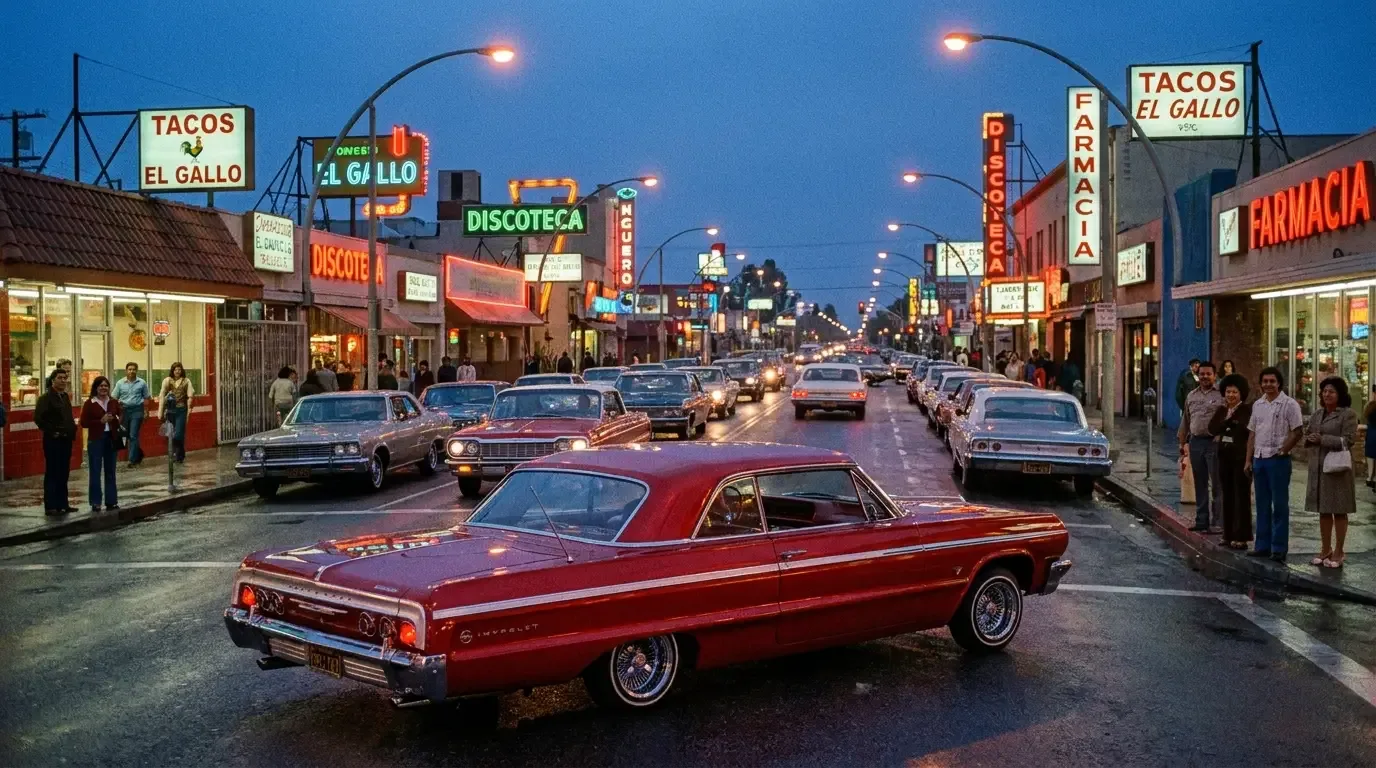
To understand the scene, you have to understand the neighborhood. East LA in the postwar decades was a working-class Mexican American community with a deep car culture already baked in. Young men who could not afford a new hot rod bought older sedans, dropped them low, and made them beautiful instead of fast. The result was a style, and then a philosophy, that spread out from these streets across the Southwest and eventually around the world.
Whittier Boulevard and the ritual of cruising
Whittier Boulevard was the main stage. For roughly two decades it functioned as the unofficial promenade of East LA lowriding, a stretch of commercial road where cars idled past storefronts and taquerias while drivers and passengers waved, called out, and sized up each other's rides. Cruising here was not aimless driving. It was a social event with an understood etiquette: you drove slow, you kept it clean, and you showed respect.
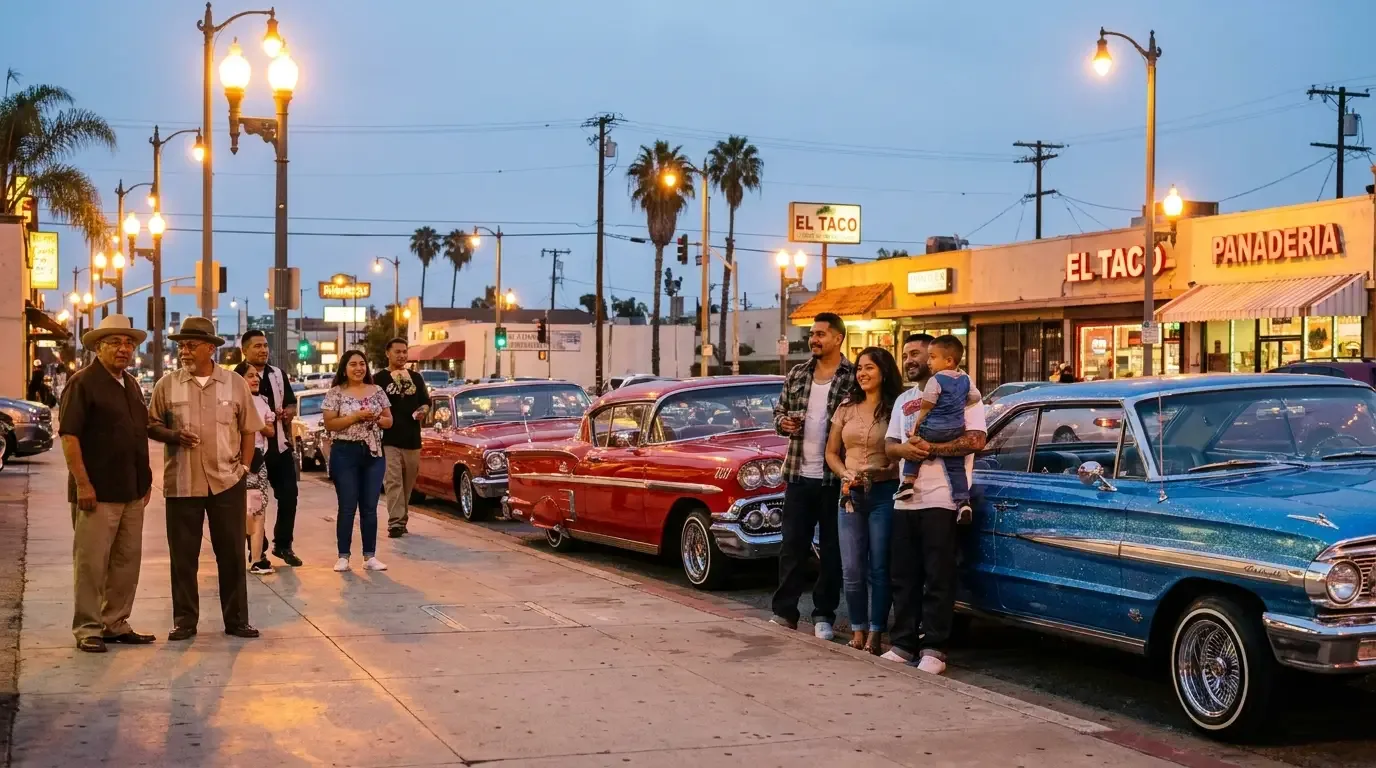
The ritual carried real weight. Families came out. Clubs staked out sections of the boulevard. A well-built car earned its owner standing that money alone could not buy. The scene grew loud and crowded enough that authorities eventually pushed back, and Whittier Boulevard became a focal point in the long fight over where and how lowriders could gather, a story tied closely to the wider history of Lowriding Laws and the Cruising Bans that shaped the culture from the outside.
Why East LA became the birthplace
Plenty of Southern California towns had customized cars. East LA is where the pieces came together. The neighborhood had the population density, the tight-knit family networks, and the mechanical know-how passed between relatives and friends. It also had the boulevards, wide flat commercial streets that were made for slow cruising and being seen.
Just as important was meaning. For a community that faced discrimination in housing, schools, and jobs, the lowrider was a public statement of pride and craftsmanship. A car built by hand, painted with Aztec imagery or a portrait of the Virgin of Guadalupe, said something about identity that words did not have to. This is a thread you can follow through the deeper lowrider history, but East LA is where the emotional center of it sits.
"I have interviewed men who can still name the exact corner where they first cruised, forty years on. They do not talk about horsepower. They talk about their father teaching them to wet-sand a fender, and about who nodded at them on the boulevard. That is the movement, right there."
Patrick Walsh
The clubs that organized the scene
Loose groups of friends gave way to organized car clubs, and the clubs gave the movement its backbone. A club was part social organization, part standards body, and part family. Membership meant your car had to meet a bar, and it meant the club watched out for you. Some of the oldest and best-known clubs took root in and around East LA and the greater Los Angeles area, and their names still carry authority in the community decades later.
Clubs did the unglamorous work that let the culture last. They organized shows, negotiated with police over cruising and parking, raised money for the neighborhood, and enforced the difference between a serious build and a sloppy one. They also pushed back against the stereotype that lowriding was about trouble, insisting in public that it was about family, craft, and pride.
- Standards: clubs held members to a level of paint, upholstery, and mechanical quality before granting a plaque.
- Community: many clubs ran toy drives, scholarships, and neighborhood fundraisers.
- Continuity: plaques and memberships passed down within families across generations.
Magazines and music carried it beyond the boulevard
The movement did not stay local, and two forces carried it outward. The first was print. Lowrider magazine, founded in San Jose in 1977, put the cars, the builders, and the neighborhoods on newsstands nationwide. Suddenly a teenager in Texas or New Mexico could study a feature car from East LA and understand the standards being set. The magazine documented shows, spread technical ideas, and gave the community a shared national conversation.
Music did the rest. Oldies and soul, especially the smooth doo-wop and R&B that became known as the lowrider sound, were the soundtrack of the boulevard. Later, artists working in funk and West Coast hip hop wrote the cars directly into their songs and videos, putting bouncing Impalas and wire wheels in front of a global audience. War's 1975 track "Low Rider" turned the word itself into a cultural shorthand. Between the magazines and the music, a neighborhood ritual became an internationally recognized style.
| Pillar of the movement | Role it played | Rooted in |
|---|---|---|
| Whittier Boulevard cruising | The public stage and social ritual | East LA, 1960s to 1980s |
| Car clubs | Standards, community, and organization | Greater Los Angeles |
| Lowrider magazine | National documentation and reach | Founded San Jose, 1977 |
| Oldies and West Coast music | Soundtrack and global visibility | SoCal Chicano scene |
Sources and notes
- Period Chicano and Southern California press coverage of East LA cruising culture.
- Car club histories, plaques, and registry records from greater Los Angeles clubs.
- Builder and cruiser interviews on Whittier Boulevard and neighborhood scene practices.
- Music and magazine references documenting the culture's national spread, including the January 1977 debut of Lowrider magazine in San Jose and the June 1975 release of War's "Low Rider" on the album Why Can't We Be Friends?
Related Reading
Have a
Classic Car
for Sale?
Reach thousands of serious classic car collectors across the US.
Sell It Here →
Are You a Classic Car Dealer?
List your full inventory and connect with targeted classic car buyers.
Join as a Dealer →

About the author
Patrick Walsh
Automotive journalist covering classic car shows, events, and the enthusiast community across North America.
More in History & Heritage
Comments
Be the first to comment on this article.