
On a Sunday afternoon in East Los Angeles, a line of cars rolls down the boulevard at a walking pace. Bolted to the rear window of each one is a chrome plaque with a club name etched across it. Nobody in that procession is trying to get anywhere fast. The plaque is the point. It says who these people are, where they come from, and who has their back. To understand lowriding, you have to understand the club, because the car was never really the whole story. The people around it were.
History & Heritage
7 min read
Lowrider Clubs and Their History
The plaque, the family, and the famous clubs behind the cars: a respectful look at lowrider club history and how these organizations really work.
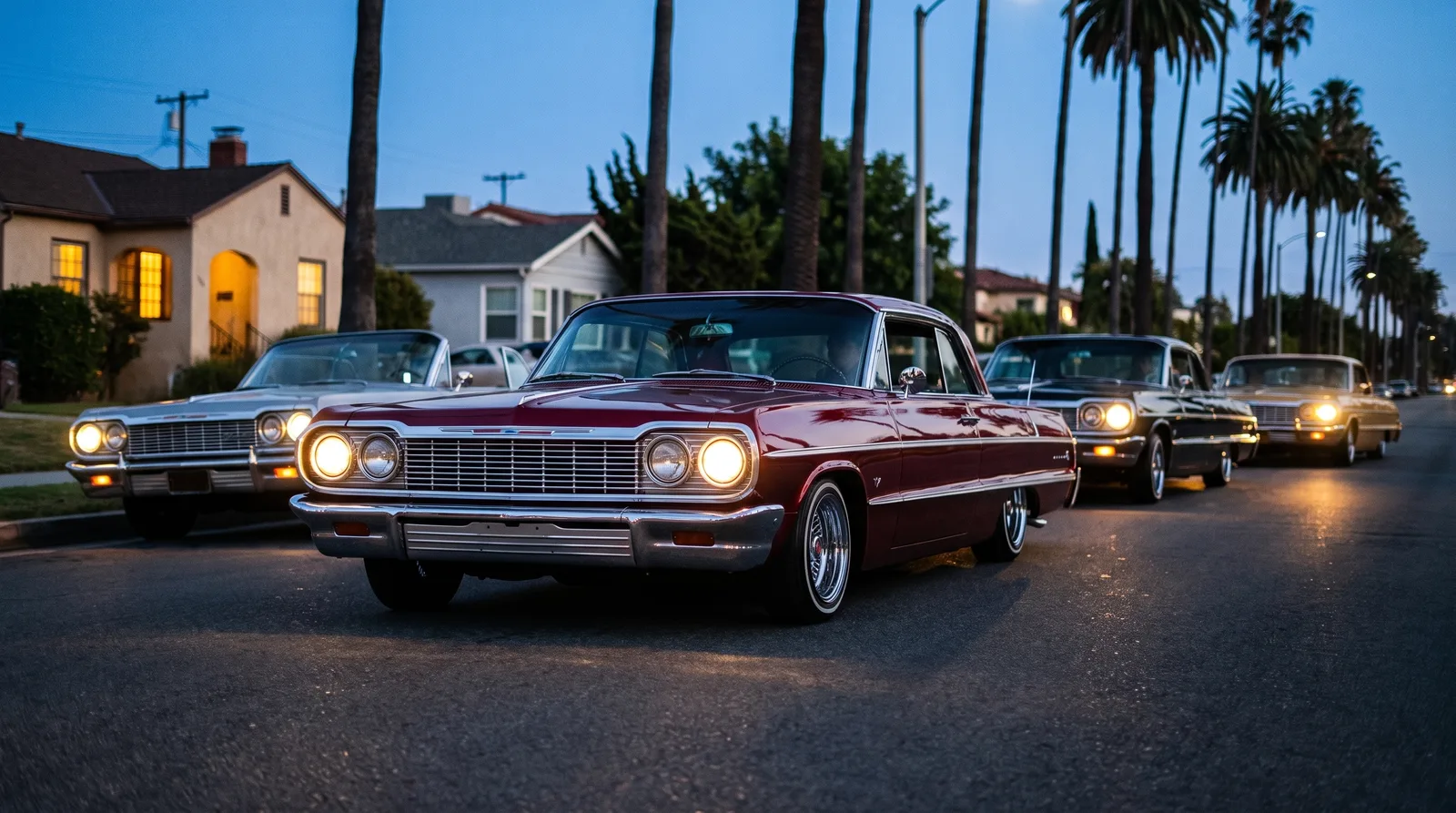
Lowrider clubs grew out of the same soil as the cars themselves, in the Mexican American neighborhoods of Southern California in the years after World War II. Young men who had learned to fix and build things, some of them returning veterans, started laying their cars low and cruising together. Riding in a pack was safer, more social, and a great deal more fun than riding alone. Over time those loose groups of friends hardened into named organizations with rules, dues, and a shared identity. If you want the wider background, the lowrider history reaches back further than most people expect, but the club is where that history became a living community.
The plaque is the club's signature
The single most recognizable object in club culture is the plaque, sometimes called a placa. It is a metal sign, often chromed or engraved, that hangs in the back window and carries the club's name and home city. A plaque is not decoration you buy at a swap meet. It is earned. A prospective member typically rides with a club for a probationary period, shows up to events, helps other members wrench on their cars, and proves they will represent the name well before they are handed one.
The etiquette around plaques runs deep. You do not display a club's plaque unless you belong to that club. Hanging one you did not earn is treated as a serious insult, the kind of thing that ends friendships. When a member is out of the car, many clubs lay the plaque down flat rather than leave it standing in the window, a small ritual that signals the club is not officially present. These are unwritten rules, passed person to person, and they matter more than any bylaw.
A family more than a car club
Ask longtime members what keeps them in a club for twenty or thirty years and few of them lead with the cars. They talk about the people. Clubs function as extended families. They show up for weddings, quinceañeras, and funerals. They organize toy drives at Christmas, raise money when a member is sick, and teach teenagers how to sand a panel or set up a hydraulic pump instead of leaving them idle. A lot of the community work that lowrider clubs do never makes it into a magazine, because it was never done for attention.
That family structure is also how skills and standards get passed down. An older member who spent decades building cars will mentor a younger one, correcting the work, explaining why a certain paint or a certain stance is right. The culture stays alive because it is taught by hand, generation to generation, in driveways and club garages. The story of these neighborhoods, told well in The Lowrider Movement in East LA, is really a story about that transmission of knowledge and pride.
"I have watched a club park thirty cars at a member's funeral and lower every plaque at the same moment. Nobody rehearsed it. That is when you understand these are not car clubs. They are families that happen to build beautiful cars."
Nora Beckett
The clubs that built the name
A handful of clubs became known far beyond their home streets, and their names come up in almost any serious conversation about the culture. The Dukes Car Club, founded in Los Angeles, is one of the oldest continuously running lowrider clubs and is often cited as a founding institution of the movement. Imperials Car Club, also rooted in Southern California, earned lasting fame when one of its members' cars, Gypsy Rose, a customized 1964 Chevrolet Impala built by Jesse Valadez, appeared on the opening of the 1970s television show Chico and the Man and became one of the most photographed lowriders ever built.
Other clubs, including Klique, Lifestyle, and Techniques, built reputations through show cars, chapters that spread across states and eventually across countries, and a refusal to cut corners on quality. What these organizations share is longevity and standards. They did not chase trends. They set them, and then they held the line on what a properly built car should look like. For the fuller arc of how the cars and the culture evolved together, the story of the lowrider is worth reading in full as the story of the lowrider.
| Term | What it means in club culture |
|---|---|
| Plaque / placa | Engraved metal sign in the rear window naming the club and its city; earned, not bought. |
| Prospect | A member on a probationary period, riding with the club before being voted in. |
| Chapter | A local branch of a larger club, often in another city, state, or country. |
| Cruise | An organized slow drive together, the original social act at the heart of the culture. |
| Hop | A hydraulic competition where cars bounce the front end high; a common club event draw. |
How clubs actually run
Behind the chrome, a lowrider club operates like any serious organization. Most have a president, a vice president, a treasurer who collects monthly dues, and a sergeant at arms who keeps order at events. New members are voted in rather than simply signing up. Cars are often expected to meet a standard before a member represents the club at a show, which is one reason club cars tend to be built to a high level rather than left half finished.
The rules exist to protect the name. A club's reputation is built over decades and can be damaged in an afternoon by one member behaving badly at a cruise. That is why the probationary period, the voting, and the plaque etiquette all point in the same direction: everything is about earning the right to represent something larger than yourself.
Why the tradition endures
Lowrider clubs have outlasted cruising bans, shifting neighborhoods, and decades of being misunderstood by outsiders. They endure because they were never only about cars. They are about belonging, about a name in a back window that ties a person to a place and to everyone else riding under that same name. The car gets the attention. The club is the reason it keeps rolling.
Sources and notes
- Club and registry records for founding clubs and chapter histories.
- Builder and member interviews on plaque etiquette and club structure.
- Period press and lowrider magazine coverage of show cars and events.
- General histories of Mexican American car culture in Southern California.
Related Reading
Have a
Classic Car
for Sale?
Reach thousands of serious classic car collectors across the US.
Sell It Here →
Are You a Classic Car Dealer?
List your full inventory and connect with targeted classic car buyers.
Join as a Dealer →

About the author
Nora Beckett
Automotive features writer and photographer who tells the human stories behind the cars, from show fields to cross-country road trips.
More in History & Heritage
Comments
Be the first to comment on this article.