
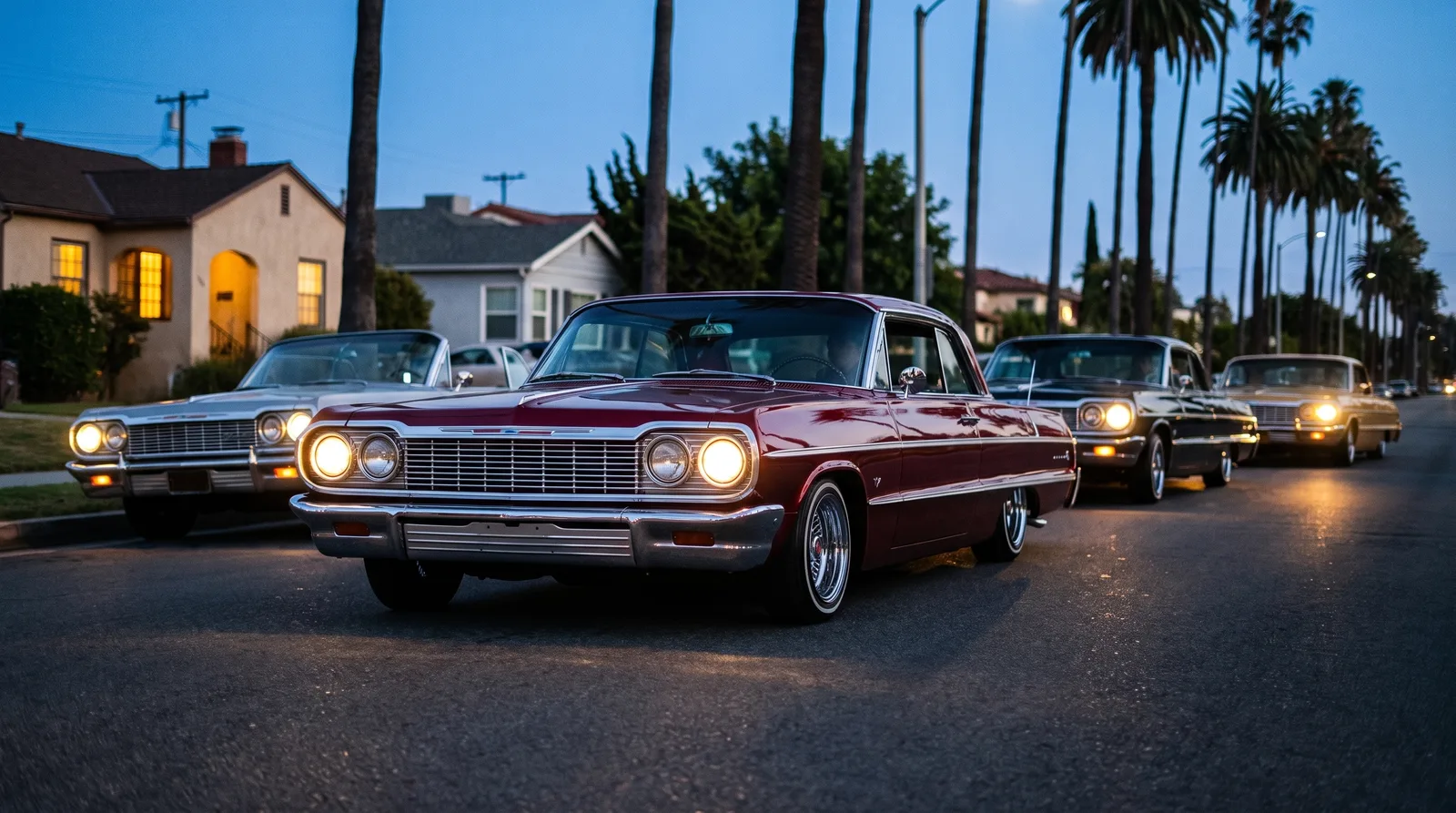
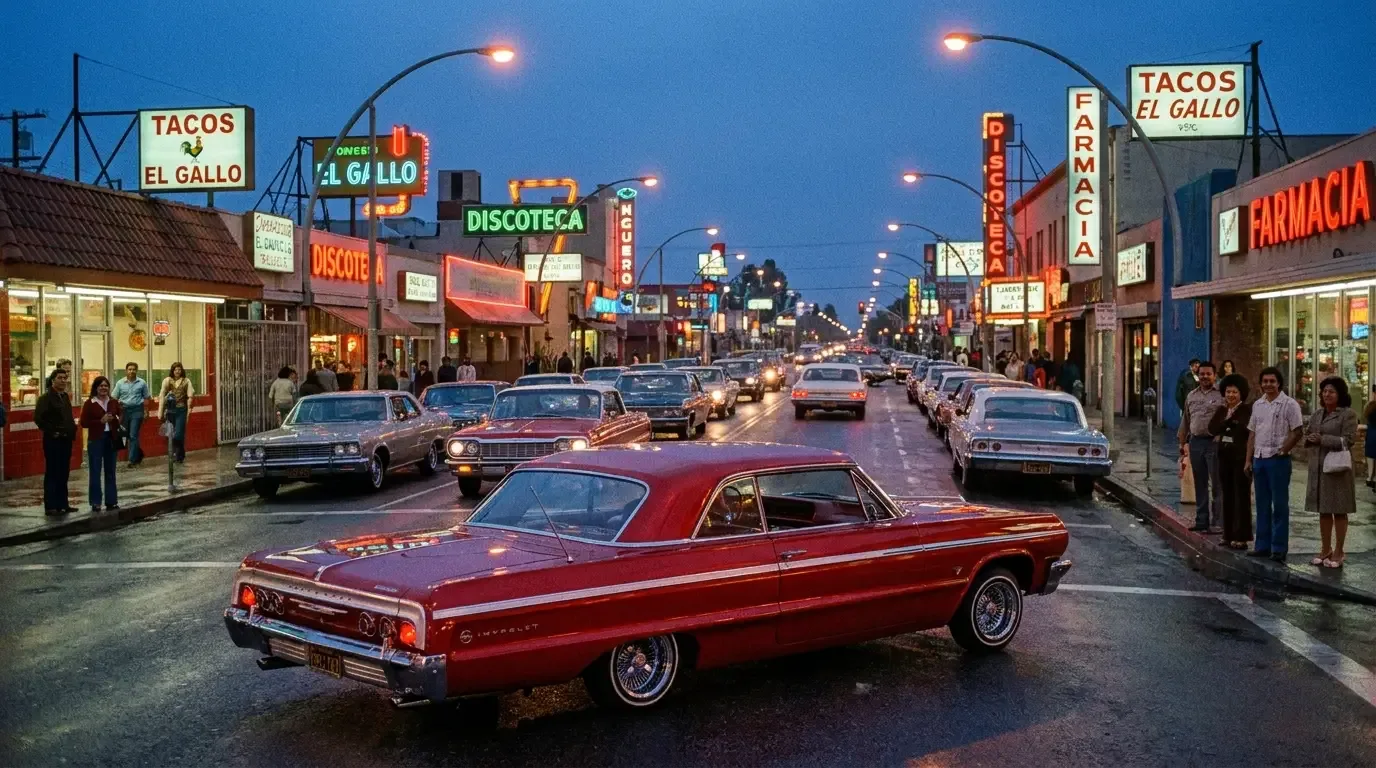
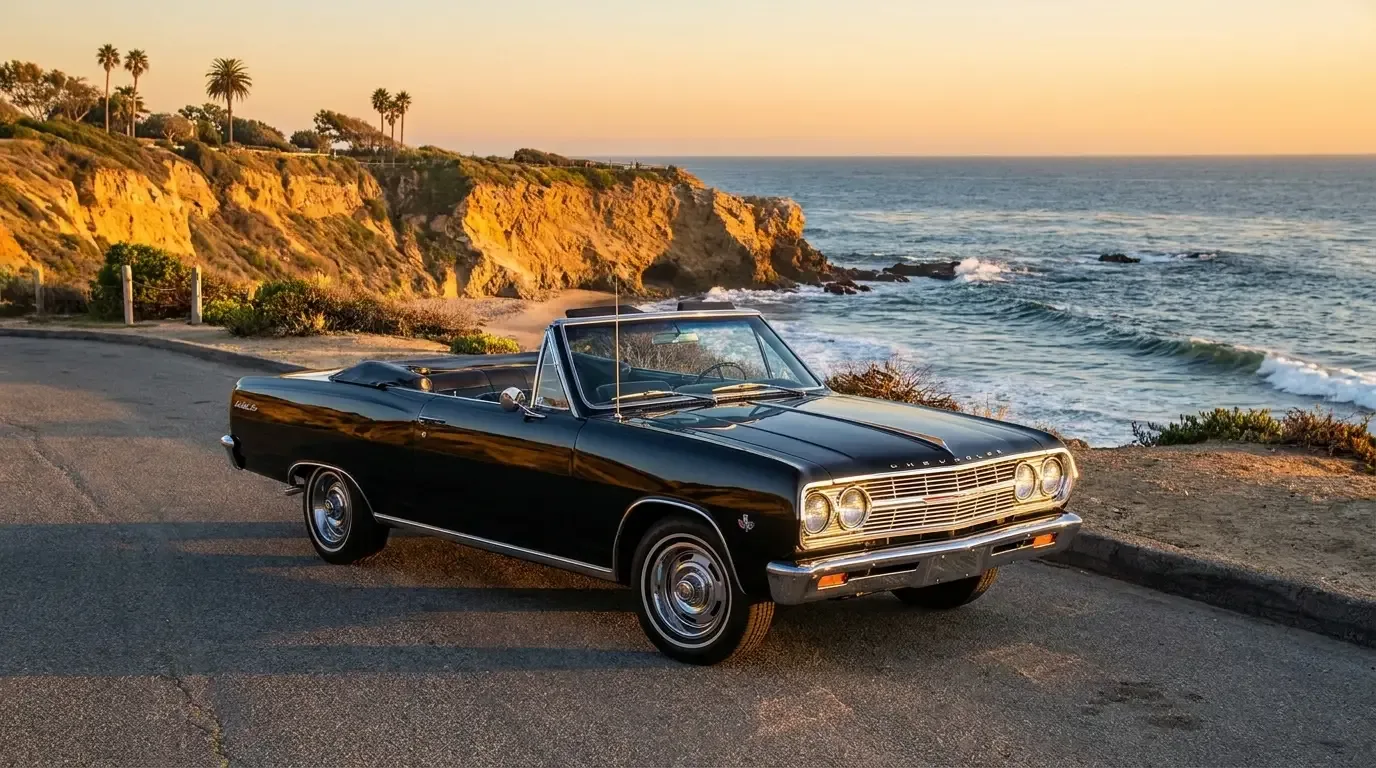
On a Sunday evening in East Los Angeles, sometime in the years after the Second World War, a young Mexican American man eased a lowered Chevrolet down Whittier Boulevard at a walking pace. He was not going anywhere in a hurry. That was the point. The car sat close to the pavement, polished until the streetlights pooled on the paint, and every head on the sidewalk turned to watch it pass. This was not speed. This was presence. To understand the lowrider you have to start here, on a specific street, with a specific person who wanted to be seen on his own terms, because the lowrider was never really about the car. It was about the community that built it and the pride it carried.
History & Heritage
9 min read
Lowrider History and Chicano Culture
How the lowrider grew out of postwar East Los Angeles into a lasting expression of Chicano pride, craft, and community.
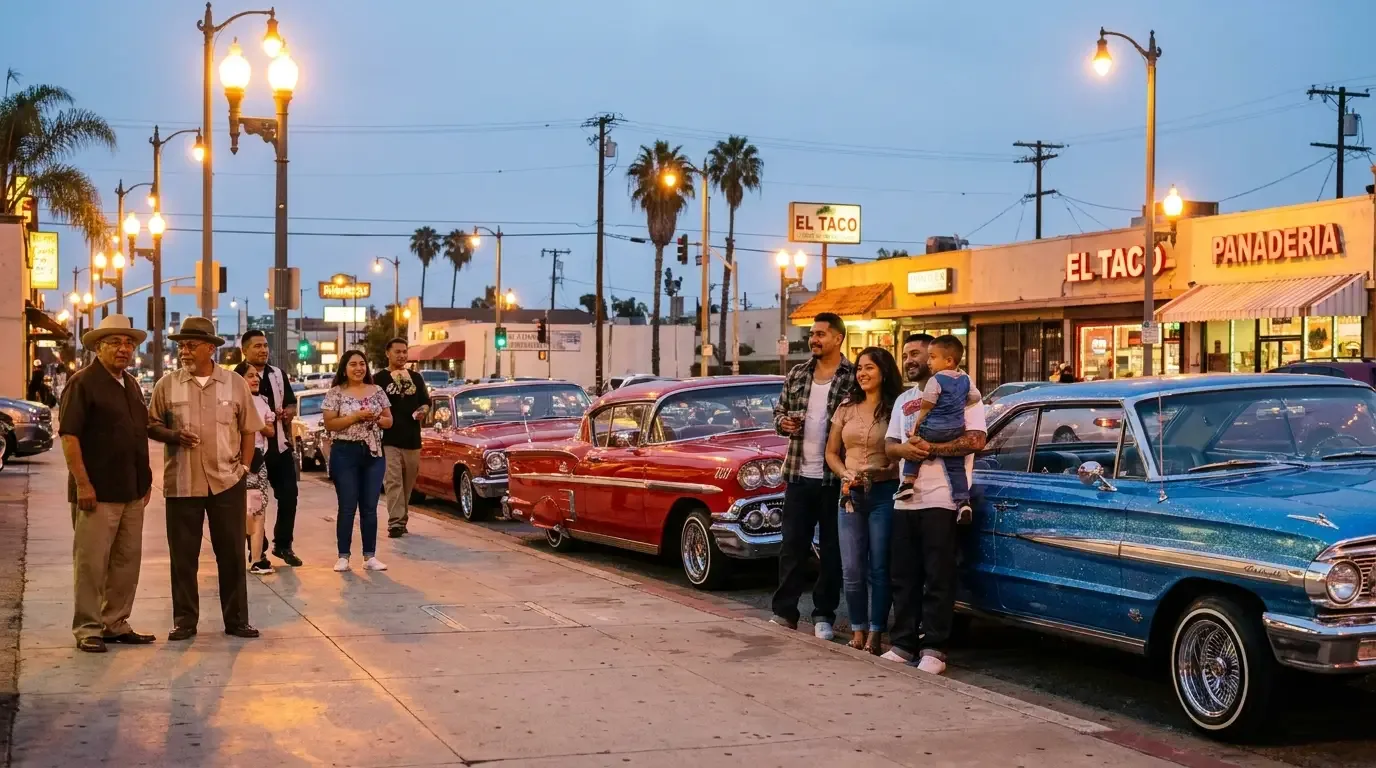
What follows is a look at where that culture came from, how it survived decades of hostility, and why "low and slow" became a philosophy rather than a driving style. For the wider arc of the movement, this piece sits alongside the lowrider story, and it stays with the people and the meaning rather than the mechanicals.
East LA after the war: where it began
The lowrider grew out of the barrios of Southern California in the late 1940s and 1950s, with East Los Angeles as its heart. Young Chicanos, many of them children of families who had come north during the Mexican Revolution and the labor migrations that followed, were coming home from military service or aging into the postwar economy. Some had money for the first time. Cars were cheap and plentiful, and a used prewar Chevrolet could be had for very little.
Where the Anglo hot rodders of the same era were stripping weight and chasing quarter-mile times, the young men of the barrio went the other direction. They kept the fenders, kept the chrome, and dropped the car toward the ground. The earliest method was simple and cheap: sandbags in the trunk, or cut coil springs, to sink the rear end. A car that sat low looked settled, serious, and unmistakably different from the raised, stripped machines of the drag-racing crowd. The aesthetic was deliberate. It said this car belongs to someone who takes his time.
That difference in approach was also a difference in values. The lowrider was a family car dressed for Sunday, not a weapon for the strip. It was meant to be driven slowly through the neighborhood where everyone knew you, past the church and the taqueria and the porch where your abuela sat. The car was an extension of the person and, by extension, the community.
The switch that changed everything
The single most important technical leap in this culture answered a legal problem. If a lowered car was illegal, the solution was a car that could change its own height on command. The story most often told credits Ron Aguirre, a Southern California customizer who fitted aircraft-surplus hydraulic components to his Corvette-bodied show car, the X-Sonic, in the late 1950s. With a flip of a switch the car could rise and fall.
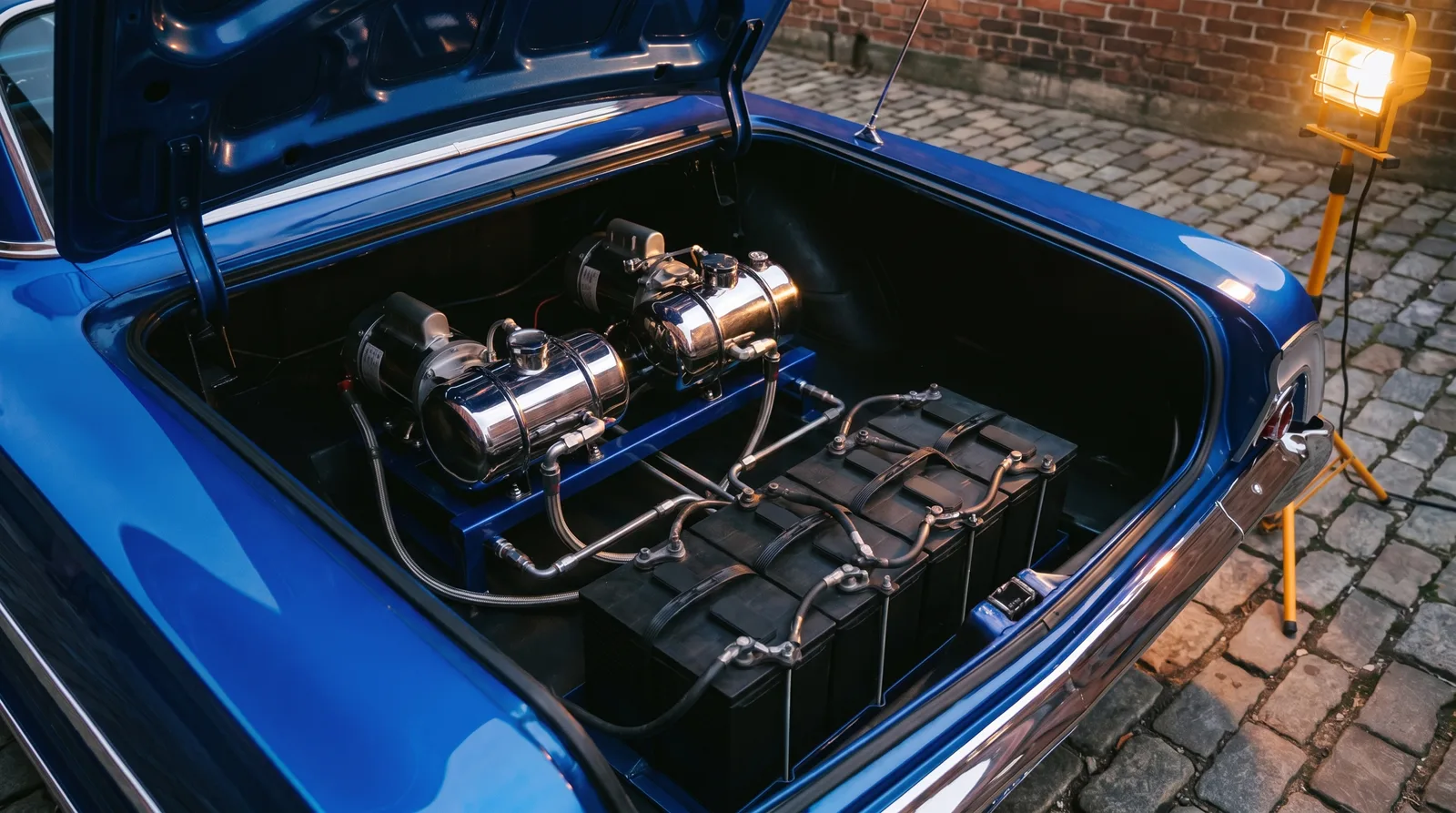
Aircraft hydraulic parts were cheap in postwar California, sold off as surplus by the crate. Builders adapted them, learned their limits, and turned a compliance trick into an art form. The ability to raise and lower the car led directly to hopping and dancing, the competitive displays that became a signature of lowrider gatherings. The technology has since branched into pumps, batteries, and modern air systems, a deep subject covered in our guide to lowrider hydraulics, but the cultural point is simple. A law meant to erase these cars instead gave them their most theatrical trick.
Low and slow: the philosophy behind the phrase
"Low and slow", or in Spanish "bajito y suavecito", is the closest thing the culture has to a motto. It is easy to read it as a description of how the cars drive. It is more accurate to read it as a description of how their builders wanted to live and be seen.
Speed cultures are about escape and dominance: outrun the other guy, beat the clock, leave. Low and slow is the opposite instinct. It is about staying, being present, and giving the neighborhood something to look at. Cruising a boulevard at a crawl on a Saturday night was a public act. You were showing your work, your patience, and your place in a community that recognized both. The slowness was a form of respect, for the car, for the craft, and for the people watching.
- Low: the car sits near the ground, settled and deliberate, the opposite of the raised, aggressive stance of a hot rod.
- Slow: the pace is a choice, a refusal to hurry through a neighborhood that is worth lingering in.
- Clean: a real lowrider is finished, detailed, and cared for, never thrown together.
- Shared: the car exists to be shown to others, not hidden in a garage.
The craft: candy paint, murals, and the tuck and roll
A lowrider is a canvas. The build style that grew up around the culture is among the most labor-intensive in the car world, and it borrows freely from Mexican and Chicano visual traditions. Candy paint, translucent color layered over a metallic base until it glows, gives the deep, wet look that defines a show car. Over that, muralists paint scenes: religious imagery, Aztec motifs, portraits of family, images of the Virgin of Guadalupe, and tributes to neighborhoods and lost friends.
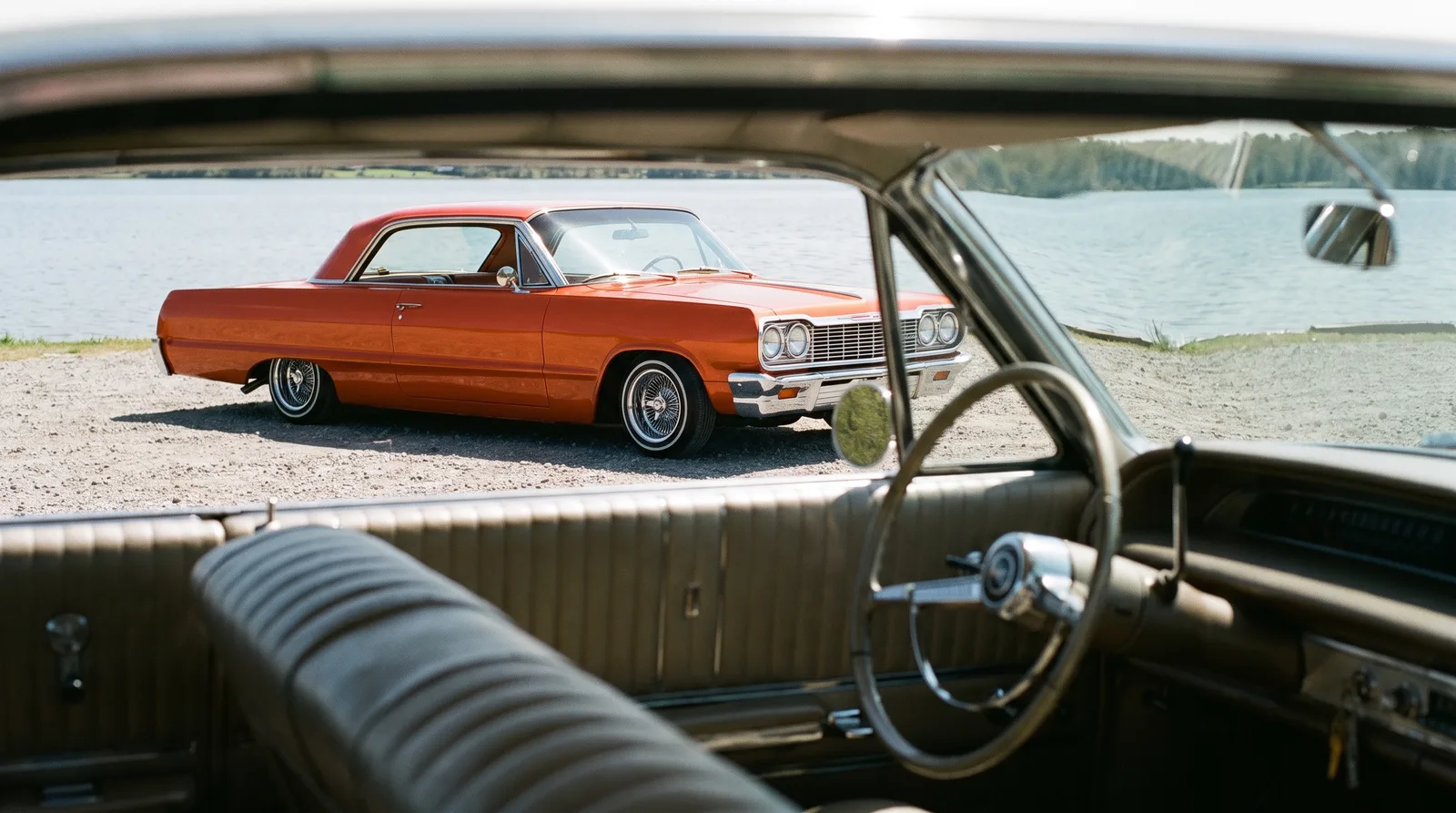
Underneath the paint sit the other signatures. Wire wheels, often narrow-spoke and gleaming, replaced the steel rims of a stock car. Inside, the tuck-and-roll upholstery, pleated and rolled fabric done by hand, turned a plain bench into something closer to furniture. Each element took skill, time, and money, and each was a way of signing the car. A lowrider done right announces exactly whose hands made it.
| Element | What it is | Why it matters |
|---|---|---|
| Candy paint | Translucent color over a metallic base coat | Deep, glowing finish that reads as hours of labor and skill |
| Murals | Hand-painted scenes, often religious or cultural | Turns the body into a personal and cultural statement |
| Wire wheels | Spoked wheels, frequently with whitewall tires | The classic lowrider stance and period-correct look |
| Tuck-and-roll interior | Hand-pleated, rolled upholstery | Craftsmanship carried inside the car, not just on the paint |
| Hydraulics or air | Adjustable suspension | Legal ride height plus hopping and dancing at shows |
"I have stood at a car show and watched three generations of one family gather around a single Impala, the grandfather pointing at the mural, the grandson asking about the switches. That car was a family history you could walk around. Nobody was in a hurry, and that was the whole idea."
Patrick Walsh
Car clubs and cruising: the social heart
The car club is where lowrider culture organized itself. Clubs gave builders a name to run under, a plaque to hang in the rear window, and a set of people who would help sand a fender, front a few dollars, or show up at a funeral. Some clubs have run for decades and now count second and third generation members. The plaque in the back window is not decoration. It is an affiliation, a statement of who you ride with.
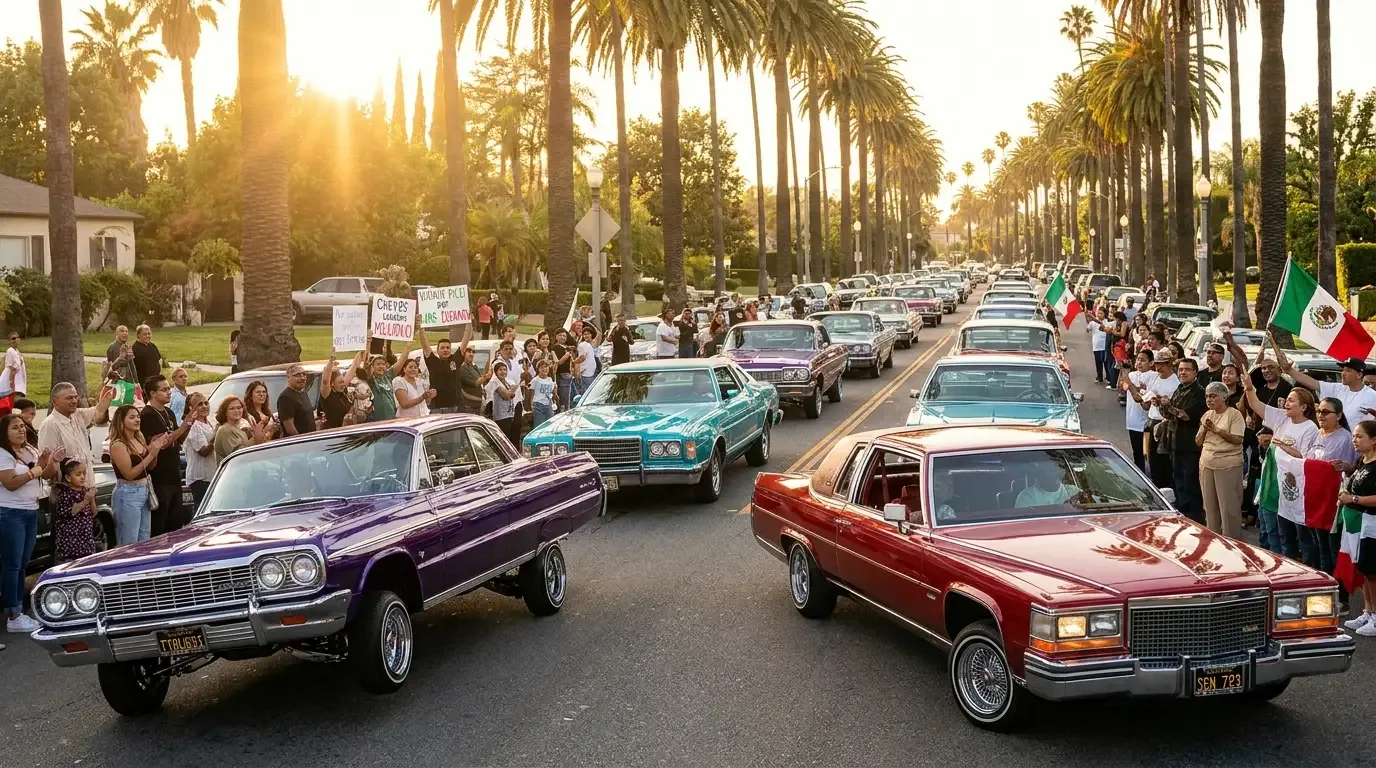
Cruising was the club's public face. Whittier Boulevard in East LA became the most famous cruising strip in the country, a slow river of polished cars on weekend nights where families gathered, music played, and the neighborhood turned out. Cruising was social, generational, and largely peaceful, but it drew official suspicion. Cities across California passed anti-cruising ordinances through the 1980s and 1990s, closing boulevards and citing drivers. Whittier Boulevard itself was shut to cruising for years. Only recently have several California cities begun repealing those bans, an official acknowledgment that a tradition treated as a nuisance was in fact community heritage.
Pride, misunderstanding, and endurance
For much of its history the lowrider was misread from the outside. Lowered cars and slow cruises were treated by some authorities as signs of trouble rather than as craft and celebration, and the culture absorbed a great deal of unfair suspicion. That reading missed almost everything that mattered. The lowrider was, and is, a form of Chicano pride made visible: a way for a community that had often been pushed to the margins to claim a stretch of public street, on a public night, with something beautiful that it had built itself.
The endurance of the culture is the answer to the misunderstanding. It survived a hostile vehicle code, decades of cruising bans, and shifting car fashions, and it did so by being about people rather than machinery. Today lowriders appear in museum exhibitions, in films and music, and in clubs from Tokyo to São Paulo, but the center of gravity is still a family, a neighborhood, and a car built to be shown with pride. For those who want to own a piece of that history, there are classic lowriders for sale that carry the marks of the hands that built them.
The young man cruising Whittier Boulevard after the war could not have known he was starting a movement that would outlast him by generations. He only knew that the car was low, the night was warm, and the whole neighborhood was watching. That, in the end, was always enough.
Sources and notes
- Period press and lowrider publications documenting the movement's origins and growth.
- California Vehicle Code references regarding ride-height regulation.
- Car club histories and builder interviews on craft, plaques, and cruising traditions.
- Regional reporting on cruising ordinances and their recent repeal in California cities.
- Museum and cultural-heritage documentation of lowrider art and community history.
Related Reading
Have a
Classic Car
for Sale?
Reach thousands of serious classic car collectors across the US.
Sell It Here →
Are You a Classic Car Dealer?
List your full inventory and connect with targeted classic car buyers.
Join as a Dealer →

About the author
Patrick Walsh
Automotive journalist covering classic car shows, events, and the enthusiast community across North America.
More in History & Heritage
Comments
Be the first to comment on this article.