
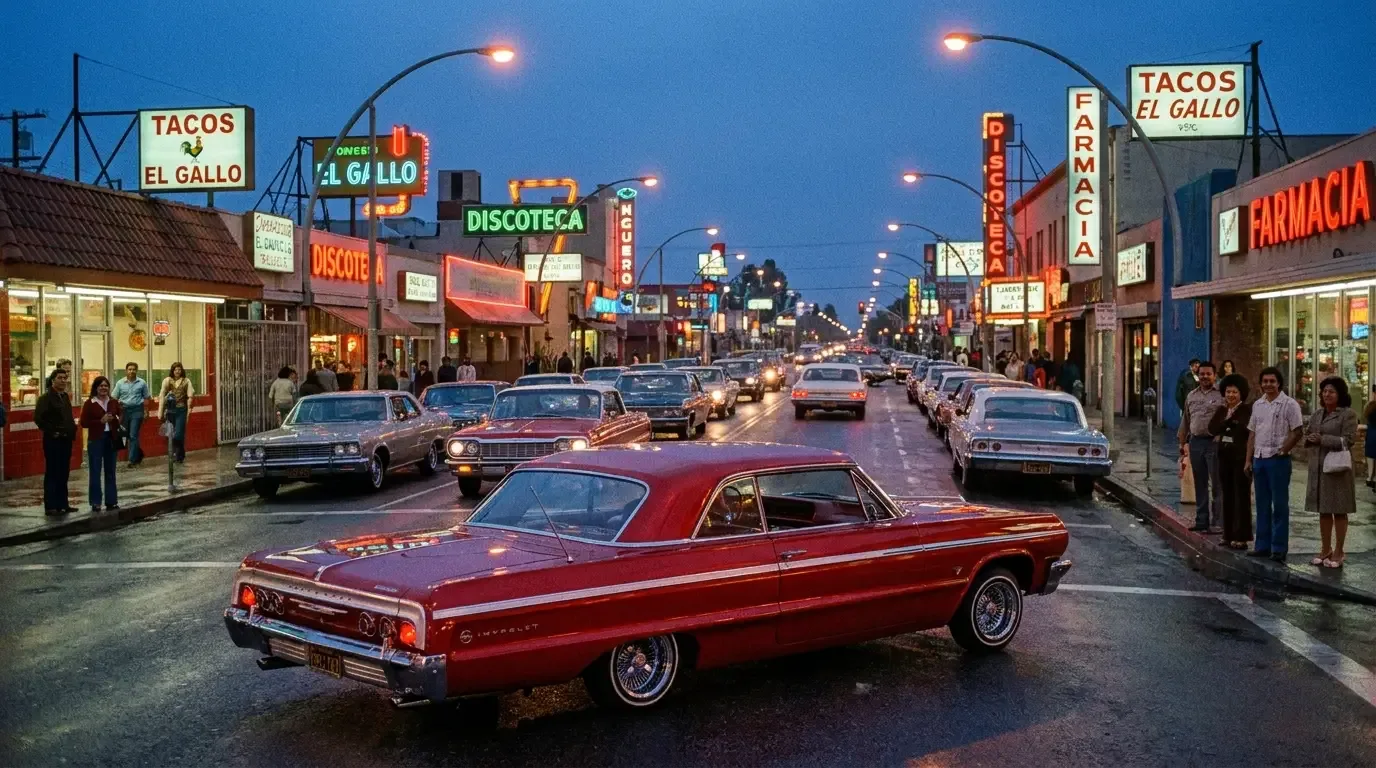
On a Friday night in the early 1980s, Whittier Boulevard in East Los Angeles filled bumper to bumper with candy-painted metal, chrome flashing under the streetlights, families waving from porches. By the middle of that decade a driver could be pulled over, ticketed, and turned around for doing the one thing the car was built to do: ride low and roll slow. The story of lowriding is not only a story of hydraulics and murals. It is a story about who gets to use a public street, and for decades the law had a specific answer that did not include the people in those cars.
History & Heritage
7 min read
Lowriding Laws and the Cruising Bans
From the 1957 low-vehicle law to No Cruising signs to AB 436: how the rules boxed in lowriders, and how the community fought back and won.
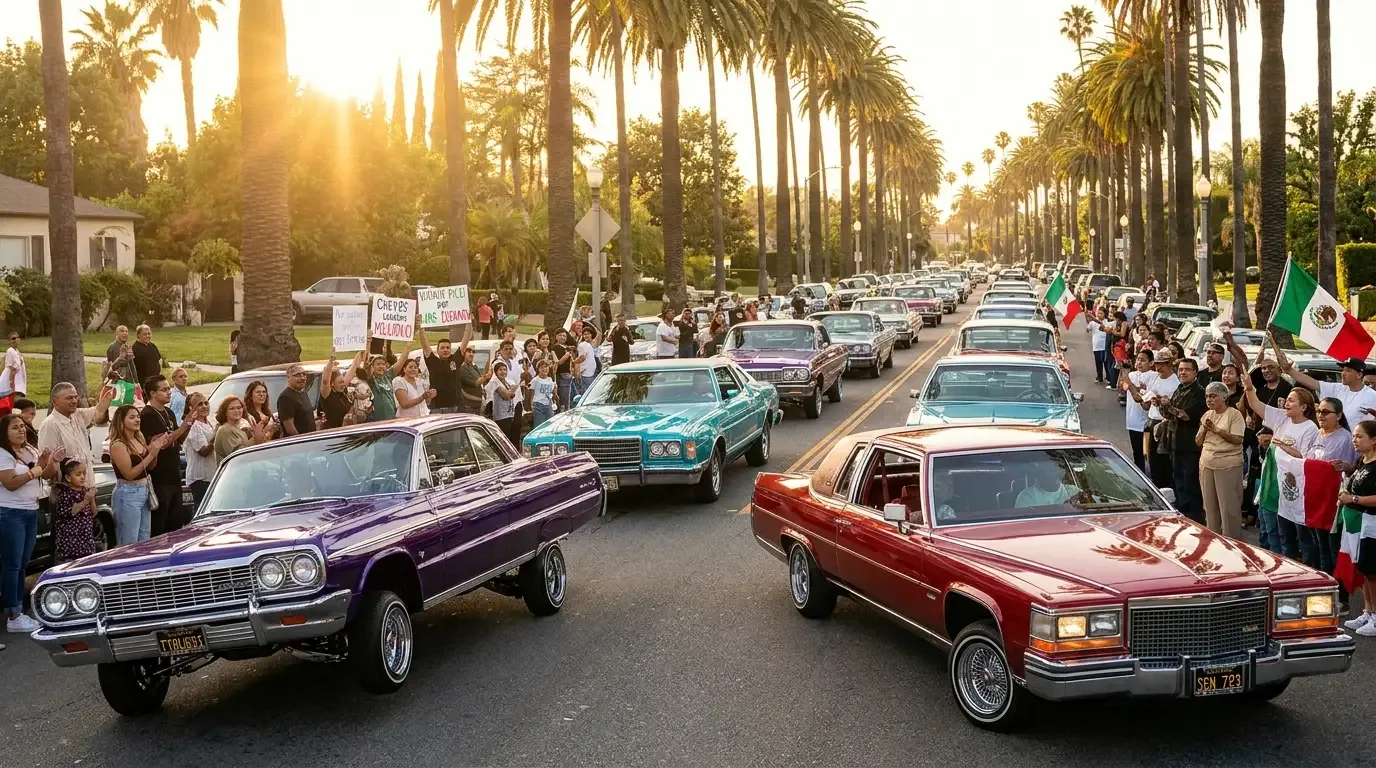
To understand why the recent legal changes matter so much to the community, you have to understand what came before. Lowriding grew out of the same postwar Chicano neighborhoods that shaped so much of Southern California, and the fight over cruising is threaded through the wider lowrider history that the culture carries with it today.
The low-vehicle law that started it all
The first legal wall came from Sacramento, not from any city council. California Vehicle Code section 24008, on the books since 1957, made it illegal to operate a car with any part of the body below the bottom of the wheel rims. On paper it read like a safety measure. In practice it gave officers a reason to stop almost any lowrider, because dropping the body close to the pavement is the entire point of the build.
The law predated hydraulics in the scene. The early builders were dropping frames with sandbags, cut coils, and blocks, so a static drop could put the rocker panels well below the rims. When switches and pumps arrived, drivers could lift the car back up to legal height at the flip of a lever, which is part of why hydraulic setups spread so quickly. Beating a §24008 stop was one of the practical reasons the technology took hold, alongside the sheer showmanship of it.
Cruising ordinances and the anti-cruising signs
The second wall was local. Starting in the late 1980s, California cities used a separate authority to attack cruising directly. Under the vehicle code, municipalities could pass ordinances defining cruising, usually as passing a designated checkpoint some fixed number of times within a set window, and post signs warning of fines. Whittier Boulevard, the boulevards of San Jose, streets in Sacramento and National City, and cruising strips across the state all carried "No Cruising" signs by the 1990s.
These ordinances rarely named lowriders, but everyone understood the target. The signs went up on the boulevards where Chicano car clubs gathered, and the enforcement fell hardest on the drivers who had turned cruising into an art form. Cruising is not aimless. It is a social ritual, a rolling show, a way for clubs to be seen. Making it a ticketable offense turned a cultural gathering into a legal risk.
"You could pour two years and every spare dollar into a car built to be looked at, then get written up for driving it slowly past the people who wanted to look. That contradiction sat at the center of cruising bans for a generation."
Patrick Walsh
The community's long fight to be seen
The pushback came from inside the culture. Car clubs organized, showed up to city council meetings in their Sunday best, and made a simple argument: cruising is expression, and lowriders bring people and money to a neighborhood rather than trouble. Clubs pointed to the toy drives, the fundraisers, and the family character of the scene. That organizing did not happen overnight, and much of it ran through the same clubs that built the culture, a thread I follow in Lowrider Clubs and Their History.
Progress arrived city by city. San Jose, which had one of the most contested cruising histories in the state, moved to lift its anti-cruising ordinance and its low-rider-specific rules in 2022. Sacramento followed, with its city council voting to repeal its own cruising ban in 2023. National City, long associated with lowrider culture in the San Diego area, also revisited its restrictions. Each local repeal chipped at the idea that cruising was a nuisance to be policed rather than a tradition to be recognized.
The 2023 repeal: Assembly Bill 436
The statewide turning point was Assembly Bill 436. The bill did two things at once. It stripped cities of the specific authority to pass and enforce anti-cruising ordinances, and it repealed the low-vehicle provision of §24008 that had made a dropped car illegal by its very design. Governor Gavin Newsom signed AB 436 on October 13, 2023, and the changes took effect on January 1, 2024.
For a community that had spent decades treating a slow drive down the boulevard as a legal gamble, the repeal was more than a technical fix. It was the state acknowledging that the cars and the ritual around them were legitimate. The legislature had already passed a resolution in 2022 encouraging cities to drop their cruising bans, and AB 436 turned that encouragement into law. The measure carried broad support, in part because lawmakers who grew up around the culture pushed it forward.
| Milestone | Year | What it did |
|---|---|---|
| CVC §24008 enacted | 1957 | Banned any car part below the wheel rim, later used to stop lowriders |
| Local cruising ordinances spread | Late 1980s–1990s | Cities posted "No Cruising" signs and set checkpoint-based fines |
| San Jose lifts cruising ban | 2022 | Repealed anti-cruising and low-vehicle rules locally |
| Sacramento repeals cruising ban | 2023 | City council voted to end its ordinance |
| AB 436 signed | 2023 | Ended statewide cruising authority and repealed the §24008 low-vehicle ban |
| AB 436 takes effect | Jan 1, 2024 | Cruising and low ride-height legal statewide |
What the repeal does and does not change
AB 436 removed the two tools most often used against lowriders, but it did not hand drivers a blank check. General traffic law still applies. Exhibition of speed, reckless driving, equipment and lighting rules, and noise ordinances remain enforceable, and a car that genuinely drags on the pavement can still raise safety questions. The difference is that riding low and cruising a boulevard are no longer offenses in themselves.
The change also reaches beyond California in spirit. Other states and cities have watched the debate, and the California repeal gave organizers elsewhere a concrete model to point to. For the culture itself, the win reinforced something the clubs had said all along, that these cars belong on the street and are part of the same tradition I trace in the lowrider story. The boulevards that once carried warning signs now carry sanctioned cruise nights, and the ritual that survived decades of tickets is finally legal to enjoy in the open.
Sources and notes
- California Vehicle Code, sections 24008 and 21100 (low-vehicle and local cruising authority provisions)
- California Assembly Bill 436 (2023) legislative record and Governor's signing action
- Municipal ordinance and city council records for San Jose, Sacramento, and National City cruising repeals
- Period and contemporary press coverage of California cruising bans and their repeal
- Car club and community accounts of cruising enforcement and civic organizing
Related Reading
Have a
Classic Car
for Sale?
Reach thousands of serious classic car collectors across the US.
Sell It Here →
Are You a Classic Car Dealer?
List your full inventory and connect with targeted classic car buyers.
Join as a Dealer →

About the author
Patrick Walsh
Automotive journalist covering classic car shows, events, and the enthusiast community across North America.
More in History & Heritage
Comments
Be the first to comment on this article.