
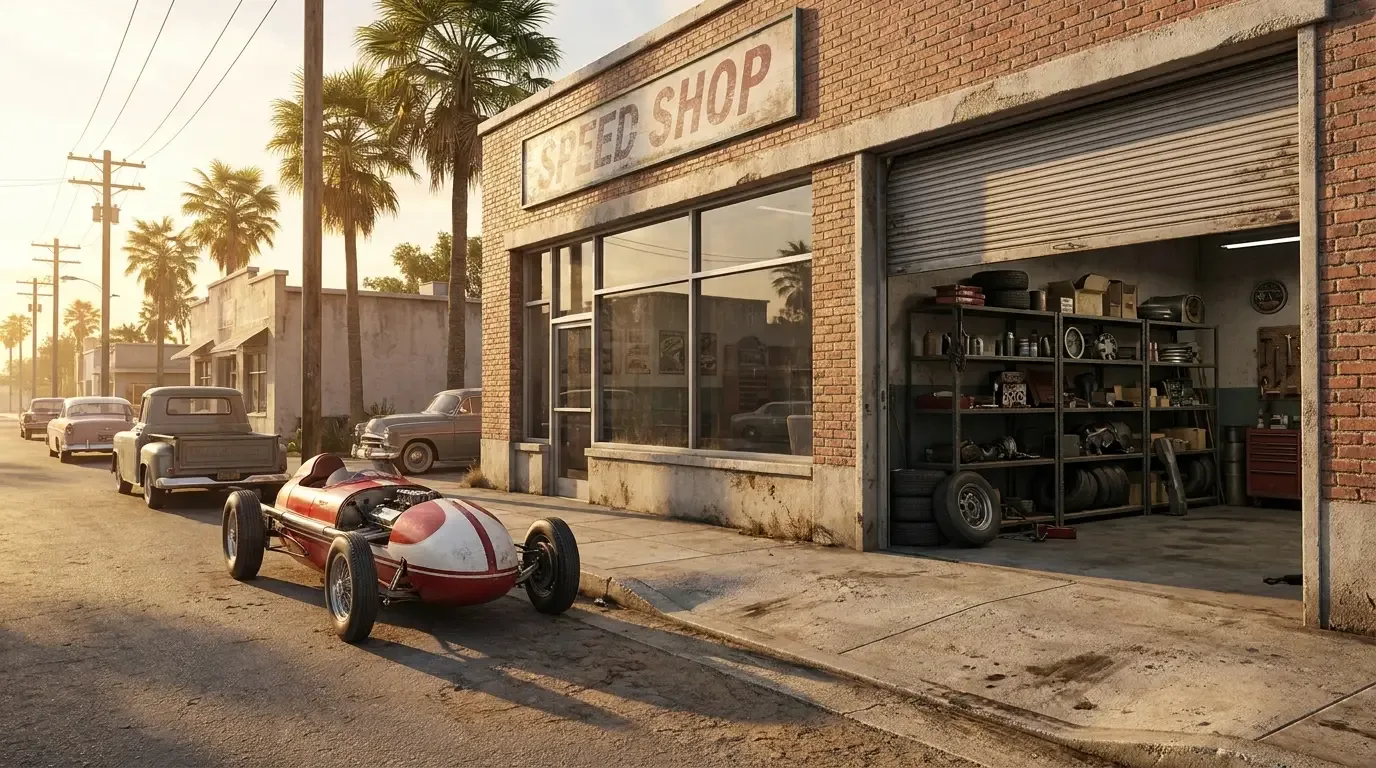
Walk into any serious hot rod shop today and you will find the same basic layout: a parts counter, a dyno or a flow bench in back, a rack of catalogs, and a guy who has run what he sells. That model did not exist before the war. Somebody had to invent it. The So-Cal Speed Shop, opened by Alex Xydias in Burbank in 1946, is where a lot of that template got set. It took the loose, backyard business of going fast and turned it into something you could buy over a counter, and honestly, every speed shop I've ever set foot in from here to Milwaukee still owes Xydias a debt he never collected on.
History & Heritage
7 min read
The So-Cal Speed Shop and the Postwar Boom
Alex Xydias, the belly tank lakester, and the red-and-white livery that made So-Cal Speed Shop the template for the hot rod industry.
Before you get lost in the history, it helps to know where all of this sits. The postwar speed shop is one chapter in a much longer story, and if you want the full arc you can read the hot rod history that frames the whole movement.
Alex Xydias and the shop that started an industry
Alex Xydias was a young guy back from military service with a feel for machinery and a nose for what other rodders wanted. The story goes that he opened So-Cal Speed Shop in a small storefront in Burbank with almost no money and a lot of hustle. What made him different was not that he sold parts. Plenty of surplus and machine shops sold parts. He understood that the men buying them wanted a place run by someone who actually competed, someone who could tell you whether a set of heads was worth the money because he had bolted them on himself.
That credibility is the whole game in this business, and it still is. A speed shop lives or dies on whether the counterman knows the difference between what works and what just looks good in an ad. Xydias built the reputation first and the catalog second. He raced at the dry lakes, he showed up at the events, and the shop's name traveled with him.
"You could always tell the shops that were run by racers, no matter what part of the country they were in. The parts were the same, but the advice was worth more than the parts. Xydias sold you a plan, not just a manifold."
Gary Nowak
The belly tanker and the value of a rolling billboard
The single smartest thing Xydias did was put his shop's name on a car that went fast in front of everybody. The So-Cal belly tank lakester is the piece of hardware most people remember. A belly tanker was built from a surplus aircraft drop tank, the long teardrop-shaped fuel container slung under a fighter or a bomber. After the war those tanks were cheap and everywhere. A rodder would cut one open, drop in a seat and an engine, and end up with a body that was already shaped for speed because it had been designed to cut through air at altitude.
So-Cal's tanker ran at the dry lakes and later at Bonneville, and it was quick. Numbers from that era get repeated and inflated, so treat any specific mph figure with caution, but the car was a genuine record contender in its classes in the late 1940s and early 1950s. What mattered for the business is that every time it ran, the So-Cal name ran with it. The car was a rolling billboard. A record in the morning was an advertisement by the afternoon.
The red-and-white livery: branding before anyone called it that
Look at any So-Cal car and you know it on sight. The red belly pan and the white body, the stripe running the length of the car, the name lettered clean along the side. That red-and-white livery is one of the first real cases of a hot rod shop building a visual brand and sticking to it. Every car that carried it reinforced every other car that carried it.
This is where my trade and the marketing side of the thing meet. A paint scheme that consistent is a signature. It tells you the shop cares about how the work presents, not just how it runs. Decades later builders still copy that red-and-white theme as a tribute, and a period-correct So-Cal tribute lives or dies on getting the proportion of the stripe and the crispness of the lettering right. It looks simple. It is not.
| Element | What defined it |
|---|---|
| Body color | White, high and clean |
| Belly pan / lower | Red |
| Signature stripe | Full-length, dividing the two colors |
| Lettering | Shop name and class, hand-lettered |
| Overall read | Instantly identifiable at speed or in a photo |
How speed shops commercialized hot rodding
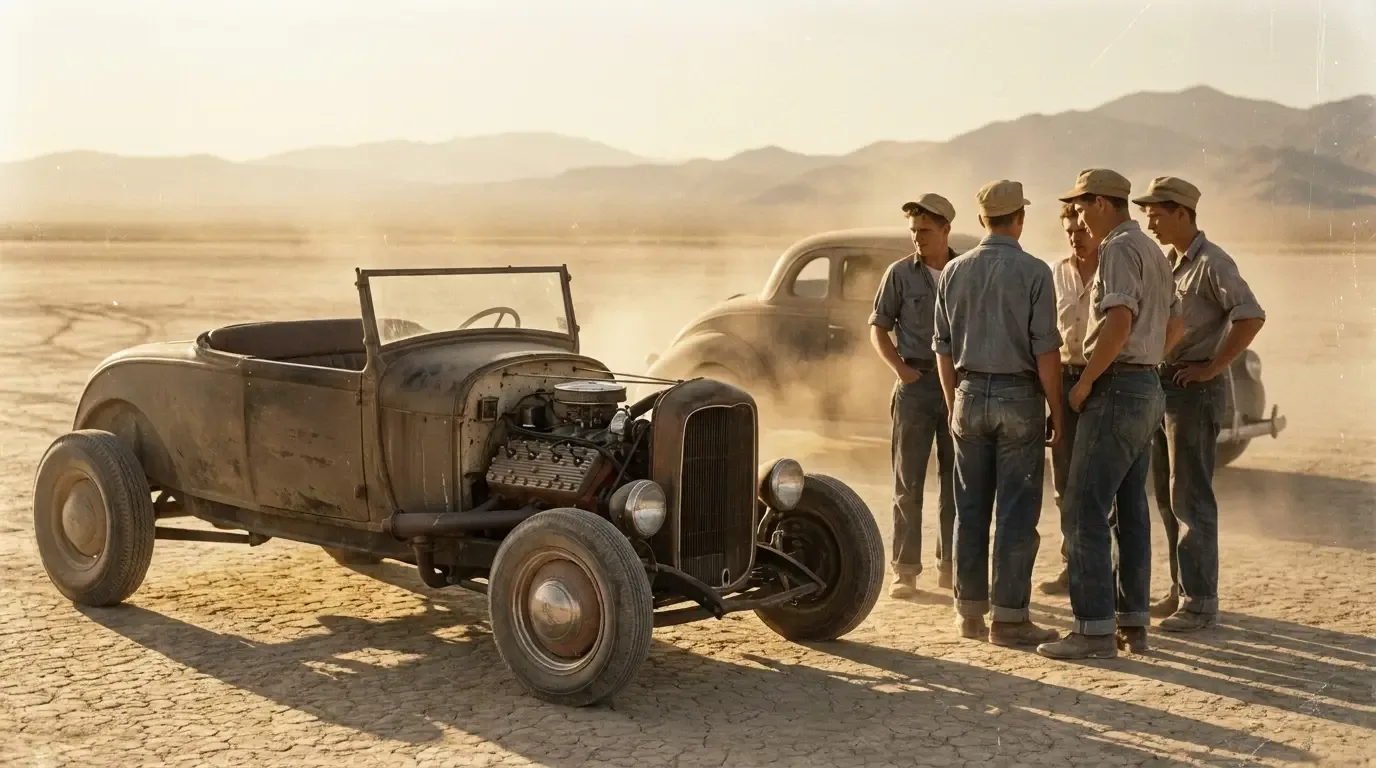
Before shops like So-Cal, going fast was a scrounger's game. You pulled a Ford flathead, you found somebody who could pour a set of high-compression heads, you traded for a manifold, and you hoped the guy who ported your block knew what he was doing. The knowledge lived in scattered heads and swap meets. The speed shop pulled it into one building.
Here is what that shift actually delivered:
- A counter where you could buy proven speed equipment instead of hunting for it one part at a time.
- A mail-order catalog, so a kid in the Midwest could buy the same manifold a lakes racer ran in California.
- A trusted middleman between the small manufacturers making heads, cams, and intakes and the guys who wanted them.
- A physical clubhouse where builders traded information, which mattered as much as the hardware.
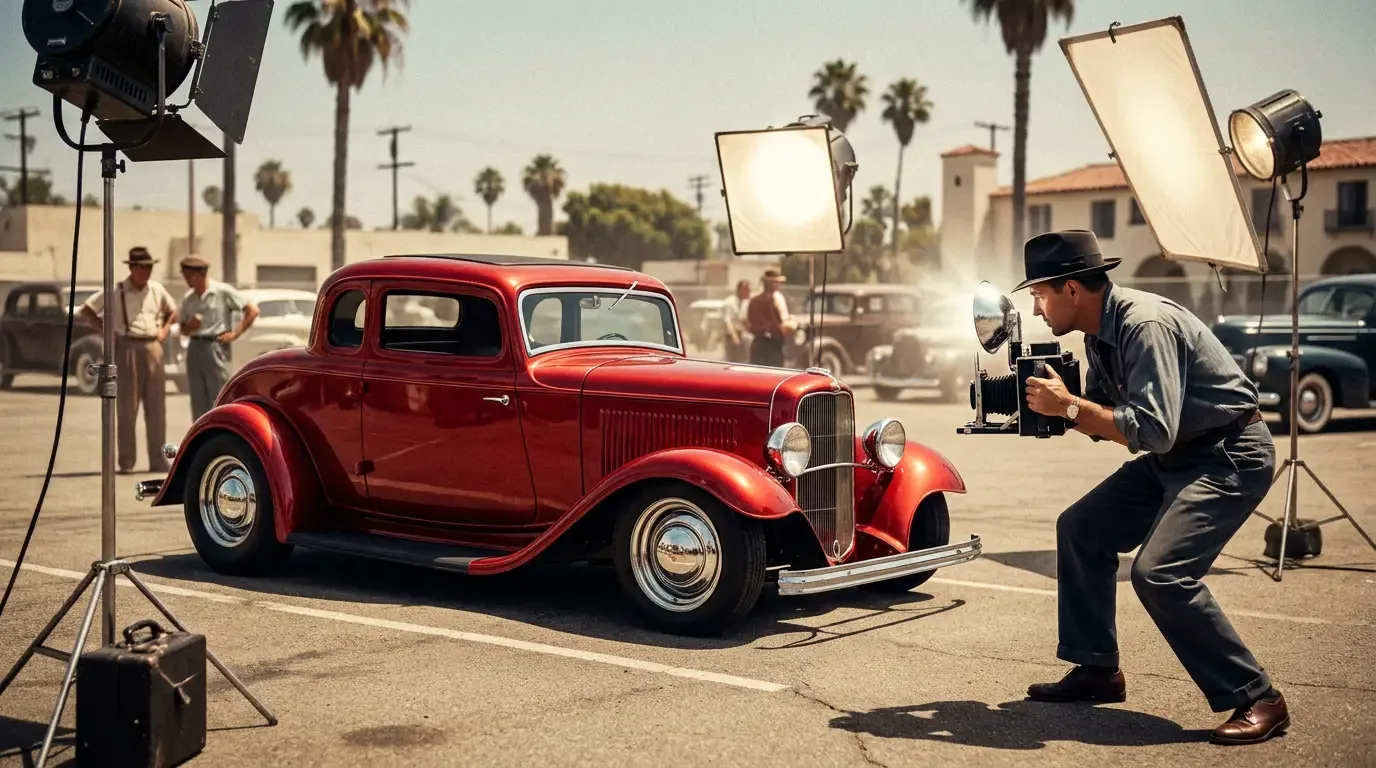
Xydias also understood media. So-Cal advertised in the young enthusiast press and used its race results as proof. That loop, race, win, advertise, sell, is the engine that turned a hobby into an industry. If you want to see how the press half of that loop worked, read How Hot Rod Magazine Spread the Culture, because the shops and the magazines grew up together and fed each other.
Why the So-Cal model still runs the shop floor
The reason this history is not just nostalgia is that the business model never really changed. The modern performance shop is the So-Cal template with better tools. Racer credibility up front, proven parts on the shelf, a recognizable brand, and race results doing the advertising. Xydias eventually stepped back from the shop, and the So-Cal name went quiet for years before being revived in the 1990s, but the pattern he set outlived the original storefront.
For a builder, the lesson is simple and old. Do the work in public, win with it, and let the results sell the parts. That is what Xydias figured out in a small Burbank shop with a surplus fuel tank and a can of white paint, and it is why his name still means something on a fender, whether you are building in Long Beach or in my neck of the woods back in Wisconsin.
Sources and notes
- Period hot-rod and enthusiast press coverage of the postwar Southern California speed-equipment scene.
- Dry lakes and Bonneville land-speed records and event accounts referencing So-Cal entries.
- Builder and shop histories, and interviews with figures from the early speed-equipment industry.
- Museum and registry records for surviving belly tank lakesters and period speed equipment.
- Specific dates, speeds, and record claims confirmed against primary period sources, including So-Cal Speed Shop and land-speed racing histories.
Related Reading
Have a
Classic Car
for Sale?
Reach thousands of serious classic car collectors across the US.
Sell It Here →
Are You a Classic Car Dealer?
List your full inventory and connect with targeted classic car buyers.
Join as a Dealer →
About the author
Gary Nowak
Lifelong Midwest rodder who has been building and driving traditional pre-war hot rods since the 1970s.
More in History & Heritage
Comments
Be the first to comment on this article.