
Ask a room full of builders to name the second most rodded Ford ever made, and the arguments start fast: I've sat through plenty of those over pie at the local diner. But the Model A always ends up near the top. Ford built it from 1928 through 1931, and it landed in a sweet spot that the little four-cylinder Fords before it never reached. It had grown-up proportions, a real steel body, and enough of them came off the line that decades later you could still find one behind a barn for cheap. That combination is why the Model A became one of the great hot rod platforms, and why guys are still cutting them up today.
History & Heritage
7 min read
The Model A as a Hot Rod Platform
The Ford Model A (1928-1931) as a hot rod platform: the A-V8 on '32 rails, and why roadsters, coupes and sedans stay a traditional favorite.
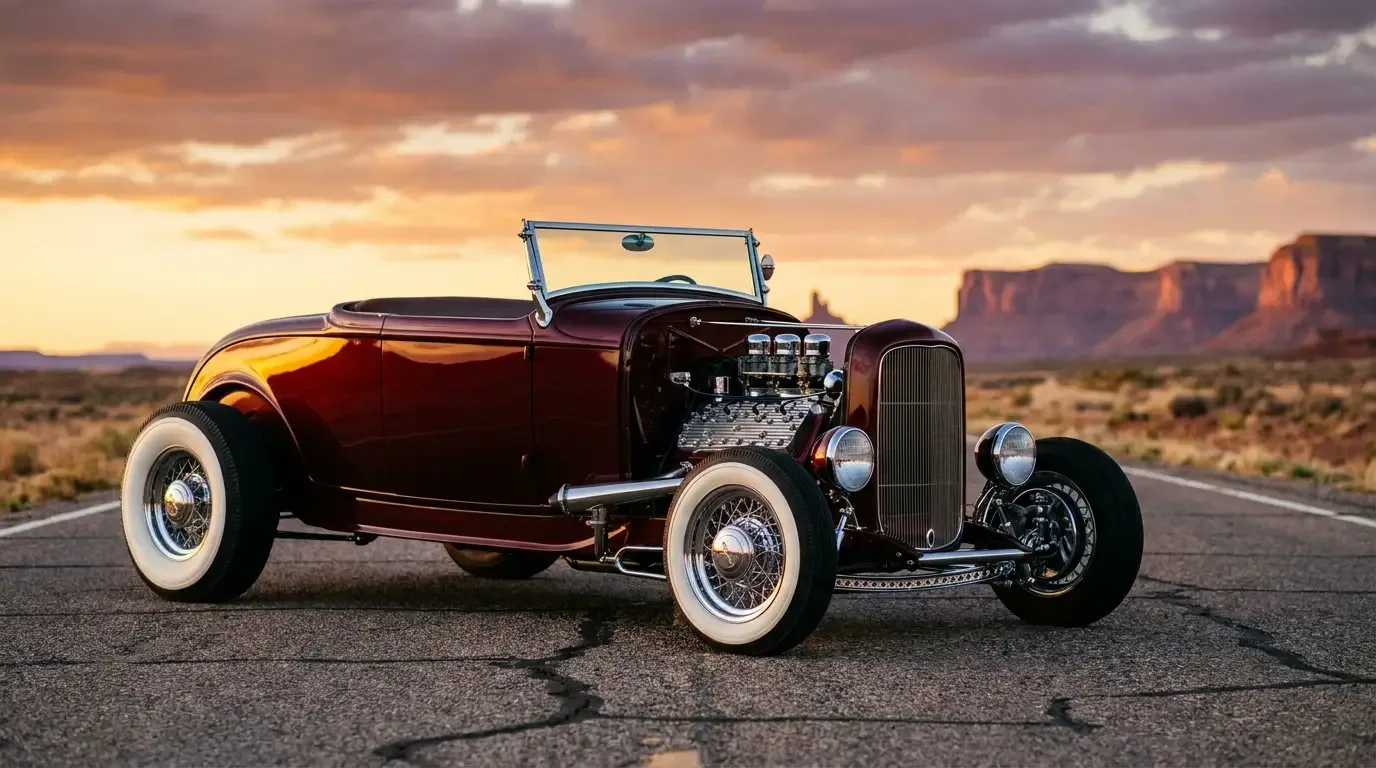
The Model A is not a Deuce. The 1932 Ford gets the songs and the magazine covers. But the A came first, it is a cousin under the skin, and in a lot of ways it is the more honest starting point for a traditional build. If you want to understand where American hot rodding got its raw material, you go back through the hot rod history to the humble Model A sitting in a farmer's field.
Why the Model A became a builder's favorite
Three things made the A the platform it is. First, Ford built a lot of them. Roughly four to five million cars over the four-year run, which meant that by the late 1940s they were everywhere and they were dirt cheap. A kid with a summer job could buy one. That mattered more than any spec sheet.
Second, the body was steel and the lines were right. The A has a taller, more upright look than the '32, but the roadster and coupe shells take a chop and a channel job beautifully. The cowl, the grille shell, the turtle-deck roadster back, all of it reads as classic hot rod once you get the stance down. There is nothing to apologize for in the shape.
Third, the A gave you a canvas without a lot of baggage. The stock four-cylinder was reliable but slow, the frame was light, and nobody felt bad about throwing away the running gear. A Model A was never a precious car. That is exactly what you want under the torch.
The A-V8: Model A body on '32 rails
Here is the move that defines the traditional Model A rod. You take the A body and you set it on 1932 Ford frame rails. Builders call it an A-V8, or an A-bone on Deuce rails. The '32 frame is a couple inches longer and has that beautiful reveal down the side, and it was designed from the factory to carry Ford's flathead V8. So you get the classic A body, the sweetheart '32 chassis, and a V8 between the rails all at once.
Why bother? The Model A frame was built for a four-cylinder and it is on the flimsy side for real power. The '32 rails are stouter and the wheelbase works. Drop a flathead V8 in there and you have the recipe that ran on the dry lakes and, later, chased records at the salt. That A-V8 combination is one of the most copied builds in the hobby, and it still gets scrutinized every year at The So-Cal Speed Shop and the Postwar Boom-era gatherings where the old cars come out.
| Model A body style | Traditional rod treatment | Notes |
|---|---|---|
| Roadster (open, no fixed roof) | Highboy on '32 rails, sometimes channeled | The classic. Light, simple, quick. |
| Five-window coupe | Chopped top, channeled or highboy | Great chop candidate, strong closed-car look. |
| Tudor / Fordor sedan | Mild chop, dropped axle, family cruiser | Room for passengers, popular street rod base. |
| Sport coupe / cabriolet | Chop, sometimes filled roof | Less common, distinctive when done right. |
Roadsters, coupes and sedans
Every Model A body style has its place in the hobby, and builders pick based on what they want the car to do.
- The roadster is the purist's choice. No top structure to fight, lowest weight, and the open cockpit is the traditional lakes look. A highboy A roadster on Deuce rails with a dropped front axle is about as classic as it gets.
- The coupe gives you a roof to chop, and a chopped A five-window is a serious statement. Closed cars are more usable in weather and the sectioned, low-roof profile is what a lot of people picture when they hear "hot rod."
- The sedan is the underrated one. Tudor and Fordor bodies give you back seats and real room, so they make honest street cars. A mildly chopped Model A sedan on a dropped axle is a comfortable driver, not a trailer queen.
The point is that the A does not force you into one build. Where a lot of platforms only really work as one kind of car, the Model A supports the whole range from stripped lakes roadster to family cruiser.
Why it stays a beloved traditional canvas
The Model A endures because it sits right at the origin of the whole thing. When guys came home from the war and wanted something fast and cheap, the A was the car sitting in the yard. It got the flathead, it got the chop, it got the drop, and the visual language of the American hot rod got written on Model A bodies as much as on any other car.
"People chase Deuces because of the price and the mystique, and I get it. But an A-bone highboy on '32 rails, done right, has a rawness the '32 never quite matches. It looks like it was built by hand in somebody's driveway on a cold Wisconsin weekend, because that's exactly how a lot of these cars were born."
Gary Nowak
There is also a practical reason the A stays popular. The aftermarket for these cars is deep. Dropped axles, brake kits, frame rails, body panels, you can build a complete A without ever finding a rusty donor if you have the budget. That keeps new people coming into traditional rodding on a platform that has been proven for the better part of a century.
Restraint is the hard part. The temptation is to modernize everything until the car loses its character. The best Model A rods keep the honesty of the original build, a real chop instead of a subtle one, a genuine stance, a period-correct look. Get that right and you have a car that would have looked at home on a lakebed in 1949 and still turns heads in a parking lot today. When you are ready to shop, plenty of these cars change hands, and you can browse hot rods for sale to see how the A holds its place in the market.
Sources and notes
- Period hot-rod press and enthusiast magazine coverage of Model A and A-V8 builds.
- Ford Model A production and specification references (1928–1931 model years).
- Flathead V8 and early Ford chassis references for the A-on-'32-rails combination.
- Car show, registry and museum records documenting traditional roadster, coupe and sedan builds.
- Builder interviews and shop-floor knowledge on chopping, channeling and frame swaps.
Related Reading
Have a
Classic Car
for Sale?
Reach thousands of serious classic car collectors across the US.
Sell It Here →
Are You a Classic Car Dealer?
List your full inventory and connect with targeted classic car buyers.
Join as a Dealer →

About the author
Gary Nowak
Lifelong Midwest rodder who has been building and driving traditional pre-war hot rods since the 1970s.
More in History & Heritage
Comments (1)
V
Vince Calabrese
2 months ago
Great breakdown of the different years. Most people just want 'one of these' without realizing how much varies between model years.