
A 1972 Ford Bronco sits in a private driveway with a price written on a card in the windshield. Two hundred miles away, a dealer has a similar truck under showroom lights, a folder of receipts on the seat and an asking price several thousand dollars higher. Most people who set out to buy a classic car from a dealer or private seller treat it as a price question. It is really a question about records, recourse and who carries the risk when something in the paperwork turns out to be wrong.
Ownership & Lifestyle
8 min read
Dealer or Private Seller? Buying a Classic Either Way
Dealer or private seller? How price, recourse, title handling, inspection access, sales tax and curbstoner risk differ when you buy a classic.
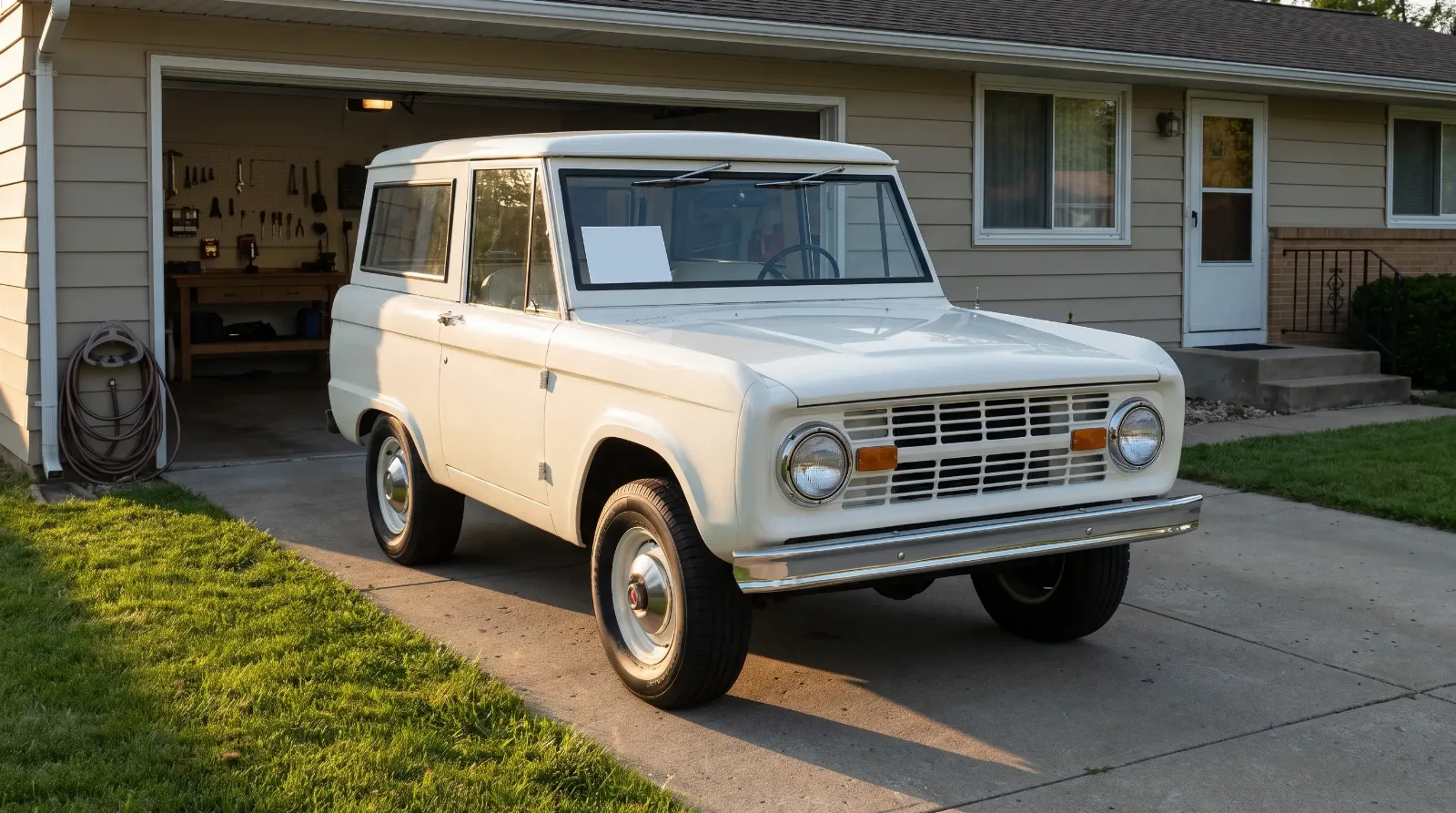
Both routes can end well. What changes is which checks the seller has already done for you and what you can do about it afterward. The full dealer process is in our guide to buying a classic from a dealer. This article stays on the comparison.
What the price difference pays for
A dealer's asking price carries costs a private owner does not have: buying the car, reconditioning, storage, insurance, advertising and a margin on top. Our own working estimate is that a dealer buying outright pays roughly 20 to 30% less than the car would bring in a private sale, and that gap funds the rest. It is an estimate built from how the business works, not a published statistic, but it explains why the same truck asks more on a lot than in a driveway.
Consignment changes the arithmetic. When a dealer sells a car for its owner, there is no purchase cost to recover, only a commission, commonly around 5 to 15% of the sale price or a flat fee. The owner sets the floor. Ask early whether the car is owned stock or consigned, because the answer tells you where any room in the price lives.
What the premium buys, when it buys anything, is work you would otherwise do yourself: a car that has been checked, paperwork that has been assembled and a business that has to answer for both. A dealer who has checked nothing is simply a more expensive private seller.
Recourse, disclosure and title handling
This is where the two routes differ most. A licensed dealer operates under state licensing rules and, in most states, posts a surety bond that gives buyers a limited claim if the dealer commits fraud or fails to deliver title. The FTC's Used Car Rule also requires dealers to display a Buyers Guide on each used vehicle they offer for sale, stating whether the car comes with a warranty or is sold as-is. Most classics are sold as-is, but the terms are in writing. Confirm the license is current with the state before you rely on any of it, and if you are building a shortlist, start with classic car dealers across the US and check each one the same way.
A private seller has none of that. If a private seller lies about the car, your remedy is a civil claim for misrepresentation, often in small claims court if the amount fits under your state's limit, and you will have to prove what was said. So get the seller's claims about the engine, mileage and history in an email or text message.
Title handling follows the same pattern. A dealer completes the title assignment, writes the bill of sale and often prepares the registration paperwork. In a private sale you check the title yourself: the name must match the seller's ID, no lien should be recorded and the VIN must match the car. Pennsylvania and Ohio require a notarized seller signature, so a private closing there may happen at a notary or tag service. With older vehicles, ask whether a title exists at all. New York does not title model year 1972 and older, and Georgia does not require a title for 1962 and older, so an early car may come with a registration and bill of sale instead.
Inspection, financing, transport and tax
A private owner usually lets you spend an hour in the garage, get underneath and go through every receipt, and tends to know the car's history first-hand. A dealer has a lift and is used to hosting inspectors, but a consigned car may not be on the premises at all. Either way, hire an independent inspector you choose and pay yourself.
Financing and shipping are where dealers earn part of their premium. Specialty collector car lenders also fund private sales, but a dealer that handles financed deals every week knows the lender's paperwork and the lien filing, and arranges transport routinely. With a private seller, you book the carrier and make sure someone is home to release the car.
A dealer may collect sales tax at the sale, sometimes for your home state, and file the forms. In a private sale you pay sales or use tax when you register, and some states, Massachusetts among them, tax a private sale on the higher of the price paid or the car's book value. Never agree to a lower price on the bill of sale to save tax. It is fraud, and it understates what you paid if you ever have to prove value to an insurer.
| Factor | Dealer | Private seller |
|---|---|---|
| Price | Higher; covers reconditioning, holding cost and margin, or a commission | Usually lower |
| Recourse | State license, a dealer bond in most states, written Buyers Guide | A civil claim, if you can prove what was said |
| Title handling | Dealer prepares the paperwork | You verify name, lien and VIN |
| Inspection access | Lift on site; consigned cars may be elsewhere | Open garage, owner on hand |
| Financing and transport | Routine, often arranged in-house | You arrange both |
| Sales tax | Often collected at the sale | Paid by you at registration |
| Documentation | Varies | Deep from a long-term owner, thin on a quick resale |
| Negotiation room | Depends on stock or consigned, and time in inventory | Direct, with the decision-maker |
| Curbstoner risk | Low with a verifiable license | Real; confirm the seller is the titled owner |
Documentation, negotiation and curbstoners
The dealer's car does not always come with the better paper trail. A dealer's folder holds whatever the previous owner handed over, and a car bought at auction may arrive with little more than a title. The deepest files tend to come from people who owned a car for decades and kept every invoice. Whoever the seller is, ask for the chain of ownership, not just the receipts.
Negotiation is more direct with a private owner, because you are talking to the person who decides. With a dealer, the room depends on whether the car is stock or consigned and how long it has sat. Our piece on negotiating with the dealer covers how to use inspection findings and sold comparables.
The real hazard on the private side is the curbstoner: someone who buys and resells cars while posing as a private owner, dodging dealer licensing, disclosure rules and taxes. Many states cap how many vehicles a person can sell in a year without a dealer license. Florida requires a license for anyone who sells three or more in 12 months, and Minnesota draws the line at more than five. The signs are consistent. The title is not in the seller's name or was signed by a previous owner and left open, the same phone number appears on several listings, and the seller wants to meet in a parking lot. Passing an open title along without recording the transfer, known as title jumping, is illegal, and it can leave you with a car you cannot register.
"The name on the title is the first record I check and the last one I trust blindly. If the person selling the car is not the person on that paper, I want to know exactly why before anything else gets discussed."
Tom Ramirez
When to buy a classic car from a dealer or private seller
A dealer makes sense when you cannot easily see the car, when you need financing or transport arranged, when it is your first classic or when the price is high enough that you want a licensed, bonded business behind the paperwork. It also helps across state lines, where a dealer used to out-of-state buyers already knows the forms.
A private seller makes sense when the car is close enough to inspect in person, when the owner has a long history with it and the records to prove it and when you know the model well. If you are weighing other routes, our comparison of an auction versus a private sale covers that side.
Either way the checks are the same: verify the title, inspect the car independently and pay in a way you can trace. The dealer simply does more of the paperwork and charges for it. When you are ready to compare real cars, start with classic cars for sale from dealers and hold every listing to the same standard of proof.
Sources and notes
Related Reading

About the author
Tom Ramirez
Corvette researcher and historian based in Bowling Green, Kentucky. Two decades documenting Corvette production history from original factory records.
More in Ownership & Lifestyle
Comments
Be the first to comment on this article.