
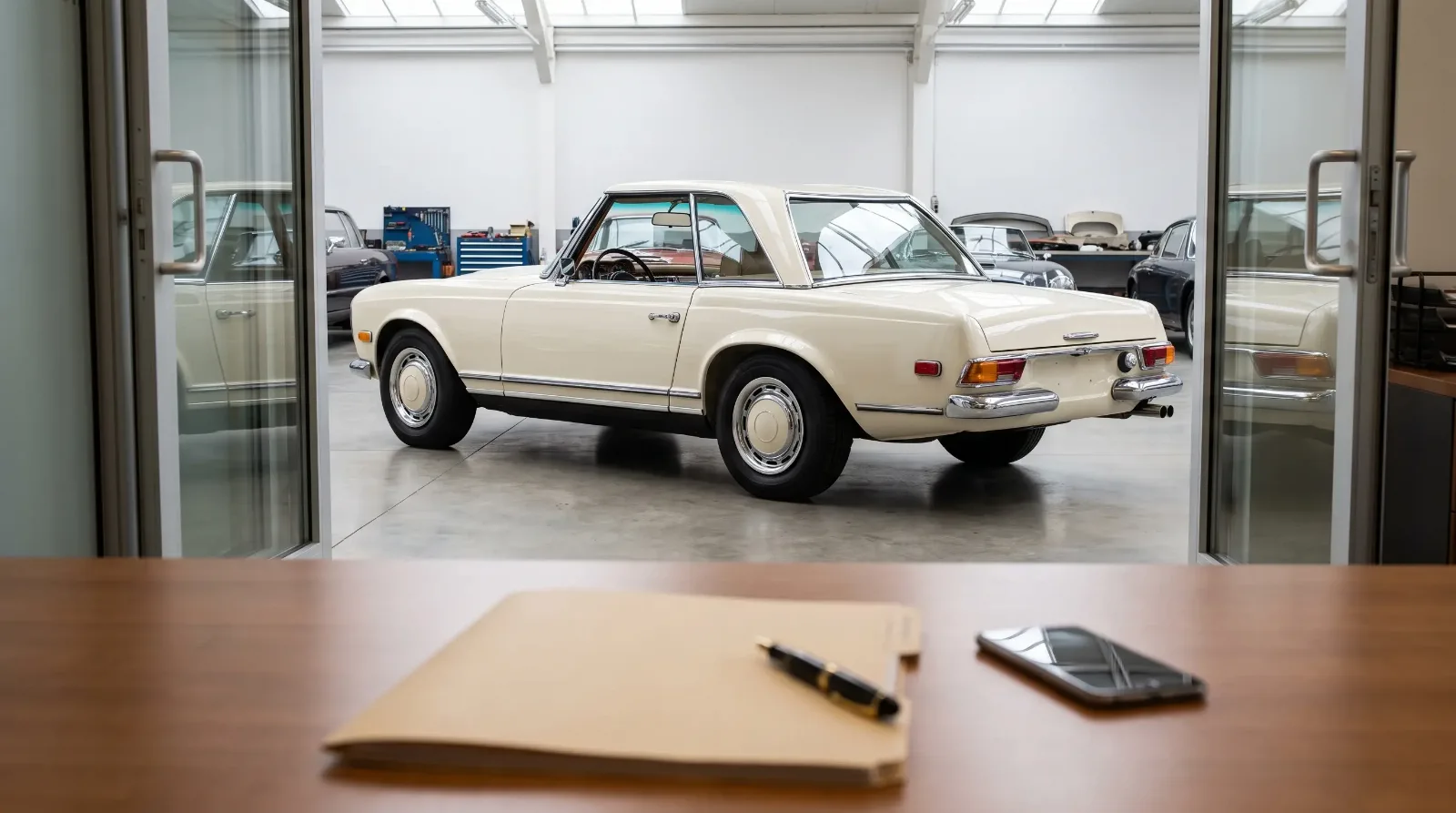
A 1970 Mercedes-Benz 280SL, agreed price settled, purchase agreement drafted, and now an email arrives with wire instructions. This is the point where a careful purchase is most exposed. The car has been inspected and the dealer has been vetted, but the money has not moved yet, and money that moves the wrong way rarely comes back. If you want to pay for a classic car safely, treat each payment as its own step, with its own conditions and its own paper.
Ownership & Lifestyle
8 min read
Paying a Classic Car Dealer Safely: Wires, Escrow and Deposits
Deposit terms in writing, wires confirmed by phone, real escrow, cashier's checks and cash rules: the order of payments that protects a buyer.
The broader process, from vetting the dealer to arranging shipping, is in the full classic car buying guide. This article covers only the money: the deposit, the balance and the moment the title and keys become yours.
Get the deposit terms in writing
Most dealers ask for a deposit to hold a car while you arrange an inspection or financing. That is reasonable. What makes it safe or unsafe is the terms, and the terms should be on paper before any money leaves your account. Four things need answers: how much the deposit is, how long it holds the car, under what conditions it comes back to you and who holds it.
The refund conditions matter most. A deposit that is refundable if the inspection turns up problems protects you. A deposit that is refundable only "at the dealer's discretion" does not. Ask for the wording to tie the refund to a specific event, such as an inspection report you find unacceptable or financing that is not approved by a stated date. On a consigned car, also ask whether the deposit sits with the dealer or goes to the owner. Classic Car Deals in Cadillac, Michigan, a consignment dealer, is a useful example of terms spelled out in public. Its FAQ says a deposit holds a car for 7 days, that a $1,000 deposit for a personal inspection and a $500 deposit for a third-party inspection are refundable if you decide not to buy, and that a $500 deposit with no inspection is not. Terms that specific tell you exactly what the deposit buys and when it comes back.
Pay the deposit by credit card if the dealer allows it. The Fair Credit Billing Act gives you billing-dispute rights if the goods are not delivered as agreed, provided your letter reaches the card issuer within 60 days after the first statement showing the charge was sent. Many dealers cap the card amount or add a processing fee, which is a fair trade for the protection. Peer-to-peer apps are a different story. PayPal and Venmo purchase protection both exclude motor vehicles, and Zelle offers no purchase protection at all.
Confirm the wire before you send it
For the balance, most dealers want a wire. Wires are fast and cheap, with outgoing domestic fees commonly around $25 to $35, but once one is sent, getting it back depends on the receiving bank's cooperation, and recalls rarely succeed. That makes verification the whole game.
Call the dealer to confirm the account details, and call a number you found yourself: the one on the state dealer license record, on an earlier invoice or on a business listing you looked up independently. Never use the number printed in the email that carries the wire instructions. Criminals who break into dealer or buyer email accounts send convincing messages with changed bank details at exactly this stage, and the phone number in that message goes to them. Any email announcing that the bank details have changed is a reason to stop and call.
Check the account name too. It should match the dealer's legal business name, the entity on the license and the purchase agreement. A personal name, a different company or a third party described as a "payment agent" is a reason to stop until you get an explanation you can verify. If something feels wrong after you have sent the wire, call your bank immediately and ask it to contact the receiving bank, and report it to the FBI's Internet Crime Complaint Center. Speed is the only thing that helps.
When escrow is worth the fee
A licensed escrow service holds your money until you accept the car, then releases it to the seller. For a remote purchase from a smaller dealer you cannot easily check on, that is real protection, and it has a cost. Escrow.com's standard vehicle fee is 2.4% for transactions from $5,000 to $50,000 and 1.9% from $50,000 to $200,000. On a $40,000 car that is about $960, and on a $90,000 car about $1,700. Who pays the fee is negotiable, and splitting it is common.
That check matters, because fake escrow is one of the oldest schemes in remote car sales. The seller insists on a particular escrow company, sends a link, and the site looks entirely real. You should choose the escrow service, type its address into the browser yourself and confirm the transaction details by logging in, never through a link in an email. Our piece on how fake escrow sites work shows the warning signs in more detail. With a well-established dealer whose license and address you have verified, escrow may be more than you need. With an unfamiliar seller, it is cheap insurance.
Cashier's checks and cash
A cashier's check works best at an in-person closing, where you hand it over and receive the signed title at the same table. Buy it from your own bank, made out to the dealer's exact legal name. Expect a dealer to wait for it to clear before releasing the title, which is fair. Under Regulation CC, banks generally make funds from a cashier's check available by the next business day, but the FTC warns that funds showing in an account do not mean a check is good, and a fake can take weeks to surface. Dealers know this, so do not be offended when they wait.
Cash is the worst option for a buyer. It leaves no trail except a receipt, and carrying a large amount to a closing is a risk of its own. It also creates reporting. A dealer that receives more than $10,000 in cash, in one payment or in related payments, must report it to the IRS on Form 8300, and your bank files its own report when you withdraw more than $10,000 in cash. Splitting withdrawals or payments to stay under that threshold is called structuring, and under 31 U.S.C. 5324 it is a federal crime even when the money is entirely legitimate. For a car purchase, the IRS also counts a cashier's check of $10,000 or less as cash for the dealer's report, so several smaller cashier's checks do not avoid it.
Pay for a classic car safely, in the right order
The order of events is what protects you. Each payment should buy you something you can hold, whether that is a document, a report or the car itself. The table below is the sequence I would follow on a remote purchase.
| Stage | What you pay | What you should have in hand |
|---|---|---|
| Car located | Nothing | VIN, photos of the title front and back, the dealer's license number |
| Deposit | A card payment or small wire under written terms | Deposit agreement: amount, hold period, refund conditions, who holds it |
| Inspection | The inspector's fee, paid by you | A written, dated report with photos |
| Balance | A wire confirmed by phone, or escrow | Signed purchase agreement, title copy, confirmed account name |
| Delivery | Nothing further | Original title or its tracking number, bill of sale, keys, bill of lading with condition photos |
Ask the dealer when the original title will be mailed and how. Many dealers send it after funds clear, often by tracked overnight courier, and some send it with the car. If a lender is involved, the title may go to the lender first. On a consigned car, confirm the owner has already signed the title over to the dealer or will sign it directly to you, and get that in the purchase agreement. If you are registering the car in another state, sort out the out-of-state paperwork before the balance is paid, so you know exactly which documents your DMV will need.
"Every payment should buy a piece of paper. The deposit buys written terms, the inspection buys a report and the balance buys the title. If you are being asked to pay before the paper exists, the order is wrong."
Tom Ramirez
Sources and notes
Related Reading
Have a
Classic Car
for Sale?
Reach thousands of serious classic car collectors across the US.
Sell It Here →
Are You a Classic Car Dealer?
List your full inventory and connect with targeted classic car buyers.
Join as a Dealer →

About the author
Tom Ramirez
Corvette researcher and historian based in Bowling Green, Kentucky. Two decades documenting Corvette production history from original factory records.
More in Ownership & Lifestyle
Comments
Be the first to comment on this article.