
People ask me all the time what makes an old muscle car sound the way it does. They mean the specific thing, that low, uneven rumble at idle that you feel in your chest before you hear it with your ears. I have had enough of these apart on the bench to tell you it is not one thing. It is a stack of decisions the factory made, most of them for reasons that had nothing to do with sound, that happened to add up to the best exhaust note Detroit ever produced. Understand the parts and the roar stops being magic. It starts being engineering.
Ownership & Lifestyle
6 min read
The Sound of Muscle: What Makes a Big-Block Roar
The muscle car sound explained: how the crankshaft, displacement, camshaft, and exhaust combine to create that unmistakable big-block roar.
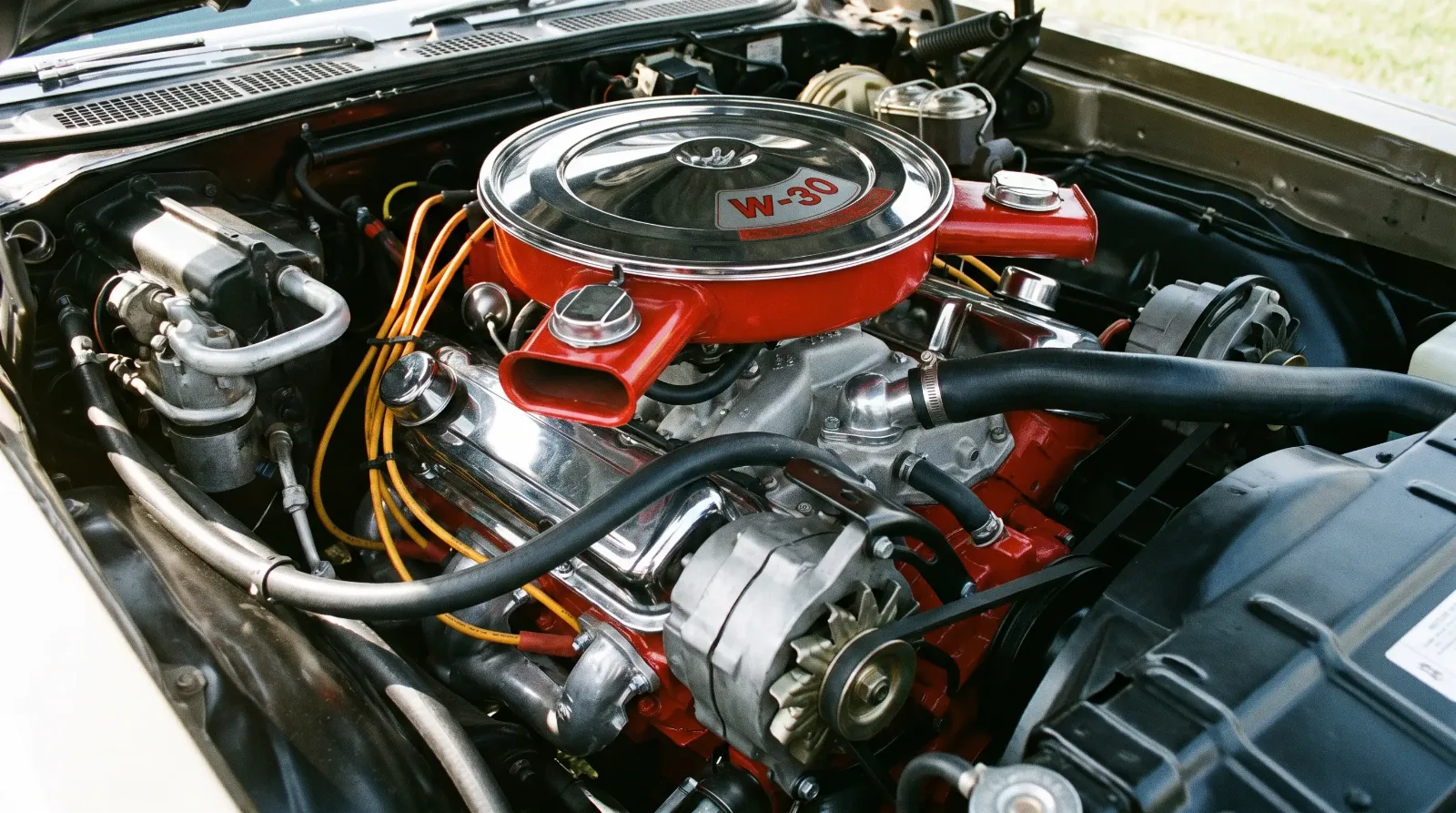
The short version is this. A big American V8 sounds like a big American V8 because of the shape of its crankshaft, the size of its cylinders, the profile of its camshaft, and the pipes bolted to the back of it. Change any one of those and you change the voice. Here is how each piece does its job.
The crankshaft does the talking
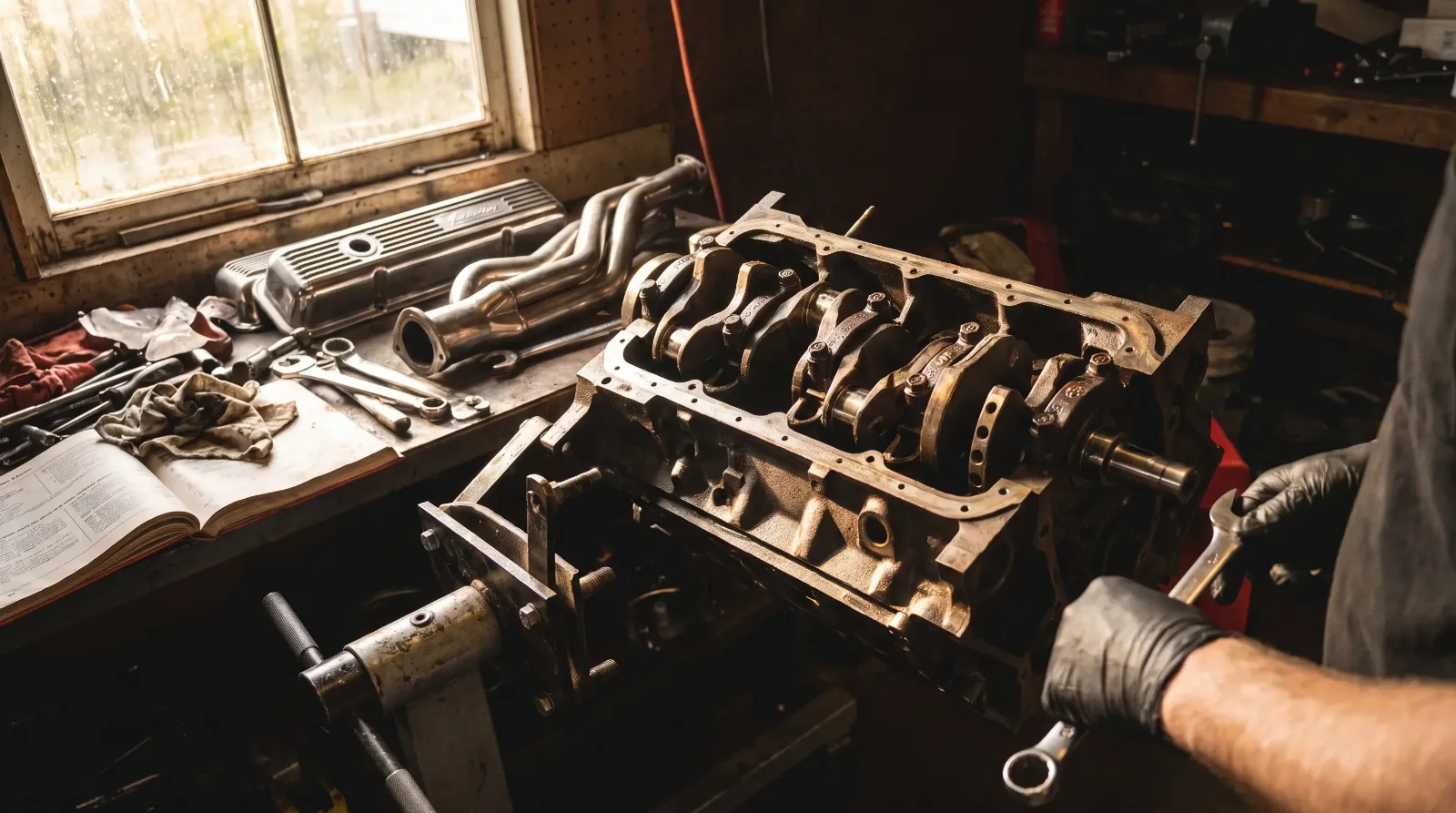
Start with the crank, because that is where the character comes from. Almost every American V8 uses what they call a cross-plane crankshaft, where the throws sit at ninety degrees to each other. That layout makes the engine smooth and gives it that strong low-end pull, but it comes with a quirk. Within each bank of four cylinders, the firing is not evenly spaced. Two of the cylinders fire closer together than the others.
That uneven spacing inside the bank is the whole ballgame. It is why the exhaust pulses come out lumpy instead of even, and it is why a Chevy 350 sounds nothing like a Ferrari V8, which uses a flat-plane crank and screams instead of rumbles. Same number of cylinders. Completely different crankshaft. Completely different voice. The burble you love is literally the sound of an engine firing a little bit out of step with itself, on purpose, and there is no bolt-on that fakes it.
Displacement makes it deep
Now put big cylinders behind that crank. A 454 or a 440 or a 429 is moving a lot of air with every stroke, and big slugs of air leaving through the exhaust at low engine speed give you a low frequency note. That is the difference between the deep chest-thump of a big-block and the busier, higher bark of a small-block wound up tight.
This is why two cars from the same era can sound like different animals. A 396 Chevelle and a 327 Nova are both Chevrolets, but the big-block loafs along making that heavy, spaced-out thud while the small-block sounds quicker and lighter. Neither one is wrong. If you want the background on how all these engines came to be, the American muscle car story walks through where the big-blocks came from and why the factories kept making them bigger.
The cam gives it the lope
Here is where the hot cars separate themselves from the grocery-getters. The camshaft controls how long the valves stay open and when, and a performance cam is ground with a lot of what we call overlap, meaning the intake and exhaust valves are both open at the same time for a longer stretch around the top of the stroke.
At high rpm all that overlap helps the engine breathe and make power. At idle it makes a mess, in the best way. The cylinders do not fill cleanly, the engine hunts a little, and you get that unmistakable choppy idle, the lope, where the whole car rocks gently on its springs at the stoplight. A stock cam idles smooth and quiet. A big solid-lifter cam idles like it is angry about something. When somebody says a car has a nasty idle, they are hearing the camshaft, not the exhaust.
The exhaust lets it out
All that sound has to get out of the car, and how it gets out matters as much as any of it. Cast-iron factory exhaust manifolds are restrictive and muffle a lot of the note. Swap to headers, which are long tuned tubes, and you free up the pulses and change the tone right along with the power. True dual exhaust, meaning two separate pipes all the way back, keeps each bank's sound intact and gives you the full stereo effect instead of mixing everything into one muddy pipe.
Then there is the muffler. A glasspack, which is just a straight perforated tube wrapped in packing, lets the sound through with that raspy hard edge everybody recognizes. A quieter reverse-flow muffler tames it. Two cars with identical engines can sound half a world apart depending on nothing but the pipes, which is why exhaust is the first thing most guys change and the first thing I check when a car sounds wrong for what is supposedly under the hood.
| Part | What it controls | Effect on the sound |
|---|---|---|
| Cross-plane crankshaft | Firing order within each bank | The uneven rumble instead of an even scream |
| Displacement | Volume of air moved per stroke | Deep low-frequency thud in the big-blocks |
| Camshaft overlap | Valve timing at idle | The lumpy, rocking lope of a hot idle |
| Dual exhaust and headers | How the pulses exit | Fuller, harder, louder tone |
"Everybody thinks the sound comes out of the tailpipe. It doesn't. It comes out of the crankshaft, and the tailpipe just decides how much of it you get to hear."
Mike Sullivan
Why nothing modern quite copies it
People wonder why a new car with more power does not move them the same way, and the honest answer is that a lot of what made the old sound has been engineered out. Modern engines run tighter tolerances, quieter cams, and exhaust designed to pass a drive-by noise test. Some of them pipe fake engine noise through the speakers, and you can always tell.
The classic roar was a byproduct, not a goal. Nobody at the factory was tuning for chest rumble. They were chasing torque and durability, and the sound came along for the ride. That accidental quality is a big part of why it still pulls people in, and it is a big reason a new generation keeps discovering these cars, which you can read more about in our coverage of the culture, and in how the sound hooked young buyers when you read the full story. The engineering is knowable. The feeling it gives you is the part that never gets old.
Related Reading
Have a
Classic Car
for Sale?
Reach thousands of serious classic car collectors across the US.
Sell It Here →
Are You a Classic Car Dealer?
List your full inventory and connect with targeted classic car buyers.
Join as a Dealer →

About the author
Mike Sullivan
Detroit-area muscle car enthusiast and restoration specialist with three decades of hands-on experience working on American iron.
More in Ownership & Lifestyle
Comments
Be the first to comment on this article.