
Most advice on the dealer vs private sale classic car question stops at a percentage. Dealers pay less, everyone agrees, and the conversation moves on. A percentage is easy to nod at and hard to feel. So this piece does the opposite. It takes one car, runs it down both roads to the closing table, and counts every dollar that leaves or arrives along the way.
Market & Values
9 min read
Dealer vs Private Sale: The Real Numbers on One Car
One illustrative classic, two roads to the closing table: the dealer worksheet, the private-sale costs, and what the gap pays per hour.
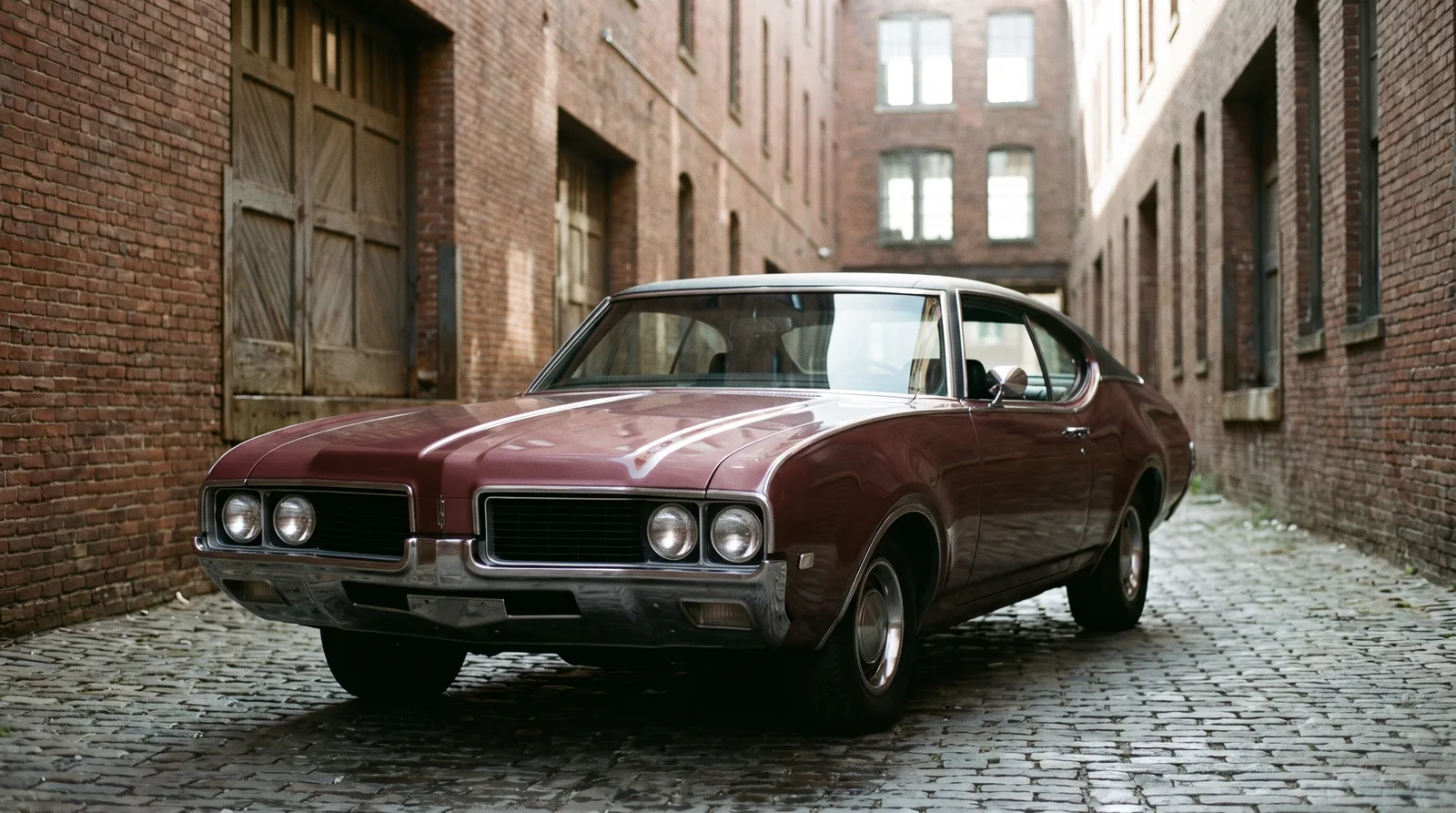
The car is illustrative, and so is every number attached to it. We built the example from the cost categories dealers and private sellers actually face, then set each one at a round, plausible level so the arithmetic is easy to follow and easy to replace with your own figures. If you want the wider picture of who the buyers are and how each one thinks, there is more on this in the main guide. This is the worksheet.
The car and the ground rules
Our example is a late-1960s American V8 coupe in honest #3 condition. It is a driver that looks right from a few feet away: straight body, a running drivetrain of the correct type, an older repaint, and a folder of receipts covering roughly the last fifteen years. We picked it because it is the most ordinary kind of collector car there is. Hagerty's condition guidance says the vast majority of collector cars are #3, so this is the segment where most sellers actually live.
Three ground rules keep the comparison honest. First, the private-sale value is fixed at $38,000. That is what we assume a reasonable private buyer pays after negotiation, not what the seller hopes for. Second, the seller asks $41,500 to leave room to negotiate, which is common practice rather than a rule. Third, every cost counts at the moment it leaves the seller's account. Nothing gets waved away as small.
None of this is a valuation of any particular model. Swap in your own car's sold comparables and the structure holds.
The dealer's offer, line by line
A dealer prices from the exit backward. He does not start with what the car is worth to you. He starts with what it will retail for on his floor, cleaned and sorted, with his name behind it. A dealer can usually ask a little more than a private seller for the same car, because his buyer gets fresh reconditioning, a business to call if something goes wrong, and often financing. In our example he sets retail at $42,000.
Then come the deductions. Reconditioning is $4,000: date-coded tires that need replacing, a brake job, carburetor sorting, a seat repair and two days of detailing. Holding cost is $1,500, covering about 90 days of floor-plan interest, floor space, insurance and someone to keep the battery up. Profit and risk cushion is $7,000, which pays the dealer and protects him against the car that turns out worse on the lift than it looked in the driveway.
| Dealer worksheet (illustrative) | Amount |
|---|---|
| Expected retail price on his lot | $42,000 |
| Less reconditioning | $4,000 |
| Less holding cost, about 90 days | $1,500 |
| Less profit and risk cushion | $7,000 |
| Total deductions | $12,500 |
| Offer to the seller | $29,500 |
That $29,500 sits $8,500 under our $38,000 private value, which is 22.4 percent below it. That lands inside the 20 to 30 percent range we use as a working estimate across this guide. To be clear about where the range comes from: it is our own estimate, built from these same cost lines, not a published industry figure.
On the seller's side, the dealer road is almost free. He drives the car over, signs the title, and is paid by business check or transfer, usually within a day or two. Out-of-pocket cost is effectively zero. Time spent is about four hours, including the drive, the walkaround and the paperwork.
What the private sale actually cost
The private road costs money before it makes any. In our scenario the seller spends $650 getting the car ready: $250 for a professional detail and $400 for fresh fluids and a carburetor tune so it starts clean on a cold morning in front of a stranger. A car headed to a dealer would not need either, because the dealer budgets his own reconditioning.
Listing costs $104. That is a $99 Featured listing here, a one-time fee with no commission that stays up until the car sells and goes out in one newsletter blast to 15,000+ subscribers with the car as the lead story, plus a $5 Craigslist ad to catch local buyers. Payment adds $15, the incoming wire fee at the seller's bank. Many banks charge about that for an incoming wire and some charge nothing.
Total out of pocket: $650 plus $104 plus $15, which is $769. The car sells after about ten weeks, for $38,000, after the buyer's first offer of $36,000 and one counter. Net to the seller: $38,000 minus $769, or $37,231.
Insurance and garage space continue through those ten weeks, but the seller was paying for them anyway as the owner, so we count them as zero extra cost. If your car sits in paid storage, add that line. We will come back to it below.
Then there is time, which is the real price of a private sale. Our seller spends about 4 hours on photos, 2 writing the listing, 8 answering messages and calls, 6 on two showings with test drives, 3 on paperwork and confirming payment, and 2 on prep logistics. That adds up to 25 hours.
The two roads side by side
| Illustrative example | Sell to dealer | Private sale |
|---|---|---|
| Gross sale price | $29,500 | $38,000 |
| Seller's out-of-pocket costs | $0 | $769 |
| Net to seller | $29,500 | $37,231 |
| Calendar time to cash | About 2 days | About 10 weeks |
| Seller's hours | About 4 | About 25 |
The private sale nets $7,731 more ($37,231 minus $29,500). It also takes 21 more hours of the seller's time (25 minus 4). Divide one by the other and the private road paid this seller about $368 for each extra hour he put in. That is the most useful single number in the exercise, because it turns an abstract percentage into a wage you can accept or turn down.
"The percentage tells you the dealer's margin. The dollar figure tells you what you earned per hour for selling it yourself. On this car that was a few hundred dollars an hour, and very few people would turn that down for a few weekends of phone calls."
David Mercer
When the numbers flip
An example is only worth something if you push on it. Here is where it bends.
The break-even price. The dealer wins on money only if the private sale closes below $30,269, which is his $29,500 offer plus the $769 in private-sale costs. That is roughly 20 percent under our private value. A car that genuinely cannot find a buyer anywhere near its comps is the case where the dealer's number starts to look good.
The long sit. Say the car takes five months instead of ten weeks and finally sells for $35,000. Net is $34,231. Add five months of paid storage at an assumed $150 a month, another $750, and net falls to $33,481. That is still $3,981 ahead of the dealer. Slow is not the same as losing.
The dealer at either end of the range. At 20 percent under private value the offer is $30,400, and the private sale still nets $6,831 more. At 30 percent under it is $26,600, and the gap widens to $10,631.
The cheaper car. Run the same costs on a car worth $9,000 privately and a dealer offer 25 percent under, which is $6,750. The private net is $8,231, so the gap is $1,481. Over the same 21 extra hours, that works out to about $70 an hour. Plenty of sellers will reasonably decide that is not worth strangers in the driveway. This is where the dealer's convenience starts to earn its price.
Location. Where the car sits moves both lines. A dealer in a market with strong winter demand may pay closer to retail in January than in August, and a private seller near a deep pool of buyers may sell faster. If you are in the Sun Belt, read about florida classic car buyers and the differences across neighboring states before you set a price.
The risks that do not fit in a cell. The private road carries scam exposure: fake cashier's checks, overpayment schemes and buyers who will not inspect. The dealer road carries the retrade, where an offer shrinks once the car is half loaded on a trailer. Neither shows up in the arithmetic, and both are manageable if you know they are coming.
My read on this example is plain. On a $38,000 car with a seller willing to answer the phone, the private sale wins and it is not close. On a $9,000 car, or for a seller who has to be done by the end of the month, the dealer's check is a reasonable trade rather than a defeat. Put your own numbers into the two tables above before you decide. If the private road comes out ahead for your car, you can start your listing here.
Sources and notes
- Hagerty: What does a car's condition really look like (most collector cars are #3)
- Harvard Business Review: The short life of online sales leads (Oldroyd, McElheran, Elkington, 2011)
- The Drive: Craigslist begins charging $5 for car and truck ads by owner
- Bankrate: Wire transfer fees at major banks (incoming domestic $0 to about $15)
- FTC: How to spot, avoid and report fake check scams
Every dollar figure in the worked example is illustrative, chosen to show the arithmetic. The 20 to 30 percent dealer discount is our own estimate built from reconditioning, holding cost and margin, not a published statistic.
Related Reading
#classic car value
#private sale
#selling a classic car
#classic car buyers
#dealer vs private sale classic car
#dealer cash offer

About the author
David Mercer
Classic car market analyst with two decades of experience tracking collector car valuations, auction results, and investment trends.
More in Market & Values
Comments (1)
V
Vic P.
1 week ago
Ten weeks of tire kickers ain't free. Seen it. That $368 an hour skips the no-shows.
Vic, the no-shows are in there. Eight of the 25 hours are messages and calls, and six are showings. Double both for a bad run of tire kickers and the private sale still pays a bit over $200 an hour on this car. The number only flips if the car sits.