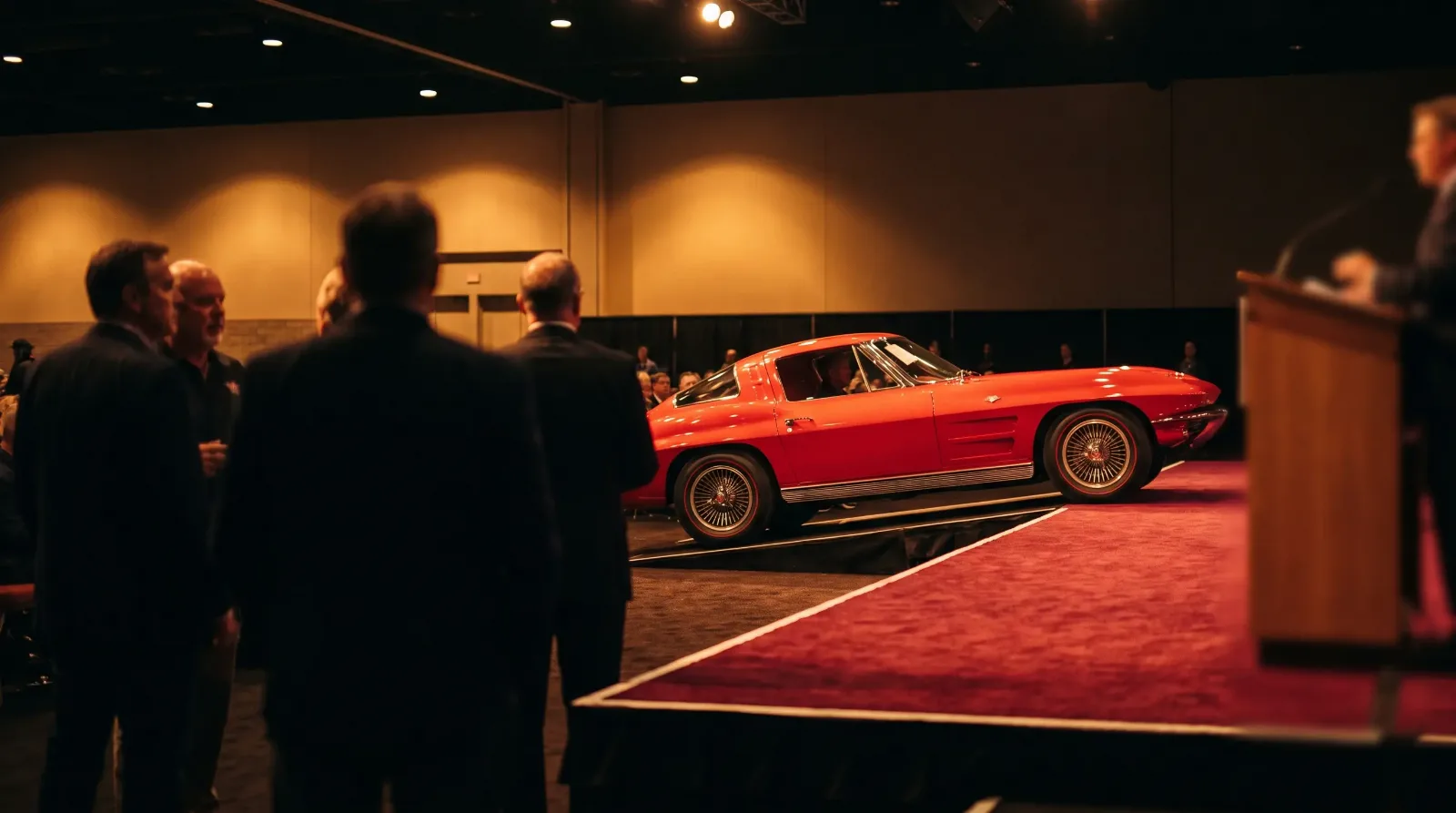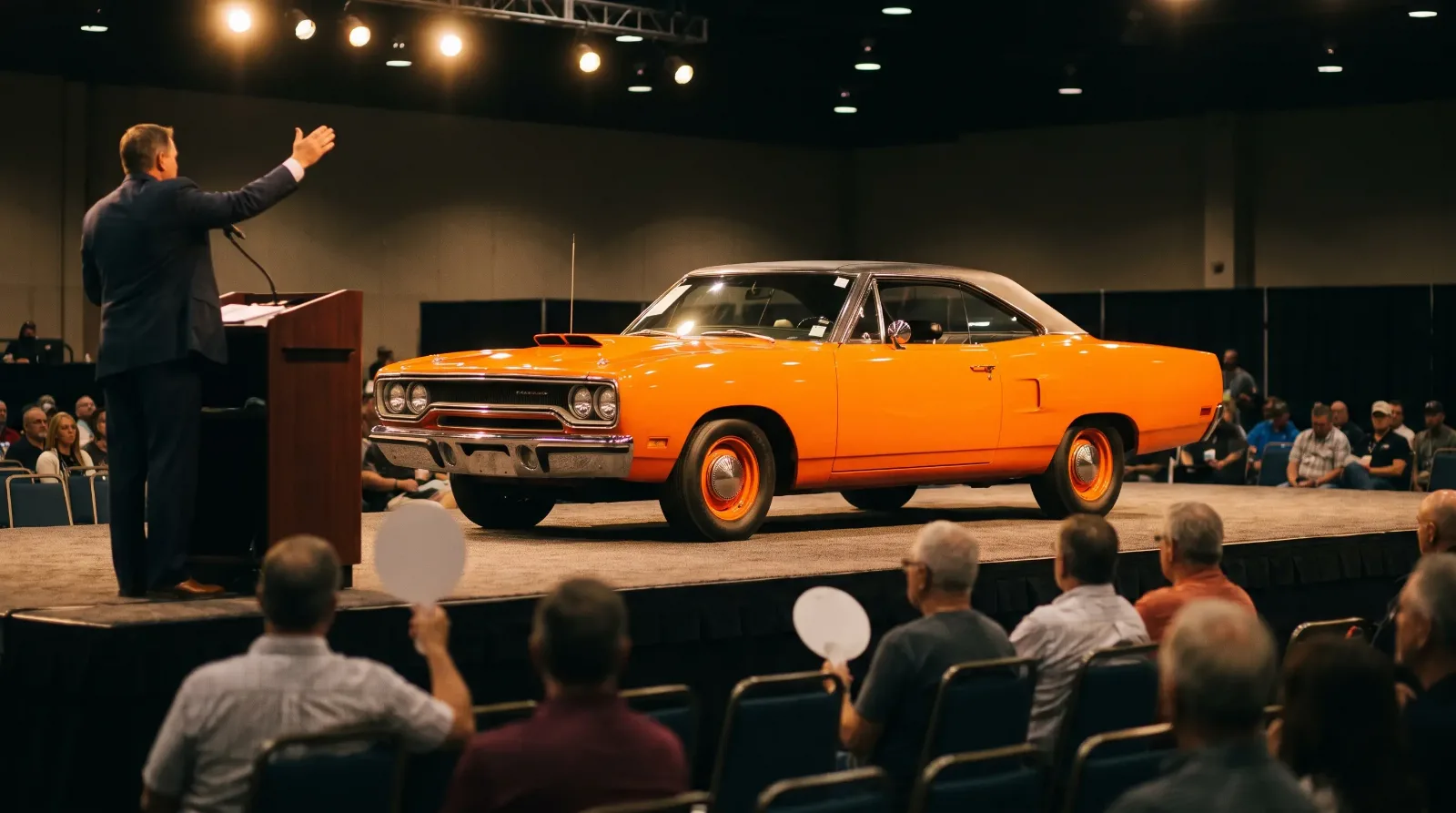
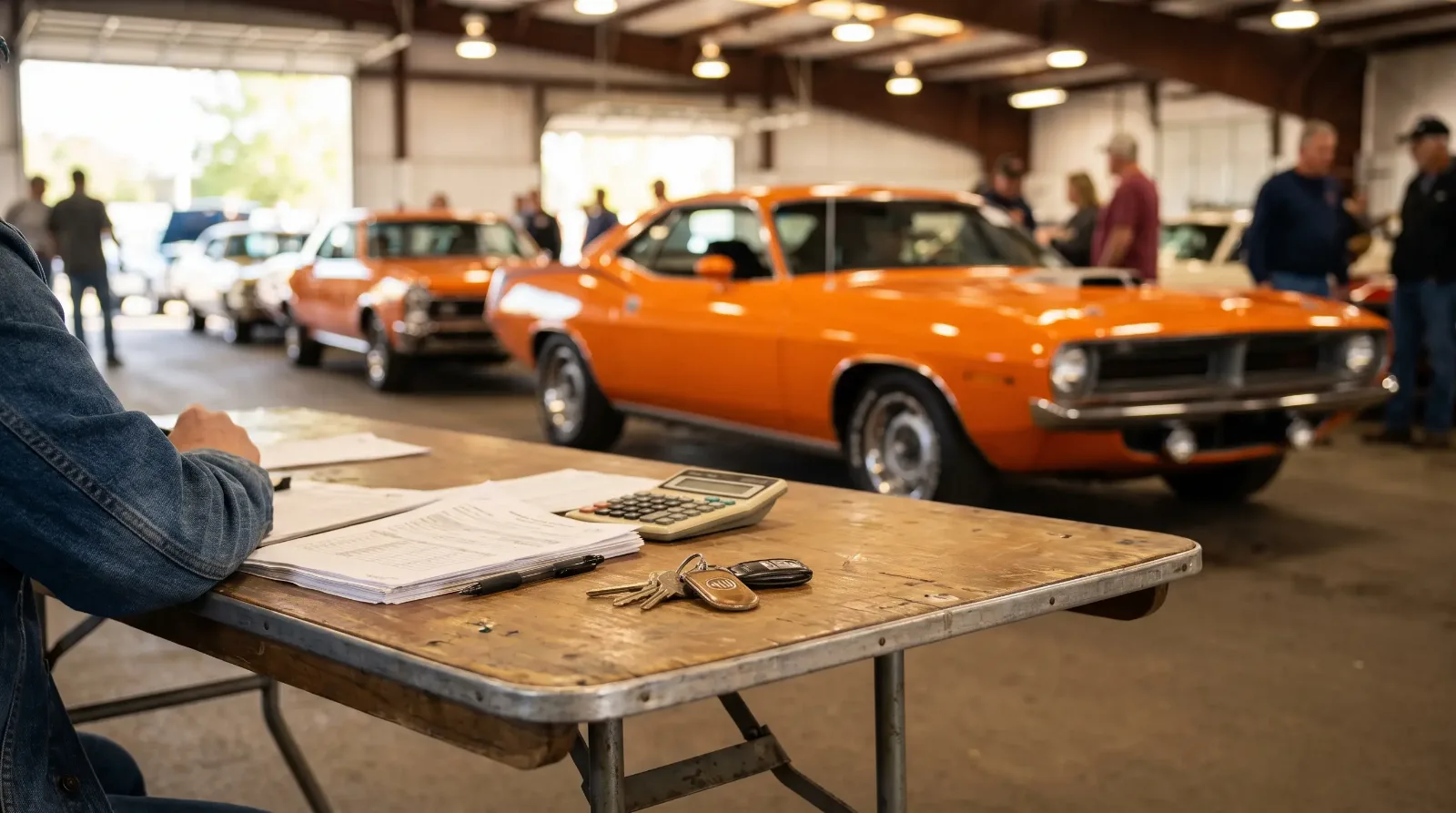
A reserve is a price below which you will not sell. That is the entire mechanism. What it does to bidders, to your final number and to the car's record afterward is where the decision gets harder, and where most sellers go wrong in one of two directions. Some set a reserve at the price they hope for and watch the car go home unsold. Others choose a no reserve auction to draw a crowd and discover, too late, that the crowd for their particular car was four people.
This is a narrow question inside a broader one. If you are still deciding between auction, private sale and consignment, our best way to sell classic car overview covers that choice. Here the method is already settled as auction. The question is whether to insure the downside, and what that insurance costs.
What a reserve does, and what it costs
A reserve protects you against one specific risk: a thin room. If the bidders who show up on the day value the car below your reserve, the car does not sell and you keep it. That protection has a price, and it is paid in more than one currency.
The first is fees. Houses charge more for the protection. At Mecum, a reserve lot pays the full entry fee of $350 to $1,000 and a 10% seller's commission, while a no-reserve lot pays half the entry fee and 6%. On a $60,000 hammer, the commission gap alone is $2,400.
The second is bidder behavior. Experienced bidders treat a reserved car as a car that may not be for sale at any price they would pay. Some will not engage until the auctioneer announces the reserve is off. Others bid early only to find the floor, then stop. The result is a slower start and fewer committed bidders, which matters most on cars where only a handful of serious buyers exist.
The third is the record. A reserve that is not met produces a no-sale and, very often, a published high bid. That figure becomes a comparable sale in everyone's notes, and it tends to cap what the car can bring privately in the months after. A reserve protects the car from a bad price today. It does not protect the car from the evidence of that bad price.
When a no reserve auction makes sense
No reserve works when the outcome is predictable enough that you can live with the floor. Predictability comes from liquidity, and liquidity comes from how many interchangeable cars trade each year. A popular model in a clear condition tier, with a clean title and a folder of receipts, is close to an ideal candidate. Hagerty's condition scale places the vast majority of collector cars at #3, good condition, and a well-documented #3 example of a common model has plenty of recent sales behind it. Bidders know its value within a narrow band, so the gap between a good day and a bad day is narrow too.
The no-reserve label also changes the room. It tells bidders the car will sell, which brings out buyers who skip reserved lots on principle. On a desirable car, two of those buyers can carry the price past what a reserve would have asked for. That upside is real. So is the caveat: it only appears when at least two of them are present.
There is one more legitimate reason to choose it. Some sellers need certainty more than they need the last dollar: an estate that has to close, a move, a deadline. A no-reserve sale converts the car to cash on a known date, and for those owners that has value of its own.
When a reserve is the right call
A reserve earns its cost when the range of possible outcomes is wide. That describes rare cars with few recent sales, modified cars and restomods whose value depends on who is looking, unrestored survivors whose originality is hard to grade from a catalog, and anything selling at a thinly attended regional event or an off-peak slot. In each case, the room on the day may simply not contain the right buyer.
It also earns its cost as value rises. A 10% miss on a $25,000 car is $2,500, which a seller can absorb. The same miss on a $250,000 car is $25,000. Higher-value consignments are often negotiated individually for this reason, and a reserve is usually part of the negotiation.
Online auctions handle reserves a little differently. Many allow them, and on curated sites the reserve is usually agreed with the platform's staff before the listing goes live, so expect a conversation if your number looks high against recent sales. Whether the timed online format suits your car at all is its own question, covered in our comparison of an online auction or listing site for selling a classic.
| Factor | Leans no reserve | Leans reserve |
|---|---|---|
| Recent comparable sales | Many, within a narrow price band | Few, or widely scattered |
| Condition | Clear #2 or #3 with records | Hard to grade, modified, or originality in question |
| Value | Modest, where a miss costs little in dollars | High, where a 10% miss is serious money |
| Audience at the sale | Large, active room or a busy online auction | Thin regional sale or an off-peak slot |
| Seller's position | Needs a certain sale by a certain date | Can take the car home and wait |
| Fee incentive | House discounts no-reserve lots (Mecum: half entry, 6%) | Little or no fee difference |
Setting a reserve you can defend
The reserve should be the lowest number you would genuinely accept, not the number you would like. Build it from completed sales of the same model in the same condition tier over roughly the past one to two years, then adjust for your documentation. Asking prices are not evidence of value. Neither is an insurance agreed value, which reflects replacement cost and often sits above what the car would bring at auction. Neither is what you spent on the restoration.
Then work backward from your walk-away net. Suppose you need $45,000 in hand. With a $600 entry fee, $1,200 of transport and a 10% commission, the reserve has to be $52,000: the commission takes $5,200, the fixed costs take $1,800, and $45,000 is what remains. Sellers who skip this arithmetic set a reserve at their target net and are surprised when the settlement statement comes back thousands short.
On the day, decide in advance how close the bidding has to come before you lift the reserve. If the floor is $52,000 and the room stalls at $50,500, a seller who has already done the math can say yes in five seconds. A seller who has not usually hesitates, and the auctioneer moves on. One more rule, which should go without saying: never bid on your own car or have a friend do it. Under the same UCC section, undisclosed bidding on the seller's behalf lets the buyer either void the sale or take the car at the last good-faith bid, and auction houses and online platforms ban it.
Reading the risk honestly
Most bad reserve decisions come from treating the reserve as a statement of what the car is worth. It is not. It is a statement of how much uncertainty you are prepared to accept. A common car with deep comps carries little uncertainty, and paying higher fees to insure against it is usually money spent on comfort. A rare or hard-to-grade car carries a great deal, and selling it without protection is a bet on the attendance list.
"A reserve is insurance against the room. Like any insurance, it is worth buying when the loss would hurt and the odds are hard to read. On a common car with deep comps, you are paying a premium against a risk the market has already priced."
— Marcus Feld
Run both versions of the settlement before you sign the consignment: once with a reserve and the higher fees, once without. If the no-reserve version at a cautious hammer still nets you a number you can live with, the discount is probably worth taking. If it does not, keep the reserve and set it honestly. And if neither auction format looks right once the numbers are on paper, our guide to every place to sell a classic car lays out the alternatives.
Sources and notes
- Cornell LII, UCC § 2-328, sale by auction: with and without reserve, withdrawal, seller bidding
- CLASSIC.com, auction fees and prices: Mecum 6% no-reserve and 10% reserve seller fees
- RM Sotheby’s, Consignor’s Conditions of Business (Arizona 2025): reserves, seller’s commission, consignment terms
- Street Muscle, what happens to cars that don’t sell at auction
- ClassicCars.com Journal, Arizona auction week report listing high bids on no-sales