
Most classic car sellers owe the IRS nothing. That is the first thing worth knowing about taxes when selling a car privately, and it is true for a simple reason: most people sell an old car for less than they paid for it plus what they put into it. The second thing worth knowing is that the sellers who do owe tax often owe more than they need to, because the federal rate on a collector car gain is higher than the rate on stocks and because the records that would have shrunk the gain went out with the recycling years ago.
This piece covers the federal side only: when a sale creates a taxable gain, how the 28 percent collectibles rate works, what counts toward your cost basis, and where the numbers go on the return. It is general information, not tax advice. A sale with a real gain is worth an hour with a tax professional before the year closes, not after. The paperwork that comes before any of this, the title, bill of sale and release of liability, is covered in our classic car title guide.
Gain or loss: the only question that starts the clock
The IRS treats a car you drove, showed and enjoyed as personal-use property. That classification cuts one way only. If you sell at a gain, the gain is taxable. If you sell at a loss, the loss is not deductible. There is no offsetting it against other income and no carrying it forward. A loss on a personal car simply disappears.
The arithmetic is short. Start with the amount you actually received, then subtract the costs of selling, such as a consignment commission, an auction seller's fee, a listing fee or transport you paid to deliver the car. That is your amount realized. Subtract your adjusted basis, which is what you paid for the car plus the cost of capital improvements. If the result is negative or zero, you have no federal income tax on the sale. If it is positive, you have a gain, and the holding period decides how it is taxed.
Held one year or less, the gain is short-term and taxed at ordinary income rates. Held more than one year, it is a long-term gain on a collectible, and the maximum federal rate is 28 percent. Note the word maximum. The collectibles rate is a ceiling, not a flat charge; a seller whose ordinary bracket sits below 28 percent generally pays at that lower bracket on the gain. Higher earners may also owe the 3.8 percent net investment income tax on top, which applies above income thresholds of $200,000 for single filers and $250,000 for married couples filing jointly, measured against modified adjusted gross income.
Whether a particular car is a "collectible" in the IRS sense is a fair question. The tax code (section 408(m)) defines collectibles as works of art, rugs, antiques, metals, gems, stamps, coins, alcoholic beverages and other tangible personal property the Treasury specifies. Cars are not named in that list, but a collector car held for its rarity or age is commonly treated as a collectible, and most preparers will apply the 28 percent rate to the gain. Near the line? Ask a preparer.
Cost basis: where receipts turn into money
Basis is the number you control, and it is the number most sellers undercount. It starts with the purchase price and grows with every capital improvement: a documented restoration, an engine or transmission rebuild, a new interior, a respray, a replaced floor or frame section. The test is whether the work added value or extended the life of the car, as opposed to keeping it running. Oil changes, tires, tune-ups, storage, insurance and club dues generally do not count.
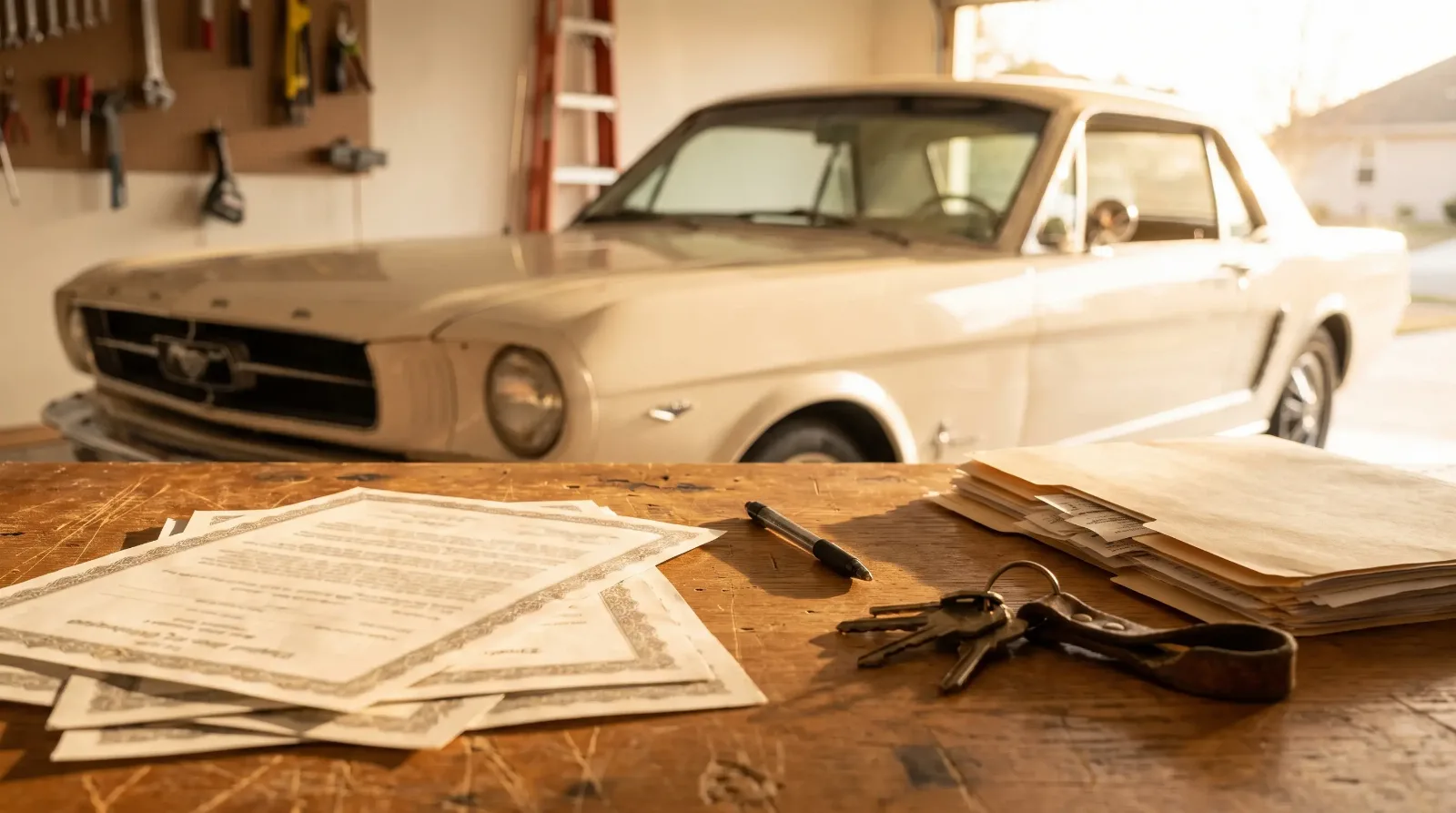
The burden of proof sits with you. A restoration that cost $30,000 and left behind a shoebox of invoices adds $30,000 to basis. The same restoration with no paper behind it adds nothing you can defend. Canceled checks, credit card statements and shop invoices that name the car or the VIN are what a preparer wants to see. If your records are thin, rebuild them now, while shops and banks still have files.
"Sellers treat restoration invoices as provenance for the next owner. They are that. They are also your basis, and basis is the only part of this calculation you get to argue about. An undocumented restoration is worth something to a buyer and nothing to the IRS."
— Marcus Feld
Two situations change the starting point. An inherited car generally takes a basis equal to its fair market value on the date of death, which often erases most of the gain the original owner built up; an appraisal as of that date is the document that supports it. A car received as a gift generally carries over the giver's basis instead, so the old receipts matter even if they were never yours.
A worked example, start to finish
The figures below are illustrative, built to show the mechanics. They do not describe any real car or seller. Assume a seller bought a driver-quality coupe in 2012 for $28,000, spent $22,000 over the following years on a documented bare-metal respray, an engine rebuild and a new interior, and sold it privately in 2026 for $78,000. Selling costs came to $1,200: a $99 listing fee, a pre-sale inspection and detailing, and an appraisal for pricing. The car was held well over a year, so the gain is long-term.
| Line | With receipts | Without receipts |
|---|---|---|
| Sale price | $78,000 | $78,000 |
| Less selling costs | $1,200 | $1,200 |
| Amount realized | $76,800 | $76,800 |
| Purchase price | $28,000 | $28,000 |
| Documented improvements | $22,000 | $0 |
| Adjusted basis | $50,000 | $28,000 |
| Long-term gain | $26,800 | $48,800 |
| Federal tax at the 28% ceiling | $7,504 | $13,664 |
| Plus 3.8% NIIT, if it applies | $1,018 | $1,854 |
| Worst-case federal total | $8,522 | $15,518 |
Read the right-hand column as the cost of lost paperwork: roughly $7,000 of federal tax on money the seller had already spent on the car. Read the bottom rows as a ceiling. A seller in a lower bracket, or below the NIIT thresholds, pays less than these figures. State income tax may apply on top, depending on where you live; nine states, including Florida, Texas, Nevada and Washington, have no broad personal income tax on wages, though Washington does tax some long-term capital gains above a high threshold.
Now run the same car the other way. Sold for $46,000 with the same receipts, the amount realized is $44,800 against a $50,000 basis. That is a $5,200 loss, and it is not deductible. Without receipts, the same sale would show a gain of $16,800 on paper. The receipts matter at every price, not only the good ones.
Reporting the sale and timing it
A taxable gain goes on Form 8949 and carries to Schedule D of your Form 1040. Form 8949 asks for the date acquired, the date sold, the proceeds, the basis and the gain; selling costs that are not already reflected in the proceeds go in as an adjustment (code E in column (f), the amount in column (g)). If you sell at a loss, the IRS instructions say a nondeductible loss on personal property generally should not be reported at all. Keep the bill of sale, the title copy, the purchase documents and the improvement invoices together in one file. That file is your support if the return is ever questioned, and the IRS's general rule is to keep property records until the period of limitations runs out for the year you sold, usually three years after filing.
If you were paid through a payment app or online marketplace, a Form 1099-K is possible but not likely for one sale: the federal threshold for those platforms is more than $20,000 in more than 200 transactions in a year. If one does arrive, remember that it reports gross payments, not profit, so it does not mean you owe tax on the full amount. It does mean the IRS has a record of the money. For a car sold at a loss, the Form 8949 instructions have you report the sale with code L so the nondeductible loss nets to zero; for a gain, report it with the basis that explains it.
Timing has a few levers. A car held eleven months and sold a few weeks early converts a long-term gain into a short-term one, so check the purchase date on your title before you agree on a closing date. Selling in a year when your other income is lower can keep the gain in a lower bracket or under the NIIT threshold. And the way you sell changes the amount realized: a commission-based route takes a percentage off the top before any tax is calculated, while a flat listing fee is a small fixed deduction. If you are still choosing a channel, it is worth seeing how the options stack up on cost before you think about tax on what is left.
One more thing sellers ask about: sales tax. In a private sale it is almost always the buyer's obligation, paid when the car is registered, and it has no bearing on your federal gain. If a buyer raises it or asks you to write a lower price on the bill of sale, the details are here. The short version is no. The bill of sale price is your proceeds figure too, and it should be the real number.