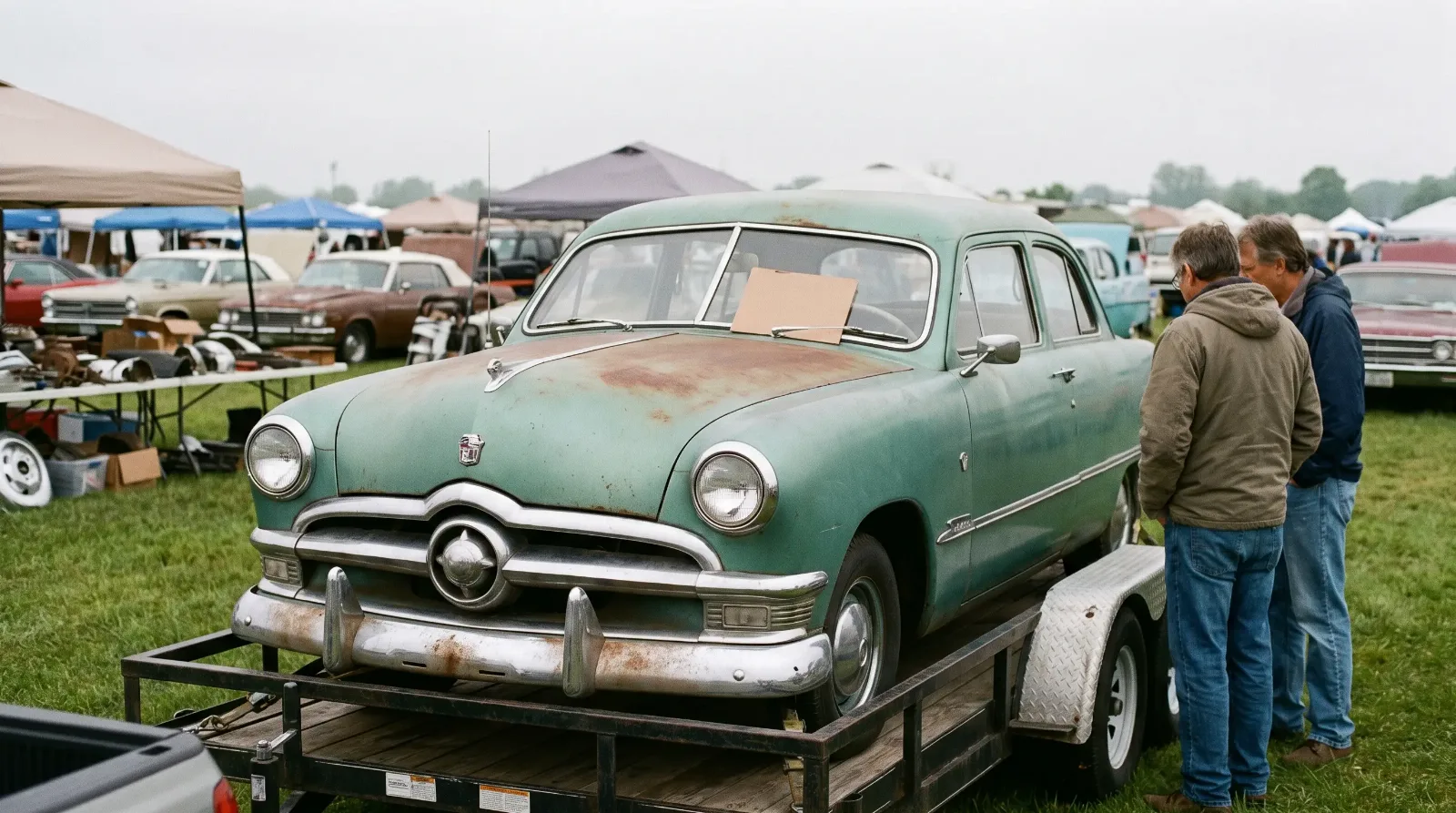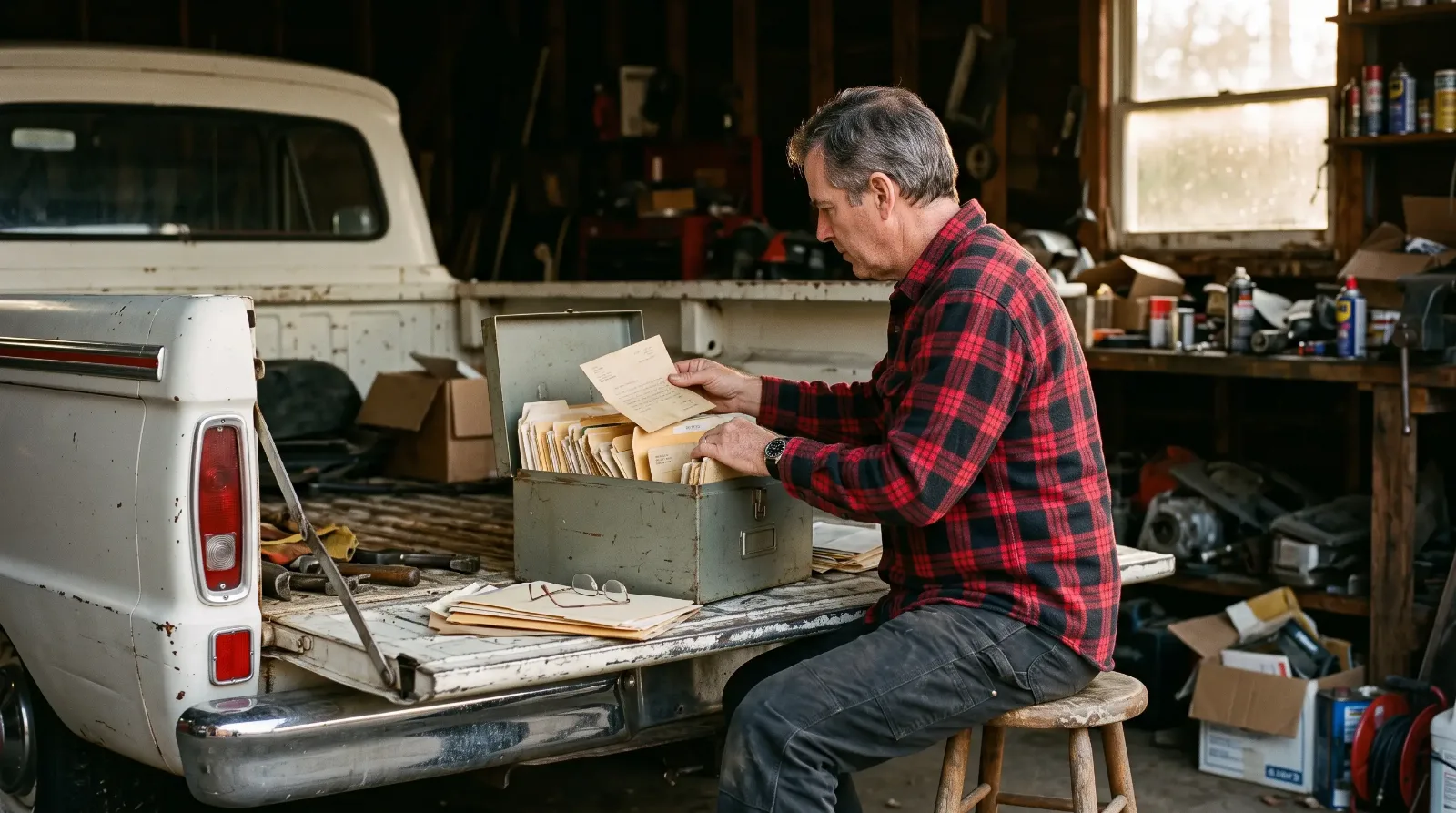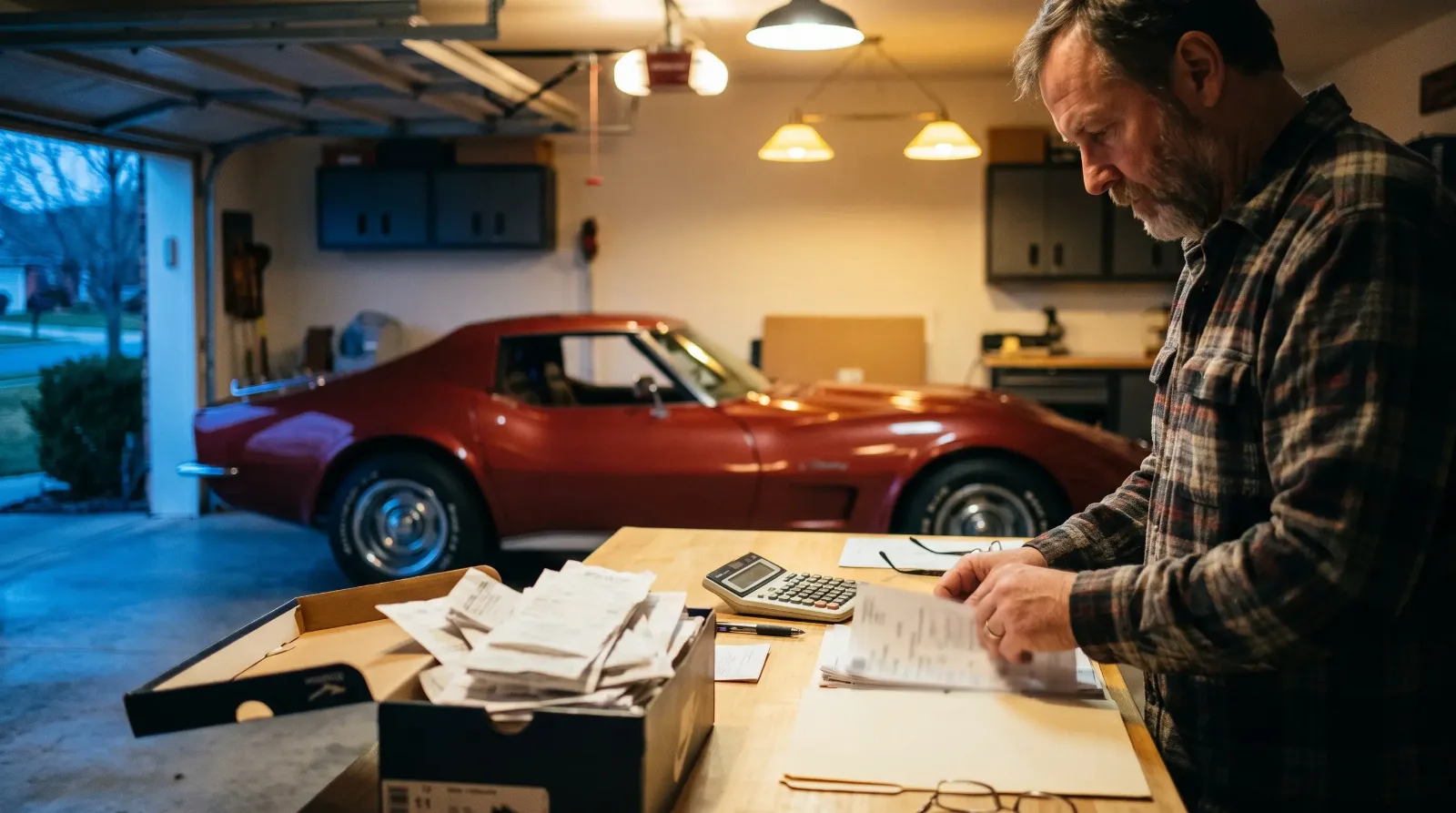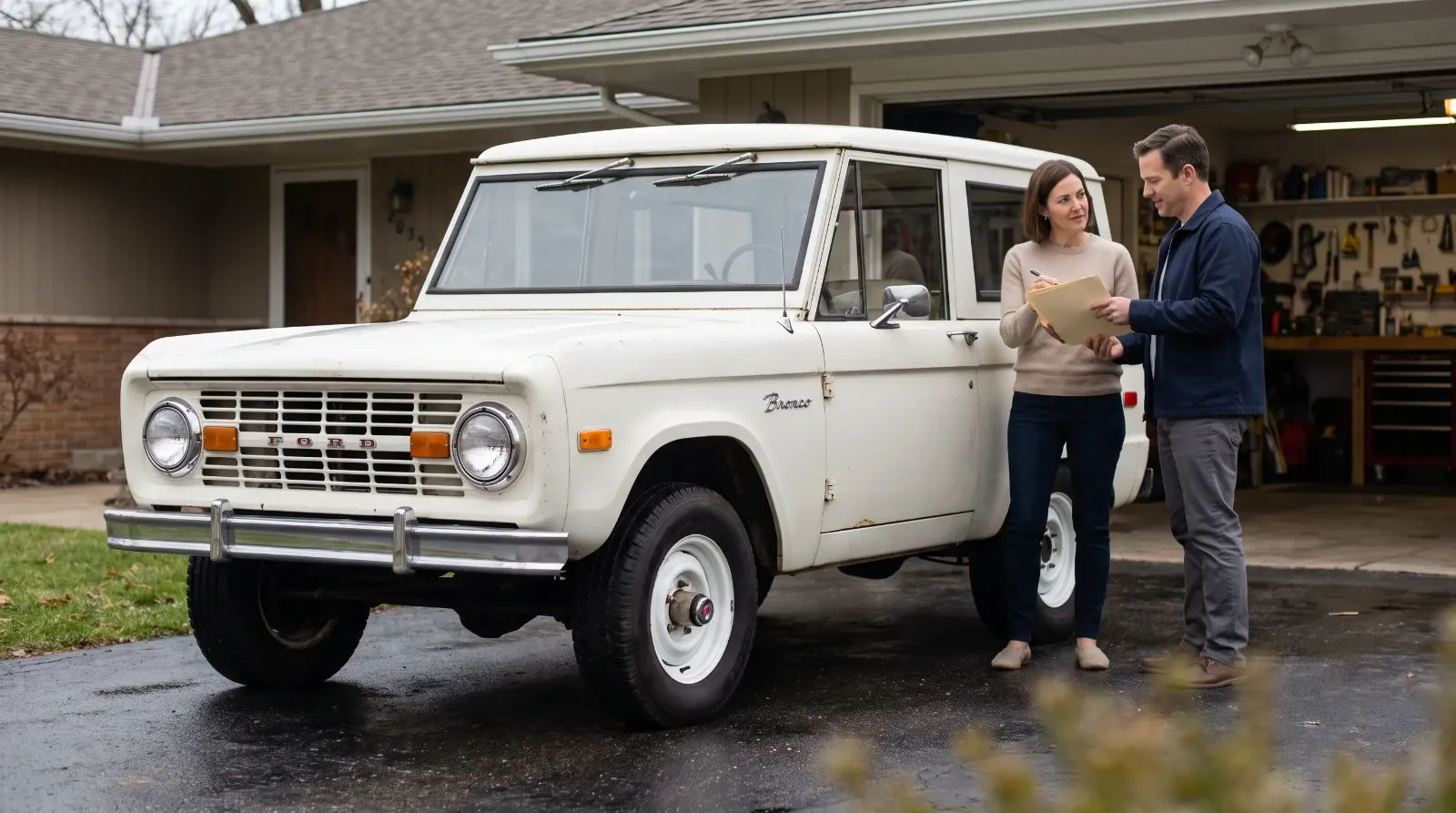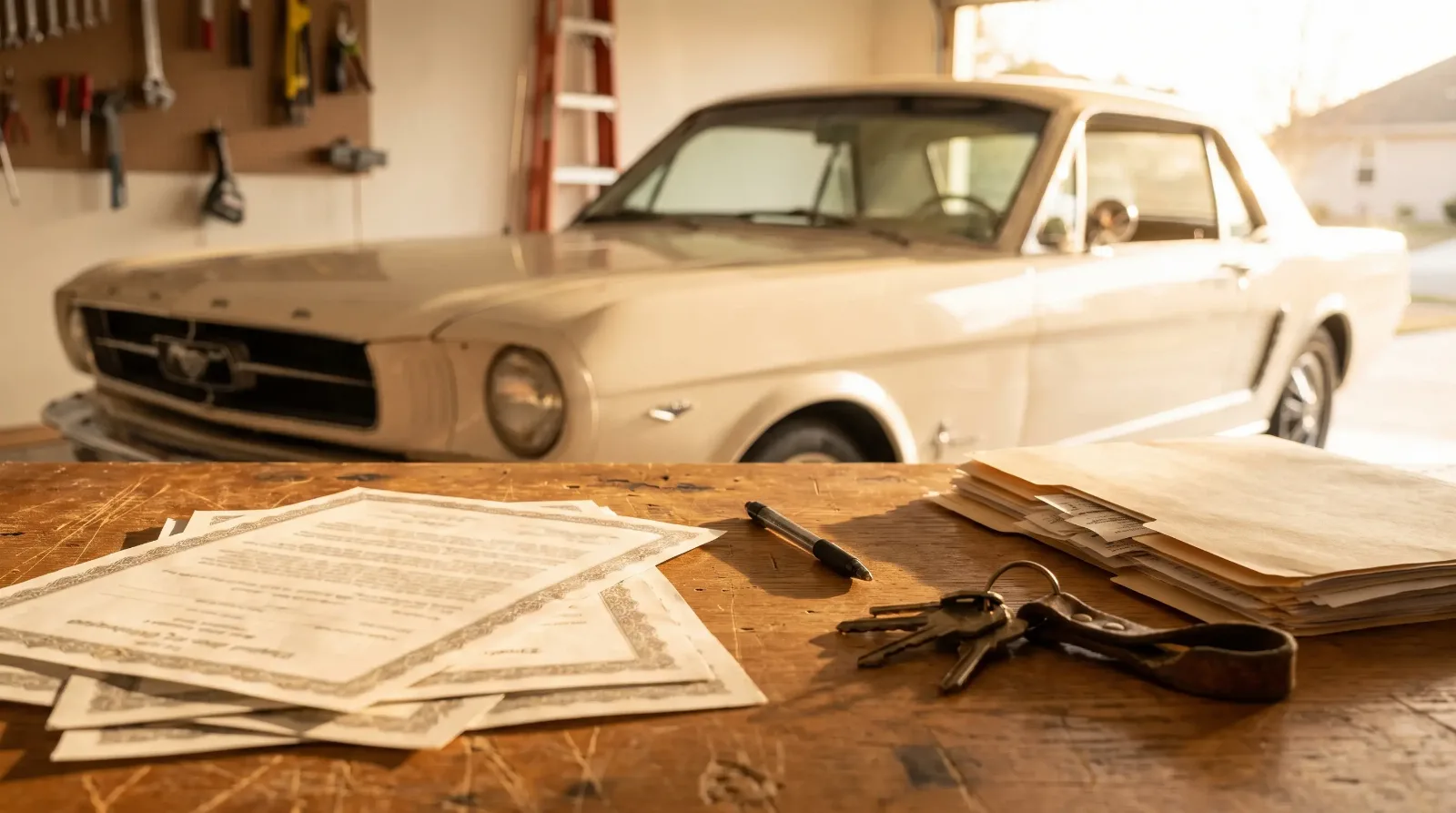
Every collector car sale ends the same way. Two people, a table, a pen, and a stack of paper that decides whether the car actually changed hands or only changed driveways. The classic car title is the center of that stack. It is the one document the state recognizes as proof of ownership, and if it is wrong, missing, or signed in the wrong box, the buyer cannot register the car and you may still be on the hook for it.
This guide covers the paperwork side of selling an older car in the US: signing over the title, what to do when there isn't one, what belongs in a bill of sale, the odometer and plate questions, liens, the federal tax on a gain, who pays sales tax, and the scams that target sellers specifically. Rules vary by state and change over time, and this is general information, not legal or tax advice. Check your state DMV and talk to a tax professional before a large sale.
The title transfer, done correctly the first time
A title transfer looks simple and fails in small ways. The seller signs and prints their name in the seller section exactly as it appears on the front of the title. If two owners are listed and joined by "and," both normally have to sign; if they are joined by "or," one signature is usually enough, though some DMVs still ask for both. The sale date, the sale price, and the buyer's full name and address go in the spaces provided. Some states require the seller's signature on the title to be notarized, Pennsylvania and Ohio among them, so read the back of your title before anyone picks up a pen.
Three habits prevent most problems. First, match the VIN on the title to the VIN on the car, physically, at the time of sale. On older cars the number may sit on a door jamb tag, a dash plate, or a frame stamping, and a mismatch is the buyer's problem today and your problem next month. Second, never sign an "open" title, meaning a title with the seller section signed but the buyer section left blank. Open titles are how cars get flipped without anyone paying tax or taking legal responsibility, and many states prohibit them. Third, do not use correction fluid or cross anything out. A damaged or altered title often has to be replaced through the DMV before the buyer can use it, and that delay lands on you.
Make a photocopy or a clear photo of both sides of the signed title for your own records before you hand it over. That copy, plus the bill of sale, is your evidence of the date ownership changed.
Missing titles, old-car exemptions and bonded titles
Older cars are where title paperwork gets interesting, because not every state titled every vehicle, and records from the 1960s and 1970s were not always carried forward. A car can have been legally owned for forty years and still not have a title in the glovebox.
Some states do not issue titles for vehicles older than a certain model year. New York, for example, does not issue titles for model year 1972 and older vehicles and uses a transferable registration instead. Georgia does not require a title for model year 1962 and older vehicles, and for 1963 to 1985 models it issues one only when there is already a title to transfer. In those states the ownership document is the old registration plus a bill of sale, and a buyer from a titling state will need to take that package to their own DMV. Ask the buyer to call their DMV before the sale and confirm what it will accept. That one phone call settles more deals than any amount of negotiation.
If your state does title the car and you have simply lost it, the fix is usually a duplicate title application with your state's DMV, a fee, and some waiting. Do that before you list the car, not after you have a buyer. If the title was never issued to you, or the chain of ownership is broken, many states offer a bonded title: you buy a surety bond and the state issues a title branded as bonded for a set period. Texas, for example, sets the bond at one and a half times the vehicle's value and keeps the bonded brand for three years; other states use different figures. A bonded title is legitimate, but some buyers discount for it, so expect the question.
What a bill of sale should contain
Some states require a bill of sale for every private vehicle transfer, some require it only when the title lacks a space for the price, and some do not require one at all. Write one anyway. It records the terms, the date, and the condition language that protects you if the buyer has second thoughts. Many DMVs publish a free form; if yours does, use it, and add a page for anything it does not cover.
| Item | Why it matters |
|---|---|
| Full names, addresses and signatures of buyer and seller | Identifies both parties for the DMV and for any later dispute |
| Year, make, model, body style and VIN | Ties the document to one specific car; check the VIN against the car and the title |
| Sale price and payment method | Sets the taxable amount for the buyer and documents your proceeds |
| Date and time of sale | Marks the moment liability for tickets, tolls and accidents shifts |
| Odometer reading, with "actual," "exceeds mechanical limits" or "not actual" noted | Records mileage even where federal disclosure is exempt |
| "Sold as is, where is, with no warranty expressed or implied" | Standard private-sale language limiting claims after the sale |
| List of items included | Spare parts, original documents, tools, covers; avoids "I thought that came with it" |
| Notary block, if your state requires it | A few states require a notarized bill of sale for certain transfers |
Make two originals and have both parties sign both. Keep yours with the title copy.
Odometer, plates, release of liability and liens
Federal odometer disclosure rules have exempted older vehicles for decades. Under the NHTSA rule that took effect on January 1, 2021, vehicles of model year 2010 and older remain exempt from federal odometer disclosure, while model year 2011 and newer vehicles must be disclosed for 20 years. For nearly every classic, that means federal law does not require a mileage statement. Write the reading on the bill of sale anyway, and be honest about it. A five-digit odometer on a 1968 car has almost certainly rolled over at least once, and "not actual" or "true mileage unknown" is a perfectly respectable thing to write. Claiming low miles you cannot document is how a clean sale becomes a fraud complaint.
Plates are a state question. In most states the plates stay with the seller and come off the car at the sale; in a few they stay with the vehicle. Historic or antique plates usually stay with you. Take them off unless your DMV says otherwise, and cancel or transfer the registration as your state requires.
Then file the release of liability, sometimes called a notice of transfer or notice of sale. Many states offer it online and set a short deadline; California, for example, requires sellers to file within five days. This filing tells the state you no longer own the car. If the buyer never registers it and racks up parking tickets, tolls, or worse, that record is what keeps them off your desk. Cancel your insurance only after the car is gone and the notice is filed.
If you still owe money on the car, the lender holds the title or holds a lien recorded on it. The cleanest approach is to close the sale at the lender's branch, where the buyer's payment covers the payoff and the lender releases the lien on the spot. Otherwise you pay off the loan first, wait for the lien release or the clear title, and then sell. Either way, a buyer should never pay you for a car whose title still names a lienholder without a written payoff plan everyone has signed.
Federal tax on a gain, and who pays sales tax
Most people selling an old car at a loss owe nothing and can stop here. The IRS treats a classic car you drove and enjoyed as personal-use property, and the IRS states plainly that losses on personal-use property such as a car are not deductible. Selling a car for less than you paid, plus what you put into it, has no tax consequence on the federal return.
A gain is different. Collector cars are commonly treated as collectibles, and net gains on collectibles held more than one year are taxed at a maximum federal rate of 28 percent, rather than the lower long-term rates that apply to stocks. Gains on cars held a year or less are taxed as ordinary income. Higher earners may also owe the 3.8 percent net investment income tax. The sale is reported on Form 8949 and carried to Schedule D. State income tax may apply on top.
The number that matters is your cost basis: what you paid for the car plus the cost of capital improvements, such as a documented restoration, an engine rebuild, or new paint and upholstery. Routine maintenance like oil changes, tires and storage generally does not count. This is where record-keeping turns into money. A restoration you cannot document is, as far as a tax return goes, a restoration that did not happen.
"The invoices in the shoebox are not just provenance for the next owner. They are your cost basis. I have watched sellers pay tax on a gain that was mostly their own restoration money, because the receipts went out with the trash years ago."
— Tom Ramirez
Sales tax in a private sale is normally the buyer's concern. In most states the buyer pays sales or use tax when they title and register the car in their home state, based on the price on the bill of sale or a state valuation, and the private seller collects nothing. That is one reason the price on the bill of sale should be the real price. Writing a lower number "to help the buyer with tax" is tax fraud, and it also lowers the figure you can point to if your proceeds are ever questioned. Some states also tax private sales on a state-set or book value when the reported price is lower.
The scams aimed at sellers
Buyers worry about rust and rolled odometers. Sellers should worry about payment. Classic car sellers are attractive targets because the amounts are large, the buyers are often out of state, and the transaction happens between two private people with no dealer in the middle. On a platform where the buyer pays the seller directly, verifying that payment is your job, and it is worth doing slowly.
Fake cashier's checks and overpayment
The classic version: a buyer, often "overseas" or "on an oil rig," sends a cashier's check for more than the price and asks you to wire back the difference to cover shipping. Federal rules require banks to release at least the first several thousand dollars of a deposited cashier's check as soon as the next business day, but a counterfeit can take weeks to be discovered, and you are responsible for the full amount. Never refund an overpayment. To verify a cashier's check, look up the issuing bank's phone number yourself, not the number printed on the check, and call to confirm. Better still, meet the buyer at their bank and watch the check get drawn, or require a wire and confirm it has landed in your account with your own bank before the title leaves your hands.
Fake escrow
Legitimate escrow services exist, and they are useful for long-distance sales. Scammers know that, so they build convincing copies. The tell is who picks the service. If the buyer insists on a specific escrow company and sends you the link, treat it as a red flag. Choose the escrow service yourself, type its address into your browser directly, check its license directly with the state regulator rather than trusting a license number on the site (California's DFPI has warned about fake escrow firms quoting a real company's number), and confirm the funds are actually in escrow by logging into your account there, not by reading an email.
"My shipper will pick it up"
A buyer who never sees the car, never asks a technical question, and arranges a transport company to collect it the day after "payment" is usually running the check scam in a different coat. Real long-distance buyers ask for photos of the floors, the VIN tag and the engine stampings, and many send an inspector. Release the car and the title only after funds have cleared and are irreversible, never on the strength of a tracking number or a screenshot.
Phishing for your VIN and title
Some requests are not about buying at all. A "buyer" who asks for a close-up of the front and back of your title, your registration, or your driver's license may be collecting what they need to clone the VIN onto a stolen car or to forge a title. Your VIN is visible on the car and is fine to share; a serious buyer needs it for a history check. The title document itself is another matter. Show it in person, or send a photo with the title number, your address and your signature covered.
A closing checklist for the day of sale
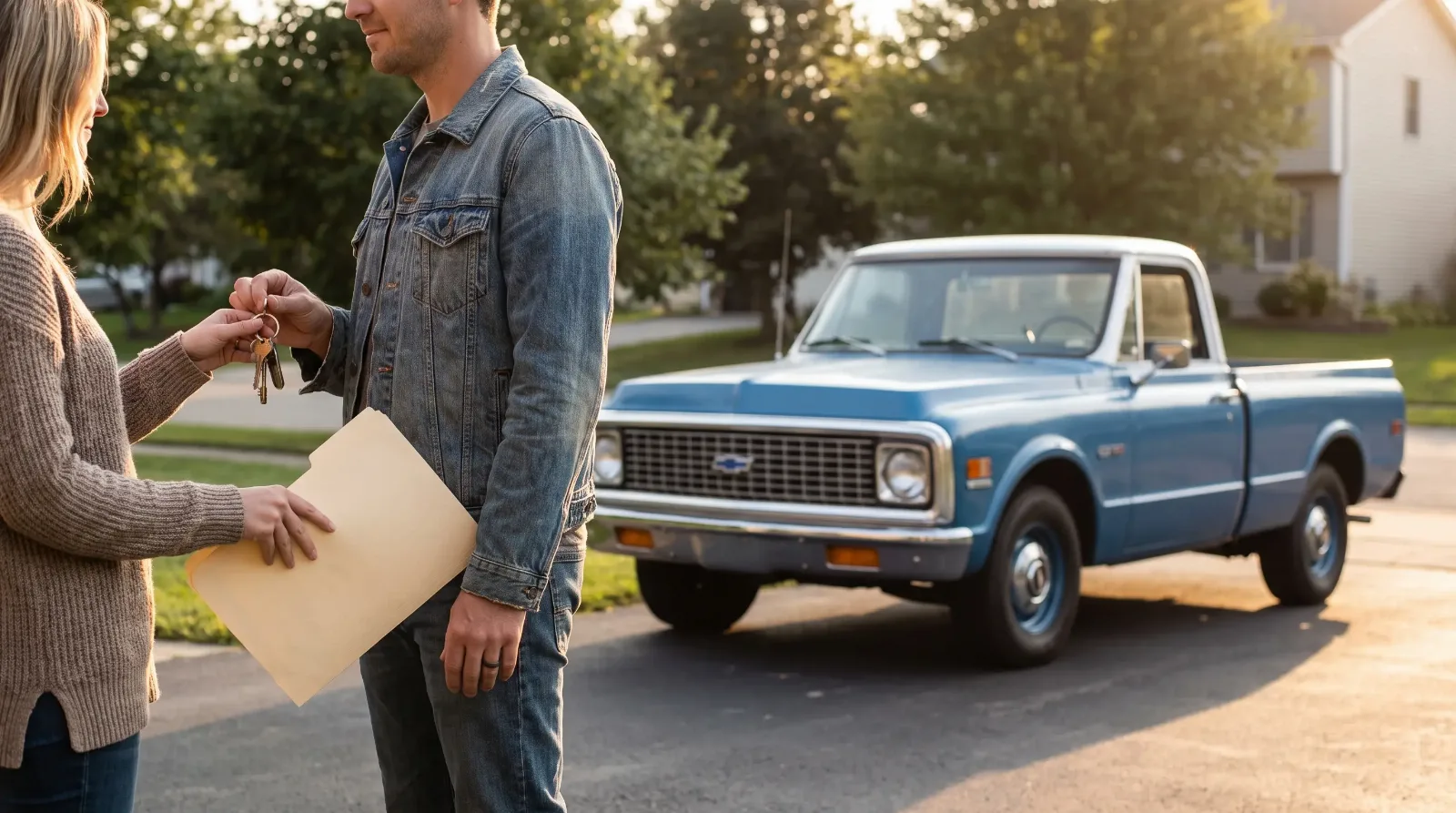
Paperwork is easier when it is ready before the buyer arrives. The week before, confirm the title is in your name, matches the VIN on the car, and is free of liens, or that you have a payoff letter. If your state does not title the car's model year, assemble the registration, any older titles you hold, and a clean bill of sale. If you are still weighing platforms and deciding where to sell a classic car, factor in how each one handles payment: an auction house or dealer handles the money for a fee, while a direct listing leaves verification to you.
On the day, check the buyer's ID against the name going on the title. Confirm the funds by the method you agreed, and confirm them independently. Sign the title in the correct boxes with the correct date and price. Sign both copies of the bill of sale. Photograph everything. Remove your plates. Hand over the keys, the title, and the documentation file, including the restoration invoices the buyer will want for provenance (keep copies for your own cost basis). That evening, file the release of liability online and call your insurer.
The paperwork is only one part of the job. For pricing, photography, writing the listing and handling inquiries, our guide on how to sell classic car deals from start to finish covers the steps that come before the table and the pen. Get those right, then let the paper close the deal cleanly.
Sources and notes
- IRS Topic no. 409, Capital gains and losses (personal-use losses, 28% collectibles rate, Form 8949 and Schedule D)
- New York DMV, Certificate of title (no titles for model year 1972 and older)
- PennDOT, Buying or selling a vehicle (seller signature notarized or verified)
- California DMV, Title transfers and changes (release of liability within 5 days)
- FTC, How to spot, avoid and report fake check scams
- Venmo, Purchase Protection eligibility (vehicles excluded)