
Drop springs go in, the truck looks great sitting an inch off the ground, and two weeks later there's a vibration at highway speed that wasn't there before. Nine times out of ten that's the pinion angle, not a bad U-joint or a driveshaft that needs balancing, even though it feels exactly like both of those things when you're chasing it in the garage.
Restoration & Tech
6 min read
Adjusting Rear Pinion Angle After Installing Drop Springs
Dropping the rear of a C10 changes the driveshaft's operating angle even though nobody touched the driveshaft, and the vibration that follows almost always traces back to an uncorrected pinion angle.
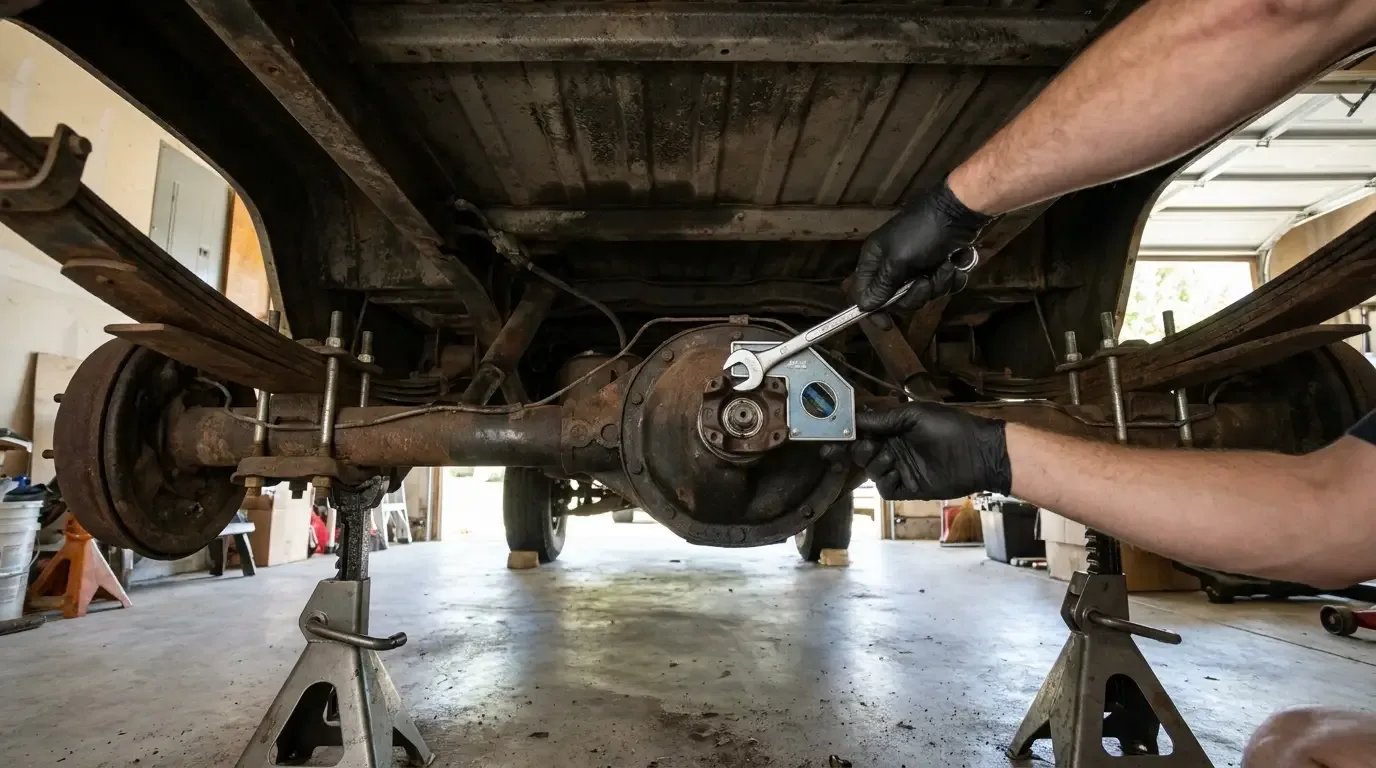
I've had this conversation with enough guys who just dropped their C10 to know it's the most skipped step in the whole job. Springs are easy. Checking what the springs did to the angle between the transmission and the rear end is the part people forget, right up until the driveshaft starts humming at 55.
Why pinion angle matters after you drop the rear
The driveshaft connects the transmission output to the pinion yoke at the rear end through a pair of U-joints, and those joints are only happy operating at an angle within a specific range, usually somewhere under three degrees of working angle depending on RPM and joint type. Drop the rear of the truck with shorter springs or a flip kit and you change the angle the pinion sits at relative to the transmission, which changes the operating angle at both U-joints even though nobody touched the driveshaft itself.
Run outside that range and you get vibration that gets worse with speed, accelerated U-joint wear, and in bad cases a driveshaft that walks itself out of the slip yoke under hard acceleration. None of that is dramatic on day one. It shows up as a slight buzz through the floor that a lot of guys write off as tire balance, right up until a U-joint fails on the highway.
Reading the symptoms of a bad pinion angle
A vibration that's speed-sensitive rather than throttle-sensitive points at driveline angle before it points at anything else. If the shake gets worse as you accelerate and better when you let off, even at the same speed, that's usually U-joint angle, not tire balance or an out-of-round tire. A clicking or clunking on hard acceleration from a stop can mean the angle's bad enough that the joint is binding at full extension.
Check for U-joints with uneven wear on the caps too. If you pull the driveshaft and one side of a joint shows more wear than the other, that's a good sign the angle's been wrong for a while, and it's worth checking before you spend money on a "quieter" driveshaft that won't fix a geometry problem.
| Symptom | Likely cause |
|---|---|
| Vibration worsens with speed, not throttle | Excessive U-joint operating angle |
| Clunk on hard acceleration from a stop | Joint binding near full extension |
| Uneven wear on U-joint caps | Sustained incorrect pinion angle |
| Vibration changes with load in the bed | Angle shifting under suspension travel |
Measuring pinion angle correctly
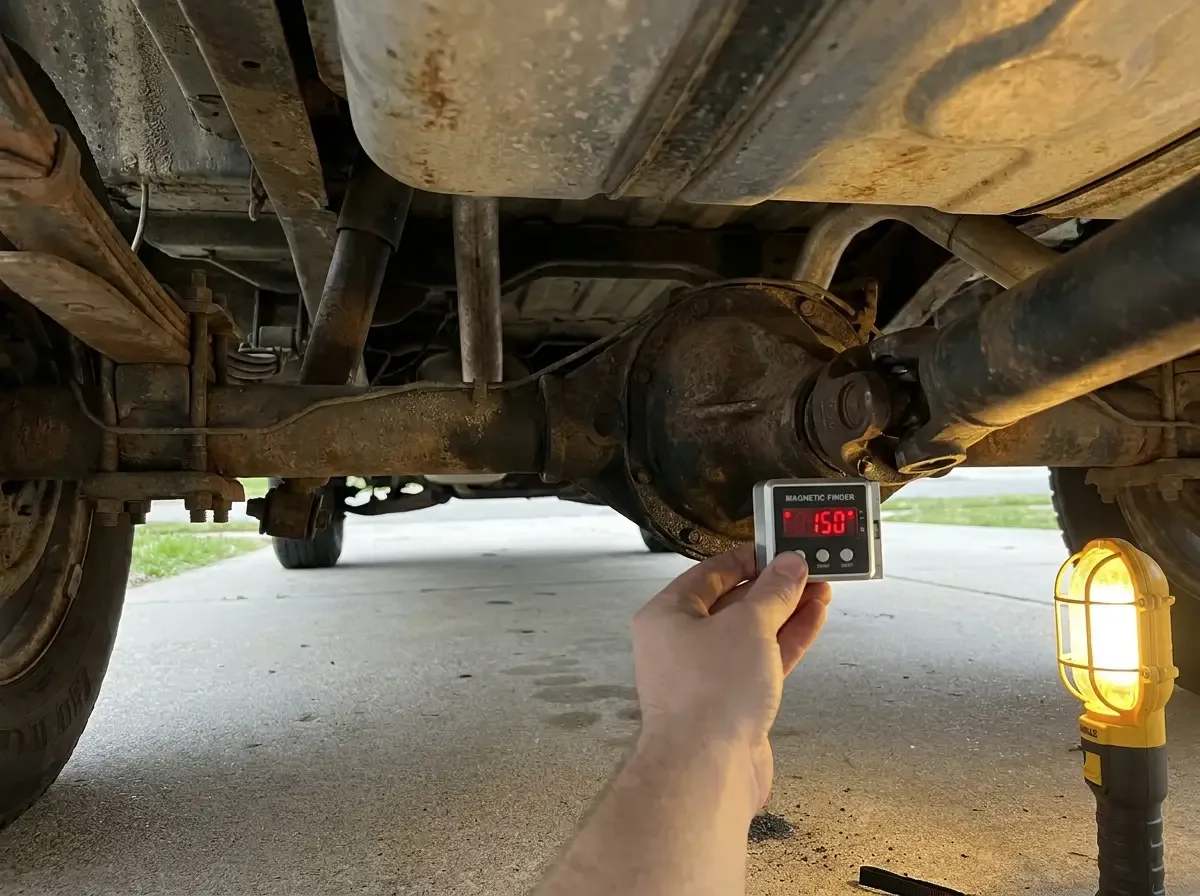
You need an angle finder, the magnetic kind that reads off a flat surface, and you're taking two readings, one off the transmission output shaft or the driveshaft itself right behind the transmission, and one off the pinion yoke at the rear end. The truck needs to be sitting at ride height, on the ground, not up on a jack with the suspension hanging free, because the whole point is measuring the geometry the truck actually drives at.
The two angles don't need to match exactly, they need to work together so the U-joints see roughly equal and opposite operating angles, which cancels out vibration at each end of the shaft. This is the part people get backwards. A pinion pointed straight up at the transmission angle isn't the goal. Matched opposing angles are.
Adjusting with shims, wedges, or adjustable arms
On a leaf spring rear end, tapered shims between the axle pad and the spring, or a wedge-shaped shim block, rotate the pinion nose down relative to stock, which is usually the correction you need after a drop, since lowering the rear tends to rotate the pinion nose up. On a truck with a four-link or trailing arm rear suspension, adjustable upper or lower control arms do the same job with a turnbuckle instead of a wedge under the spring pack.
Make small adjustments and remeasure. A degree or two of shim is usually enough, and overcorrecting just moves the vibration to the other joint instead of eliminating it. If you're running lowering guide specs on drop height, expect to need somewhere around 2 to 4 degrees of correction for a typical 2 to 3 inch drop, though every combination of springs, axle, and ride height is different enough that you should measure your own truck rather than trust a number from someone else's build.
Double-checking under load
Once you've made the correction, drive it, then recheck. Load the bed if that's how the truck's normally used, since a loaded rear end sits at a slightly different point in its travel than an empty one, and that shifts the angle again. Take it out on the highway and listen and feel for the speed-sensitive vibration you started with. If it's gone, you're done. If it's better but not gone, it's usually a small remaining correction, not a sign you need to start over.
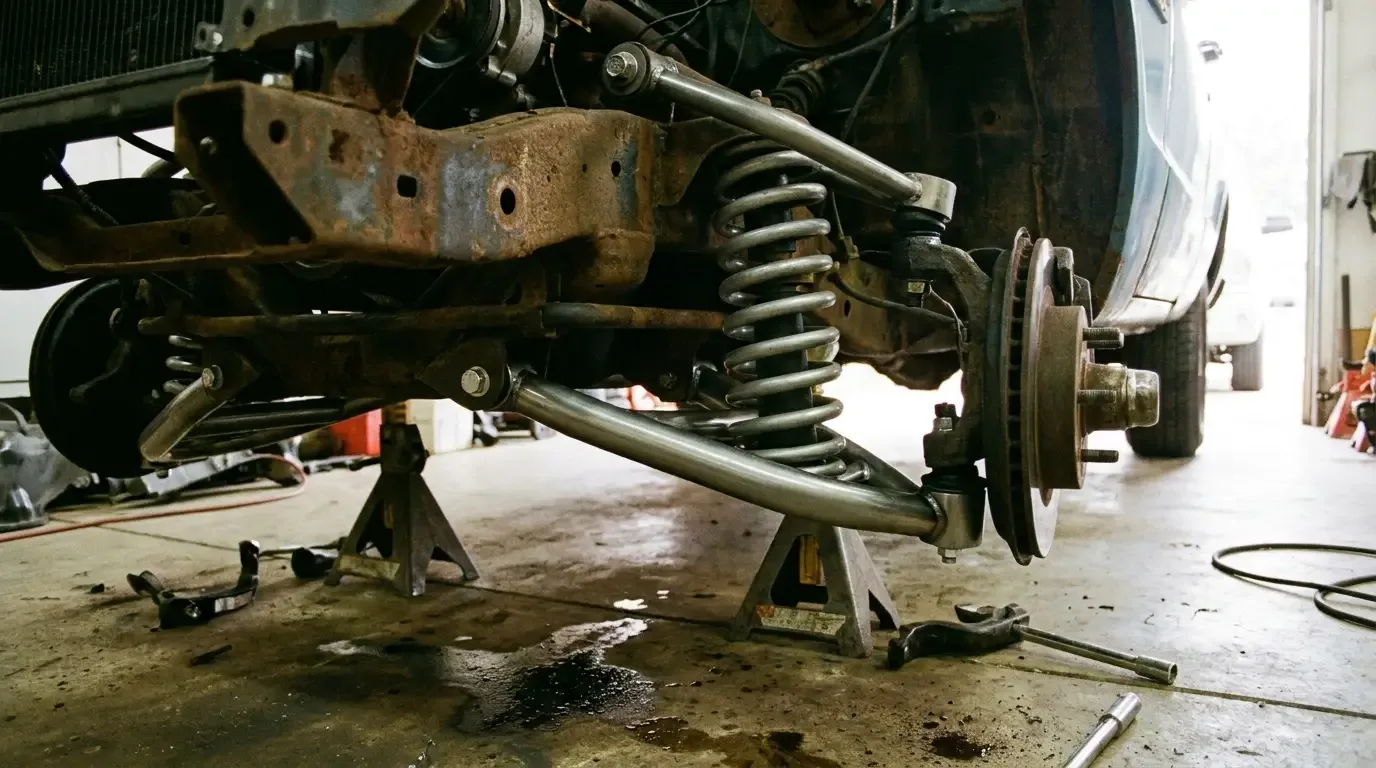
This is also a good point to think ahead. If the front end's getting attention next, tubular control arms as the next upgrade step is a logical place to keep improving how the truck rides and handles, since correcting the rear geometry only fixes half of what a lowered C10 needs sorted.
"Guys spend real money on drop springs and then drive around with a driveshaft angle that's eating a U-joint every six months, because checking pinion angle isn't as fun as picking out wheels. Twenty minutes with an angle finder saves you that headache."
Mike Sullivan
Pinion angle is one of those checks that takes less time than people assume and gets skipped more than it should. If you just dropped the rear of your C10, put the angle finder on it before you put miles on it. It's cheaper than a driveshaft and a lot cheaper than the U-joint that fails on the highway.
Sources and notes
- The Ranger Station, Pinion & U-Joint Angles tech reference
- Spicer Parts, Driveline Operating Angle Calculator
- DJM Suspension, pinion angle shim kits (2/4/6 degree options)
- Calvert Racing, 6 Degree Pinion Shims product listing
- Fleet Equipment Magazine, Ensure Your Truck's U-Joints Are Operating At The Correct Angle
- Tom Wood's Custom Drive Shafts, Driveline Geometry 101
Related Reading

Have a
Chevrolet C10
for Sale?
Reach thousands of serious classic car collectors across the US.
Sell It Here →
Are You a Classic Car Dealer?
List your full inventory and connect with targeted classic car buyers.
Join as a Dealer →

About the author
Mike Sullivan
Detroit-area muscle car enthusiast and restoration specialist with three decades of hands-on experience working on American iron.
Related Listings - Chevrolet C10
More in Restoration & Tech
Comments
Be the first to comment on this article.