
Pull the hood off a top-shelf gasser and you usually find one of two things sticking through it: a big polished GMC blower drive, or a forest of aluminum velocity stacks feeding a mechanical injector. Both setups exist for the same reason. A gas-class car had to make more power than the guy in the other lane, and the fastest way to do that was to force-feed the engine or meter fuel straight into it. The stance and the straight axle get all the attention, but the engine is where the class was won or lost.
Restoration & Tech
8 min read
Blown and Injected Gasser Engines
GMC blowers, Hilborn injection and the fuel behind big gasser power, and why a supercharged gasser made the numbers it did.
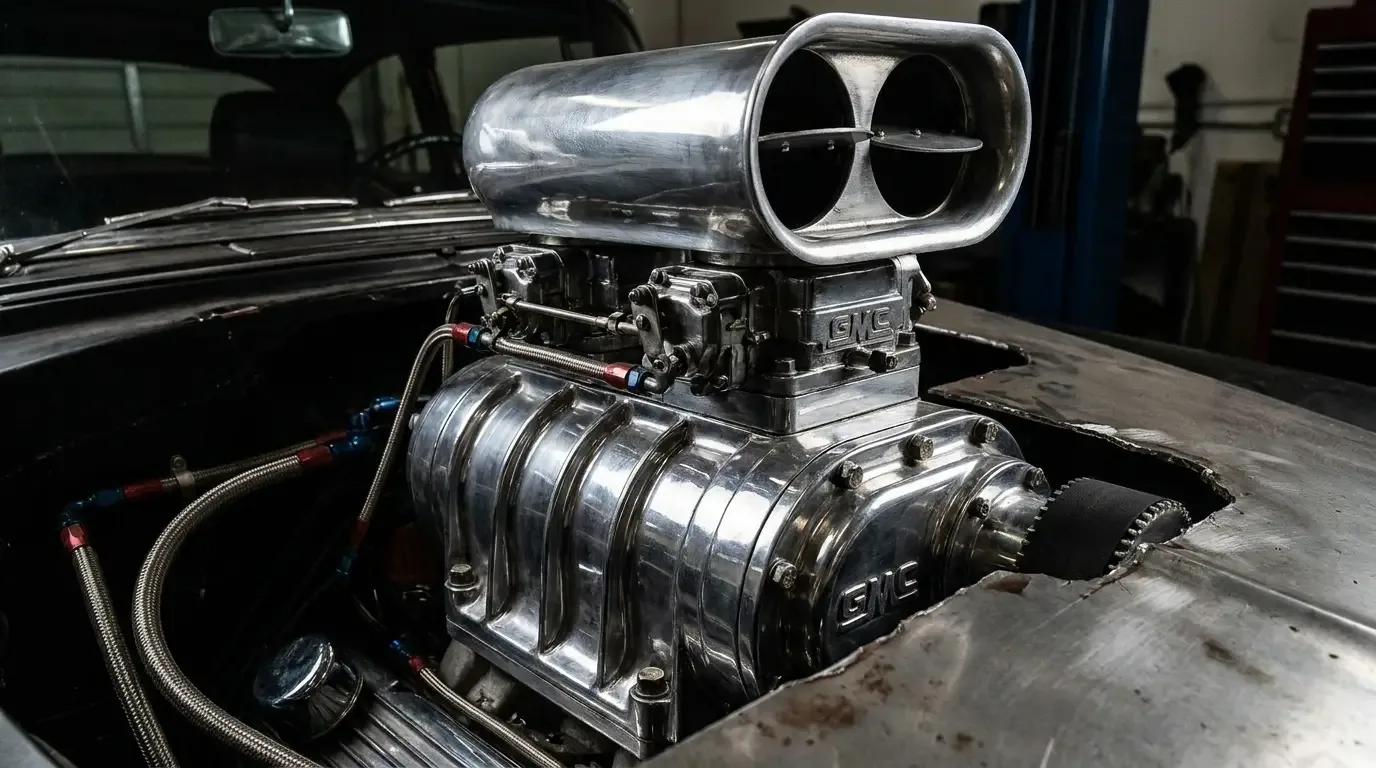
This is the induction end of the build. If you want the chassis and stance side of things, that lives in the guide on how to build a gasser. Here I want to walk through what a supercharged gasser actually runs, why a Roots blower and a Hilborn injector do different jobs, and where the real horsepower came from.
The GMC blower and why gassers ran it
The blower you see on most period gassers is not a purpose-built race part. It is a Roots-type supercharger lifted off a General Motors two-stroke diesel. GMC built them to scavenge those engines, and hot rodders figured out they would just as happily cram air into a gasoline V8. The sizes are named for the diesel they came off: a 4-71, a 6-71, and later the 8-71. The number tells you the diesel had four, six or eight cylinders of 71 cubic inches each. On a gas engine those numbers became shorthand for how much blower you were running.
A Roots blower moves a fixed volume of air per revolution. Two rotors mesh and shove air from the intake side to the manifold side. It does not build boost by compressing air inside itself, it builds boost because it pushes more air than the engine can swallow at that rpm. Spin it faster than the crank with a bigger drive pulley and you get more boost. Spin it slower and you get less. That pulley ratio is a tuning knob, and gasser guys played with it constantly to keep pistons alive on pump-adjacent fuel.
Boost on a street-and-strip 6-71 gasser was usually modest by modern standards, often in the single digits to low teens of pounds. That was plenty. A mild small-block that made maybe 350 horsepower naturally could pick up a big chunk of power with a 6-71 on top, and a stout big-block with a blower could push past 600 horsepower depending on compression, cam and pulley. Those figures move around a lot with the specific combination, so treat them as roughly typical rather than fixed numbers.
Hilborn injection and the mechanical fuel setup
The other classic look is mechanical fuel injection, and the name most people say is Hilborn. Stuart Hilborn built a constant-flow injection system that threw out the carburetor entirely. Instead of a float bowl and venturi, you get individual throttle bores, one stack per cylinder in the classic setup, and a gear-driven fuel pump that pushes fuel through nozzles at a rate set by engine speed and a pill, or metering jet, in the barrel valve.
Here is the honest part. Mechanical injection like this is not clever. It does not read the air, it does not compensate for weather, and it is happiest at wide-open throttle. That is exactly why it worked on a drag car. A gasser spent its working life at full throttle for a few seconds at a time, so a system that meters a steady slug of fuel under load was ideal. On the street those same injectors were a nightmare, loading up at idle and going lean or rich as the day warmed up.
Injection did not add boost the way a blower did. What it added was clean, unobstructed airflow and precise fuel delivery. No carburetor to restrict the intake, one runner per cylinder, and fuel dumped in close to the port. On a naturally aspirated gasser a stack injector was worth real power over a carburetor, and it looked the part, which never hurt in this class.
Fuel: gasoline, and the alcohol question
The class was called gas class for a reason. NHRA gas-class rules meant these cars were supposed to run gasoline, not the nitromethane the fuel dragsters burned. So a true period gasser ran pump gas or racing gasoline, and the whole tuning game was about making big power without the crutch of exotic fuel.
That said, plenty of blown and injected cars ran alcohol, meaning methanol, once you stepped outside the strict gas classes or into match-race and exhibition territory. Methanol likes a rich mixture, runs cooler, and tolerates more boost and compression before it detonates. If you see a mechanical injector flowing a lot of fuel through fat nozzles, there is a good chance it was set up for alcohol. The tradeoff is thirst. Methanol needs roughly twice the fuel volume of gasoline, so the pump and lines have to be bigger.
"People think the blower is the magic. It isn't. The blower just gives you a bigger air pump. The magic is fuel and timing that keep up with it. Get greedy on the pulley and lazy on the tune, and you will find pieces of your pistons in the oil pan."
Mike Sullivan
Why these setups made big power
Strip away the polish and it comes down to air and fuel. An engine makes power by burning fuel, and it can only burn as much fuel as it has air to burn it with. Everything on top of a gasser engine is about getting more air into the cylinders or feeding fuel more directly.
- The blower forces air in. A Roots supercharger stuffs more air per stroke than the pistons could pull on their own, so you can burn more fuel and make more power at the same rpm.
- Injection clears the path. Mechanical injection removes the carburetor restriction and gives each cylinder its own runner, so the air that does come in moves freely and gets a precise shot of fuel.
- Compression and cam do the rest. A hot cam and the right compression turn that extra air and fuel into cylinder pressure, which is what actually pushes the car down the track.
A blown engine and an injected engine are solving the same problem from two directions. One raises how much air gets crammed in. The other lowers how hard it is for air and fuel to get where they belong. Some cars ran both, a blower with injection sitting on top of it, which is where the biggest and angriest gasser numbers came from.
Blower versus injection at a glance
| Feature | GMC Roots blower | Hilborn-style injection |
|---|---|---|
| Adds boost | Yes, pressurizes the intake | No, naturally aspirated airflow |
| Main power gain | More air crammed in per stroke | Less restriction, direct fuel |
| Street manners | Poor to fair, tunable | Poor, loves wide-open throttle |
| Typical fuel | Gasoline or methanol | Gasoline or methanol |
| Tuning knob | Drive pulley ratio | Metering pill and nozzles |
| Common sizes | 4-71, 6-71, 8-71 | One stack per cylinder |
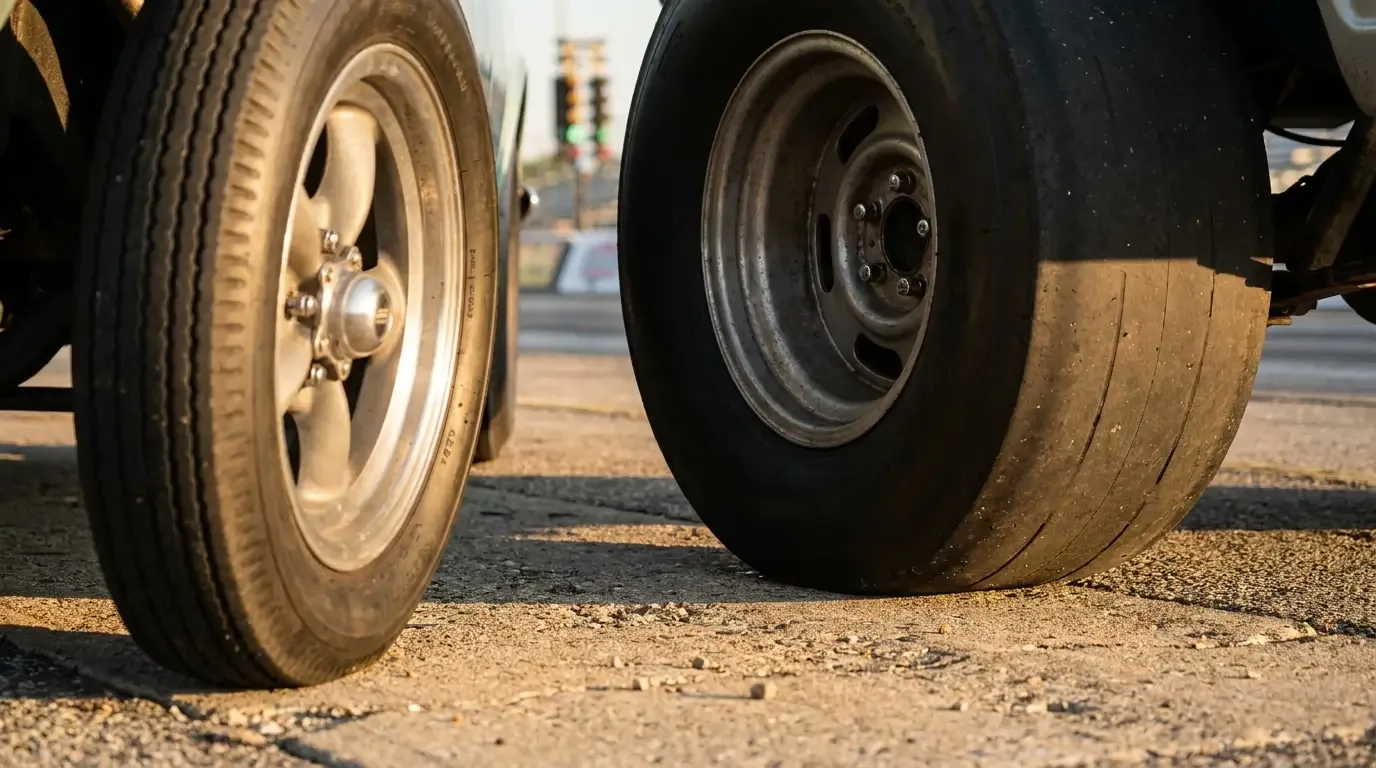
Whichever way you go, the induction has to work with the rest of the car. A blown big-block puts real load through the driveline and pins the rear tires, which is why the wheel and tire choices matter as much as the engine. That is a whole topic on its own, covered in Gasser Wheels and Tires: Skinnies and Slicks. Get the engine and the contact patch talking to each other and the car hooks. Get them out of step and all that boost just makes smoke.
Sources and notes
- Period drag-racing press and NHRA gas-class rulebooks of the 1950s and 1960s.
- General Motors and Detroit Diesel references on 71-series Roots supercharger origins and sizing.
- Mechanical fuel injection manufacturer literature on constant-flow injector operation and metering.
- Engine builder and gasser restorer interviews on blower boost, fuel choice and tuning practice.
- Horsepower and boost figures given as approximate; actual output varies with each specific combination of compression, cam and pulley.
Related Reading
Have a
Classic Car
for Sale?
Reach thousands of serious classic car collectors across the US.
Sell It Here →
Are You a Classic Car Dealer?
List your full inventory and connect with targeted classic car buyers.
Join as a Dealer →

About the author
Mike Sullivan
Detroit-area muscle car enthusiast and restoration specialist with three decades of hands-on experience working on American iron.
More in Restoration & Tech
Comments
Be the first to comment on this article.