
The crate engine is the easiest call on a street rod build, full stop. You get a complete engine, dyno-tested, with a printed spec sheet and a warranty card. No junkyard core. No machine shop invoice full of surprises. No guessing if the crank is standard or ten under. For a car built to actually get driven, that certainty is the whole point. Get this one choice right and it sets up every other part of a comfortable street rod build.
Restoration & Tech
6 min read
Choosing a Street Rod Crate Engine
Small-block Chevy vs Ford crate engines compared on power, reliability, and cost, and why a crate engine is the right call for a street rod you drive.
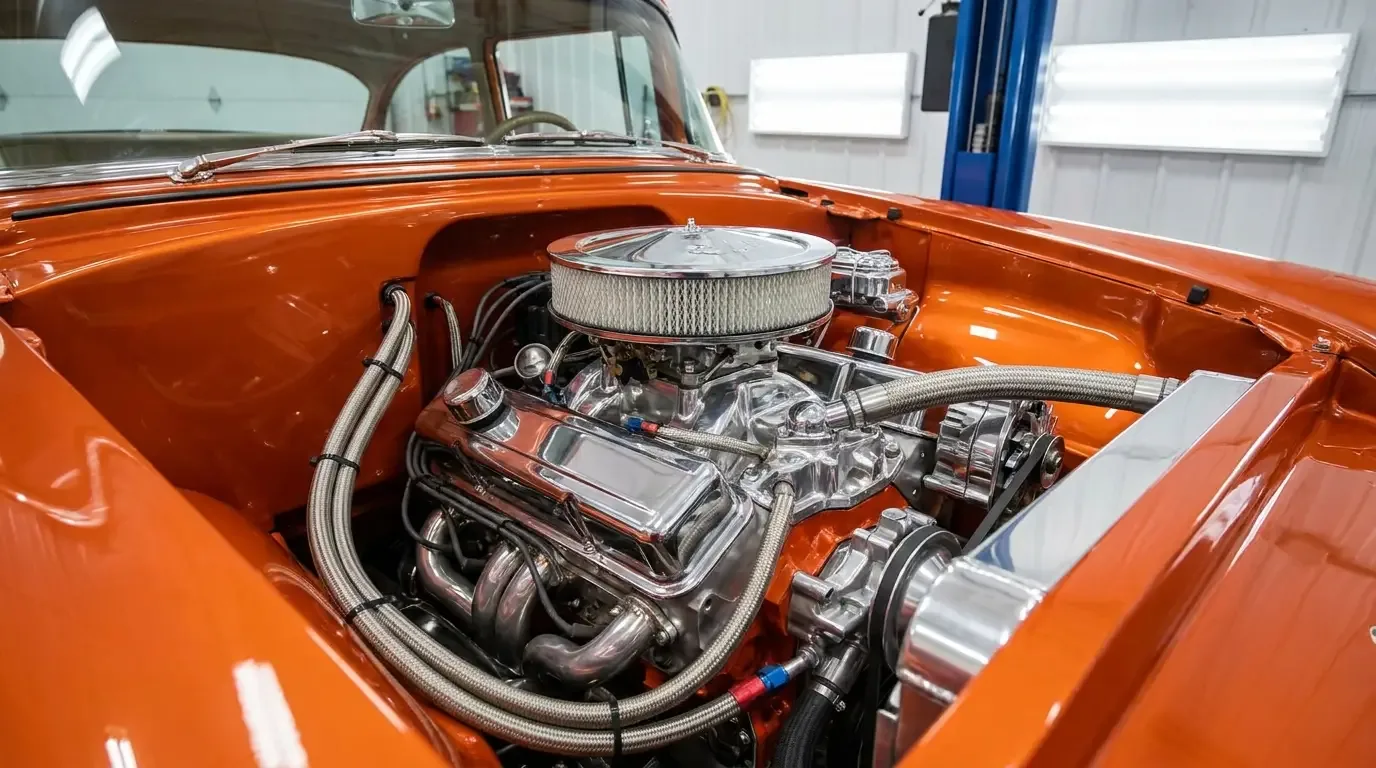
I've set a lot of these in a frame rail, and the pattern never changes. Guys come in chasing the biggest number on the spec sheet. The ones who listen leave with something that fires on a 95-degree day, idles clean in a drive-through line, and doesn't roast the cab. That's the engine that gets driven. The one with the lumpy cam and 11:1 compression sits under a cover in the shop.
Why a crate engine fits a driver
A street rod exists to be driven. That is the line that separates it from a period-correct hot rod. When the goal is climate control, an overdrive gearbox, and 500 relaxed miles in a weekend, a crate engine is the honest answer. You get a known quantity: a warranty, a break-in procedure printed on a card, and a power curve someone else already sorted out on a dyno.
Compare that to building from a core. A used small-block might cost less on paper, but by the time you pay for machine work, gaskets, a cam, and the two weekends you lose chasing an oil leak, the crate engine looks cheap. And it runs the first time you turn the key. For anyone who wants to spend Saturday driving instead of diagnosing, that math is not close.
Small-block Chevy: the default for a reason
The small-block Chevy is the default crate choice, and it earns it. The current GM crate catalog is deep. A ZZ4 or its descendants gives you a carbureted 350 making roughly 350 to 355 horsepower, which is plenty for a light pre-1949 body. Step up to an LS-based crate, like the popular LS3-style 376 cubic inch unit, and you are looking at around 430 horsepower from a modern aluminum engine that weighs less than the old iron small-block.
The reason I point most first-time builders to Chevy isn't brand loyalty. It's the parts ecosystem. Motor mounts, headers, transmission adapters, and fuel systems for a small-block Chevy are stocked at every parts counter in the country. When something needs a bracket at 4pm on a Friday, you can get it. That parts availability is worth real money and real weekends.
- Carbureted small-block 350: roughly 350 horsepower, simple, cheap to service.
- LS-style aluminum crate: around 430 horsepower, lighter, needs an EFI harness and a fuel pump that supports it.
- Widest parts and adapter support of any V8 platform.
Ford crate options: character and a cleaner fit in a Ford
If you are building a Ford body, and a lot of pre-1949 street rods are Fords, there is a real case for keeping it a Ford under the hood. The Ford Performance crate catalog covers the classic 302 and 351 Windsor family plus the modern Coyote 5.0. A carbureted 302-based crate lands in the 300 to 340 horsepower range depending on spec, and the crate Coyote 5.0 makes around 460 horsepower as a modern DOHC engine.
The tradeoff is honest. Ford small-block parts are common but not quite as thick on the shelf as Chevy, and the Coyote is physically wide, so it takes more planning to clear the frame rails and headers on a narrow early body. What you get in return is a Ford in a Ford, which matters to a lot of owners, and the Coyote's refinement is genuinely a step above an old pushrod V8 at highway cruise.
"I tell every customer the same thing. Pick the engine that starts on the third-hottest day of the year and idles without you riding the pedal. The horsepower number, nobody asks about it twice. How it drives in traffic, they notice that every single time."
Dan Reeves
Power, reliability, and cost, side by side
Here is how the common crate options stack up. Treat the horsepower figures as manufacturer ratings for typical configurations, not gospel, since exact output moves with the specific part number and induction.
| Crate engine | Approx. hp | Type | Best fit |
|---|---|---|---|
| Chevy 350 (ZZ4-style) | ~355 | Carbureted, iron | Budget, simplest build |
| Chevy LS3-style 376 | ~430 | EFI, aluminum | Modern power, light weight |
| Ford 302/351 Windsor | ~300-340 | Carbureted, iron | Ford body, classic feel |
| Ford Coyote 5.0 | ~460 | EFI, aluminum DOHC | Ford body, max refinement |
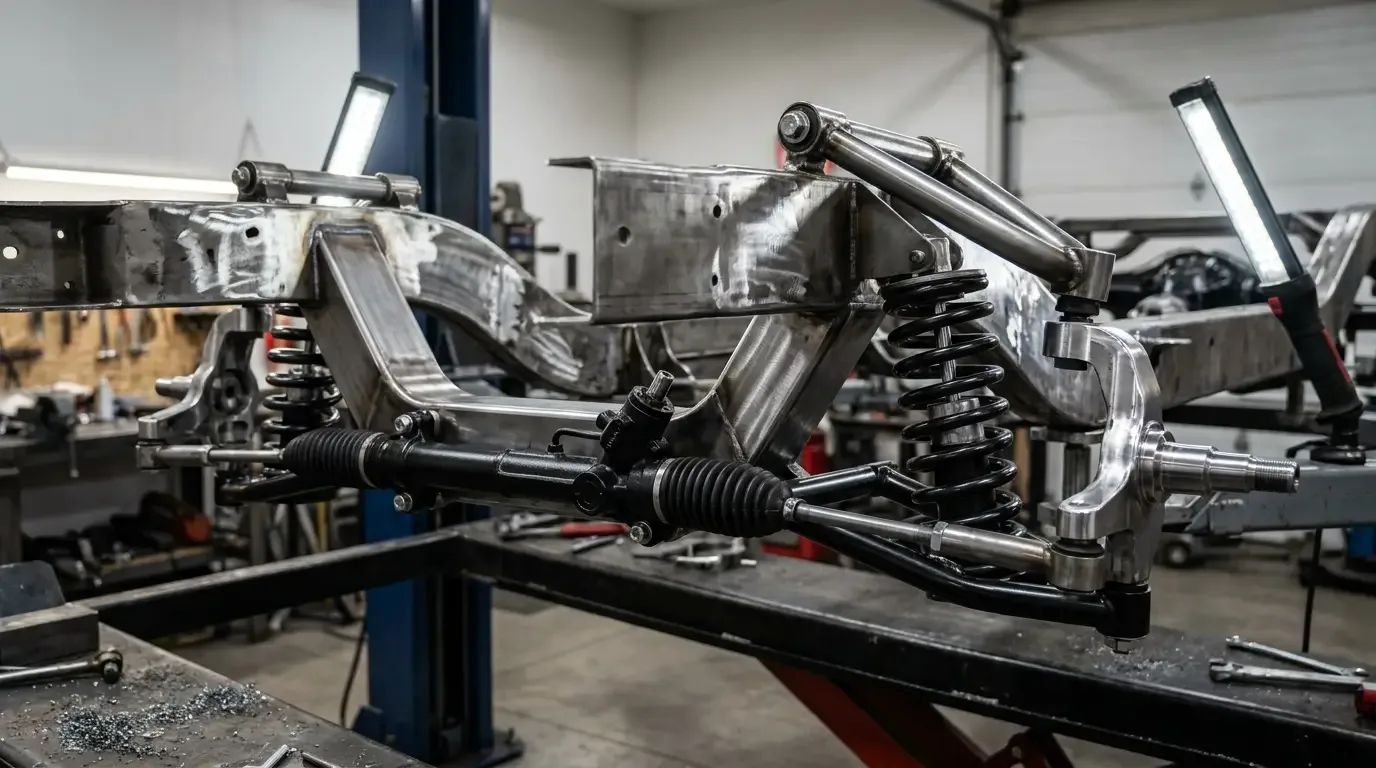
On cost, the carbureted iron engines are the value play and the modern EFI aluminum engines cost more up front but add fuel injection reliability, cold-start manners, and lighter weight over the front axle. That weight matters more than people think, because it changes how the front end behaves. It is worth reading up on Street Rod Front Suspension and the Mustang II IFS before you commit, since a heavy iron big-block and a light aluminum LS ask very different things of the same front crossmember.
Matching the engine to the whole car
The engine does not live alone. Your crate choice sets the tone for the brakes, the cooling system, and the gearing, and the best street rods are built as a package rather than a pile of parts. If you understand the story of the street rod, you already know the movement was always about drivability, so lean toward the choices that make the car easier to live with.
Here's my short version. First build, working a Chevy budget: take the carbureted small-block and drive it. Building a Ford and want modern manners: the Coyote earns the extra planning. Either way, buy the complete crate, follow the break-in card, and go drive the thing. That's the whole point of a street rod.
Sources and notes
- Manufacturer crate engine catalogs and published power ratings (engine builder reference material).
- NSRA street rod guidelines on the pre-1949 body definition.
- Marque and small-block engine reference histories.
- Builder interviews and shop experience with crate engine installations.
Related Reading
Have a
Classic Car
for Sale?
Reach thousands of serious classic car collectors across the US.
Sell It Here →
Are You a Classic Car Dealer?
List your full inventory and connect with targeted classic car buyers.
Join as a Dealer →

About the author
Dan Reeves
Performance engine builder from North Carolina's motorsports corridor, focused on swaps, forced induction and making real, repeatable power.
More in Restoration & Tech
Comments
Be the first to comment on this article.