
A street rod is supposed to be driven. That is the whole point. Yet plenty of guys pour money into paint and a shiny crate motor, then park the car after twenty minutes because the cabin is a sweatbox, the seat feels like a church pew, and the noise makes conversation impossible. Comfort is not the soft part of the build. It is what decides whether the car sits in the garage or eats up a 300-mile weekend to a show. I have watched too many finished rods become trailer queens for exactly this reason.
Restoration & Tech
7 min read
Street Rod Air Conditioning and Comfort
Climate kits, insulation, seats, sound-deadening, and power steering: the systems that make an old street rod livable for long drives.
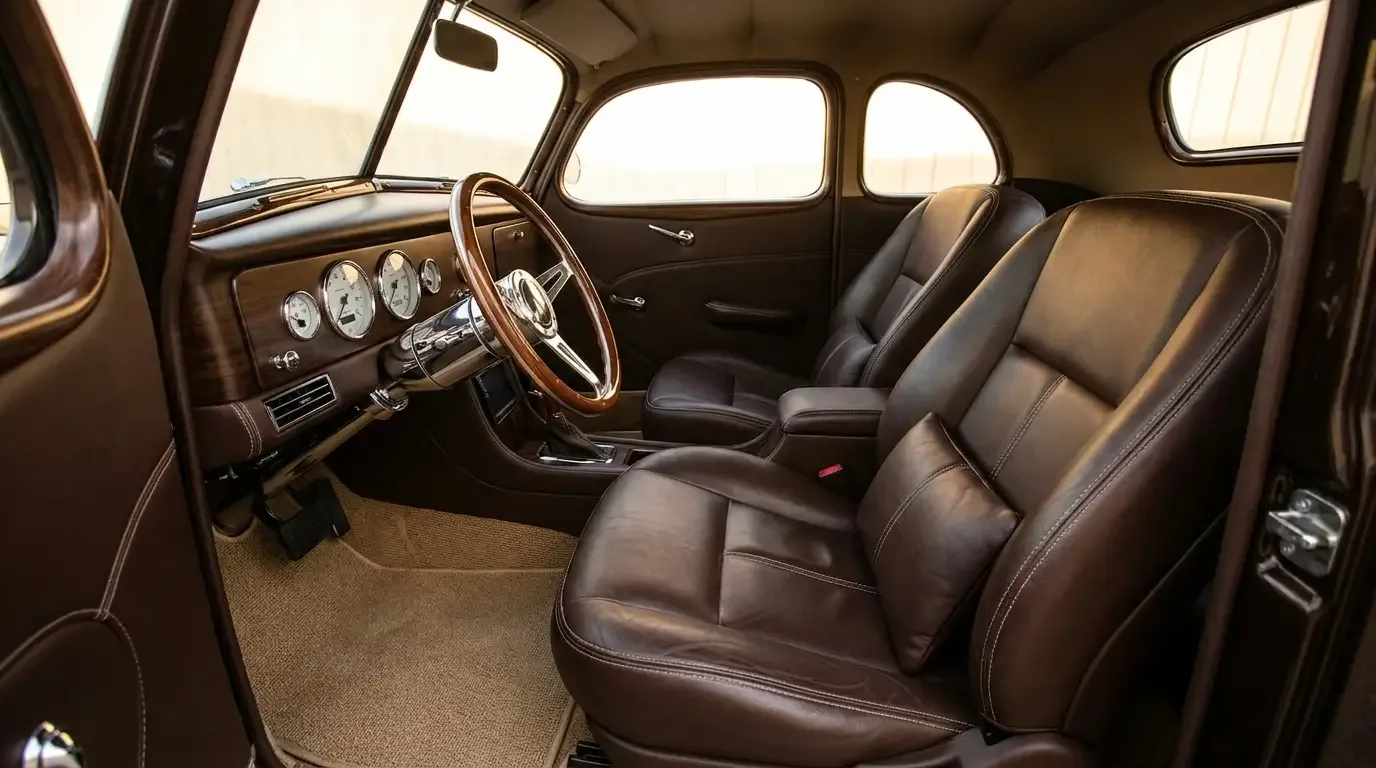
Air conditioning gets the headlines, but comfort in a pre-1949 body is a stack of systems working together: climate, insulation, seating, sound control, and steering effort. Get one wrong and the others cannot save the drive. This piece walks through what actually makes an old car livable, and it fits into the larger picture of the street rod build where every subsystem has to agree with the others.
Aftermarket climate kits that actually cool a small cabin
Factory air did not exist on a 1932 Ford or a 1940 Chevy, so everything is aftermarket. The industry standard names here are Vintage Air and Southern Air, and they sell complete under-dash and in-dash evaporator kits built around a rotary or scroll compressor that a modern serpentine crate engine can spin without drama. A modern R-134a system in a cabin this small will freeze you out if it is installed right. The failures are almost never the kit. They are the install.
The evaporator unit mounts under or behind the dash, the condenser goes ahead of the radiator, and the compressor hangs off the front of the engine. The catch in a street rod is space. These bodies have shallow firewalls and cramped engine bays, so you plan the AC before the motor goes in, not after. Trying to shoehorn a condenser in front of a radiator that already fills the grille opening is how people end up with a system that runs but never gets cold, because there is no airflow through a stacked heat exchanger.
The compressor draws power, so the electrical side matters. A rod running an original-style generator or a marginal alternator will struggle when the AC clutch cycles on. Match your charging system to the load. This is also where the engine choice pays off, and it is worth reading Choosing a Street Rod Crate Engine before you commit, because a modern crate motor with a serpentine accessory drive makes the compressor bracket a bolt-on instead of a fabrication project.
Insulation and sound-deadening: the part nobody photographs
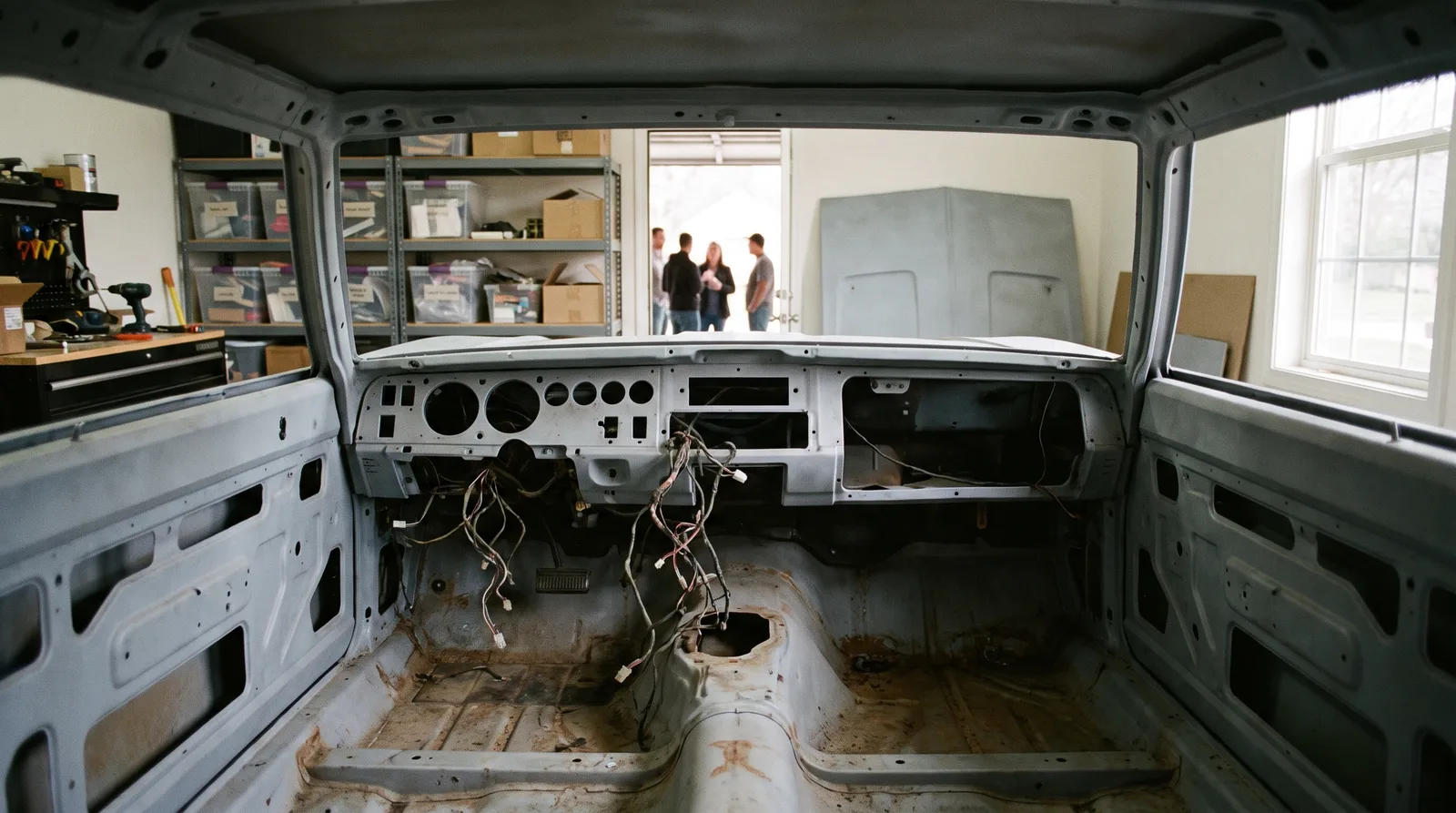
Here is the thing people skip because it does not show. A bare steel body with a fresh floor is a drum and a radiator. Exhaust heat comes up through the floor, the transmission tunnel bakes your right leg, and road noise turns the interior into a place you cannot hear the radio. The fix is layered, and you do it before the carpet and upholstery go in, because retrofitting it later means tearing the interior back out.
The stack works like this: a constrained-layer damper on the sheet metal to kill vibration, then a thermal and acoustic barrier over that to block heat and sound. Butyl-and-foil mats such as Dynamat handle the vibration layer. Jute or a closed-cell foam plus a heat-reflective barrier such as a Thermo-Tec or LizardSkin ceramic coating handle the thermal side, especially on the floor and firewall where the exhaust and engine heat live.
Seats: the difference between an hour and a full day
Original bench seats in a pre-war car were designed for short trips on slow roads. The springs are shot on most survivors, the foam is gone, and there is zero lateral support. For a car you intend to drive far, the honest answer is a modern seat frame with proper foam and, ideally, adjustable lumbar. Plenty of builders adapt low-back buckets from later production cars, or buy purpose-built street rod seats from suppliers like Glide Engineering or TEA's Design that already have the correct dimensions for a narrow body.
Seat height and rake matter more than most people expect in a chopped or channeled car, where the roof is lower and the floor may be raised. You lose headroom and you change the driving position, so mock up the seat with you in it before the upholsterer commits foam and leather. A gorgeous interior in the wrong position is a car you dread driving. This is one of those choices that ties back to the whole comfort philosophy behind the street rod movement, a story I get into in the street rod story.
"I tell every customer the same thing. Spend the seat money before the paint money. You feel the seat every mile. You only see the paint in the driveway. A car that hurts your back at hour two is a car you stop driving, and a rod you do not drive is just expensive furniture."
Jim Vasquez
Power steering and the effort question
An old front end with skinny bias-ply tires steered fine because the contact patch was small and the car was light on the nose. Put a modern crate V8 and wide radials up front and the steering effort at parking speed becomes a workout. For a driver, power steering is not a luxury, it is what keeps low-speed maneuvering from being a two-handed fight. Most modern street rod front ends, whether a Mustang II style independent setup or a dropped tube axle with a modern box, offer a power-assisted option.
The two common routes are an integral power box, such as a Vega-style or later GM box, or a rack-and-pinion, often power-assisted, on independent front suspension. Electric power steering units are also showing up in street rods now, which removes the belt-driven pump and its plumbing entirely and helps in a tight engine bay. Whichever route you take, steering effort, seat comfort, and climate are one connected system. Fix the whole cabin, not one piece.
| Comfort system | Common approach | Why it matters on a long drive |
|---|---|---|
| Air conditioning | Vintage Air / Southern Air R-134a kit | Integrated heat, cool, defrost in one small under-dash box |
| Sound deadening | Butyl mat plus thermal barrier | Kills drumming and blocks floor heat from the exhaust |
| Heat rejection | Ceramic spray coating on floor and firewall | Most heat blocked per pound in the hottest zones |
| Seating | Modern frame with foam and lumbar | Support that lasts past the first hour behind the wheel |
| Steering | Power box, power rack, or electric assist | Removes the low-speed fight from wide modern tires |
None of this is about turning a street rod into a sedan. It is about honoring what the car is for. A pre-war body with a modern drivetrain, a cabin that stays cool and quiet, a seat that supports you, and steering you can manage in a parking lot is a car you will actually take places. That is the reward for doing the unglamorous work.
Sources and notes
- Aftermarket climate-control manufacturer product literature and installation guides.
- Street rod builder interviews and shop practice.
- NSRA event and club reference material on driven street rod standards.
- Automotive insulation and sound-deadening supplier technical documentation.
- Period and current street rod press build features.
Related Reading
Have a
Classic Car
for Sale?
Reach thousands of serious classic car collectors across the US.
Sell It Here →
Are You a Classic Car Dealer?
List your full inventory and connect with targeted classic car buyers.
Join as a Dealer →
#sound deadening
#vintage air
#street rod air conditioning
#street rod comfort
#power steering
#street rod interior

About the author
Jim Vasquez
Southern California hot rod and custom car builder with roots in the traditional kustom kulture scene.
More in Restoration & Tech
Comments
Be the first to comment on this article.