
Every dropped C10 I've looked at has a shock problem hiding somewhere, and most owners never find it until something bottoms out or blows a seal on a rough road. The truck rides low, looks right, and then six months in the front end clunks over every driveway lip. Nine times out of ten it's not the springs. It's a shock that was never sized for the ride height the truck actually sits at now.
Restoration & Tech
6 min read
Choosing the Right Shock Length for a Lowered C10
How to measure and match shock length to a dropped C10 so the suspension has real travel left, instead of bottoming out on the shock body itself.
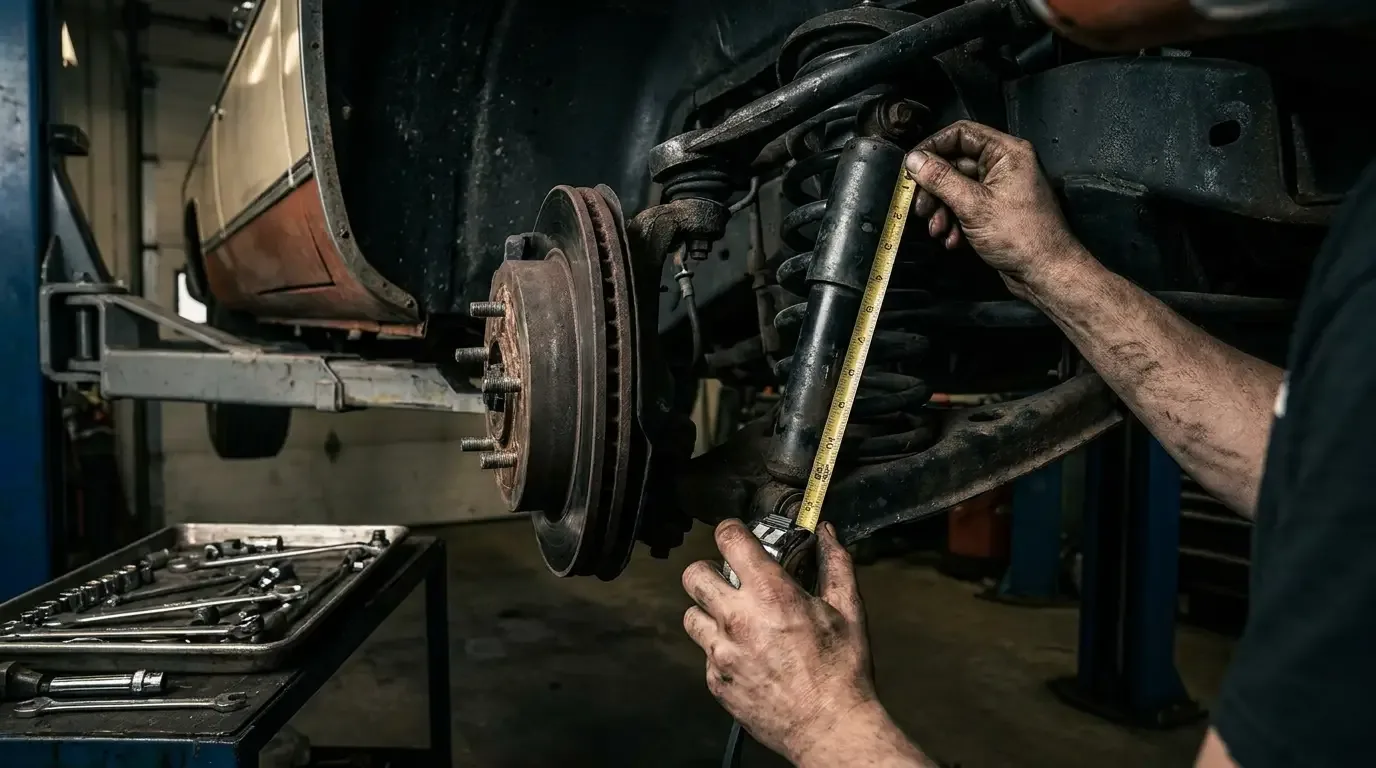
Why shock length matters once you drop the truck
A shock absorber has two numbers that count: extended length and compressed length. Extended is how long the shock is at full droop, wheel hanging free. Compressed is how short it gets at full bump, wheel all the way up in the wheel well. Everything in between is the shock's usable travel, and that travel is what actually controls the ride.
Stock C10 shocks were valved and sized around stock ride height, with enough extended length to let the axle drop when a wheel goes into a pothole and enough compressed length before the shock body itself becomes the thing stopping suspension travel. Drop the truck four or five inches and that stock shock is now sitting most of its travel closer to full compression before you've even hit a bump. There's nowhere left for the suspension to go. The shock body bottoms out internally, not the spring, and that's a hard metal-on-metal stop that transmits straight into the frame.
How to measure compressed and extended length
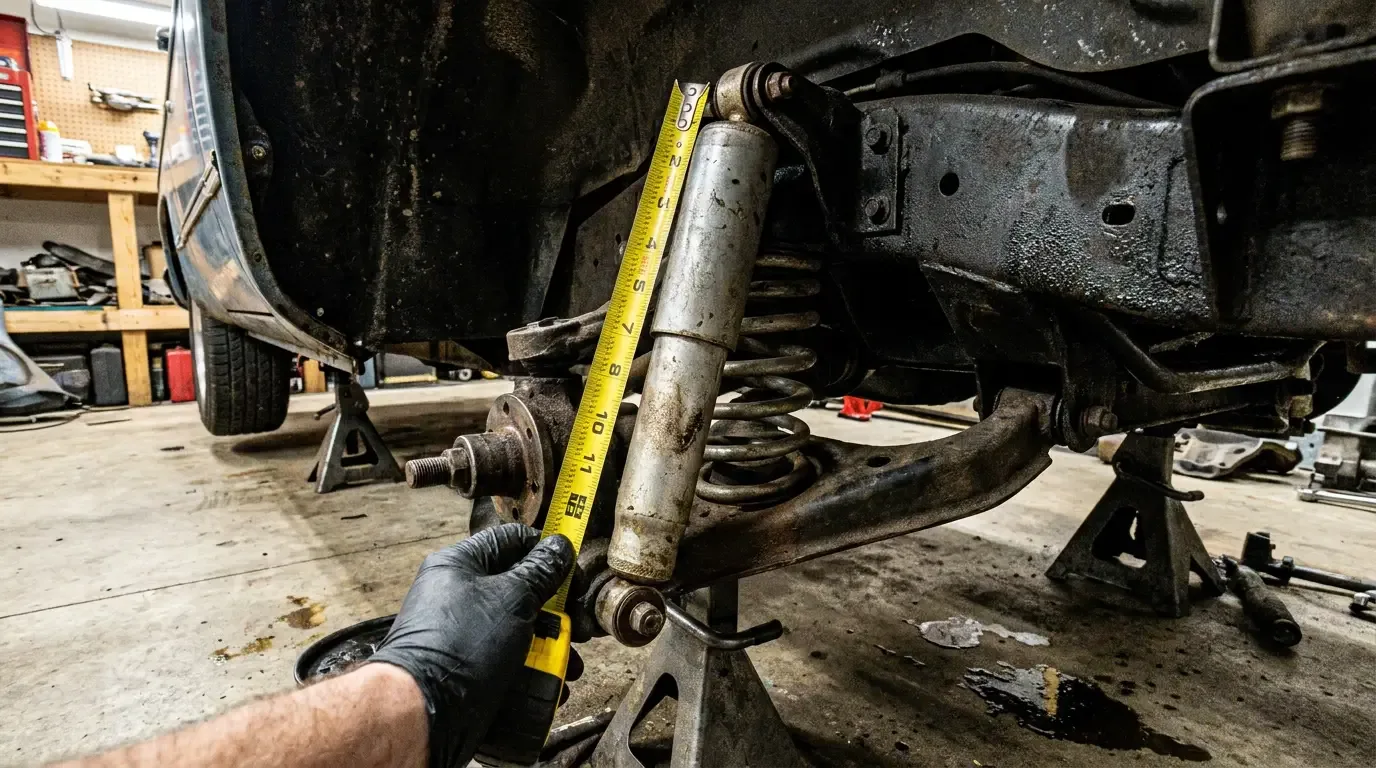
Before you order anything, get the truck sitting at its final ride height, static drop already done, and measure eye-to-eye on the old shocks or, if they're already removed, measure the actual mounting points. You want the distance from the upper mount to the lower mount at full droop, which is your extended length target, and at the point where the tire is about to hit the fender lip or the bump stop, which is your compressed length target.
Do this on all four corners, not just the front. Rear shock length gets overlooked constantly because everyone fixates on the front stance, and a rear axle that's been dropped with lowering blocks or flipped hangers needs the same travel math the front does. I've had guys call me convinced their front end is the problem when the truck is actually running out of rear shock travel on washboard roads.
Write both numbers down for every corner before you call a shock manufacturer or start scrolling a parts site. Vague measurements get you a shock that's close enough to bolt on and wrong enough to ruin the ride.
Matching shock travel to your drop
Most reputable shock makers publish length charts specifically for common C10 drop amounts, and that's the starting point, not the final answer, because every build stacks its drop differently. A 2/4 drop with drop spindles up front rides different than a 4/6 with lowered coils, even though the finished ride height might land close to the same number. The spindle changes where the control arm geometry sits relative to the shock mount, which changes the effective travel even at an identical ride height.
This is exactly the kind of detail that gets skipped when someone follows a drop recipe off a forum post without checking it against their own truck. If you're working from lowering guide for the drop itself, treat the shock length chart in there as the baseline and confirm it against your actual measured numbers before ordering, because spindle brand and control arm choice both shift the math.
| Front drop | Typical shock category | Travel note |
|---|---|---|
| 2 in drop spindle only | Stock-length or mild shortened | Usually close to stock travel, verify compressed length |
| 2/4 in (spindle + coil) | Shortened front shock, roughly 1-2 in shorter than stock | Rear needs matching shortened shock or the truck rakes wrong under load |
| 4/6 in (drop spindle + lowered coil + rear blocks) | Dedicated lowered-truck shock kit | Order as a matched front/rear set, don't mix |
Buy front and rear shocks as a matched kit from a manufacturer that lists them for your specific drop amount whenever you can. Mixing a front shock from one brand's chart with a rear from another because it was five dollars cheaper is how you end up with a truck that rides fine going straight and hops over anything with a seam in it.
Common mistakes shocks get blamed for
A shock that's too long for the drop will hit full extension before the axle does, which yanks on the mounts and can tear a shock eye or bend a lower mount bracket over time. That's the quieter failure. A shock that's too short bottoms out internally on every good bump and takes the abuse the springs should be absorbing, and eventually the shock body itself fails.
I've also seen people replace shocks twice chasing a clunk that was actually a worn sway bar end link or a tired bushing, because a bad shock and bad bushings can produce a similar noise over rough pavement. Before you assume the shock is wrong, put the truck on a lift and physically check every bushing and end link in the front end. It's a cheap check that saves you from buying a third set of shocks that were never the problem.
Wheel and tire fitment gets tangled up in this conversation too. A lot of these drop builds happen alongside the wheel bolt pattern swap that often comes with a build like this, and a wheel offset change can shift how much the tire tucks into the fender at full compression, which changes your real-world compressed length target even if the suspension geometry didn't move at all. Measure after the new wheels are on, not before.
"I've pulled apart enough of these to tell you the shock is almost never the first thing wrong. It's the last thing people check and the first thing they replace, and usually in that order for no good reason."
Mike Sullivan
What it costs and what to expect
A decent shortened shock built for a specific drop runs around $100-150 per corner for a basic gas shock, and more like $150-250 per corner for an adjustable unit, depending on brand. Buying all four as a matched kit usually beats piecing them together separately, and it guarantees the valving is at least intended to work together front to rear.
Spend the money on getting the length right the first time. A shock that's cheap but correctly sized beats an expensive one that's fighting your ride height every mile. The truck will tell you fast if you got it wrong, and by then you've already paid for shocks twice.
Sources and notes
- C10 Suspension Buyer's Guide, Street Trucks Magazine
- Shocks on a 4/6 drop C10/GMT400, GMT400 Truck Forum
- 74 C10 lowered shock issues, GM Square Body Forum
- Shocks and mounts for a lowered C10, 67-72 Chevy Trucks Message Board
- 1967-1972 Chevy C10 Pickup Lowering Guide, Speedway Motors
- Shocks for Vehicles with a Lowered Suspension, ShockWarehouse
Related Reading
Have a
Chevrolet C10
for Sale?
Reach thousands of serious classic car collectors across the US.
Sell It Here →
Are You a Classic Car Dealer?
List your full inventory and connect with targeted classic car buyers.
Join as a Dealer →

About the author
Mike Sullivan
Detroit-area muscle car enthusiast and restoration specialist with three decades of hands-on experience working on American iron.
Related Listings - Chevrolet C10
More in Restoration & Tech

Comments
Be the first to comment on this article.