
Drop an old diesel into a rat rod and you change the whole character of the build. The gas flatheads and small-blocks that most people bolt in give you noise and revs. A junkyard diesel gives you torque, a lot of it, down low where it matters, and it does it on the cheap. That is the appeal, and it is a real one. But a diesel is heavy, it runs hot, and it is loud in a way that wears on you. This is where a diesel earns its place in a rat rod, and where it does not.
Restoration & Tech
8 min read
Diesel Rat Rods: Big Torque on a Budget
Junkyard diesels give a rat rod fat low-end torque on the cheap, but the weight, heat, and noise are the real work. Here is what to know.
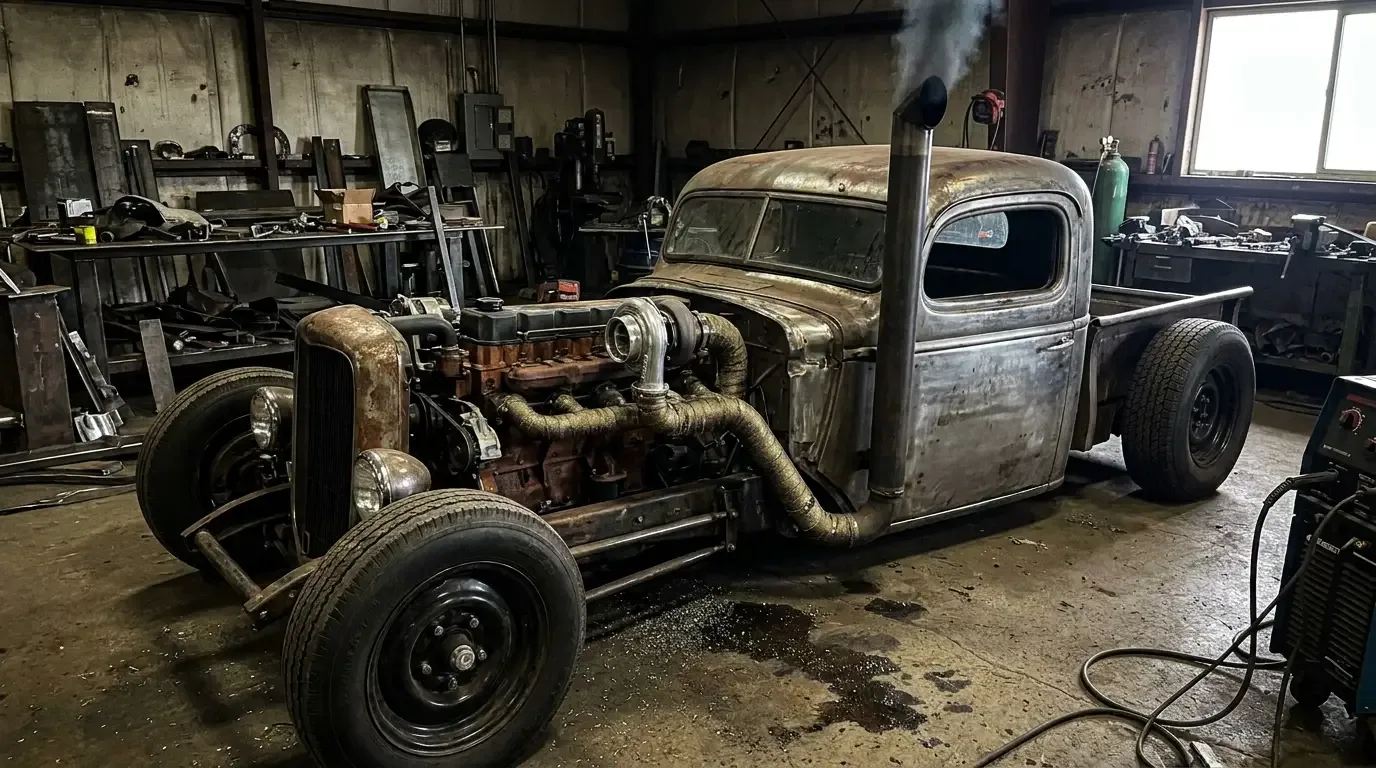
I have wrenched on enough of these to know the pattern. The engine is the easy part. Everything you have to build around it is the work.
Why an old diesel makes torque on the cheap
Diesels make their power differently than a gas engine. High compression, a long stroke, and fuel that burns with more energy per gallon. The result is a fat torque curve that peaks early and stays flat. You are not chasing horsepower up at 5,500 rpm. You are getting a shove off idle that a gas engine of the same size cannot touch.
Take a 12-valve Cummins 6BT, the 5.9-liter inline six out of a 1989 to 1998 Dodge Ram. In stock trim it made around 160 horsepower but roughly 400 lb-ft of torque, and it did that just above idle. That is the whole point. You do not need a built engine. A tired, high-mile 6BT pulled from a wrecked truck will still move a light rat rod chassis without breathing hard. The mechanical Bosch P7100 injection pump on the earlier ones means no computer, no wiring headache, just fuel and compression.
Detroit Diesel two-strokes are the other classic choice. A 3-53 or 4-53 from old equipment screams like nothing else and makes torque all day. Tractor diesels, single and twin-cylinder units out of farm iron, show up in the wildest builds. None of these are precious. That is exactly why they end up in rat rods. A good running core is often a few hundred dollars, and that fits the low-buck ethic better than a crate small-block ever will. If you want the full menu of what people drop between the rails, the rat rod engine options run a lot wider than just diesels.
The weight problem nobody warns you about
Here is what the internet photos leave out. A cast-iron diesel is heavy. A 12-valve Cummins long-block runs around 1,100 pounds dressed out. A small-block Chevy is maybe 575. You are hanging twice the weight over the front axle of a car that was never engineered for it.
That changes everything downstream. Your front suspension has to carry it. Your brakes have to stop it, and rat rods already have a bad name for weak brakes, so do not make it worse. The frame has to hold the engine mounts without flexing or cracking. On a Model A or a similar light chassis, a diesel this heavy can overwhelm the original rails. You either box the frame, build a new front crossmember, or step up to a heavier chassis to begin with.
"People fall in love with the torque and forget the scale. That engine weighs as much as the rest of the front half of the car. Build the chassis for it first, or you will be chasing cracks and steering shimmy forever."
Mike Sullivan
The driveline has to survive the torque too. A stout diesel will twist a light rear axle apart, and it will punish a transmission that was never meant for that much low-end grunt. Match the gearbox and the axle to the engine, not to the look. I go into that pairing in more detail in Rat Rod Transmissions and Rear Ends, because getting it wrong is how you end up stranded.
Cooling, noise, and the things that make it livable
A diesel throws off a lot of heat, and it needs a bigger cooling system than the pretty little brass radiator a rat rod builder wants to run. Undersize the radiator and you will cook the engine in traffic on a summer day. You need adequate core area, a shroud, and often an electric fan or two moving real air. This is not the place to cut corners for the look.
Then there is the noise. An old mechanical diesel, especially a Detroit two-stroke or a bare 12-valve with no sound deadening, is loud. Not fun-loud, tiring-loud on a long drive. Add the vibration, which is worse than a gas V8 at idle, and you understand why diesel rat rods are usually short-hop cruisers and show cars rather than long-distance drivers. You can manage it with good mounts and some insulation, but you cannot make a bare industrial diesel quiet.
And then there is the rolling coal. A diesel rat rod belching black smoke is a spectacle, and some builders lean into it hard. Be straight about what that is. Rolling coal is unburned fuel, it is wasteful, and deliberately modifying a vehicle to produce excess smoke is illegal in a lot of places under tampering and emissions rules. A little haze from an old mechanical pump under load is one thing. Tuning it to smoke on purpose is another, and it will get you cited.
Common diesel choices compared
Not every old diesel makes sense in a light chassis. Here is a rough comparison of the engines that show up most, with approximate figures. Treat the weights and outputs as ballpark stock numbers, because condition and year vary a lot.
| Engine | Config | Approx. stock torque | Approx. weight | Notes |
|---|---|---|---|---|
| Cummins 6BT (12-valve) | 5.9L inline six | ~400 lb-ft | ~1,100 lb | Mechanical pump on early ones, very durable, heavy |
| Detroit Diesel 3-53 | 2.9L two-stroke I3 | ~205 lb-ft | ~965 lb | Loud, distinctive sound, common in old equipment |
| Detroit Diesel 4-53 | 3.9L two-stroke I4 | ~285 lb-ft | ~1,100 lb | More power than the 3-53, still very loud |
| Single-cyl tractor diesel | 1-cyl | Low, but huge flywheel effect | Varies | Novelty builds, big slow torque, thump-thump idle |
The Cummins is the practical pick because parts and knowledge are everywhere. The Detroits are the choice when the sound and the spectacle matter more than the ease of the build. Tractor engines are for people building a statement, not a driver.
Is a diesel rat rod worth it?
If you want cheap, planet-flattening torque and you do not mind the weight, the heat, and the noise, a diesel swap delivers something no gas engine can. It is a genuine low-buck path to a car that pulls like a locomotive. The catch is that the money and labor you save on the engine, you spend on the chassis, the brakes, and the cooling. Nobody hands you a cheap diesel rat rod that also stops and steers well without that work being done.
Go in with your eyes open. Build the chassis for the weight, oversize the cooling, respect the brakes, and keep the emissions side legal. Do that and a diesel rat rod is one of the most distinctive things you can put on the road. If you would rather buy one that somebody already sorted out, it is worth watching the used rat rods for sale to see what a finished, running build actually costs before you take on a swap yourself.
Sources and notes
- Period and current rat-rod and hot-rod press coverage of diesel swaps and low-buck builds.
- Builder interviews and shop experience on engine-swap weight, mounting, and chassis reinforcement.
- General engine and drivetrain references for approximate diesel output and weight figures (marked for verification).
- DMV registration, inspection, and emissions/tampering guidance regarding diesel modifications and rolling coal.
- Show and club records documenting diesel-powered rat rod builds.
Related Reading
Have a
Classic Car
for Sale?
Reach thousands of serious classic car collectors across the US.
Sell It Here →
Are You a Classic Car Dealer?
List your full inventory and connect with targeted classic car buyers.
Join as a Dealer →

About the author
Mike Sullivan
Detroit-area muscle car enthusiast and restoration specialist with three decades of hands-on experience working on American iron.
More in Restoration & Tech
Comments
Be the first to comment on this article.