
The engine gets all the attention. The transmission and the rear end are what actually get you home. On a rat rod you are working with whatever you can drag out of a junkyard and make fit, so the trick is picking parts that are cheap, common, and strong enough to live behind whatever you bolted up front. Get the drivetrain wrong and you will be walking. This is the unglamorous half of the build, and it is the half that decides whether the car drives or just sits in the yard looking mean.
Restoration & Tech
7 min read
Rat Rod Transmissions and Rear Ends
Picking cheap, tough transmissions and junkyard rear ends for a rat rod, plus gear matching and driveshaft basics that keep the car driving.
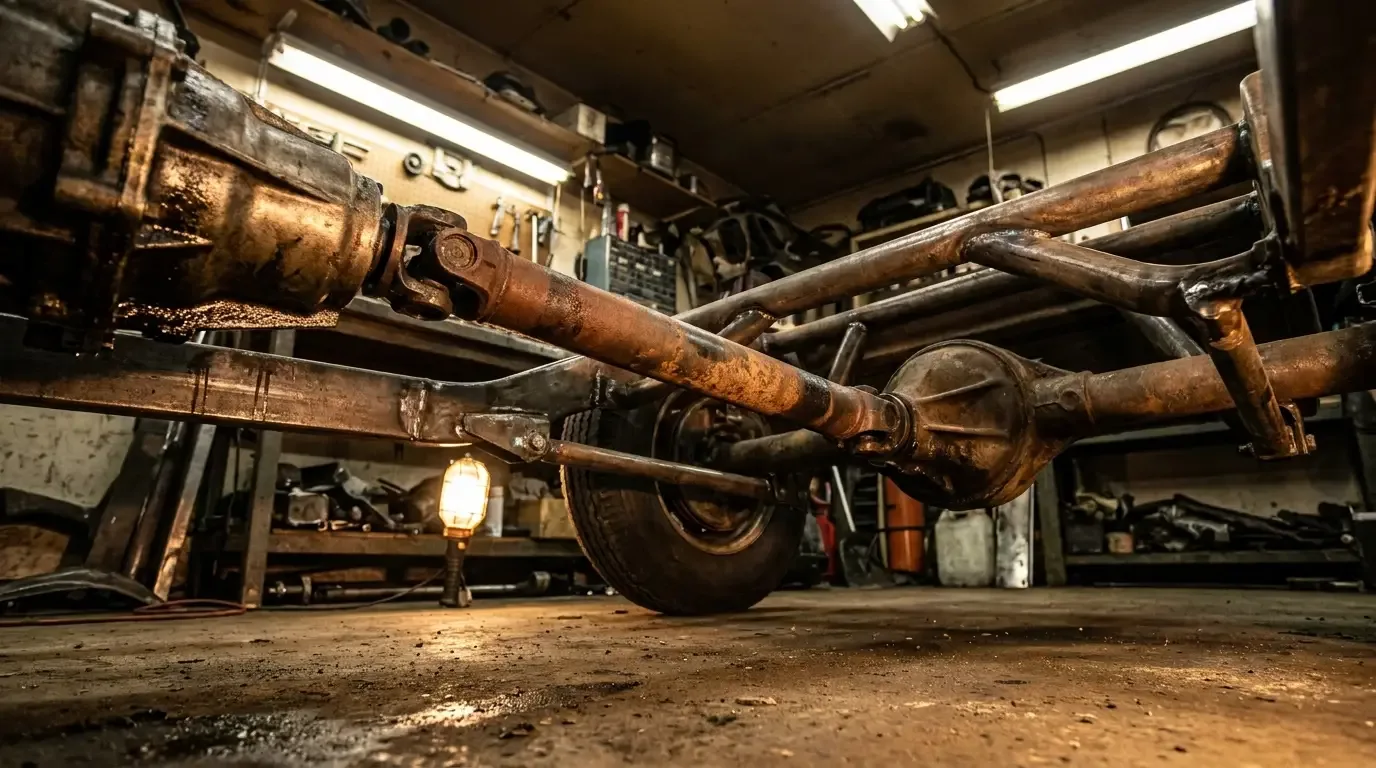
Everything here follows from the rat rod engine you already have. A mild small-block does not need the same gear as a built big-block, and a four-cylinder does not need a nine-inch rear that weighs as much as the car. Match the parts to the power, not to the internet forum.
Automatic or manual: pick your poison
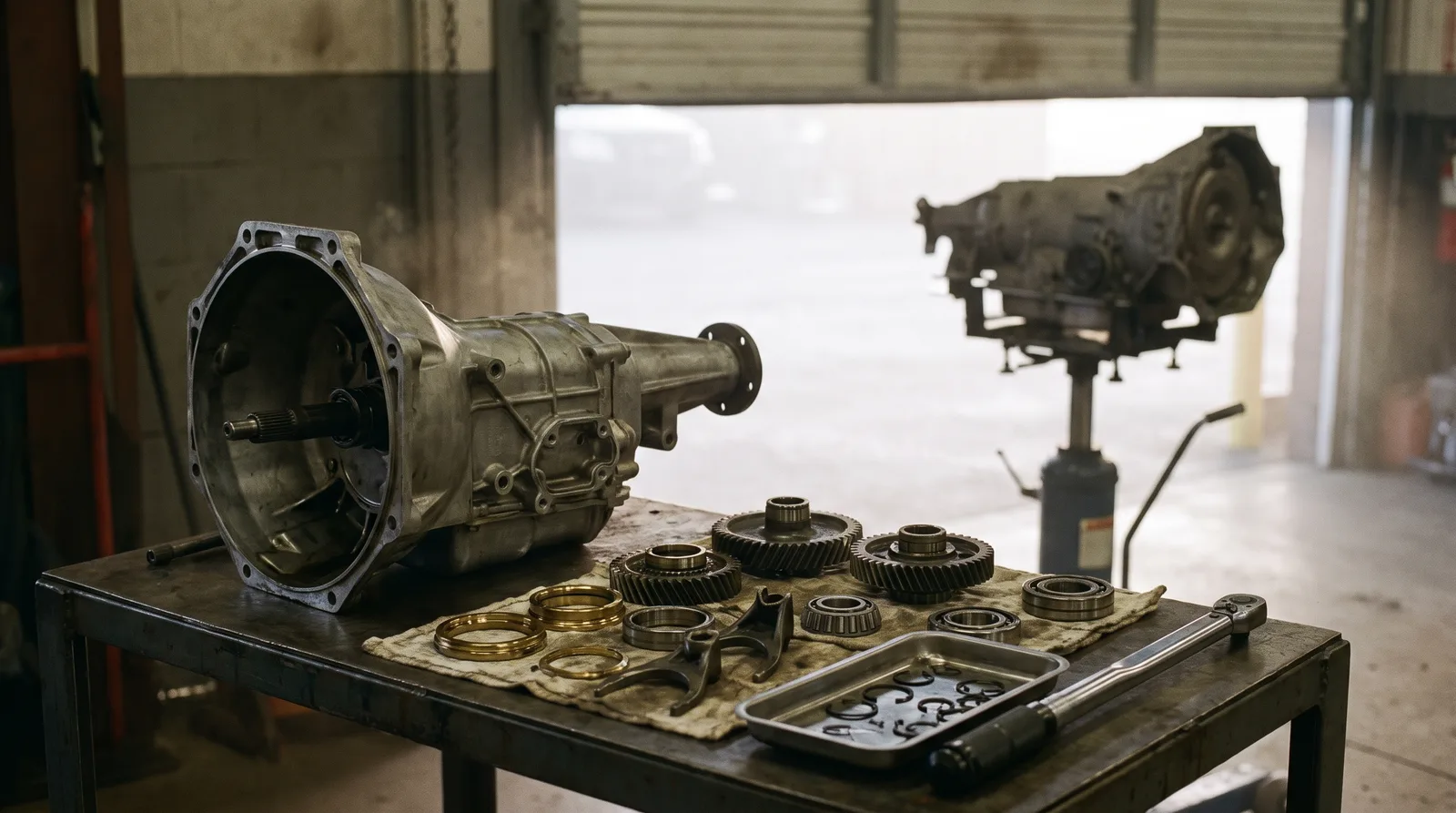
Most cheap rat rods run an automatic, and for good reason. Behind a GM small-block the two you will trip over in every junkyard are the TH350 and the 700R4. The TH350 is a three-speed, short, light, dead simple, and it will take a beating. It is the transmission to grab if you want cheap and bulletproof and you do not care about freeway RPM. The 700R4 is a four-speed with an overdrive top gear, which drops your cruising RPM way down and saves the engine on a long drive. The catch is the 700R4 needs its TV cable set correctly or it burns itself up fast. Set that cable wrong and the trans is scrap in a hundred miles.
On the Ford side the C4 and C6 fill the same slots as the TH350, tough three-speeds with no overdrive. Chrysler guys run the 727 TorqueFlite, which is about as hard to kill as any automatic ever built.
A manual is the honest rat rod choice and it looks the part, but it is more work. You need a clutch, a pedal setup, a bellhousing that matches the engine, and a shifter coming up through the floor. The upside is you can find old T5 five-speeds and Muncie or Saginaw four-speeds cheap, and nothing feels more like a hot rod than rowing your own gears. If you want the deeper argument on what engine to build around in the first place, read Flathead vs Small-Block in a Rat Rod before you commit to a bellhousing pattern.
Cheap junkyard rear ends that will not break
The rear axle is where rat rod guys argue the loudest. The famous one is the Ford 9-inch, and it earned the reputation. The pinion sits below the centerline so the ring gear is huge, it carries in a drop-out center section you can swap on the bench, and aftermarket parts are everywhere. It is heavy and it is not the cheapest thing in the yard anymore because everybody wants one, but behind real power it just works.
If you are on a tighter budget, the GM 10-bolt and 12-bolt are all over the junkyard. The 8.5-inch 10-bolt is plenty for a mild small-block. The 12-bolt is stronger and worth more. Both are lighter and cheaper than a 9-inch. For a light four-cylinder or six-cylinder rat rod, an S10 rear end is the sleeper pick. It is narrow, which matters on a skinny early frame, it is light, and you can pull one for almost nothing. Do not put an S10 axle behind a big-block and expect it to survive.
| Rear end | Strength | Weight / cost | Best for |
|---|---|---|---|
| Ford 9-inch | Very high | Heavy, pricier now | Big power, serious builds |
| GM 12-bolt | High | Medium | Small-block, mild big-block |
| GM 10-bolt (8.5) | Medium | Light, cheap | Mild small-block cruiser |
| S10 rear | Low to medium | Very light, very cheap | 4-cyl / 6-cyl, narrow frames |
Whatever you grab, measure the width flange to flange before you buy it. A rear that is too wide pushes the tires out past the fenders, and one that is too narrow tucks them in where they look wrong. Width is the number that kills more junkyard rear ends than strength ever does.
Matching the gears so the car actually drives
The rear end ratio and the transmission have to agree, or the car is miserable. A steep gear like 3.73 or 4.10 launches hard but screams on the highway. A tall gear like 3.08 or 3.23 cruises quiet but feels lazy off the line. With a three-speed and no overdrive, like a TH350, you want a taller rear gear around 3.08 to 3.23 so the engine is not buzzing at 3,500 RPM on the freeway. With an overdrive like the 700R4 you can run a steeper 3.55 or 3.73 and still cruise easy, because the overdrive top gear does the RPM-dropping for you.
"I have watched a guy build a gorgeous rat rod and then run 4.10 gears behind a three-speed. Drove it once, RPMs through the roof at 55, parked it forever. The gear math is not optional. Do it before you weld in the rear, not after."
Dan Reeves
You find the ratio by turning the tire and counting driveshaft turns, or by reading the tag or the casting numbers. Do not guess. Know the number before you build around it, because pulling a rear back out to change gears is a rotten afternoon.
Driveshaft basics: the part that can kill you
Once the engine, trans, and rear are set, the driveshaft connects them, and this is not a place to eyeball it. A driveshaft that is the wrong length, out of balance, or running the wrong U-joints can let go at speed and go through the floor. Get this one right.
The length is set by the distance between the transmission output and the rear end pinion once the car is sitting at ride height with the engine and rear mounted. Any decent driveshaft shop will cut and balance one to your measurement for short money. The U-joint at each end has to match the yokes on your trans and your rear, and those two are often different sizes, so you may need a conversion joint. The pinion angle matters too. If the trans and the pinion are not close to parallel, the shaft vibrates and eats U-joints.
None of this is exotic. It is measuring, matching, and not cutting corners on the one spinning steel tube under your feet. A rat rod is allowed to look rough. The driveshaft is not allowed to be rough. For the wider picture on how these cars came to be built this cheap and this raw, the rat rod story is worth your time.
Sources and notes
- Period and current hot-rod and rat-rod press on junkyard drivetrain swaps.
- General-service transmission references for the TH350, 700R4, C4/C6, and 727 TorqueFlite.
- Rear-axle identification and gear-ratio guides for Ford 9-inch, GM 10/12-bolt, and S10 axles.
- Driveshaft and U-joint fabrication guidance from driveline shops and chassis references.
- Builder interviews on gearing and cruising-RPM tradeoffs.
Related Reading
Have a
Classic Car
for Sale?
Reach thousands of serious classic car collectors across the US.
Sell It Here →
Are You a Classic Car Dealer?
List your full inventory and connect with targeted classic car buyers.
Join as a Dealer →

About the author
Dan Reeves
Performance engine builder from North Carolina's motorsports corridor, focused on swaps, forced induction and making real, repeatable power.
More in Restoration & Tech
Comments
Be the first to comment on this article.