
Every rat rod build hits the same fork in the road. You stand in the shop, staring at an empty engine bay, and you pick a side. Flathead Ford or small-block Chevy. One is history you can hear. The other is a running engine you can buy on a Saturday and drive home Sunday. I've bolted both into bare frames. Here's how they actually shake out once the romance wears off and you're the one turning the wrenches.
Restoration & Tech
6 min read
Flathead vs Small-Block in a Rat Rod
Flathead cool-factor or cheap small-block reliability? An honest, shop-floor look at cost, parts, power, and character for your rat rod engine.
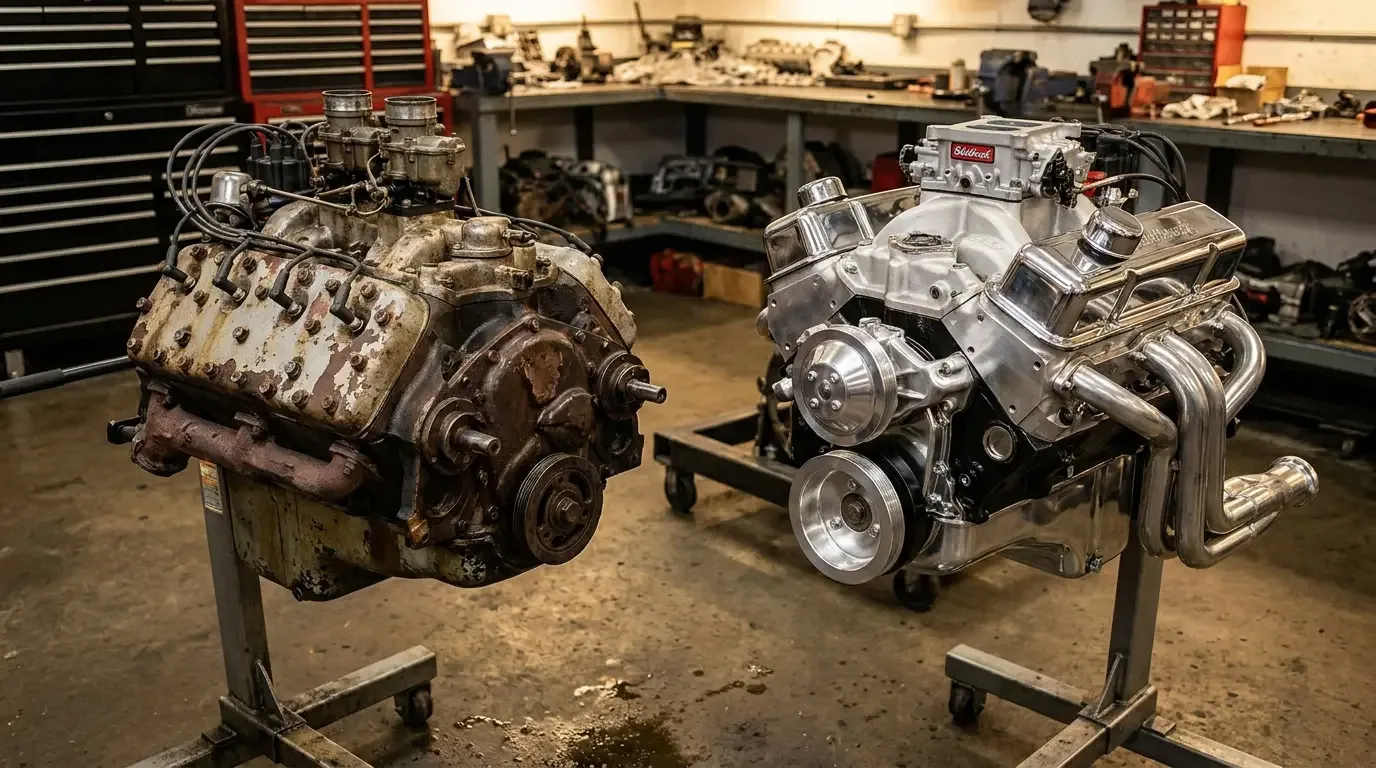
This choice sits at the center of any rat rod engine decision, because the motor sets your budget, your skill demands, and the whole attitude of the car.
The flathead is the cool one. Nobody argues that
The Ford flathead V8 ran from 1932 to 1953 in U.S. production. That valve-in-block design, the flat heads, the exhaust routed through the block, it's the sound and shape that built the whole hot-rod hobby. Drop one in a rat rod and you've said something before you turn the key. It looks right. It sounds right. Old-timers at the show walk straight past the Chevy and stop at your engine bay.
Power was never the point. A stock early flathead made around 65 horsepower. The last of the line, the 1953 239 cubic inch, made roughly 110. You can build past that with heads, a multi-carb intake, and a hot cam, but you're spending real money to get where a junkyard V8 starts. If you want the culture and the sound, read the story of the rat rod and you'll see why the flathead earned its place.
Here's the wrench truth on flatheads. They run hot. The exhaust passages route through the block, so cooling is a constant fight, especially in traffic on a summer day. Parts exist, but you're buying reproduction and NOS pieces at collector prices. A rebuild is not a beginner job. You need someone who knows the quirks, or you need to become that someone.
The small-block Chevy is the cheap, reliable one
The small-block Chevy started in 1955 as a 265 cubic inch V8, then grew into the 283, 327, 350, and beyond. Chevrolet built these engines by the tens of millions across decades. That single fact is why it wins on cost. They're everywhere. Junkyards, swap meets, that guy down the street with three in his garage.
A running small-block 350 is cheap because supply is enormous. Every part is cheap for the same reason. Gaskets, rebuild kits, intakes, headers, distributors, you buy them off the shelf at any parts counter, and half of it fits engines from 1955 forward. You don't wait two weeks for a specialty vendor to ship a water pump. That's the whole argument, and it's a strong one.
Power is easy money. Even a mild, tired 350 makes far more usable torque than a built flathead, and it does it without exotic parts. You can make a small-block reliable, driveable, and quick for less than a proper flathead rebuild costs you. If big low-end grunt is your goal on a tight budget, the same thinking pushes some builders toward Diesel Rat Rods: Big Torque on a Budget, but for most rat rods the small-block is the sensible default.
Head to head, on the shop floor
Strip out the sentiment and put the two side by side. This is roughly how they compare on the things that matter when you're the one paying and building.
| Factor | Ford flathead V8 | Small-block Chevy |
|---|---|---|
| Production years | 1932 to 1953 (U.S.) | 1955 onward, tens of millions built |
| Stock power | Around 65 hp early, roughly 110 hp late | Roughly 160 to 195 hp early 265, far more available |
| Parts cost | High, collector and repro pricing | Low, off-the-shelf everywhere |
| Rebuild difficulty | Specialist knowledge needed | Well documented, beginner friendly |
| Cooling | Runs hot, needs attention | Straightforward, proven |
| Cool factor | Unmatched, period-correct | Common, less character |
Read the table honestly. If your priority is character and you have the budget and patience, flathead. If your priority is driving the thing this year without a second mortgage, small-block. Both are legitimate rat rod choices. Anyone who tells you the small-block is a sellout has never had a flathead boil over three miles from home.
"I've overheated a flathead in traffic and I've fixed a small-block on the shoulder with a screwdriver. Pick the fight you want to have. One's for your heart, one's for your driveway."
Mike Sullivan
Which one belongs in your build
Ask yourself two questions before you commit. First, what's the car for? A show-and-cruise rat rod that lives near home and gets fussed over can carry a flathead and all its needs. A daily-ish driver that has to start every morning wants the small-block. Second, what can you actually fix? If a hot-running, specialist-parts engine will strand you, that's not character, that's a project that never gets driven.
My honest steer for a first rat rod is the small-block. Get the car on the road, learn it, drive it, enjoy it. The flathead is the reward build, the second engine, the one you do once you've got the shop skills and the spare cash to feed it. There's no shame in either. There's only the difference between a rat rod that runs and one that sits under a tarp waiting on a water pump.
Sources and notes
- Period hot-rod and rat-rod press covering flathead and small-block engine swaps.
- Builder interviews on engine selection, cost, and driveability tradeoffs.
- Engine and rebuild references for the Ford flathead V8 and Chevrolet small-block families.
- General power figures stated as approximates from published engine specifications; verify against your specific casting and year.
Related Reading
Have a
Classic Car
for Sale?
Reach thousands of serious classic car collectors across the US.
Sell It Here →
Are You a Classic Car Dealer?
List your full inventory and connect with targeted classic car buyers.
Join as a Dealer →

About the author
Mike Sullivan
Detroit-area muscle car enthusiast and restoration specialist with three decades of hands-on experience working on American iron.
More in Restoration & Tech
Comments
Be the first to comment on this article.