
Every restoration club has the same argument sooner or later. Somebody swears the car left the factory with a certain clamp, a certain bolt, a certain shade on the hose, and somebody else swears the opposite. The argument can run for years, right up until someone opens a factory document and reads the answer out loud. Then everybody goes quiet and gets another coffee.
Restoration & Tech
6 min read
Factory Assembly Manuals and Parts Catalogs: Your Restoration Bible
A factory assembly manual and parts catalog settle the arguments before they start. Learn what each one shows, where to find them and how to use them on a restoration.
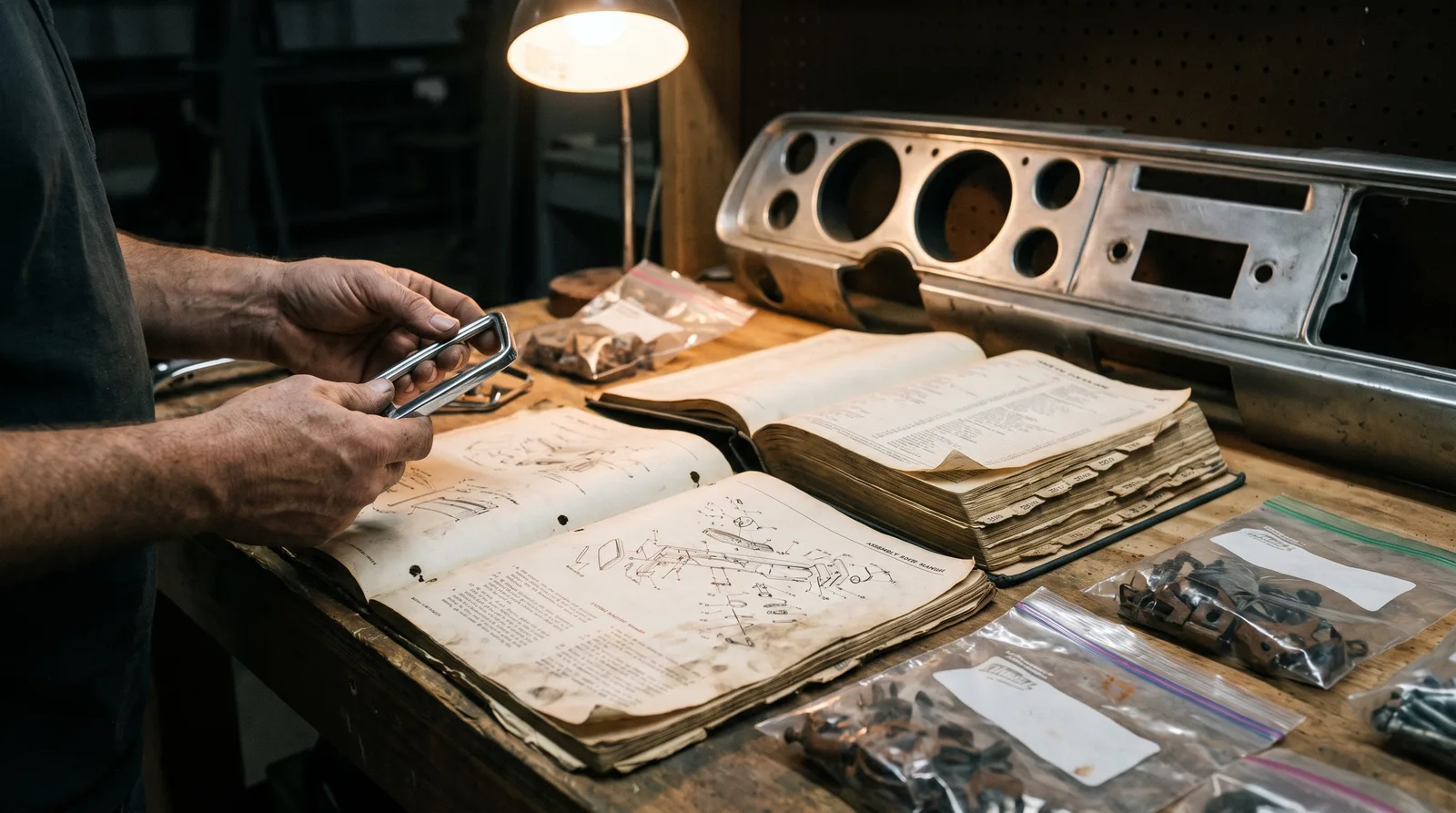
That is the value of factory literature. It does not care who is right. It shows what the manufacturer built, how the workers put it together, and which part numbers went into which assembly. If you are planning parts for a classic restoration, these books should be on the bench before the first order goes out.
Assembly manuals, shop manuals and parts catalogs
These three get confused, and they do different jobs. A factory assembly manual was written for the people building the car. It shows how parts go together on the line, in order, with fastener locations, routing, torque and adjustment steps. A shop manual, also called a service manual, was written for dealer mechanics. It covers diagnosis, repair and adjustment on a finished car. A parts catalog is a numbered list of parts with exploded drawings, written for counter staff who had to order replacements.
| Document | Written for | Best for |
|---|---|---|
| Factory assembly manual | Assembly line workers | Correct fit, order of assembly, clip and fastener placement, original finish |
| Shop or service manual | Dealer technicians | Torque specs, adjustments, repair procedures |
| Parts catalog | Dealer parts counters | Part numbers, assembly breakdowns, running changes |
| Owner's manual | Original buyers | Operating instructions, maintenance schedules, correct equipment |
For a restoration, the assembly manual is the one that settles originality questions, while the parts catalog tells you what to ask for. Use both. A catalog gives the number, and the assembly manual shows where it goes.
What these books answer
Take a simple example. You are reassembling a dash and you have a bag of unlabeled clips. The assembly manual shows which clip goes where and how the wiring is routed. The parts catalog tells you the clip's part number, and whether it changed partway through the model year. Without both, you are guessing. With them, you can order the right piece and install it the way the factory did.
The same books explain finishes. Many fasteners and brackets were left bare, painted, phosphate coated or plated, and the correct finish is part of the originality score on a judged car. Assembly literature often notes which parts were painted body color, which were black and which were left natural. Not every book covers every finish, so treat what is missing as a prompt to ask a marque club.
Where to find them
Start with the club for your marque. Owner clubs often sell reprints, scans or digital copies, and their members know which edition matches your build date. Specialty publishers reprint many shop manuals and parts catalogs. Used book dealers, swap meets and online marketplaces carry original copies, and prices range widely depending on the model and the condition. Common reprints are usually a modest purchase, while a scarce original can cost far more, so compare a few sellers before you buy.
Check that the book matches your car. Assembly manuals and catalogs were revised during a model year, and a book for the early run may not cover late changes. Look at the date, the revision number and the coverage list. If you are buying online, take care. Our advice on buying online applies here too: check the seller, check the edition, and check the return policy before you pay.
Some libraries and museums hold factory literature, and some manufacturers keep archives that will answer questions for owners. Policies change, so ask before you travel. Do not pay for a scan you cannot verify, and do not assume a PDF found at random matches your car.
How to use the books on a project
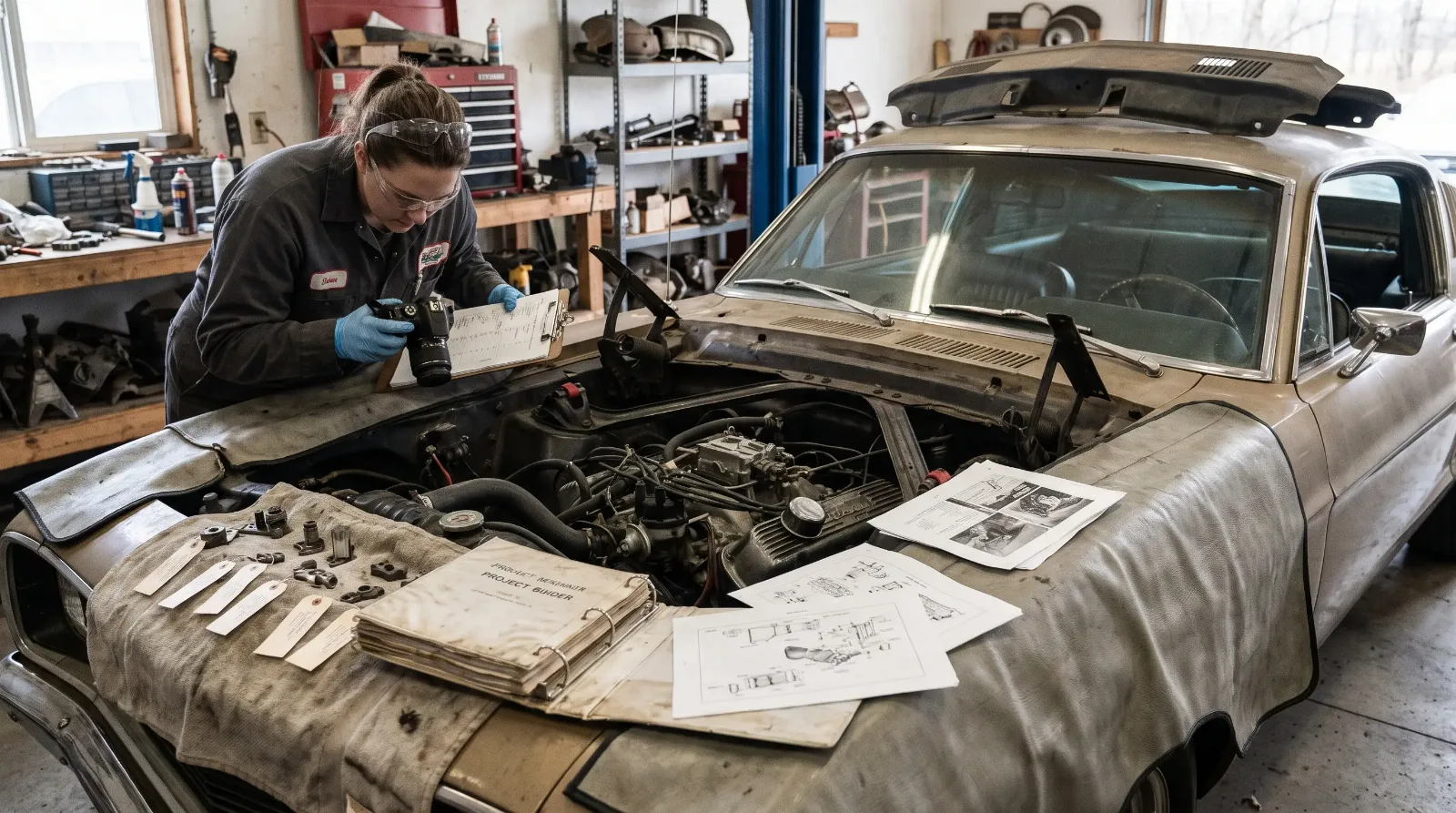
- Before teardown, find the manuals for your exact model year and body style, and read the sections on the areas you will work on.
- As you take the car apart, photograph each assembly and label parts. Compare what you see to the book, and note differences.
- When you order parts, use the catalog number and check any supersession notes. Parts were replaced by newer numbers over time, and the replacement may or may not be identical.
- During reassembly, follow the assembly order in the manual. Many fitment problems come from doing steps in a different order than the factory did.
- Keep a project binder with copies of the pages you used and a record of which parts were reused, replaced or reproduced.
"I have watched a lot of arguments get settled by one page of the right book. The books do not take sides. They just say what the factory did, and that is the end of it."
Wayne Coburn
Limits of factory literature
Do not treat any book as perfect. Plants made running changes, substituted suppliers and used up old stock, so a car can differ from the published description and still be original. Printing errors exist. Some details, like paint daubs, inspection marks and chalk markings, were never in any manual, and those come from original cars, registries and judging guides. Use the books as the strongest evidence, then check against surviving cars and club records.
Build records matter as much as the books. A build sheet, window sticker, data plate or dealer invoice tells you what your car had. On a GM car, for example, the Fisher Body plate lists the trim code, paint codes and option group codes, and the manuals tell you how that equipment looked and fit. Put the two together and you have a car that is documented from the paperwork to the last clip.
When to bring in help
Some jobs outrun the documentation. If the car needs structural work, body panel alignment or a full disassembly, the literature helps but experience matters more. Look for a restoration shop in your state that works from factory documents, ask to see the books on their shelf, and ask how they use them. A shop that cares about the references is usually one that cares about the details.
Buy the books early. They cost little against the price of a single wrong part, and they make every other decision on the project easier. A restoration without documentation is a guess with a budget.
Sources and notes
- Restoration tip: get the factory manuals (OPGI), the four manual types and what an assembly manual contains, plus GM-licensed reprints
- 1967 Fisher Body number plate (Chevellestuff), what the GM body plate lists and its value for checking original specifications
- Chevrolet body number plate (Old Car Manual Project), style, trim and paint numbers on the plate
- Ford boosts restoration parts inventory for older models (AutoGuide), Ford licensed restoration parts and master samples as quality benchmarks
- National Corvette Restorers Society, judging guides and technical manuals as originality references
Related Reading


About the author
Wayne Coburn
Longtime Corvette owner, judge and club figure who knows the cars, the records and the people behind them.
More in Restoration & Tech

Comments
Be the first to comment on this article.