
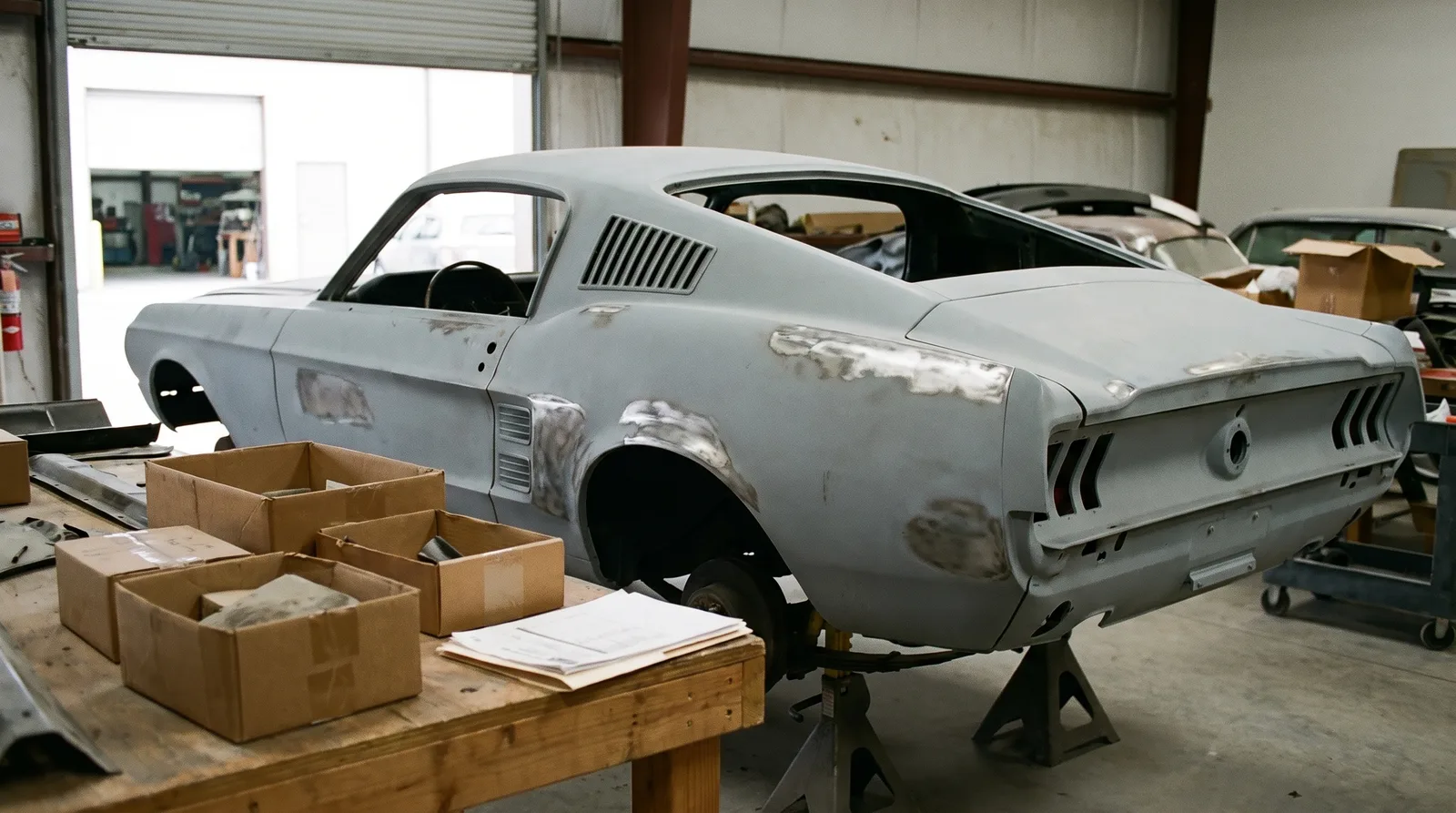
A stalled restoration is a financial problem before it is a mechanical one. The car is an asset sitting in someone else's building, the owner has paid for work that may or may not exist, and every month of delay raises the cost of the fix. The goal is not to win an argument with the shop. It is to recover the car, and as much of the value in it as you can, in the right order.
Restoration & Tech
7 min read
When a Restoration Stalls: Getting Your Car Back From a Shop
A restoration that stalls is a recoverable problem if you act in the right order. Here is how to document, negotiate and retrieve your car from a shop.
This article is general information, not legal advice, and the rules on vehicle liens and storage vary by state. Treat it as a way to organize your approach before you speak with an attorney. If you are on the other side of this and still choosing a shop, how to choose a shop next time covers the checks that prevent most of these situations.
Is it stalled or just slow?
Restorations run long. Panels back-order, paint booths fill, and rust discovered at teardown changes the plan. Slow is normal. Stalled has a different profile: little or no visible work for weeks, missed promised dates with no new schedule, vague answers about progress, new requests for money without matching new work, and a shop that is hard to reach or will not let you see the car.
State the facts to yourself in numbers. How much have you paid? How many hours or invoices support that? What does the contract say about timing? A cool assessment of the gap between money spent and work completed is the foundation of everything that follows. Most restorations are not recouped at sale unless the car is rare, and a half-finished car is typically worth well below what has been spent on it, so the earlier you stop the clock, the less you lose.
Document before you confront
Before any hard conversation, build your record. Gather the signed agreement, every estimate, every invoice, proof of payment, and all emails and texts. Pull together any photos the shop sent and any you took on visits. If you have a build log or progress report, save it. Then make your own dated inventory of the car as you understand it: what is on the car, what is in boxes, what was supposed to be done by now.
Visit in person if you can, and photograph the car and the parts. Do it politely. You are an owner checking on your property, which is entirely reasonable. Note whether the car is stored indoors, whether it is covered, and whether parts you paid for are present.
Put it in writing and set a deadline
Your first formal step is a written notice, sent in a way that creates a record, such as email plus a letter with delivery confirmation. Keep the tone factual. List the contract terms, the dates missed, the amount paid and the work you can verify. State what you want: a completion schedule with firm milestones, or an accounting of the work done and the car returned. Give a clear but reasonable deadline.
Ask for an itemized accounting of labor, parts and any outside work, with receipts. A shop that is simply overwhelmed will often respond to a firm, organized letter by finally producing a plan. A shop that is in trouble may respond with excuses. Either response is information, and either one belongs in your file.
Do not make threats you will not keep, and do not make accusations you cannot support. Emotional messages get quoted back at you. Precise ones get answered.
Negotiating the exit
If the relationship is not recoverable, the practical goal is a clean separation. Many disputes end in a negotiated settlement in which the owner pays something toward verified work, the shop releases the car and parts, and both sides sign a short agreement acknowledging that. This is rarely satisfying, but it is often cheaper than months of conflict, and every month the car sits is a month of deterioration.
When negotiating, work from your records rather than from anger. Separate three things: work that was done and is acceptable, work that was done badly and will need redoing, and work billed but not done. Be ready to concede the first and contest the third. Where the second is large, an independent evaluation of the car by a qualified, neutral restorer gives you something firmer than your opinion. Expect to pay for that inspection, and expect it to be worth it if the numbers are large.
| Option | Cost and speed | Best used when |
|---|---|---|
| Negotiated settlement and release | Usually fastest, you may absorb some loss | The shop is cooperative but unable to finish |
| Mediation | Usually a matter of hours in session, plus a mediator's fee, so often faster and cheaper than court | The contract requires it, or both sides want to avoid court |
| Small claims court | Low filing fee, limits vary widely by state (roughly $2,500 to $25,000) | The amount in dispute fits the state limit |
| Civil suit with an attorney | Highest cost, slowest | Large sums, missing parts or a refusal to release the car |
When the shop will not release the car
This is the point to stop handling it yourself. If a shop refuses to return the car, claims a lien you cannot verify, or the car has been moved or sold, talk to an attorney experienced in vehicle and contract disputes. Bring your file. An attorney may advise a demand letter, a court order for return of property, or a complaint to your state's consumer protection office, depending on the facts. Ask about whether your state has a repair shop licensing authority as well, since some, such as California's Bureau of Automotive Repair, license repair businesses and take consumer complaints.
If you suspect theft or fraud, such as payments for parts that were never ordered or a car that has vanished, a police report is appropriate. Do not go to the shop and attempt to remove the car yourself, even if it is yours. Entering property or moving a car in a heated confrontation can turn a strong position into a weak one.
"A half-restored car is worth less than the sum of the invoices. The most valuable thing you can do for it is act early, with paper in hand."
Marcus Feld
Moving the car and starting over
Once you have the car, get it inventoried again, photographed and insured. Compare what comes back with what you documented. Missing parts should be itemized and the list kept. Then decide what you want next: a new restoration shop to finish the job, or a different approach, perhaps splitting the work between a shop and your own garage, which can reduce exposure.
If you are looking for a new restoration shop, treat the experience as data. Insist on a written scope, staged payments tied to completed work, a documented schedule with milestones, and regular photo updates. Ask for references, including one on a difficult job. And transfer the car with a full condition report, so the next shop starts from a documented baseline and not from your last shop's version of events.
The cost of a stalled job is real, and some of it will not come back. But a calm, documented, sequenced response limits the damage, and it puts the car back where it belongs: in your control.
Sources and notes
- Mechanic's lien (Wikipedia), artisan's lien on repaired vehicles, possession requirement and state variation
- Mediation (Wikipedia), voluntary, non-binding process that usually resolves in hours rather than months
- Small claims court (Wikipedia), self-representation and typical filing fees
- Small claims court limits by state, dollar limits from about $2,500 to $25,000
- California Bureau of Automotive Repair, example of a state agency that licenses repair shops and takes complaints
Related Reading

About the author
Marcus Feld
Accredited collector-car appraiser who reads the market through hammer prices, condition tiers and risk.
More in Restoration & Tech
Comments
Be the first to comment on this article.