
A rat rod is a hot rod built to look like it was thrown together in a driveway with whatever the junkyard would sell cheap, and that is exactly the point. No paint booth. No chrome bill that runs into five figures. A blistered original finish, a flathead or a swap-meet small-block, a frame welded up by the guy who drives it. I have built cars both ways, and I will tell you straight: a real rat rod is harder to get right than people think, because the whole thing has to work while looking like it barely holds together.
Car Features
18 min read
The Rat Rod Story
A rat rod is a deliberately unfinished, low-buck hot rod built to look raw and cost almost nothing. Here is the whole story: ethos, origins, patina and safety.
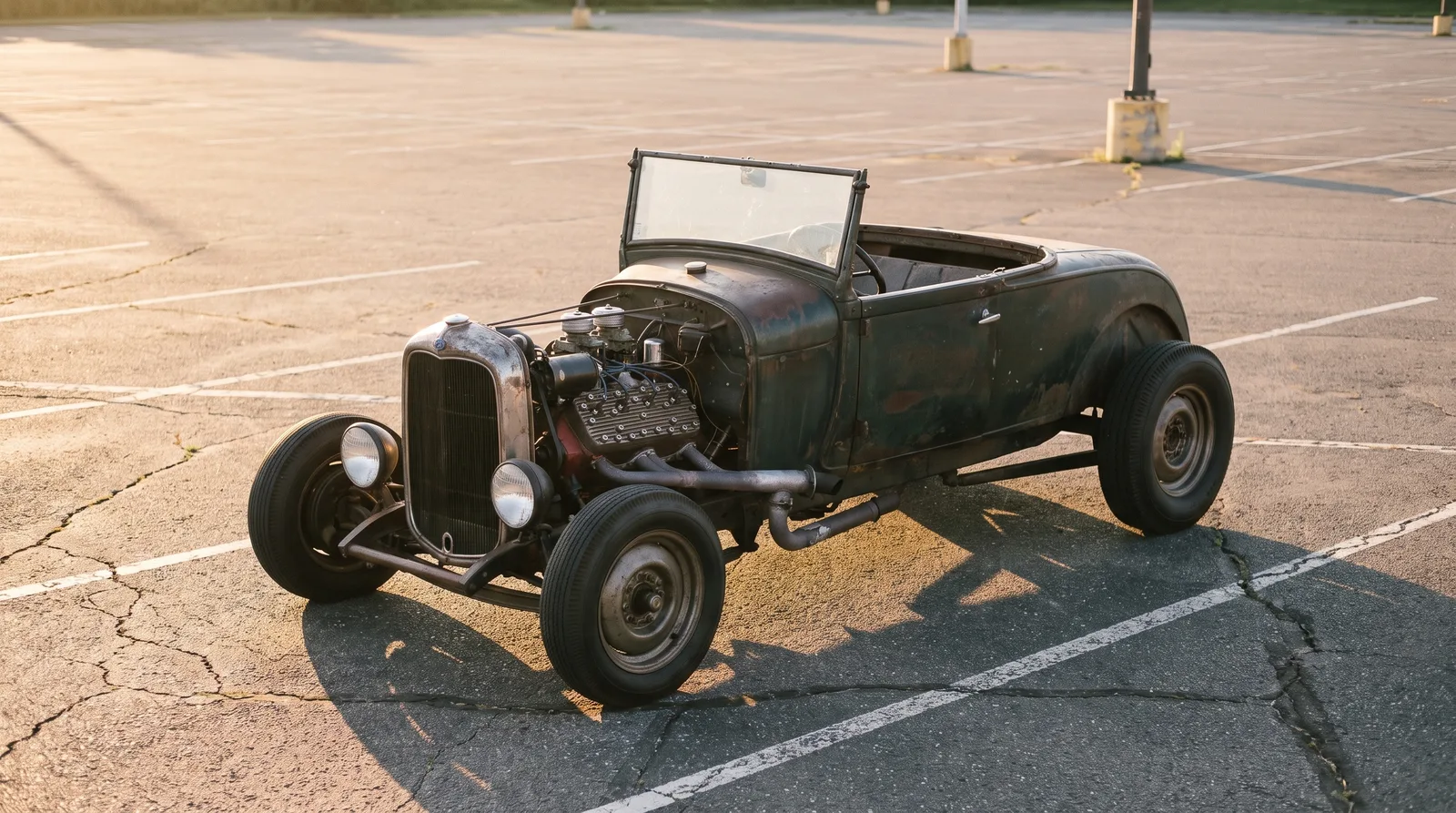
The category gets abused. Half the cars wearing the name at any given show are expensive builds pretending to be broke. So before we get into how these things came to be, what goes under them, and why purists still argue about them, let me define the ground we are standing on.
What a rat rod actually is
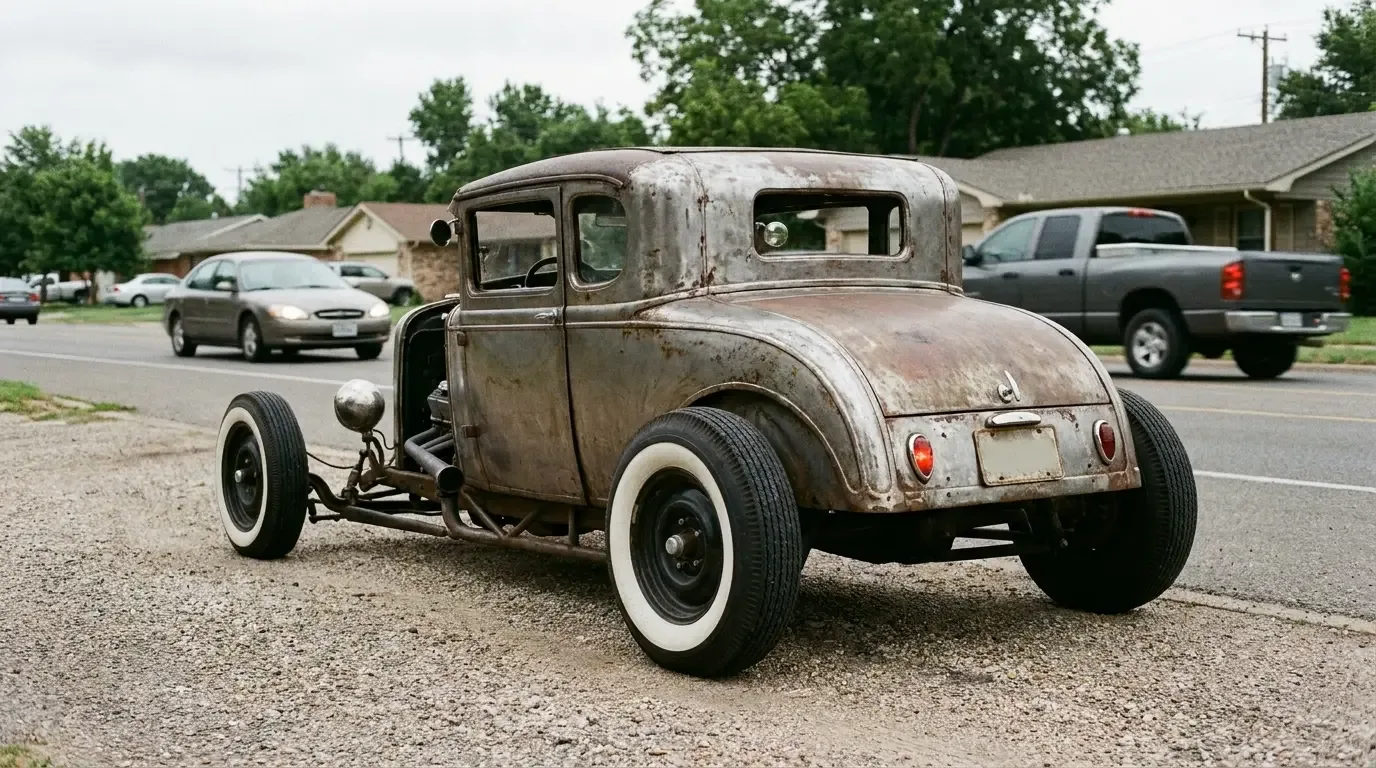
A rat rod is a deliberately unfinished, low-buck, anti-show hot rod. The look is bare metal, surface rust or clear-coated patina, found-object parts, and fabrication you can see the welds on. The attitude rejects the polished, over-restored show car. That is the honest short version, and it is the line I hold when someone rolls up in a car that cost forty grand and calls it a rat rod.
The confusion is real because the surrounding categories overlap. Here is how I keep them straight, and if you want the long version of where this fits in the whole custom-car family, that runs through the story of the rat rod and its siblings.
| Type | Era of body | Finish | Priority |
|---|---|---|---|
| Traditional hot rod | Pre-1948 | Period-correct, tidy paint or primer | Historical accuracy |
| Street rod | Post-1948 build ethos | Smooth modern paint | Comfort, reliability |
| Restomod | Any | Show-quality, modern drivetrain | Modern performance, polish |
| Rat rod | Usually pre-1960 tin | Bare metal, rust, clear-coated patina | Cheap, raw, driven |
The dividing line is money and intent. A traditional rod chases a period look and keeps it clean. A rat rod chases the opposite: it wants to look raw, and it wants to have cost almost nothing to get there. Fail that second part and you have a rat-look poseur, not a rat rod.
Where rat rods came from
This did not appear out of nowhere. Go back to the postwar years and hot rodding was cheap by necessity: surplus Ford tin, flathead V8s, kids building in the driveway because that was all they could afford. Fast forward to the 1980s and street rodding had gone the other way. Cars were getting fiberglass repro bodies, billet everything, air conditioning, paint jobs worth more than a house down payment. A lot of them never got driven. People called them trailer queens because that is how they got to the show, on a trailer.
The rat rod was the pushback. In the late 1980s and through the 1990s a group of builders decided to go back to raw steel, junkyard parts, and cars you actually drove hard and left dirty. It was part nostalgia for the original hot-rod ethos and part middle finger to the money that had crept in. The look was the message: this cost nothing, I built it myself, and I drive it.
By the 2000s the style had a following, magazines covered it, and clubs formed. That popularity is also where the trouble started, because once a look sells, the market fills up with people buying the look instead of building it.
It helps to remember what the early builders were actually reacting against. A show-quality street rod in the 1990s could carry a smooth basecoat-clearcoat paint job that ran into the thousands on its own, then polished stainless, a crate engine, and an interior stitched by a trim shop. The total on a nice one landed well past the price of a new car. Meanwhile the guys who wanted that first-generation hot-rod feeling looked at a rusty Model A cab in a field and saw a whole car for the price of a weekend and a case of welding wire. The rat rod was not a marketing category invented by a magazine. It was what happened when working people who loved old iron got shut out of the polished end of the hobby and decided the door was not worth walking through anyway.
The ethos: cheap, DIY, and driven
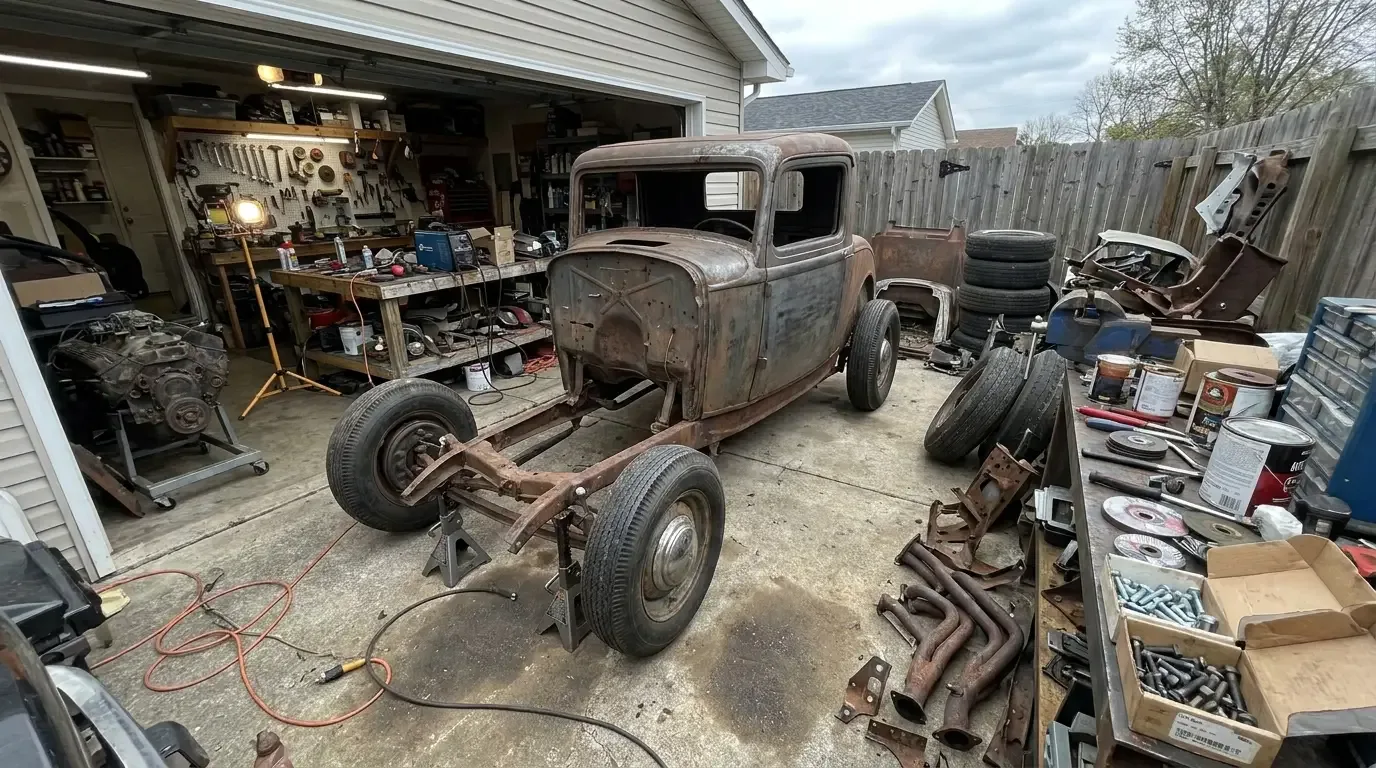
Strip away the aesthetics and the rat rod is really a set of values. Spend as little as possible. Do the work yourself. Use what you can find. Drive the thing. The rust and the mismatched parts are the visible result of those choices, not a costume applied afterward.
That is why I get worked up about fake builds. When a shop takes a straight body, ages it artificially, bolts on brand-new "distressed" parts, and charges a fortune, they have inverted every value the rat rod stands for. The car looks the part and betrays the point. A guy who welded a frame together in his driveway out of two donor cars has more claim to the name than a checkbook build ten times the price.
"I can spot a poseur across a parking lot. Real patina has a logic to it, it wears where hands and weather touch it. Bolt-on rust from a spray can sits everywhere evenly, like a costume. The car tells on itself."
Jim Vasquez
None of this means a rat rod should be a death trap. Cheap and DIY does not have to mean unsafe, and the best builders in this world are proud of the fact that their frames are square and their brakes stop the car. More on that below, because it is the part of the hobby that deserves the most honesty.
Building one on a budget
The money case is the whole appeal. A modest rat rod can be built for a fraction of what a finished street rod costs, and a lot of that saving comes from skipping the two most expensive line items in any build: paint and chrome. When your finish is the finish the car already has, you have deleted a bill that often runs into the thousands.
Where the money actually goes on a budget build:
- A cheap starting platform, often a rough body or cab nobody else wants.
- A junkyard drivetrain, frequently a small-block V8 and an automatic pulled from a wrecked donor.
- Brakes and steering, which is where you should not cut corners.
- Consumables: welding wire and gas, cutoff wheels, grinder discs, primer for anything genuinely bare.
- Registration, safety inspection where required, and insurance.
The skills matter more than the cash. If you can weld, cut, and turn a wrench, you can build a rat rod cheaply. If you cannot, you pay someone, and the budget advantage shrinks fast. That is the honest math. For the full walkthrough of a first build, we cover how to build a rat rod step by step in its own guide.
The place people underestimate the cost is time, not parts. A junkyard engine is cheap, but mating it to a chassis it was never designed for eats weekends. You fabricate motor mounts, you sort out an exhaust that clears the frame, you adapt a driveshaft to the right length, you wire an ignition and a charging system with no factory harness to fall back on. None of those steps costs much in dollars, and all of them cost hours. A builder who values his own time at anything close to a real wage is not saving money on a rat rod. He is spending it on the doing, which is the part he wanted in the first place. That is the trade the hobby is built on, and it is worth naming plainly before someone starts a build expecting a cheap car and gets a long project instead.
Patina: real, protected, and faked
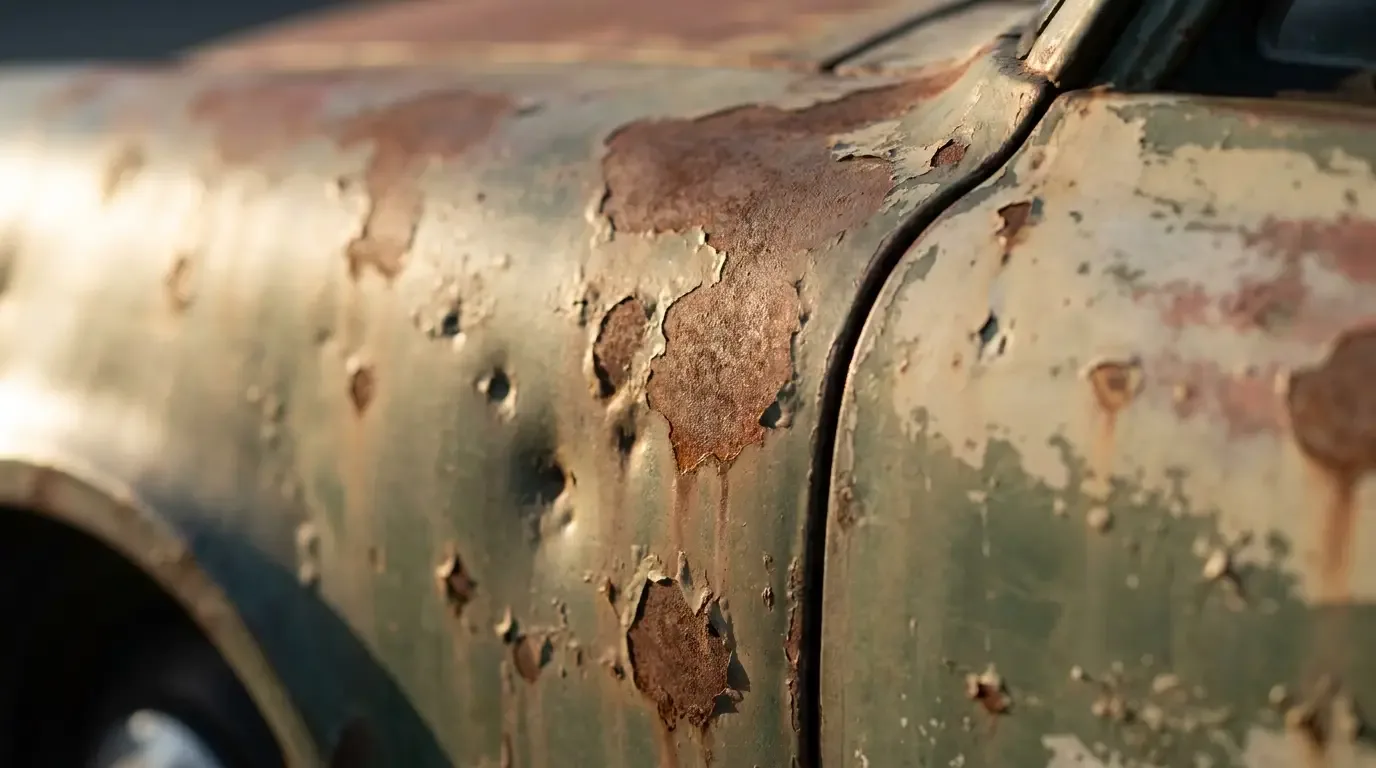
Patina is the aged, worn look of an old finish: faded paint, surface rust, the ghost of an old business logo on a truck door. On a genuine rat rod it is original and earned, and the builder's job is to stop it from getting worse without erasing it. That usually means cleaning the surface and sealing it with a matte clear coat so the rust stabilizes instead of eating through the panel.
Then there is fake patina, and here the hobby splits. Some builders artificially age straight steel with acid, salt, and paint techniques to get a rusted look on demand. Craftsmen do it well and honestly, as a finish technique. Others use it to disguise a pristine expensive build as a cheap one, which is the poser move I keep coming back to. The technique itself is neutral; the intent behind it is what I judge.
If you want to go deeper on how the look is achieved and preserved, the details of rat rod patina get their own treatment, including the clear-coat process and where fake aging crosses the line.
"Patina is a finish, not an excuse. Seal it, protect it, respect that the car earned it. What I cannot stand is a fresh build sprayed to look like it rotted in a field. Age a car if you want, just do not lie about what it cost you."
Jim Vasquez
Engines and drivetrains
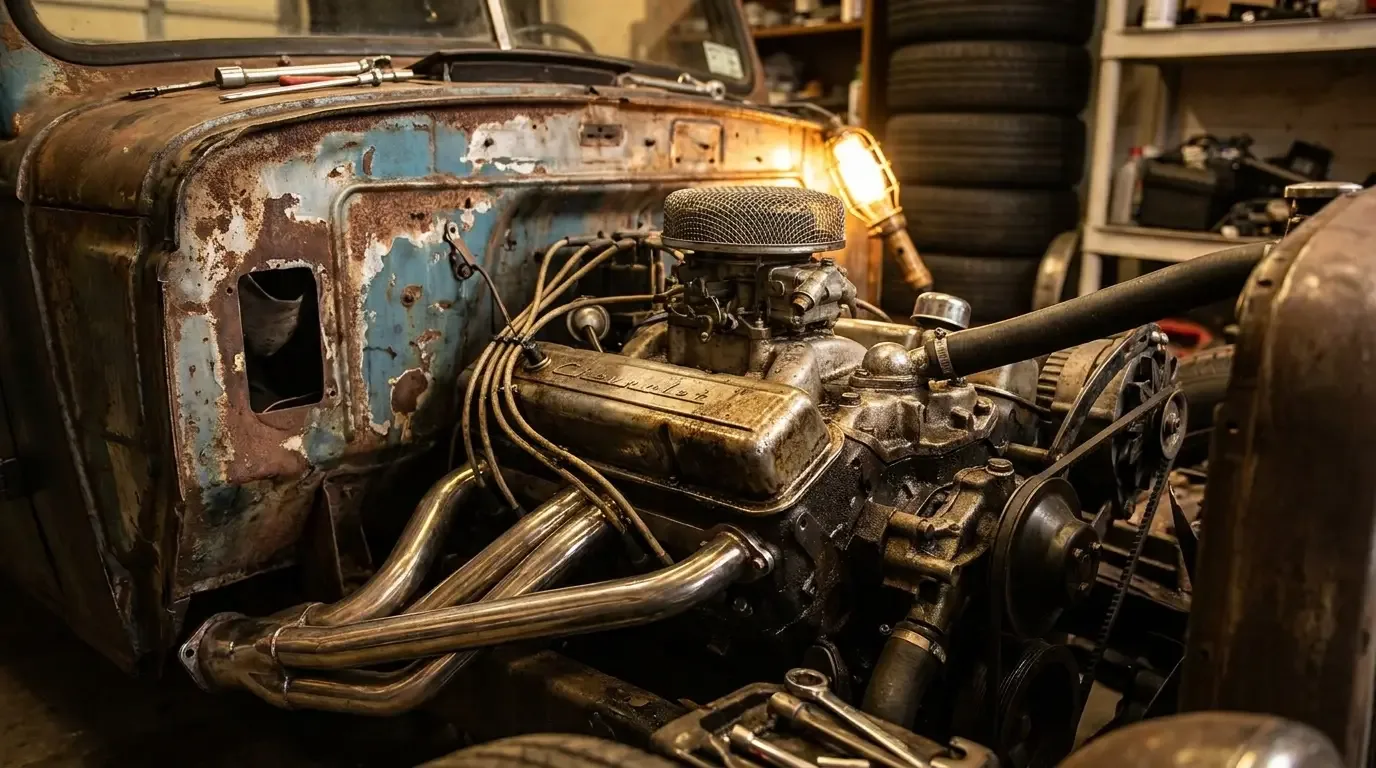
The powertrain is where rat rods show their junkyard heart. The traditional choice is the Ford flathead V8, the engine that powered the original hot rods, and running one is a nod to where the whole thing started. It is not the cheap or easy path anymore, though. Flathead parts have gotten pricey and the engines make modest power.
The practical budget choice is the small-block V8, most often the Chevy small-block, because they are everywhere, they are cheap, parts support is enormous, and they bolt to common transmissions without drama. A tired but running small-block and a matching automatic can often be pulled from a wrecked donor for less than the price of a rebuild kit for something exotic, and if it ever grenades you can find another that afternoon. That interchangeability is the real reason builders keep reaching for it. Diesel swaps have become a thing too, prized for big low-end torque on a budget and the smoke-and-clatter attitude that suits the style, though the weight and the mounting work are a bigger job than most first-timers expect. Whatever goes in, it usually comes out of a wrecking yard rather than a crate.
| Engine choice | Why builders pick it | The catch |
|---|---|---|
| Ford flathead V8 | Traditional, correct, iconic sound | Modest power, parts now expensive |
| Chevy small-block V8 | Cheap, plentiful, easy to source and mate | Less period-correct, very common |
| Inline-six | Cheap, simple, distinctive lean look | Less power, needs the right stance to suit it |
| Diesel swap | Big torque, budget donors, strong character | Weight, complexity, adapting the mounts |
The full breakdown of what goes in, what bolts to what, and how to keep a junkyard combination reliable lives in our guide to the rat rod engine and its supporting drivetrain. The short rule: pick a combination the aftermarket already supports, and you will spend your weekends driving instead of fabricating adapters.
Safety, legality, and the honest part
Here is where I stop being romantic about it. Rat rods have a real reputation for cut-corner brakes, sketchy steering, chopped tops that hurt visibility, and homemade fabrication that was never tested. Some of that reputation is earned. A car built to look thrown together can also be thrown together where it matters, and that gets people killed.
The distinction that matters: the look can be raw, the engineering cannot. A frame has to be square and strong. Brakes have to actually stop the car, which for most builds means a modern dual-circuit system, not a single-circuit relic. Steering has to be tight with no binding through the full travel. Fuel lines have to be routed away from heat and secured. None of that shows in a photo, and all of it is the difference between a rat rod and a rolling liability.
🔧 Inspection Priorities
- Brakes. Confirm a dual-circuit master cylinder and a working system at all four corners. A single-circuit failure leaves you with no brakes at all. Budget several hundred dollars if it needs redoing.
- Frame and welds. Look for cracked, porous, or undercut welds and any frame section that is rusted through. Bad structural welds are a scrap-the-car problem, not a patch job.
- Steering. Check for slop, binding, and clearance through full lock. A suicide front end or dropped axle setup must be checked for bump steer. Costs vary; do not drive it until it is right.
- Fuel and wiring. Look for fuel lines near exhaust, ungrounded circuits, and no fuse block. Fire risk. A proper fuse panel and rerouted lines are cheap insurance.
Legality varies by state and this is not the place for legal advice, but the pattern is consistent: registration and inspection depend on where you live, some states are strict about brakes, lights, and safety glass, and insurance for a home-built car needs a specialist classic or custom policy rather than a standard auto quote. The controversy, the regulations, and the paperwork all get their own detailed treatment in our coverage of whether are rat rods legal and how to keep one on the road properly.
The culture and the fights inside it
The rat rod scene is loud, friendly, and argumentative, which fits its roots. It connects to a wider American streak of building things yourself and refusing to buy what you can make. Shows are casual, the cars get driven to them and driven hard, and the craft is celebrated over the credit card. Welded metal art, skulls, shift knobs made from anything, exposed rivets: the details are personal and often funny.
The internal fight never really ends. Traditional hot-rod purists resented rat rods from the start, seeing them as sloppy or as mocking real craftsmanship. Rat rodders shot back that the purists had priced regular people out of the hobby. And within the rat rod world itself, the poseur argument runs constantly: who built it cheap and who bought the look. That tension is not a flaw in the scene, it is the scene. The whole thing exists because people got tired of hot rods becoming a rich man's game.
If the style has hooked you, the next step is usually looking at what is out there, and you can browse classic rat rods for sale to see the range from honest driver-quality builds to project cars waiting for someone with a welder and a weekend.
The rat rod at a car show today
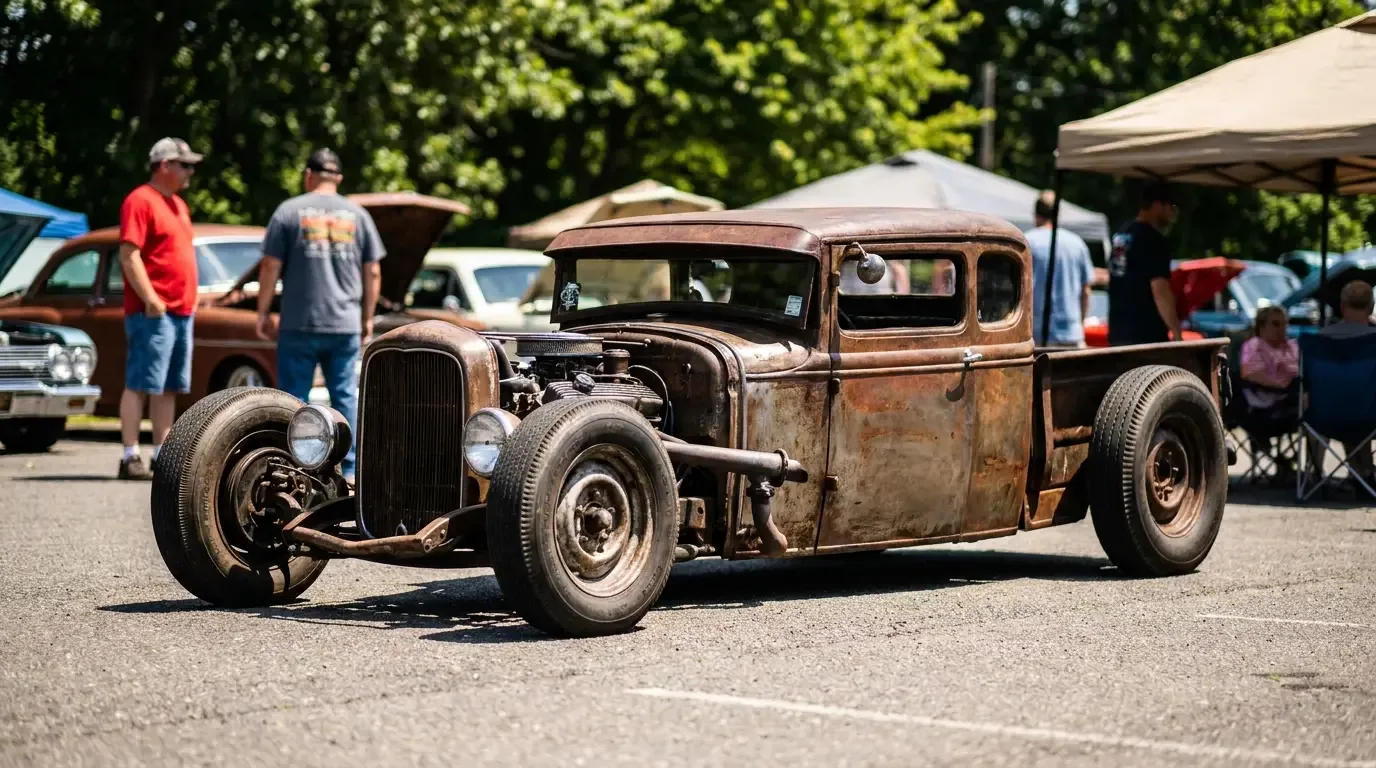
Walk a big open show now and the rat rods are easy to find, usually parked in a cluster off to one side, engines ticking as they cool because these cars drove in under their own power. That is the first tell of a real one. It has bugs on the grille and road grime up the firewall. The polished builds nearby came off enclosed trailers with tire shine still wet. The rat rod earned its dirt on the way over.
Judging is the flashpoint. Traditional show classes reward paint depth, panel gaps, and correctness, and a rat rod scores near zero on every one of those by design. For years that meant these cars had no category and got shoved into a novelty class or excluded outright, which suited a lot of owners fine because they never built the car for a trophy. Over time many shows added a rat rod or "unfinished" class judged on its own terms: fabrication craft, stance, the cleverness of the found-object parts, and whether the thing looks like it belongs to the person leaning on the fender. The gearheads who understand the style judge it by how well the car does the hard thing, which is running right while looking rough.
The details are where a real build shows itself. Look under one and you find a fuel line clamped every few inches, a fresh dual-circuit master cylinder tucked where it does not show, wiring run in loom and fused properly, welds that are ugly on purpose but sound where it counts. The costume builds get this backward: gorgeous fake rust on top, and a scary mess underneath. If you are new and want to learn to read these cars, spend your time crouched at the frame rails and the pedal box, not staring at the patina. The patina is the easy part to fake. The engineering is not.
"At a show I skip the paint and go straight to the brake lines and the steering. Five minutes under a car tells you more than an hour of looking at the top of it. The owners who built it right are proud to show you exactly that."
Jim Vasquez
Buying versus building a rat rod
Most people who catch the bug face the same fork: build one from a pile of parts, or buy something already running. Neither answer is wrong, but they suit different people, and picking the wrong one is how projects end up covered in a tarp behind the garage for a decade.
Building is for the person who wants the process as much as the car. You control every choice, you learn the whole machine, and a scratch build is the only path to a car with a genuine claim to the name because you actually made it cheap and made it yourself. The cost is time and skill. If you cannot weld and fabricate, you are either learning on the job or paying a shop, and paying a shop to build you a "cheap" rat rod is a contradiction that gets expensive fast.
Buying is for the person who wants to drive this weekend, not in three winters. The trap is that a rat rod is the single hardest kind of car to inspect, because the whole look is built on wear and improvisation, and that same look hides the difference between a clever driver and a rolling hazard. You cannot judge one by how it looks. You judge it by whether the safety-critical systems were done by someone who knew what they were doing.
🔧 Inspection Priorities
- Ask who built it and get the story. A real builder will walk you through the frame, the brake choice, and the engine swap in detail. Vague answers or "I bought it like this" with no history is a reason to walk.
- Get it on a lift or on your back. Every safety-critical system lives underneath. Refusal to let you inspect the underside ends the conversation.
- Verify the title and how it is registered. A scratch-built car titled as an assembled or specially constructed vehicle is normal; a car with no clear paper trail is a headache you inherit.
- Drive it, then check the brakes hard from speed in a safe place. Listen for driveline vibration, feel for bump steer, and confirm the car stops straight and true before you trust it.
My honest steer for a first-timer who cannot yet weld: buy a sorted driver from someone who clearly built it right, drive it a season, and learn the car from the seat. Then build your own once you know what a good one feels like. You will make far better decisions with a year of real seat time behind you than you would starting cold with a rusty cab and a welder you are still learning to run.
Sources and notes
- Period and modern hot-rod and rat-rod press covering the origins of the term and the 1980s–90s reaction against street rodding.
- Builder interviews and workshop practice on fabrication, patina preservation, and clear-coating of original finishes.
- Engine and chassis references for flathead, small-block, inline, and diesel swap characteristics and parts support.
- State DMV registration guidance on specially constructed and assembled vehicles, and general classic/custom insurance guidance.
- Car-show and club records documenting rat rod events, judging attitudes, and the purist controversy.
- Figures given as approximate; specific hp, cost, and production numbers were not asserted where they could not be verified.
Related Reading
Have a
Classic Car
for Sale?
Reach thousands of serious classic car collectors across the US.
Sell It Here →
Are You a Classic Car Dealer?
List your full inventory and connect with targeted classic car buyers.
Join as a Dealer →

About the author
Jim Vasquez
Southern California hot rod and custom car builder with roots in the traditional kustom kulture scene.
Comments
Be the first to comment on this article.