
If a C10 has bad floors, I already know to check the cab corners and rockers before I even walk around the truck. Water travels. It comes in through the cowl and the door seals, runs down inside the rocker, and pools right where the cab corner meets the bottom of the door opening. By the time you see bubbled paint or a crease that shouldn't be there, the structure underneath has usually been compromised for a while.
Restoration & Tech
7 min read
Replacing C10 Cab Corners and Rocker Panels
A hands-on guide to diagnosing and replacing rusted C10 cab corners and rocker panels, including how to keep door gaps straight through the repair.
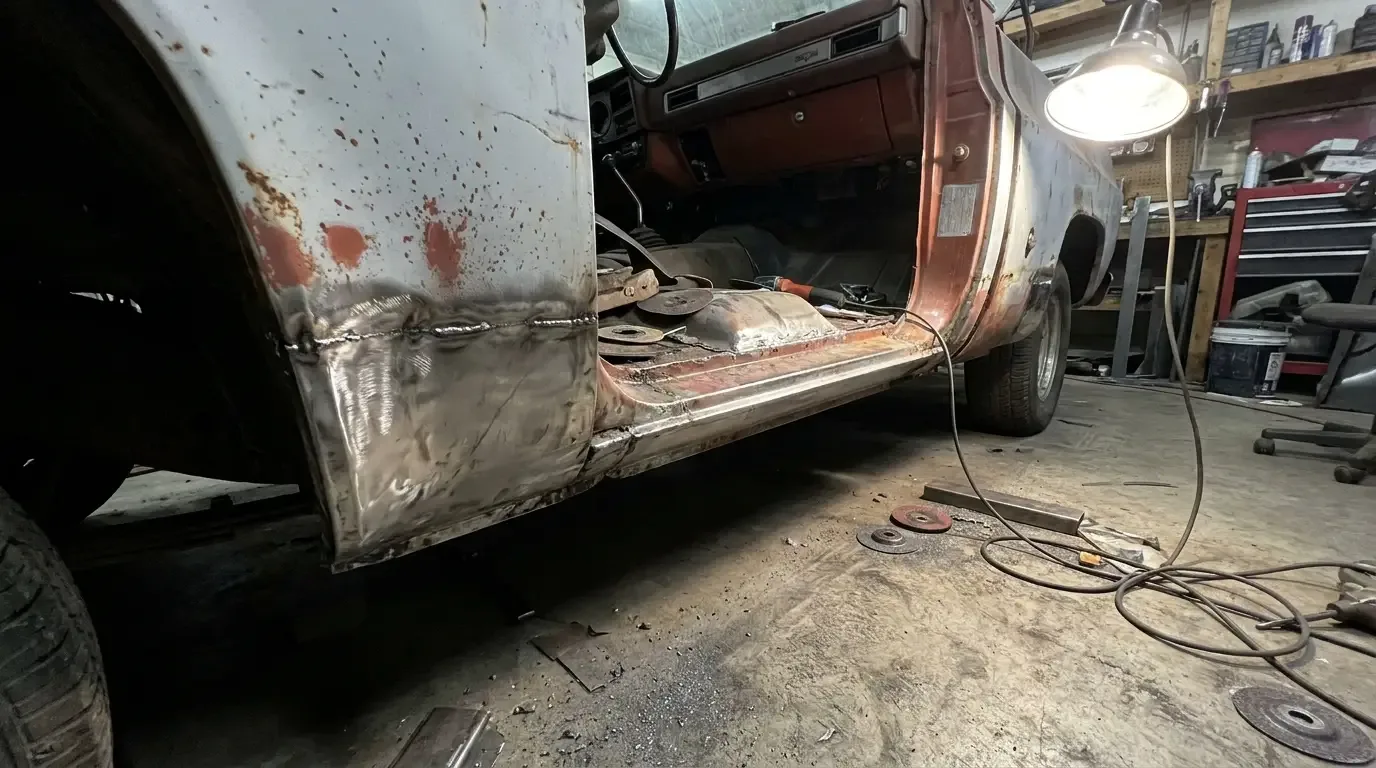
This is a job I'd put a notch above floor pan work on the difficulty scale, not because the metal is harder to cut, but because cab corners and rockers carry more structural load and sit right where the door hangs. Get this wrong and you'll be chasing door gaps for the life of the truck. Get it right and the truck drives, and rusts, like a much newer one.
Where the rot actually starts
The rocker panel runs the full length under the door, and on these trucks it's really an outer skin over an inner structural rocker, sometimes with a reinforcement in between depending on cab configuration. Water gets trapped between those layers and rots from the inside out, so a rocker can look decent from three feet away and be paper thin underneath the outer skin. Poke it with an awl before you trust it.
The cab corner is the panel where the rocker, the rear of the cab, and the bottom of the door jamb all come together. It's a low point that collects mud, road salt, and standing water, especially on trucks that spent winters anywhere salt gets used on the roads. Cab corners rust from that trapped debris as much as from water alone. If the truck came from the rust belt, budget for cab corner work before you even see the truck in person.
I carry a cheap magnet on a string in my back pocket for exactly this job. Run it along the rocker and the cab corner before you touch a grinder to anything, and if it won't stick anywhere along a six-inch stretch, that's filler doing the job structural steel is supposed to be doing. I had a numbers-matching short bed come through a few years back that looked clean enough to sell as a driver, decent paint, straight chrome, and the magnet told a completely different story the second it hit the driver's side rocker. Somebody had mudded in a hole about the size of a coffee can and painted right over it.
Cutting out rocker and cab corner rust
Start by removing the inner fender or splash shield so you can see how far the rot travels up into the rocker and cab corner from underneath. Cut back to solid metal, and expect that number to be bigger than what you saw from outside the truck. Rust hollows out a rocker from the inside, so the visible bad section on the outer skin is often smaller than the actual damaged structure behind it.
Support the door before you start cutting anything near the cab corner. With the rocker and lower jamb compromised, the door opening can shift slightly once you remove structural metal, and a door that's been holding its own weight against a rotted rocker will sag the moment that support disappears. A floor jack with a padded block under the door, or a simple support stand, keeps the opening from moving while you work.
Fitting new panels without losing your gaps
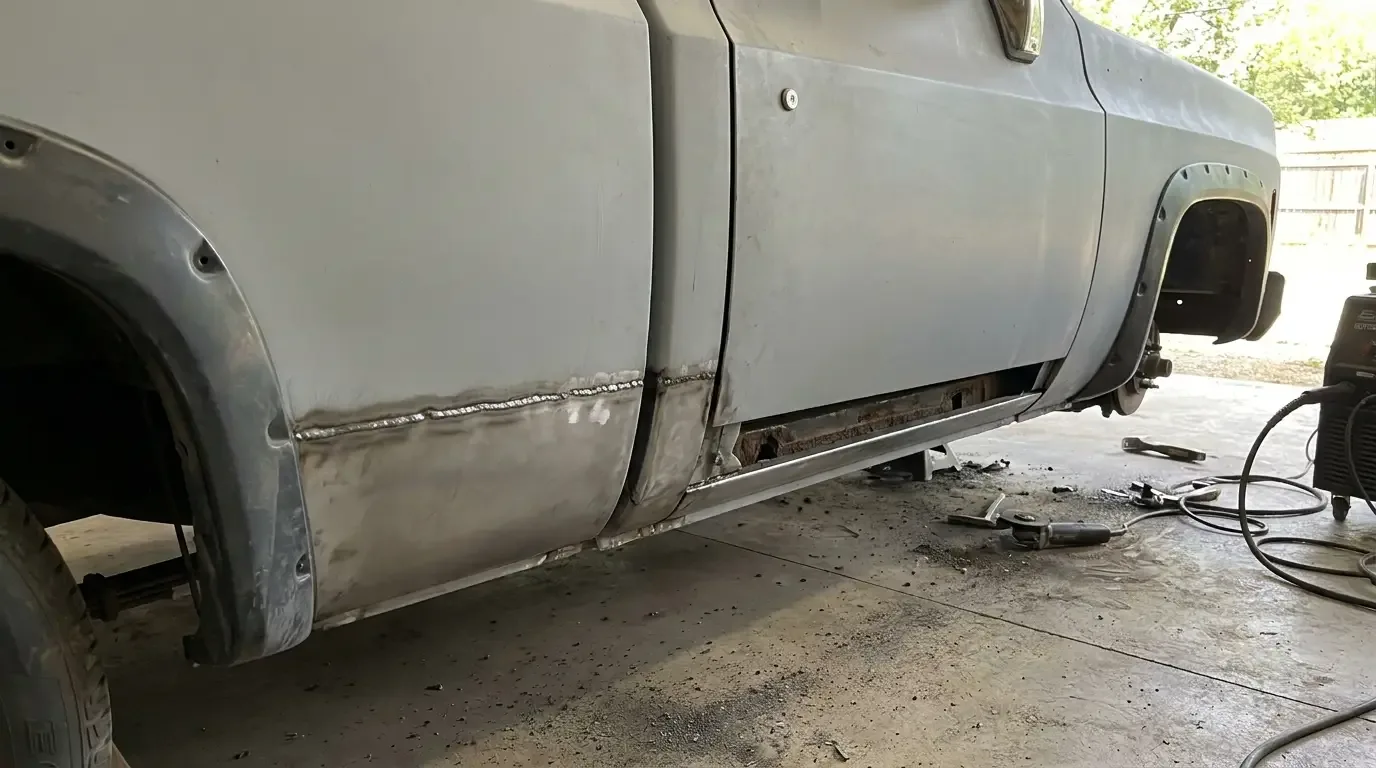
Tack weld in small sections rather than fully welding one seam before starting the next. Work the cab corner, check the door gap, work the rocker, check the gap again. This back-and-forth is tedious but it catches shrinkage and movement early, before you've got a fully welded panel that's pulled the door opening out of square by an eighth of an inch you can't easily fix later.
Rocker panels typically need both an inner reinforcement piece and an outer skin, and skipping the inner piece to save time is a mistake I see a lot of home builders make. The inner structure is what actually carries load. The outer skin is cosmetic. A truck with a nice-looking rocker skin over no inner structure will flex and eventually crack the fresh paint right along the seam.
Once the metal work is done and everything's tacked and finish welded, seam seal the overlaps and treat the inside of the rocker with a rust inhibiting coating before you close it back up. You won't get back in there easily once the outer skin is on, so this is the last chance to protect that cavity for the next twenty years.
"Cab corners and rockers are where I decide whether a truck was actually restored or just made to look restored. Anybody can lay a nice bead on visible sheet metal. The trucks that hold their door gaps five years later are the ones where somebody did the inner structure right and didn't rush the fit-up."
Mike Sullivan
This work usually comes right after you've already dealt with the floor, since the rust that ate one tends to have started on the other. If you haven't tackled the floors yet, it's worth reading the C10 restoration guide first to understand where this fits in the overall sequence. And once the cab corners and rockers are welded in and the doors are hanging right, the next thing on your list should be getting the panel gaps right afterward, since fresh metal work almost always shifts something you'll want to true up.
Time and cost, realistically
Budget more time for this than floor pans. Supporting the door, working the inner structure, and checking gaps repeatedly slows the job down compared to a flat floor section. Reproduction cab corner and rocker sets run roughly $100 to $300 depending on the supplier and whether you're buying a combined piece or separate corner and rocker sections, with basic individual patch pieces running under $50 each and full combined kits landing in the $100-$150 range from most reproduction suppliers.
Labor on a correct cab corner and rocker job, done right with the inner structure replaced and not just skinned over, usually runs 20 to 24 hours at a shop rate somewhere around $80 to $95 an hour, which puts labor alone in the $1,600 to $2,200 range, more than most guys budget for going in. Parts are the easy part of that estimate. It's the hours spent supporting the door, checking gaps, and re-checking them after every weld that eat the clock, and any shop quoting this fast and cheap is telling you something about which corners they're planning to cut.
If a shop is quoting this job, expect the labor estimate to reflect the extra care around door fitment, not just the cutting and welding. A rushed rocker and cab corner job is one of the easiest things to spot on a "restored" C10 at a show or a sale, because the door gap gives it away every time.
Sources and notes
- JL Fabrication: 73-87 combined cab corner and inner/outer rocker panel kit pricing
- Speedway Motors: 67-72 C10 rocker and cab corner repair with individual panel pricing
- GMT400 forum: real shop quote of 24 labor hours and roughly $85/hour for cab corner replacement
- The Pricer: rocker panel and cab corner replacement cost breakdown, parts vs. labor
- KUAFU 4-piece cab corner and rocker panel kit for 1973-1987 C10/K10
Related Reading
Have a
Chevrolet C10
for Sale?
Reach thousands of serious classic car collectors across the US.
Sell It Here →
Are You a Classic Car Dealer?
List your full inventory and connect with targeted classic car buyers.
Join as a Dealer →

About the author
Mike Sullivan
Detroit-area muscle car enthusiast and restoration specialist with three decades of hands-on experience working on American iron.
Related Listings - Chevrolet C10
More in Restoration & Tech
Comments (1)
G
Gary Tompkins
2 weeks ago
Good writeup. One thing I'd add is the regional price variation — Southwest cars vs. Rust Belt cars at similar asking prices aren't comparable purchases.