
You can build the prettiest small-block on the block and drop it into a body straight enough to shave in, but if the car still stops on four drums from 1966, you built a fast way to hurt yourself. Brakes are the part of a restomod nobody photographs and everybody bets their life on. A disc brake conversion is not a bolt-on toy. It is the piece that lets the rest of the build cash the checks the engine writes.
Restoration & Tech
7 min read
Restomod Disc Brake Upgrades
Front and rear disc conversions, master cylinder and booster choices, proportioning, and big-brake wheel clearance, built as one system.
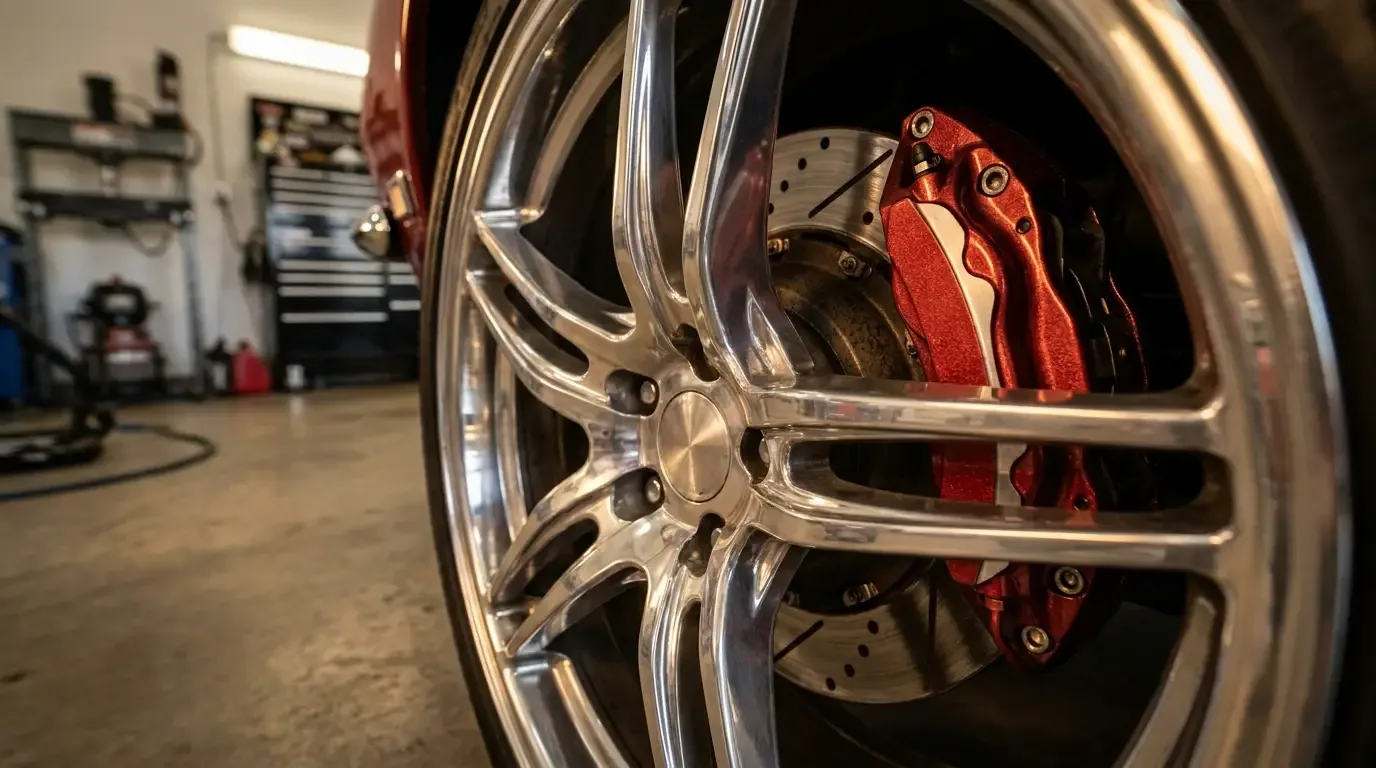
I have pulled apart enough old cars to tell you the plain truth: the factory brakes were marginal when they were new, and fifty years of heat cycles did not help. A modern engine and sticky tires only make the gap wider. Here is how the whole system fits together, front to back, so you spend money in the right order.
Front disc conversion: where the stopping actually happens
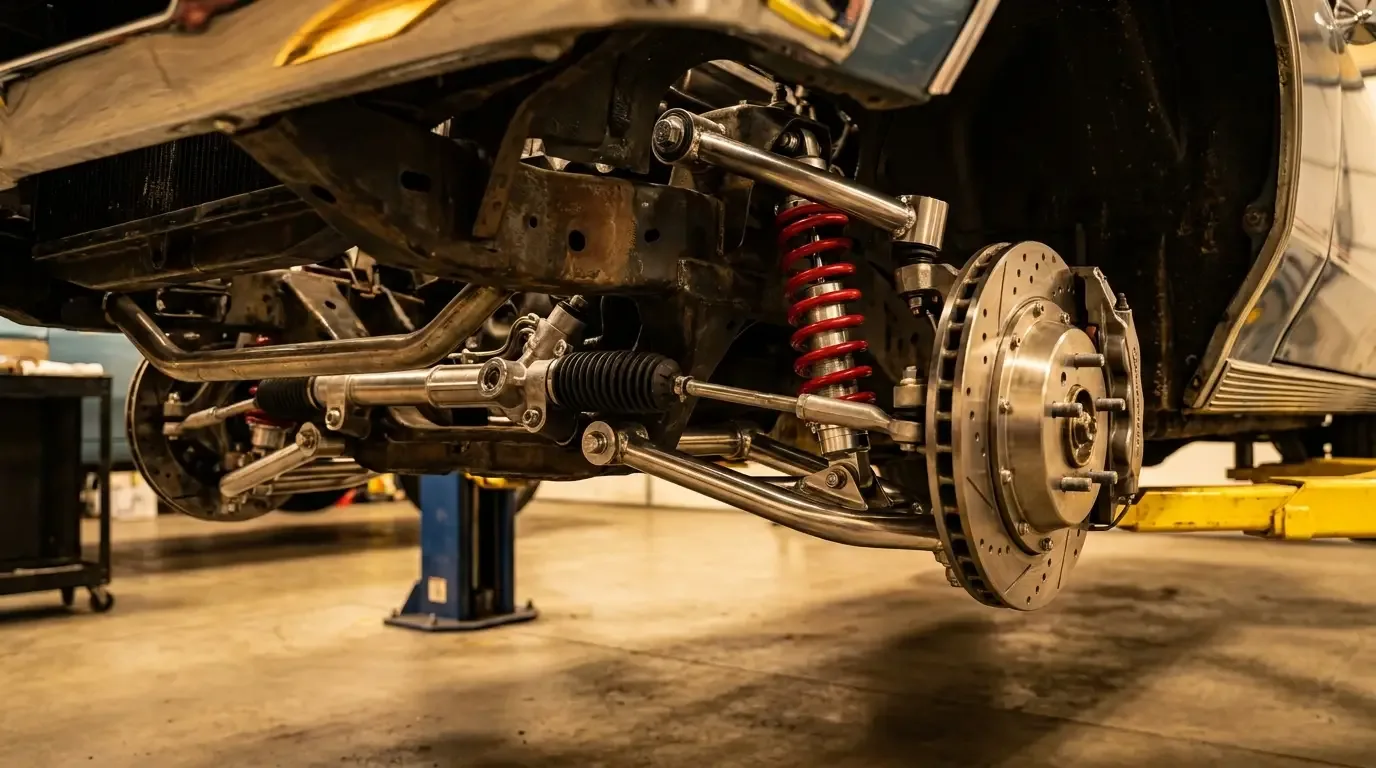
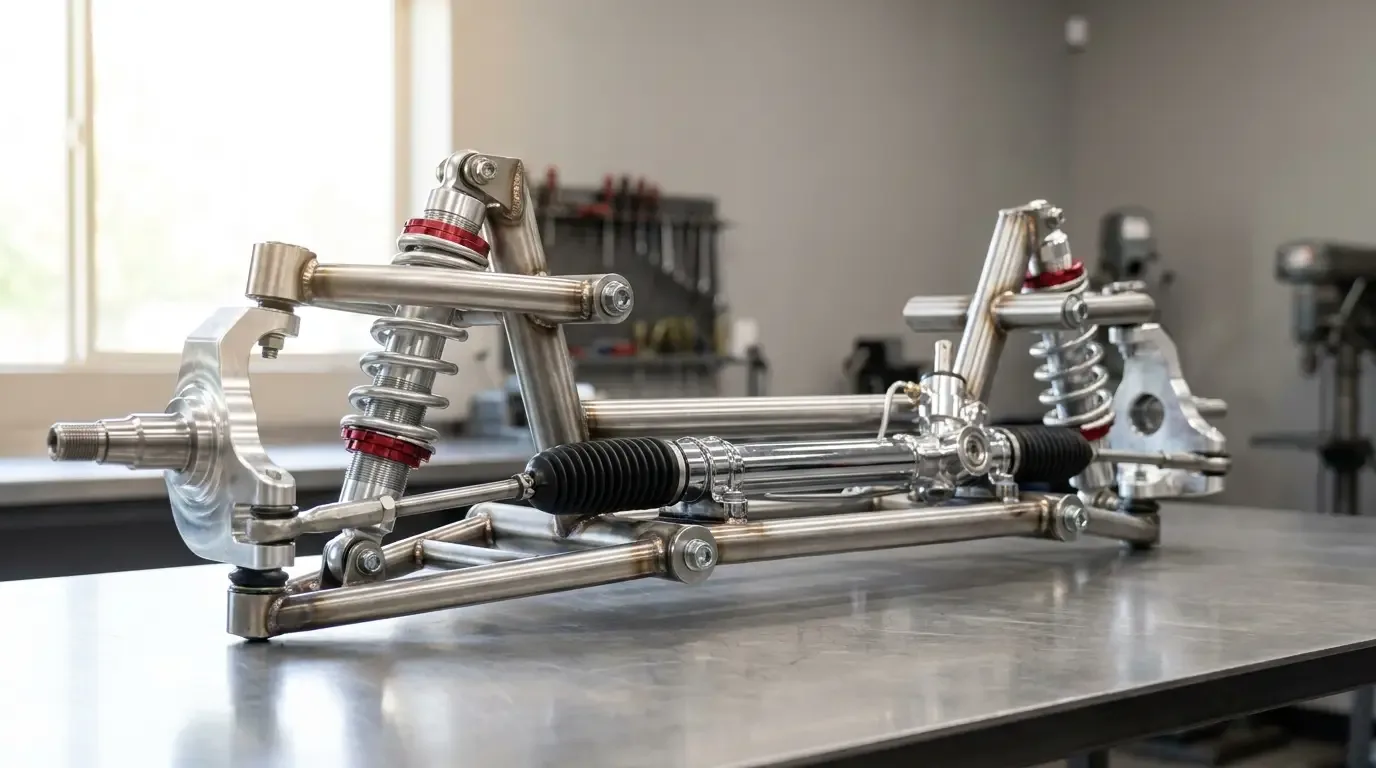
Roughly 60 to 70 percent of your braking work is done up front, because weight shifts forward the instant you hit the pedal. That is why the front conversion is the first check you write. On most popular platforms you can buy a spindle-and-caliper kit that bolts to your existing steering knuckle, or a full drop-spindle setup that lowers the car and upgrades the brakes in one move.
The trap people fall into is buying the biggest rotor they can find and worrying about fit later. Don't. Start with a single-piston floating caliper and a vented rotor around 11 to 12 inches. That combination stops a street car hard, sheds heat, and fits inside a 15-inch wheel. You only need to go bigger when you have a real reason, and most of us don't.
The rear: discs, drums, and when to stop spending
Here is where I lose friends. You do not always need rear discs. On a street restomod that sees back roads and cars-and-coffee, a good set of rear drums with fresh shoes and a working self-adjuster stops the car fine and keeps the parking brake simple. Drums make a great parking brake almost for free. Discs need a separate mechanism to do the same job.
That said, if the car is headed for track days, autocross, or serious pro touring duty, put discs on the back. They handle repeated hard stops without fade and they balance a big front setup better. Just go in with your eyes open about the parking brake. Most rear disc kits use either a tiny drum-in-hat brake or a cable-actuated caliper, and both are fussier than the drum you are replacing.
- Street cruiser, stock-ish power: keep the drums, spend the money up front.
- Big power, sticky tires, twisty roads: front and rear discs, matched as a system.
- Track or autocross: discs everywhere, and start thinking about pad compound and cooling.
Master cylinder and booster: the part everyone forgets
This is the mistake I see most. A guy bolts four beautiful discs onto a car that still has the old single-circuit drum master cylinder, then wonders why the pedal goes to the floor or the car barely slows down. Discs and drums want different amounts of fluid and different pressure. You cannot just leave the old hydraulics in place and hope.
When you convert to disc, you almost always need a new master cylinder sized for your setup, and you need to decide on assist. Drum brakes ran a small bore because they needed little fluid. Discs need more volume and higher line pressure. Get this wrong and no amount of caliper quality saves you.
Your three main paths for assist:
- Manual (no booster): simplest, lightest, needs a firmer leg. Great for a stripped-down build, and it clears tight engine bays where a big booster won't fit.
- Vacuum booster: the factory-feel option. It uses engine vacuum, so it works great behind a stock-ish cam. A lumpy race cam that pulls low vacuum will make it inconsistent.
- Hydroboost: uses power-steering pressure instead of vacuum. It is the answer for big-cam engines and for LS swaps that run out of vacuum. Compact and strong, but it ties your brakes to your steering pump.
"I tell every customer the same thing. Spend your first dollar on the master cylinder and the booster, not the shiny six-piston calipers. A correctly sized master with a plain single-piston caliper stops a car better than a race caliper fed by the wrong hydraulics. Every time."
Mike Sullivan
Proportioning: getting the front and rear to agree
Once you mix disc and drum, or disc front and disc rear with different piston sizes, the two ends of the car want to lock up at different moments. Too much rear bias and the back steps out under hard braking, which on a street car is how you end up facing the wrong way. An adjustable proportioning valve lets you dial down rear pressure until the fronts lock a hair before the rears. That order keeps the car straight and stable.
You also need a combination valve or a residual pressure valve set up correctly, especially if the master cylinder sits lower than the calipers. Skip that and you get a low pedal or brakes that drag. This is the unglamorous plumbing that separates a car that stops right from a car that stops eventually. If you want the full picture of how brakes fit into the larger handling package, read our Pro Touring Explained guide before you finalize a parts list.
Big-brake kits and wheel clearance: measure twice, buy once
Big-brake kits look great and, on a heavy or high-power car, they earn their keep with more heat capacity and a firmer pedal. But a 13 or 14-inch rotor will not fit behind a 15-inch steel wheel, period. Before you spend a dime on a big-brake kit, you need to know your wheel diameter, the wheel's backspacing, and the caliper clearance the kit demands.
The classic heartbreak is buying the wheels first for looks, then discovering the calipers won't clear. Do it the other way. Pick the brake package, get the manufacturer's brake clearance template, and buy wheels that fit around it. A caliper touching a wheel spoke at 70 mph is not a problem you fix on the side of the road.
| Rotor size | Minimum wheel (typical) | Best use |
|---|---|---|
| 10.5 to 11 in | 15 in | Mild street, stock-look wheels |
| 12 in | 16 to 17 in | Street restomod, spirited driving |
| 13 in | 17 to 18 in | Big power, track days |
| 14 in | 18 in and up | Heavy, high-speed, serious track use |
Build the brakes as a system, not a shopping cart of the biggest parts. Front discs sized to your wheels, a rear end matched to how you actually drive, a master cylinder and booster picked for your engine, and a proportioning valve to make both ends agree. Get that order right and the car stops like the modern machine it pretends not to be.
Sources and notes
- Brake system engineering references and manufacturer fitment guides for disc conversion kits.
- Master cylinder and booster sizing documentation from hydraulic component suppliers.
- Builder interviews and shop experience on real-world restomod brake installations.
- Wheel and brake clearance templates published by big-brake kit manufacturers.
Related Reading
Have a
Classic Car
for Sale?
Reach thousands of serious classic car collectors across the US.
Sell It Here →
Are You a Classic Car Dealer?
List your full inventory and connect with targeted classic car buyers.
Join as a Dealer →

About the author
Mike Sullivan
Detroit-area muscle car enthusiast and restoration specialist with three decades of hands-on experience working on American iron.
More in Restoration & Tech
Comments
Be the first to comment on this article.