
The engine gets all the attention. Nobody brags about their brakes at the show. But I will tell you straight: the brakes are the part that decides whether your street rod is a car you actually drive or a car you park and admire. A pre-1949 Ford or Chevy left the factory with four-wheel drum brakes, some of them mechanical, most of them undersized for anything past 45 mph in modern traffic. Bolt a crate 350 behind that and you have built a fast car that cannot stop. That is not a project. That is a liability.
Restoration & Tech
7 min read
Street Rod Disc Brakes
The brakes decide whether your street rod is a driver or a display piece. Here is how disc conversions, master cylinders, and boosters fit together.
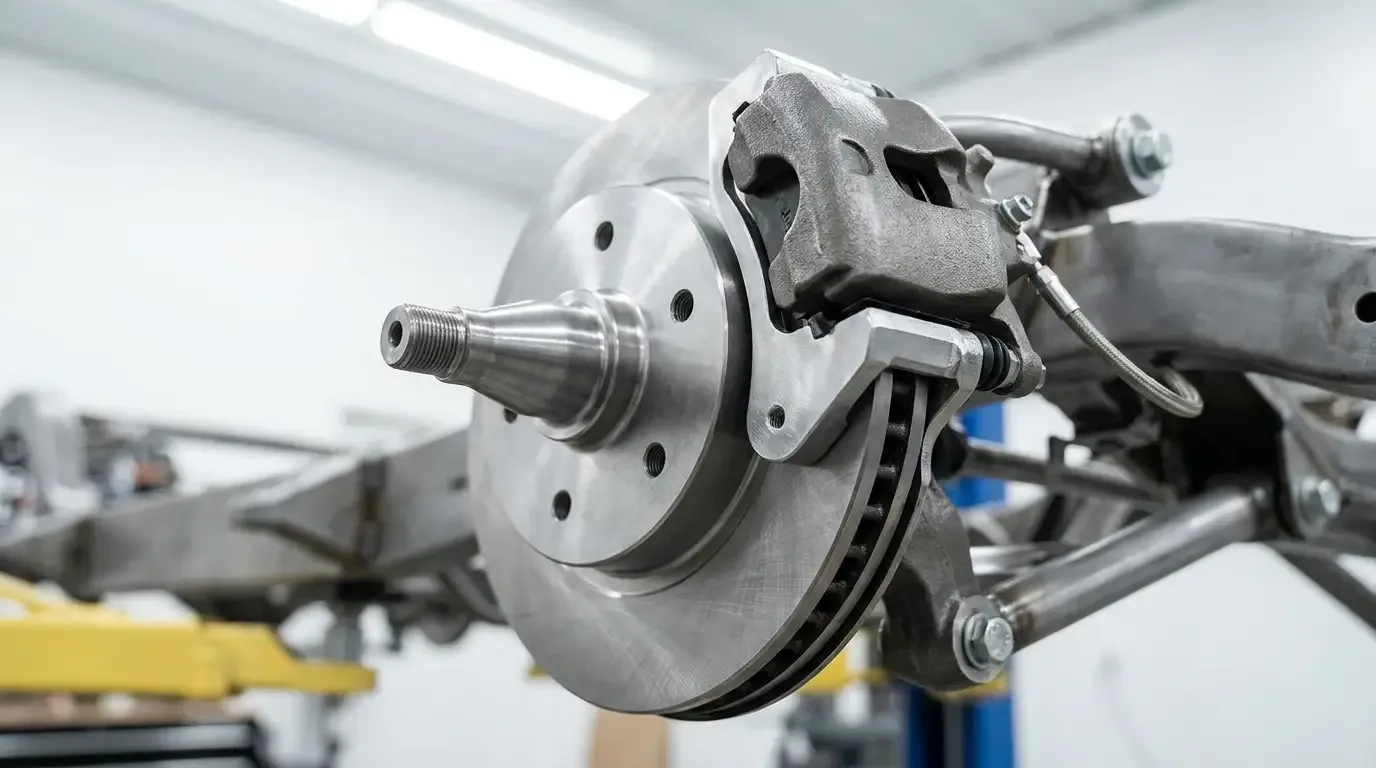
Upgrading the brakes is not the glamorous part of a street rod build, but it is the part I do first and never cut corners on. Here is how the whole system fits together, and why the old drums have to go.
Why old drums are not enough for a driver
Drum brakes work. That is not the argument. A properly adjusted set of drums on a lightweight prewar car will stop it on a quiet road. The problem is everything that road throws at you now. Drums fade. When you drag them down a long grade, or make three hard stops in a row in traffic, the shoes heat up, the drum expands away from the shoes, and the pedal goes to the floor. You do not get a warning. You get a floor.
Drums are also self-energizing, which sounds good until you understand what it means: a small change in input makes a big change in output, so they grab unevenly and pull to one side when they are wet or worn. Disc brakes do not do any of that. The rotor is open to the air, so it sheds heat instead of trapping it. The pad squeezes a flat surface, so the bite is linear and predictable. You push a little, you get a little. You push a lot, you get a lot. For a car you are going to drive on the highway, that predictability matters more than raw stopping power.
Front disc conversion: where the money goes first
The front brakes do most of the work. When you stop, weight transfers forward, and the front tires carry roughly 70 percent of the braking load. So if you only upgrade one axle, upgrade the front. Most street rodders do the fronts and leave drums on the rear, and that is a legitimate, safe build.
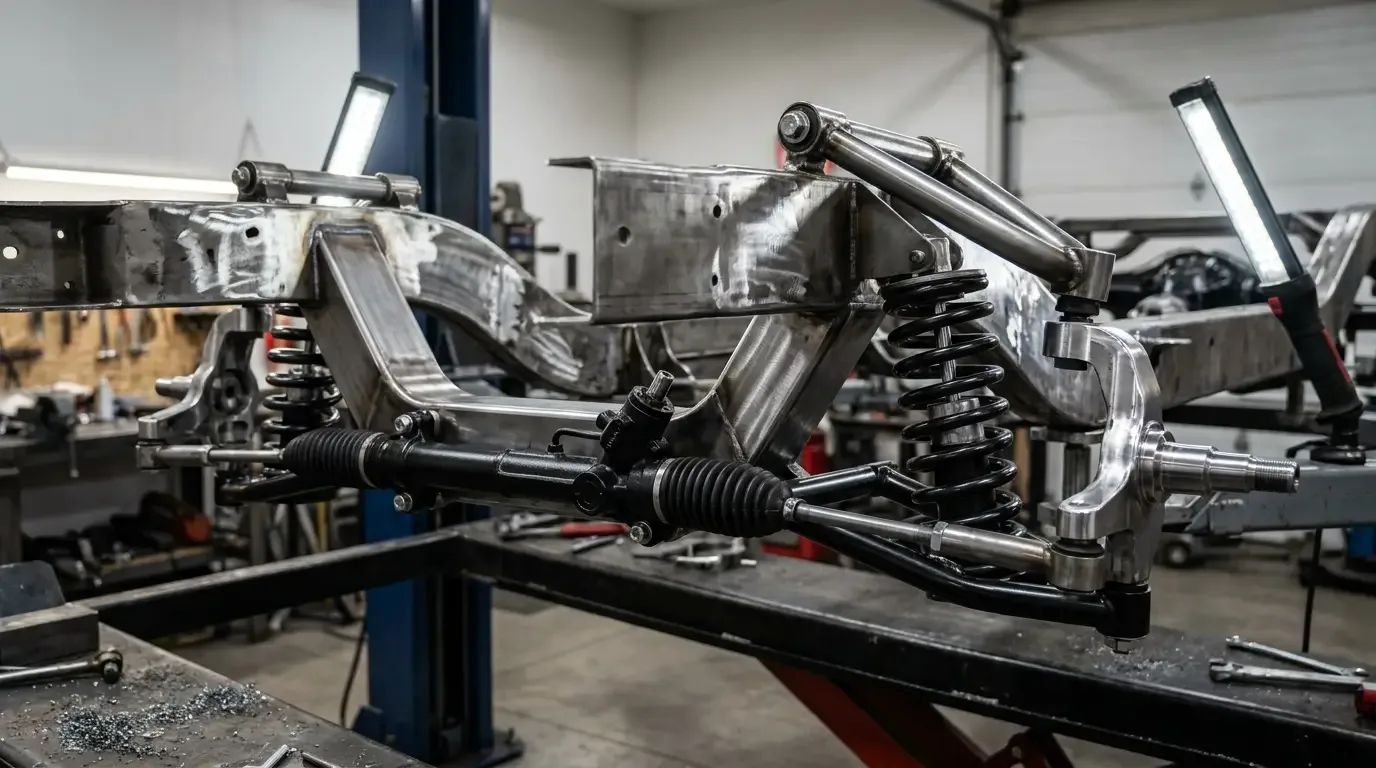
How you do the front conversion depends on your front suspension. If you kept a solid front axle, there are bolt-on disc kits with brackets that mount a GM-style caliper to the original spindle. If you swapped in an independent front end, and most comfort-focused builds do, the disc brakes usually come as part of that crossmember package. That is one more reason the suspension and brakes are really one decision, not two.
- Rotor type. Solid rotors are fine for a mild street car. Vented rotors, which have cooling vanes cast between two faces, handle heat far better and are worth it if you built any real power.
- Caliper. Single-piston floating calipers are the common, affordable choice and work well. Multi-piston fixed calipers give a firmer pedal and more even pad wear, at more cost.
- Rotor diameter. Bigger is not always better under small wheels. Measure your wheel clearance before you order. An 11-inch rotor that will not fit inside a 15-inch steelie is a paperweight.
"I have pulled apart plenty of nice-looking street rods where the brakes were the last thing anyone touched. Fresh paint, chrome everywhere, and a 60-year-old master cylinder feeding drums. That car scares me more than a rusty one."
Mike Sullivan
Rear discs, or leave the drums alone
Here is where I disagree with a lot of catalog copy. You do not need rear disc brakes on most street rods. Rear drums are cheap, they last, and they make the parking brake simple because the mechanism is built into the drum. If your rear end came from a car that had drums, keeping them is the honest, practical choice.
Rear discs make sense in two cases. One, you swapped in a rear axle that already has disc brackets, so the work is done. Two, you built serious power and you want the balance and the looks to match the front. Just know that a rear disc setup needs a parking brake solution, either a cable-actuated caliper or a separate small drum inside the rotor hat, and that adds cost and fiddling. Do not add rear discs because a forum told you drums are obsolete. Add them because your specific build needs them.
| Component | Typical street rod choice | Why |
|---|---|---|
| Front brakes | Vented disc, single-piston caliper | Carry ~70% of stopping load, need heat capacity |
| Rear brakes | Drum (or disc if axle has it) | Cheaper, easy parking brake, adequate for the load |
| Master cylinder | Dual-reservoir, disc/drum matched bore | Split circuit for safety, correct pressure balance |
| Booster | 7-inch dual-diaphragm or hydroboost | Fits tight engine bays, gives real assist |
| Proportioning valve | Adjustable, in the rear circuit | Tunes front-to-rear bias, prevents rear lockup |
Master cylinder, booster, and the pieces in between
This is the part people get wrong, and it is the part that makes or breaks the whole job. You cannot just bolt disc brakes to the corners and keep the old single-reservoir master cylinder. It will not push the right volume, it has no safety split, and discs and drums do not want the same pressure.
Start with the master cylinder. A modern dual-reservoir unit splits the system into two circuits, so a leak at one wheel does not empty the whole car. Get one with a bore matched to your setup. Discs need more fluid volume than drums, so a disc/drum master cylinder is sized differently than an all-drum one. Match it or you get a mushy pedal or a grabby one.
Then decide on assist. Prewar bodies have tight footwells and short pedal geometry, so a manual disc setup can feel heavy unless the pedal ratio is right. A vacuum booster gives you that assist, but a big single-diaphragm booster will not clear a fenderwell headers install. This is where the dual-diaphragm 7-inch booster earns its keep, or hydroboost, which runs off power steering pressure and needs almost no room at all. For a tight small-block bay, hydroboost is often the clean answer.
Once the brakes are sorted, the rest of the comfort build follows the same logic: make the car livable, not just fast. If you are working through the whole list, the next stop is usually Street Rod Air Conditioning and Comfort, because a car you can stop is a car you will actually want to drive on a hot afternoon.
Sources and notes
- Period automotive press covering early factory disc brake systems and prewar drum brake design.
- Aftermarket brake and chassis component references for street rod disc conversion kits, master cylinders, and boosters.
- Builder and shop interviews on front-versus-rear brake priorities and pedal-ratio setup.
- General service and engineering references on hydraulic brake circuits and proportioning.
Related Reading
Have a
Classic Car
for Sale?
Reach thousands of serious classic car collectors across the US.
Sell It Here →
Are You a Classic Car Dealer?
List your full inventory and connect with targeted classic car buyers.
Join as a Dealer →

About the author
Mike Sullivan
Detroit-area muscle car enthusiast and restoration specialist with three decades of hands-on experience working on American iron.
More in Restoration & Tech
Comments
Be the first to comment on this article.