
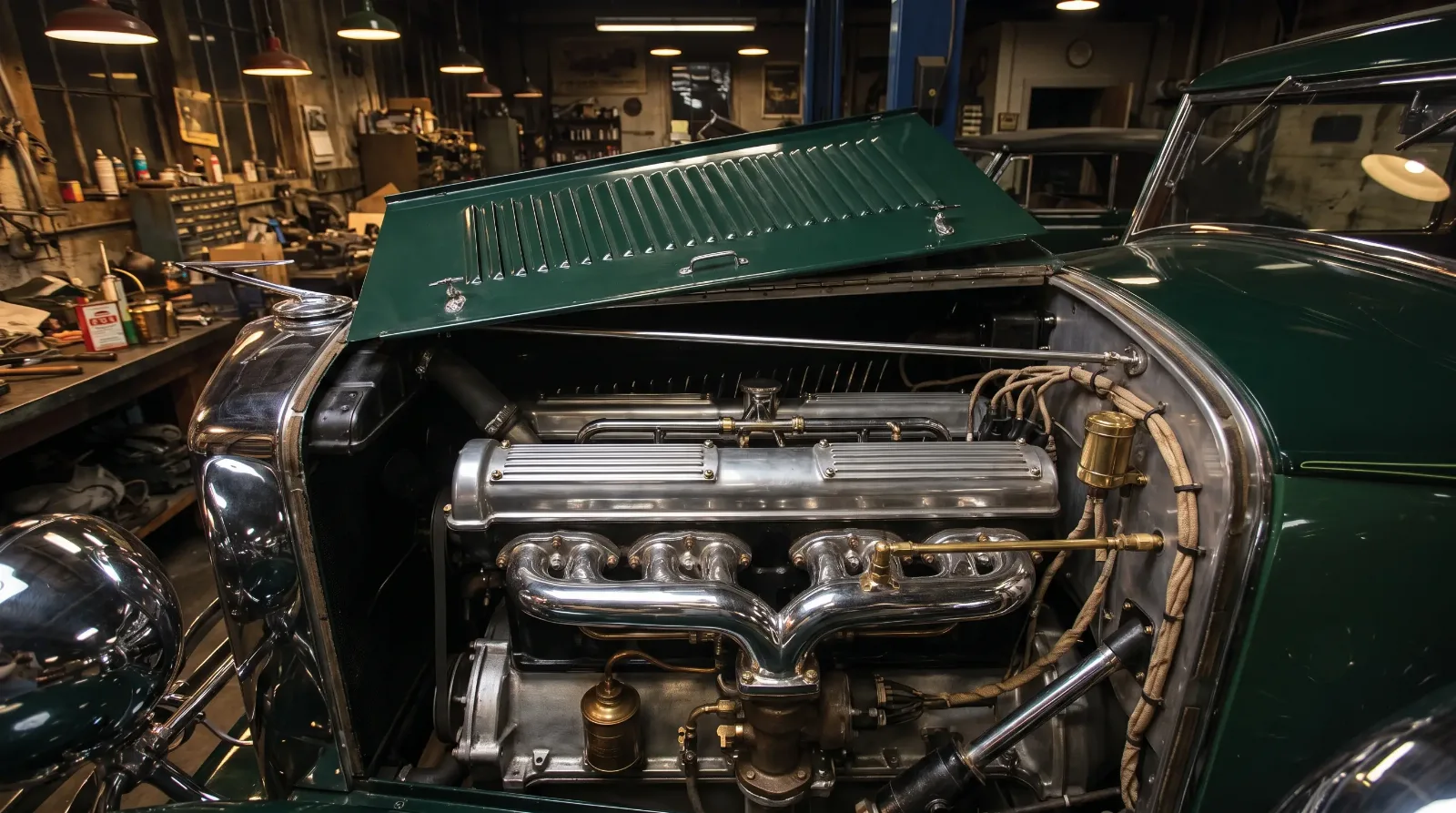
Eight cylinders in a row, no vee, no compromise. That's what a straight-eight was, and by the back half of the 1920s it was the number that separated a car with real presence from everything else on the lot. Forget the marketing copy for a minute. The straight-eight mattered because it solved a problem four- and six-cylinder engines couldn't: it made a big, heavy luxury car feel smooth instead of feeling like it was fighting itself.
Car Features
6 min read
The Rise of the Straight-Eight Engine
Eight cylinders in a row solved a smoothness problem four- and six-cylinder engines couldn't, and by the late 1920s the straight-eight had become the calling card of a real luxury car.
The vibration problem, and the fix
A straight-eight, done right, has inherently better primary and secondary balance than a straight-six or an inline-four of comparable displacement. That's not opinion, that's the physics of how the pistons and rods cancel each other's forces through the firing cycle. Owners in period didn't need to know the engineering to feel the result. A well-built straight-eight idled and pulled with a smoothness that a lot of buyers described as feeling almost electric, a strange comparison for a gasoline engine but one that shows up again and again in period reviews and dealer literature.
Packard, Duesenberg, Stutz, Auburn, and Studebaker all leaned into straight-eight engines through the decade, and each one used the smoothness as the headline selling point over raw horsepower numbers, at least at first. The engine wasn't just about output. It was about how the output arrived.
The real cost of eight cylinders
Here's the number that actually mattered to a 1920s buyer: a straight-eight cost more to build, and it cost more to buy. The added length meant a longer engine bay, a longer hood, a longer chassis, and a longer crankshaft that needed more careful support to avoid whip and flex at higher revs. Manufacturers who got the crankshaft engineering wrong ended up with engines that vibrated worse than a good six, which is the opposite of the whole point. The ones who got it right, usually by adding more main bearings and stiffening the block, produced engines that are still smooth-running curiosities on a modern test drive.
That extra length is also why straight-eight cars from this era have such long, dramatic hoods. It wasn't styling for its own sake, though stylists absolutely took advantage of it. It was where the engine physically lived. Anyone chasing the visual side of this story should look at the 1920s straight eight cars guide for how that long-hood proportion became one of the defining looks of the decade.
"Everybody talks about horsepower from this era like it's the whole story. It's not. The number that separated a straight-eight buyer from everybody else was the price on the sticker, and they paid it because the car felt like nothing else on the road."
Dan Reeves
Straight-eight versus the alternatives
The straight-six was cheaper, shorter, and mechanically simpler, and it remained the mainstream choice through most of the decade for exactly those reasons. The V8, which Cadillac had already pioneered before 1920 and which Ford would bring downmarket in 1932, offered a shorter package for a given cylinder count but came with its own balance challenges that took longer for the industry to fully solve. The straight-eight split the difference in the wrong direction for most family buyers: all the length and cost of a big engine, with a mechanical smoothness that justified the price tag mainly to buyers who could actually afford to care.
| Engine type | Typical 1920s displacement | Typical output |
|---|---|---|
| Straight-four (Model T era) | ~2.9L | 20 hp |
| Straight-six (mainstream) | 3.0-4.5L | 60-75 hp |
| Straight-eight (luxury) | 4.5-6.3L | 85-135 hp |
What survived, and what to look for
Straight-eight cars from the 1920s that survive today tend to be the ones that were expensive enough in period to get real care from their original owners, then expensive enough later to be worth restoring rather than scrapping. That's a lucky loop for collectors now, because it means a disproportionate number of the survivors are well-documented, well-restored examples rather than beaters. If you're evaluating one, the crankshaft main bearing count and any history of block cracking are the two things worth asking about before anything else, since those are the failure points that separate a great straight-eight from a troublesome one.
The mechanical story of the straight-eight runs directly into the tire and chassis story of the same decade, since a heavier, longer car needed better rubber to match. That's worth following through to the next installment on how balloon tires changed the ride quality these bigger engines were finally smooth enough to deserve.
The manufacturers who bet everything on it
Some companies staked their entire brand identity on the straight-eight in a way that's hard to appreciate now, decades removed from the actual sales floor. Auburn built its reputation through the late 1920s largely around offering straight-eight power at a price point below what buyers expected to pay for that kind of smoothness, undercutting Packard and the other established luxury makes on cost while still delivering the same basic mechanical formula. Stutz went further still, pairing its straight-eight with an overhead-camshaft design that pushed performance beyond what most rivals were offering, trading some of the smoothness argument for genuine speed.
Packard, by contrast, treated its straight-eight as a statement of engineering conservatism done exceptionally well rather than a performance play, refining the same basic layout year over year rather than chasing bigger numbers. That approach built a reputation for reliability that outlasted plenty of flashier competitors, and it's part of why Packard straight-eights from this era still have such a devoted following among collectors who value mechanical soundness over outright numbers.
What happened when the Depression hit
The straight-eight's status as a symbol of prosperity made it particularly vulnerable when the economy collapsed at the end of the decade. Companies that had built their identity entirely around expensive eight-cylinder engineering, without a cheaper model line to fall back on, struggled badly through the early 1930s. Some straight-eight builders survived by trimming costs wherever they could without abandoning the engine that defined them. Others didn't survive at all. That fragility is worth remembering when looking at surviving cars from this era, since a lot of what's left today represents companies and engineering philosophies that didn't make it much further past 1930, which only adds to the historical weight these cars carry now.
Sources and notes
Related Reading
Have a
Classic Car
for Sale?
Reach thousands of serious classic car collectors across the US.
Sell It Here →
Are You a Classic Car Dealer?
List your full inventory and connect with targeted classic car buyers.
Join as a Dealer →
#pre-war classics
#1920s cars
#straight eight engine
#duesenberg model j
#packard straight eight
#vintage engines

About the author
Dan Reeves
Performance engine builder from North Carolina's motorsports corridor, focused on swaps, forced induction and making real, repeatable power.
Comments
Be the first to comment on this article.