
The automobile spent its first two decades as a mechanical object that happened to carry people. By the mid-1920s, that relationship reversed. Coachbuilders and factory design departments alike began treating the car as an object of composition first, a machine second, and the visual language they borrowed to do it came straight from the Art Deco movement that was reshaping architecture, furniture, and graphic design across the same years.
Car Features
7 min read
How Art Deco Shaped 1920s Car Design
The geometric confidence of the Art Deco movement moved from Parisian exhibition halls into radiator shells and fender lines, changing how cars were designed for good.
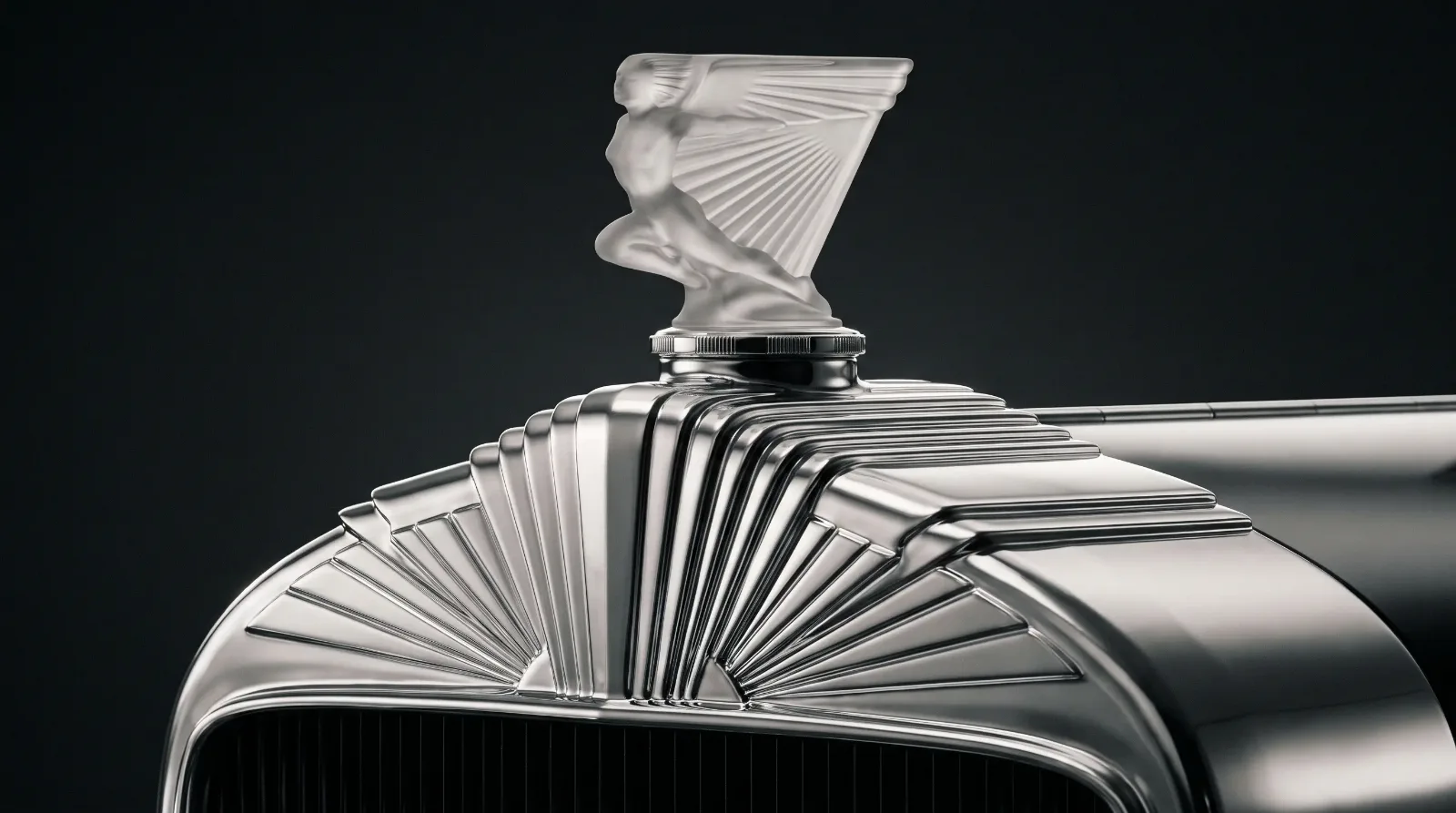
Where the style actually came from
Art Deco takes its name, loosely, from the 1925 Exposition Internationale des Arts Décoratifs in Paris, an exhibition of decorative and industrial arts that celebrated geometric clarity over the flowing organic lines of Art Nouveau that preceded it. The movement favored symmetry, stepped forms, chevrons, sunbursts, and a general sense of controlled, machine-age confidence. It reached automobiles a little later than it reached buildings and jewelry, but once it arrived, coachbuilders in France, Italy, and increasingly the United States began applying its logic to fenders, radiator shells, and interior trim.
What made cars a natural fit for Art Deco thinking was that a car's form already had to answer to engineering. The style's emphasis on streamlined geometry gave designers a vocabulary that flattered mechanical necessity rather than fighting it. A radiator shell could be a piece of sculpture without pretending it wasn't also a radiator shell.
Reading the details on a period car
Look closely at a well-preserved 1920s coachbuilt car and the Deco influence shows up in specific, repeatable places. Radiator shells grew taller and more architectural, often stepped or fluted like a skyscraper's crown. Fender lines began to sweep rather than simply curve, anticipating the fully streamlined fenders of the following decade. Interior door handles, instrument bezels, and window cranks were cast in geometric patterns rather than left as plain machined metal. Even upholstery patterns picked up the era's fondness for zigzags and sunburst motifs, particularly in closed sedans aimed at an urban clientele who wanted their car's cabin to read the same way their apartment lobby did.
Coachbuilders like Hibbard & Darrin, LeBaron, and the French houses working on Delage and Talbot-Lago chassis pushed this furthest, because a custom body commissioned by a wealthy client was, in effect, a piece of applied sculpture with a drivetrain underneath it. American factory bodies absorbed the influence more gradually and more conservatively, but by the late 1920s even mainstream sedans carried echoes of it in their grille shells and hood ornaments.
"A coachbuilt Deco body isn't decoration applied to a car. The geometry is structural to how the eye reads the whole vehicle, and that's exactly why these cars still look modern next to anything built in the decade before them."
Sarah Whitfield
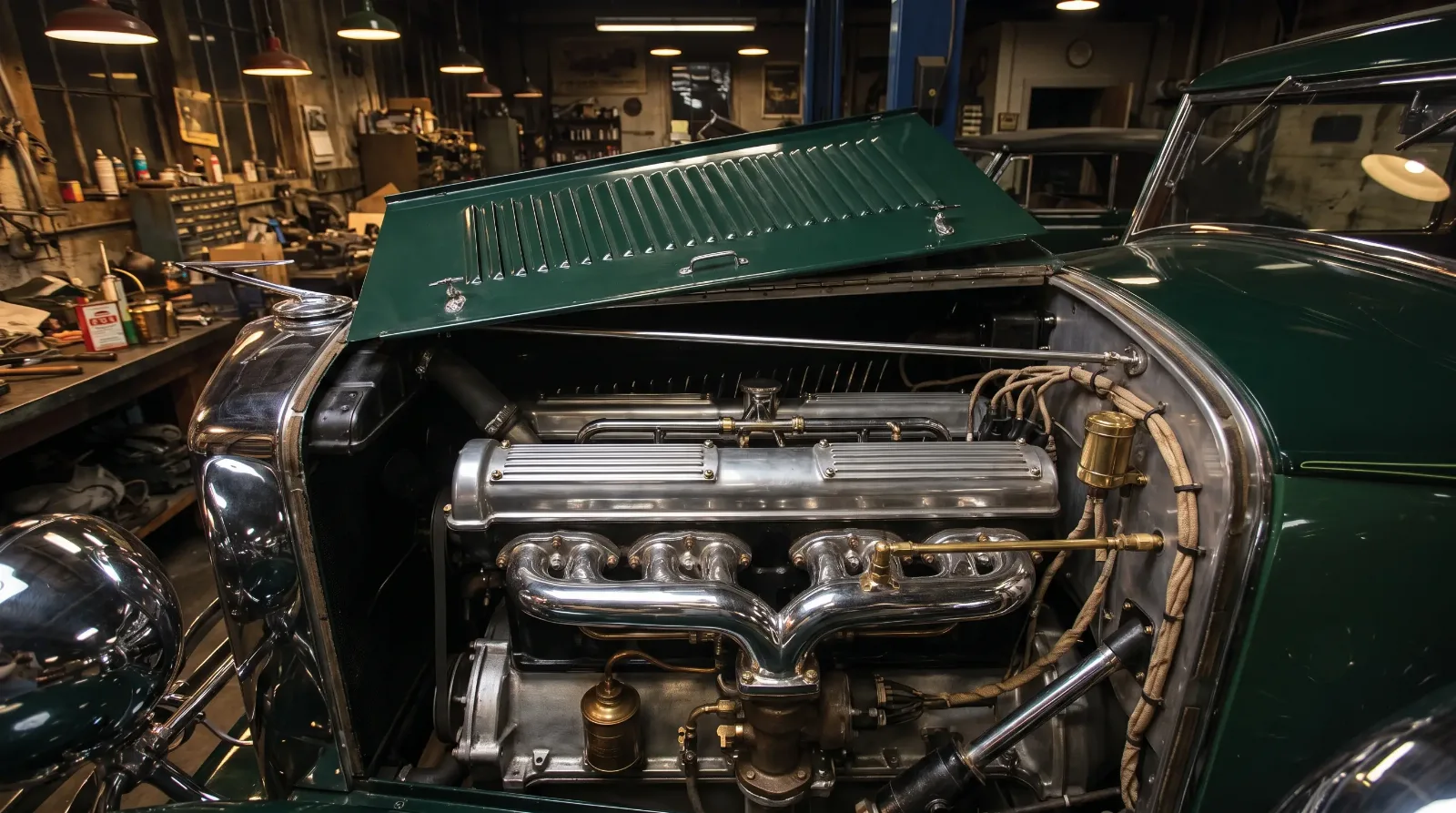
Straight-eight engines gave designers room to work
The style didn't develop in isolation from mechanical trends. As American manufacturers adopted longer straight-eight engines through the decade, hoods stretched out accordingly, and that additional length gave designers a longer canvas for horizontal Deco detailing, louvers, and hood ornamentation. A short four-cylinder hood simply didn't offer the same proportions to work with. Anyone tracing how engineering and styling reinforced each other in this period should look at keep reading on how the straight-eight became the engine of choice for cars that wanted to look as impressive as they performed.
This is also where originality becomes a serious question for collectors today. A car with its factory or coachbuilt Deco trim intact, unmolested by later "improvements," carries a different kind of value than one that's had its details simplified or swapped over the decades. Provenance on the trim matters as much as provenance on the mechanicals. Readers who want to see how this design language plays out across the broader Deco car world should check out the next story.
Why the look faded by the 1930s
Art Deco's crisp geometry gave way fairly quickly to the more fluid, aerodynamically-inspired Streamline Moderne look that dominated the following decade, as wind-tunnel testing and a growing interest in genuine aerodynamic efficiency pushed designers toward rounded, teardrop forms rather than stepped, architectural ones. But the handoff wasn't a rejection. Streamline Moderne inherited Deco's confidence in geometry as a design principle, it just applied that confidence to curves instead of angles. For a broader look at the decade that produced this entire visual vocabulary, more on art deco 1920s cars ties the design story back into the culture that surrounded it.
Collectors chasing this era should pay particular attention to hood ornaments and mascots, which are often the single most distinctive Deco element on an otherwise conservative sedan and among the easiest details to lose or replace with an incorrect part over a long restoration history. There's a deeper dive worth reading on exactly that subject.
The cars that carry this style best reward slow looking. Step back from a well-restored Deco-era coachbuilt car and the proportions do most of the work, but get close and the details reward the kind of attention a period furniture piece or a piece of architectural ironwork would. That layered quality, mechanical object and decorative object at once, is the clearest legacy the style left on everything that came after it.
Interiors got the same treatment
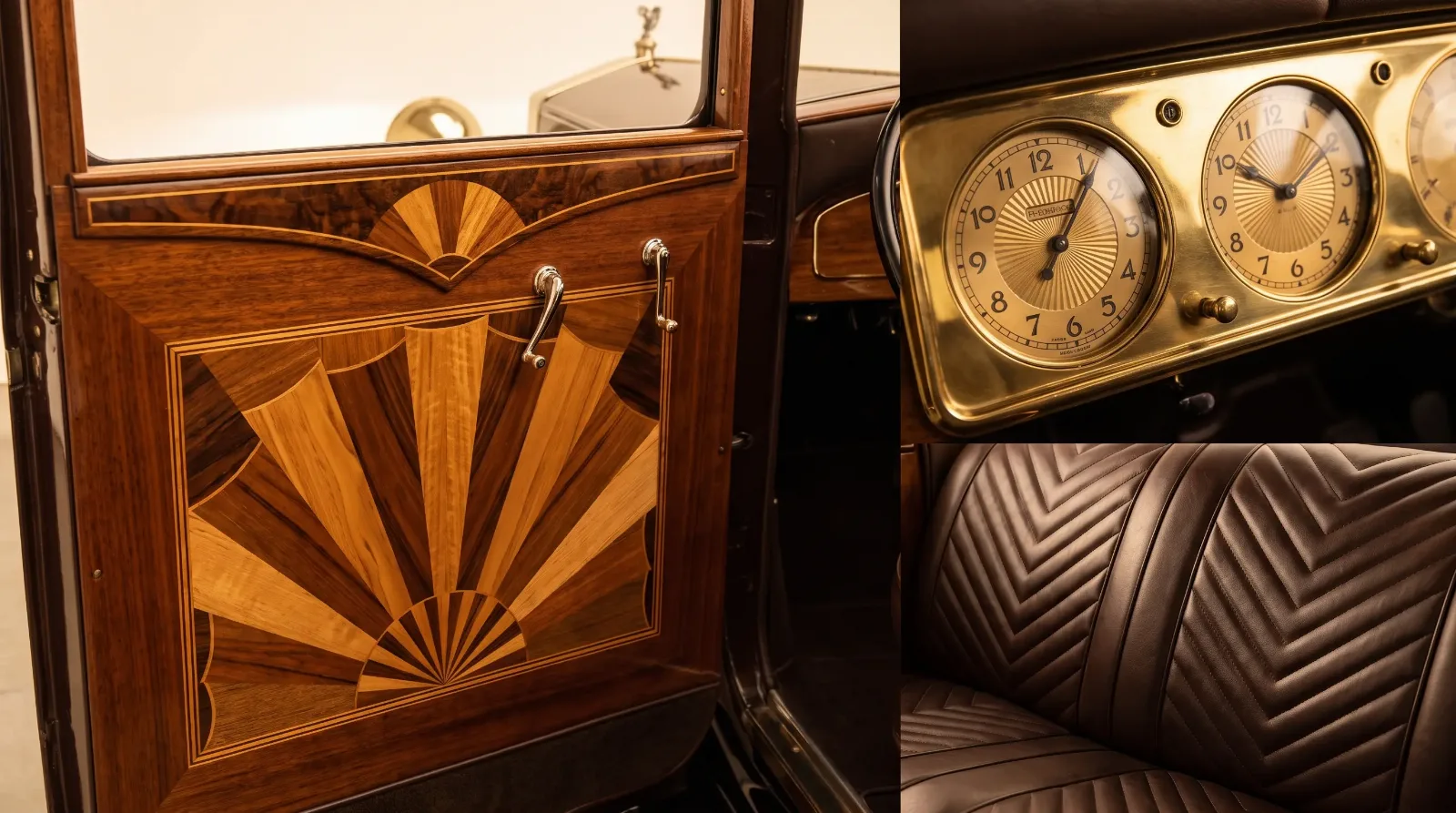
It's easy to fixate on the exterior when talking about Deco design, since a radiator shell or fender line is what catches the eye in a photograph, but the movement's real ambition was total. Interior door panels on higher-end 1920s cars started carrying the same geometric marquetry patterns showing up in Deco furniture of the period, and instrument clusters were laid out with a symmetry that felt closer to a jewelry case than a dashboard. Clock faces, gauge bezels, and even the stitching pattern on leather upholstery picked up the sunburst and chevron motifs that defined the movement everywhere else it touched. A serious restoration of a coachbuilt car from this era has to account for all of it, not just the visible exterior trim, because an interior redone with period-inappropriate materials or patterns undercuts the whole design statement the original coachbuilder was making.
Color choices followed suit. Where earlier cars leaned toward dark, conservative paint because that's what was durable and available, Deco-influenced coachwork embraced two-tone schemes and metallic finishes that emphasized the car's geometric panel lines rather than hiding them. A fender line picked out in a contrasting color did real work, drawing the eye along the sweep of the body in exactly the way the coachbuilder intended.
Why this matters to collectors specifically
All of this detail work means that evaluating a coachbuilt Deco-era car properly takes more than checking the chassis number and engine specs. The trim, the mascot, the interior hardware, and the paint scheme all carry their own originality questions, and a car that's mechanically correct but has lost its original Deco details through decades of well-meaning but historically careless restoration work is a different, lesser proposition than one that's kept its full design intact. That distinction is worth understanding before shopping seriously in this segment.
The reward for getting it right is a car that still reads as genuinely modern, nearly a century later, in a way that a lot of more conservatively styled contemporaries simply don't.
Sources and notes
Related Reading
Have a
Classic Car
for Sale?
Reach thousands of serious classic car collectors across the US.
Sell It Here →
Are You a Classic Car Dealer?
List your full inventory and connect with targeted classic car buyers.
Join as a Dealer →
#automotive design history
#pre-war classics
#coachbuilt cars
#art deco cars
#1920s car design
#radiator mascots

About the author
Sarah Whitfield
Third-generation classic car collector specializing in pre-war American and European coachbuilt automobiles. Researcher and concours enthusiast.




Comments
Be the first to comment on this article.