The factory service literature from the late 1920s and early 1930s makes an argument that period advertising tended to soften: mechanical brakes, the system nearly every car used before this decade, were genuinely dangerous at the speeds cars had started reaching. Cable and rod-actuated brakes relied on a network of linkages that stretched, wore unevenly, and needed constant adjustment to keep all four wheels braking with anything close to equal force. This is the 1930s hydraulic brakes story, and like a lot of engineering history, it moved slower and more unevenly than the marketing of the era liked to admit.
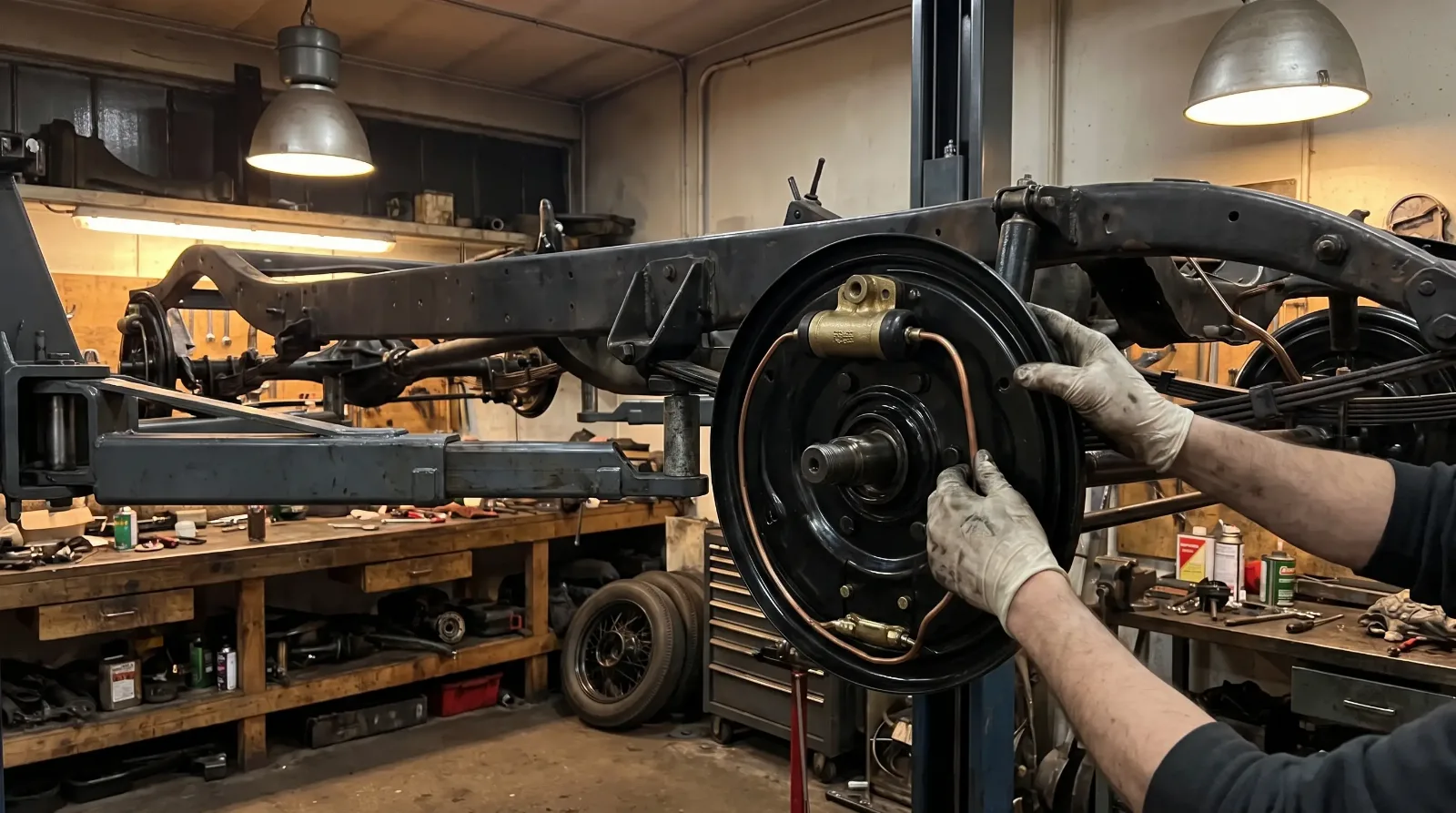
Hydraulic brakes solved the linkage problem by replacing mechanical rods with fluid-filled lines. Press the pedal, and equal pressure transmits instantly to a cylinder at each wheel, applying force evenly without the stretch and slack that plagued mechanical systems. The physics were understood well before the 1930s. What took time was convincing a conservative industry, and a cautious buying public, that trusting your brakes to fluid instead of solid metal linkage was actually safer, not riskier.
Malcolm Loughead, who later shortened the family name to Lockheed, is generally credited with the foundational patents behind the automotive hydraulic brake system in the years just after the First World War. His work moved slowly into production, first appearing on a handful of low-volume and racing cars before any major manufacturer committed to it across a full model line. The gap between a workable patent and a mainstream factory rollout ran well over a decade, which says something about how cautiously the industry treated any change to a system as safety-critical as the brakes.
Who moved first, and who held back
Chrysler is generally credited as the first major American manufacturer to adopt four-wheel hydraulic brakes broadly across its lineup, doing so in the late 1920s and expanding the system through the early 1930s as the technology proved itself in the field. Plymouth, Chrysler's lower-priced sibling brand, carried hydraulic brakes down into the mainstream market earlier than most competitors, which gave Chrysler's engineering group a genuine and marketable advantage through the early part of the decade.
Ford, notably, held out. Henry Ford was famously skeptical of hydraulic brakes, reportedly distrusting a system that relied on fluid rather than solid mechanical connection between pedal and wheel, and Ford continued fitting mechanical brakes on its cars well after most of the rest of the industry had switched. Ford didn't adopt four-wheel hydraulics until 1939, a genuinely late holdout for a company that was aggressive about other engineering advances, like the flathead V8, in the same period.
How rivals used the gap against Ford
The gap between Ford and its competitors on this one system became a genuine sales talking point for rival dealers through the middle of the decade. A salesman at a Chrysler or General Motors dealership could point to hydraulic brakes as a concrete, demonstrable safety advantage over the Ford parked across the street, and period road tests occasionally noted the difference in stopping distance directly. That kind of public comparison, repeated for years across nearly every mainstream competitor, makes Ford's holdout even more notable in hindsight, since the company was rarely shy about matching or beating rivals on other fronts.
The transition period, and why it matters for originality
Because adoption spread unevenly across manufacturers and even across model years within the same manufacturer, the transition from mechanical to hydraulic brakes is a genuinely useful dating tool when examining an original chassis. A car's brake system, master cylinder placement, wheel cylinder design, and line routing, should match what the factory shipped for that specific model year, and mismatches are one of the clearer signs that a chassis has had later parts substituted in, whether through a period safety upgrade or a more recent restoration shortcut.
It's also worth noting that some owners in the 1930s themselves opted to upgrade older mechanical-brake cars with aftermarket hydraulic conversion kits once the safety case became widely accepted, which means an early-decade car with hydraulic brakes installed isn't automatically suspect, but it is worth investigating against factory records to understand whether the conversion happened in period or much later.
| Manufacturer | Four-wheel hydraulic brakes |
|---|---|
| Chrysler / Plymouth | Late 1920s, broadly by early 1930s |
| Most independents (Dodge, DeSoto, REO, Franklin, Graham) | By 1931 |
| Ford | 1939 |
"You can date a mechanical-brake Ford almost to the year just from that detail alone, because the company held out so much longer than everyone else. It's a good reminder that engineering leadership and stubbornness sometimes come from the same person."
— Tom Ramirez
What this meant for how these cars actually drove
The practical difference between mechanical and hydraulic brakes shows up most clearly in an emergency stop. A well-maintained mechanical system could work adequately at moderate speeds, but uneven wear between wheels meant a hard stop could pull a car sideways, and stopping distances were longer and less predictable than a hydraulic system delivered. As cars got faster through the decade, thanks in part to the horsepower gains discussed elsewhere in this cluster, the gap between what mechanical brakes could safely handle and what the cars were now capable of only widened, which is exactly the pressure that eventually pushed even Ford to switch.
For anyone driving or maintaining a mechanical-brake car today, that history is not just trivia. Period mechanical brakes demand a discipline modern drivers rarely practice: frequent adjustment, careful attention to equal shoe wear across all four wheels, and a driving style that anticipates stops well ahead of where a modern driver would begin braking. Owners who understand this history tend to be more patient with the limitations of an original mechanical-brake car rather than assuming something is wrong with the setup, when in fact it is simply behaving the way the engineering of its year always did.
Braking wasn't the only mechanical system chasing more performance out of these engines during the same years. Superchargers were showing up on a handful of ambitious American and European models looking for another way to extract power without waiting for a bigger displacement engine, and a related read covers how that technology fit into the same decade's engineering race.
Sources and notes
- Mac's Motor City Garage - 1939: Ford finally adopts hydraulic brakes
- Rock River Valley Chapter SDC - first hydraulic brakes history
- Wikipedia: Malcolm Loughead and the Lockheed hydraulic brake patents
- Model T Ford Forum - Henry Ford's brake system skepticism
- Antique Automobile Club of America - early automobile brakes, 1918 to 1942