
The factory records tell a cleaner story than the popular history does. Independent front suspension is often described as a General Motors invention that arrived fully formed in 1934, but the production paperwork shows a slower, more contested rollout, and knowing the actual sequence matters if you are trying to date or verify a chassis from this period. This is more on 1930s suspension than most overviews cover, drawn as closely as possible to what the option codes and engineering bulletins actually say.
Car Features
7 min read
Independent Front Suspension
The sales brochures made independent front suspension sound flawless from day one. The factory service bulletins tell a messier, more useful story.
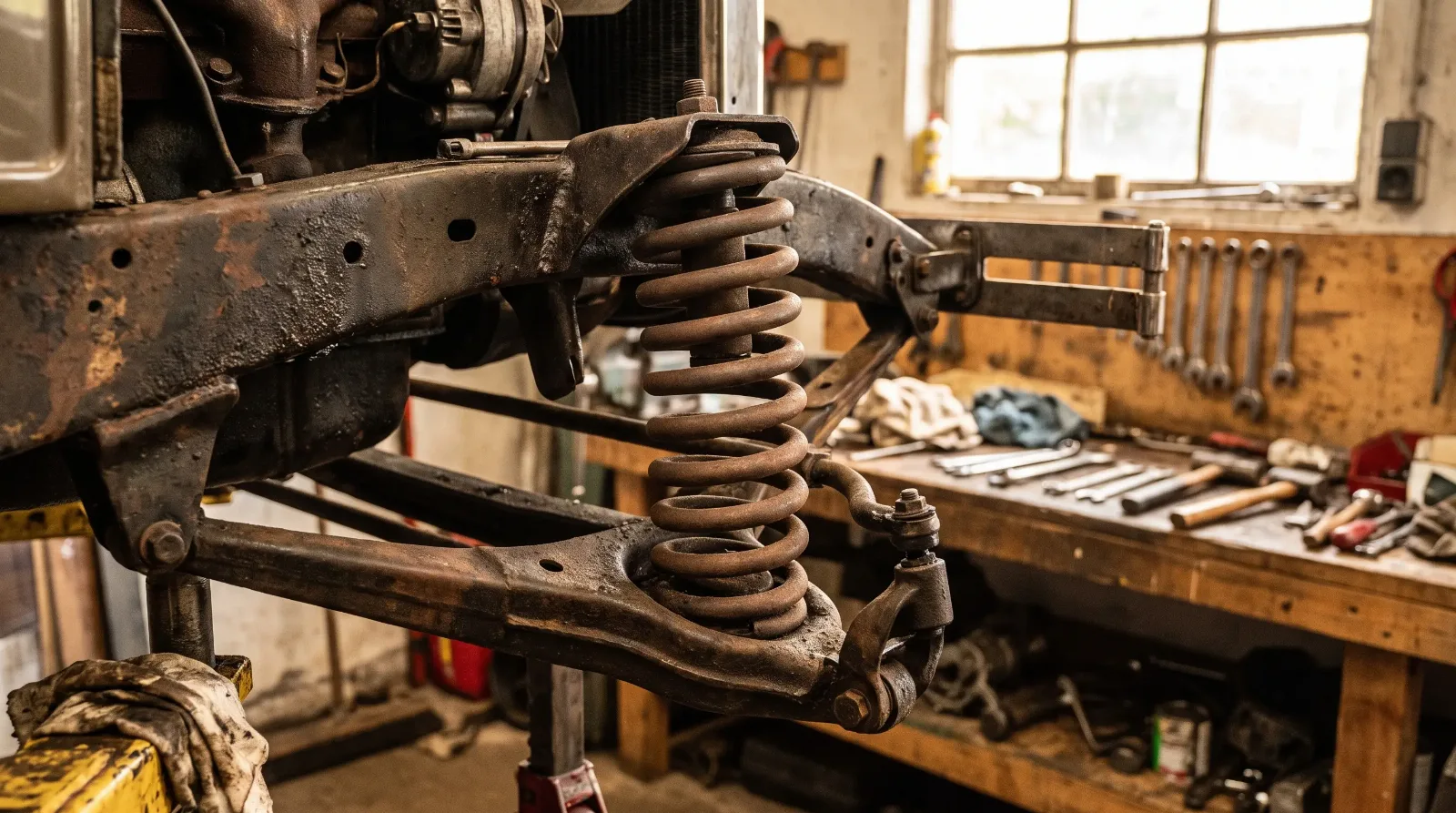
Before independent front suspension, nearly every American car used a solid front axle, a single beam connecting both front wheels, suspended on leaf springs. It was simple, durable, and cheap to build, and it had one persistent flaw: hit a bump with one wheel and the disturbance transmitted straight across the axle to the other wheel, upsetting the whole front end. At higher speeds, on the improving road network of the 1930s, that flaw became harder to ignore.
The road network itself is part of why this mattered more in the 1930s than it had in the 1920s. State and federal highway programs paved and straightened long stretches of road through the decade, and cars were spending more time at sustained higher speeds than the solid-axle designs of the previous decade had ever really been asked to handle. A suspension system that felt adequate on a rutted country lane at twenty-five miles an hour started to feel genuinely unsettling at fifty on a smooth new highway, and that gap between road quality and suspension technology is a big part of what pushed engineers to act.
Who actually got there first
Credit for the first independent front suspension on an American production car usually goes to General Motors, which introduced its "knee-action" system, based on a design licensed from the French engineer André Dubonnet, across Chevrolet, Pontiac, Oldsmobile, and Cadillac lines starting in the 1934 model year. The factory bulletins from that period describe it as a major selling point, marketed heavily in showroom literature as the end of the jarring "picket fence" ride over rough pavement.
What gets left out of the popular telling is that GM's early knee-action system had real reliability problems. The shock units, filled with oil and prone to leaking, caused enough warranty claims that GM revised the design more than once over the following seasons. Reading the service bulletins from 1934 through 1936 makes clear this was not a triumphant, trouble-free launch. It was a genuine engineering advance shipped a little before it was fully sorted, and dealers spent real money fixing it under warranty.
What the competition did instead
Not every manufacturer followed GM's exact approach, and the variation across brands is instructive. Studebaker introduced its own independent front system, a coil spring and control arm layout it branded "Planar," on the 1935 model year, and it proved more durable in service than GM's early Dubonnet-based design. Packard moved the same year, fitting a double wishbone system it called "Safe-T-fleX" to the new One-Twenty, its first mid-priced model. Ford was the real holdout: it kept a solid beam axle on a transverse leaf spring, not a true independent design, through the 1930s and on into the late 1940s, partly because it was cheap and proven, and partly because Henry Ford was famously reluctant to follow a design direction set by his rivals.
By the end of the decade, though, the direction was set. Nearly every major manufacturer had settled on some form of independent front geometry using coil springs and control arms, a layout that, in its basic principles, still underlies most front suspension design today. The 1930s knee-action controversy was really the industry working out the bugs in an idea that turned out to be correct.
| Manufacturer | System | Approx. introduction |
|---|---|---|
| General Motors | Dubonnet-based knee-action | 1934 |
| Studebaker | Coil spring / control arm, branded "Planar" | 1935 |
| Packard | Double wishbone, branded "Safe-T-fleX," on the One-Twenty | 1935 |
| Ford | Transverse leaf on a solid beam axle, not independent | Held through the 1930s and into the late 1940s |
Why the record on this gets muddled
Part of the confusion around who did what first comes from how period advertising talked about suspension. Marketing copy from the mid-1930s used "independent," "knee-action," and various trademarked names almost interchangeably, and not always accurately, which makes it risky to date a car purely off a brochure claim. The more reliable approach for anyone researching an original chassis is to cross-reference the actual component part numbers against factory parts books rather than relying on advertising language from the period, since dealers sometimes described features loosely to keep pace with competitors' claims.
For restorers, this history has a practical edge. A car that has had its suspension components replaced over the decades may carry a mix of original and later parts, and knowing which system a given model year actually shipped with is the only way to spot a mismatch. The early knee-action units in particular are scarce today, since many were swapped out for more durable aftermarket or later factory replacements once owners tired of the maintenance.
Sourcing correct parts for an early knee-action system remains one of the tougher jobs in pre-war restoration precisely because so few original units survive intact. Specialists who rebuild these systems often work from a small pool of donor parts and period factory drawings rather than any reliable new-old-stock supply, which is worth knowing before committing to a fully original restoration on a 1934 or 1935 GM product. A car converted to a later, more durable suspension design decades ago is not necessarily a lesser restoration candidate, but it is a different one, and buyers should understand which situation they are looking at before pricing a purchase.
"The brochures from 1934 make it sound like independent suspension arrived overnight and worked perfectly. The service bulletins from the same year tell a different story, and if you only read the sales literature you'll misdate half the cars you look at."
Tom Ramirez
The bigger picture behind the shift
Independent front suspension did not happen in isolation. It arrived during the same stretch of years when manufacturers were also chasing better brakes, smoother engines, and lower bodies, all aimed at the same underlying goal: making a car that felt modern to drive rather than merely modern to look at. Suspension is the part of that story that gets the least attention because it is invisible from the outside, but it did more to change how these cars actually behaved on the road than almost any styling change of the decade.
The context for all of this sits against a brutal economic backdrop, since manufacturers were funding this engineering work while sales were collapsing around them. Read on for how the industry paid for advances like this one while half its competitors went under.
Sources and notes
Related Reading
Have a
Classic Car
for Sale?
Reach thousands of serious classic car collectors across the US.
Sell It Here →
Are You a Classic Car Dealer?
List your full inventory and connect with targeted classic car buyers.
Join as a Dealer →
#independent front suspension
#pre-war classics
#1930s suspension
#knee-action suspension
#general motors history
#pre-war chassis

About the author
Tom Ramirez
Corvette researcher and historian based in Bowling Green, Kentucky. Two decades documenting Corvette production history from original factory records.
Comments
Be the first to comment on this article.